F Drill Bit Size: 0.257″ (6.53 mm) and What It’s Used For
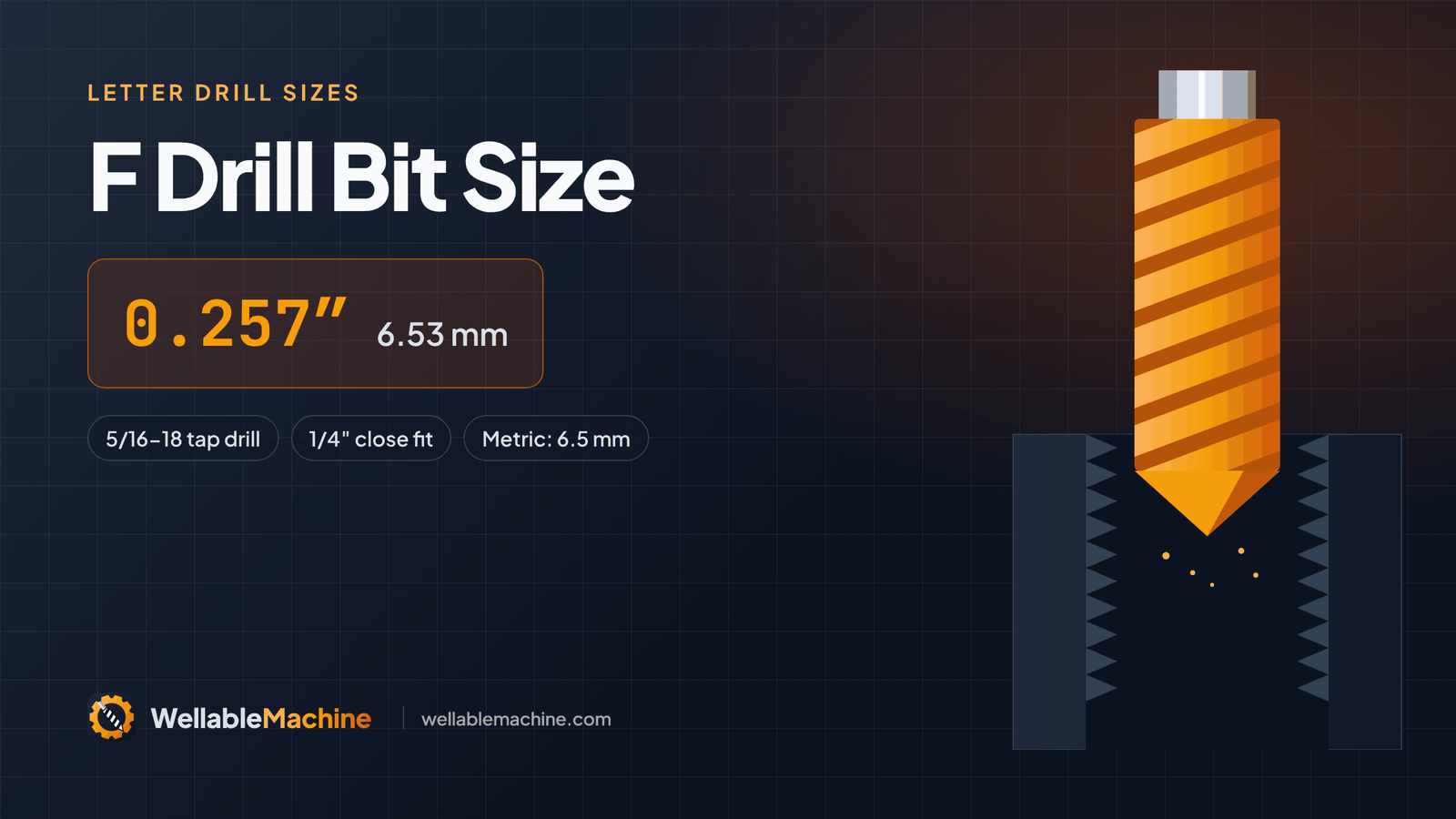
Quick answer: an F drill bit is 0.257 in in diameter, which is 6.528 mm. It sits between an E drill (0.250 in, the same as 1/4 in) and a G drill (0.261 in). The closest metric size is 6.5 mm, and the closest fractional size is 1/4 in, which is 0.007 in smaller. The F drill is the standard tap drill for 5/16-18 threads and the close-fit clearance hole for 1/4 in bolts.
Letter drills confuse a lot of people because most home drill sets don’t include them. If a drawing, a tap chart or a set of instructions calls for an “F drill”, this guide tells you what it is, what it’s for, which bits you can use instead, and how to drill a clean, accurate F-size hole.
F Drill Bit Size at a Glance
| Property | Value |
|---|---|
| Decimal inches | 0.2570 in |
| Millimeters | 6.528 mm |
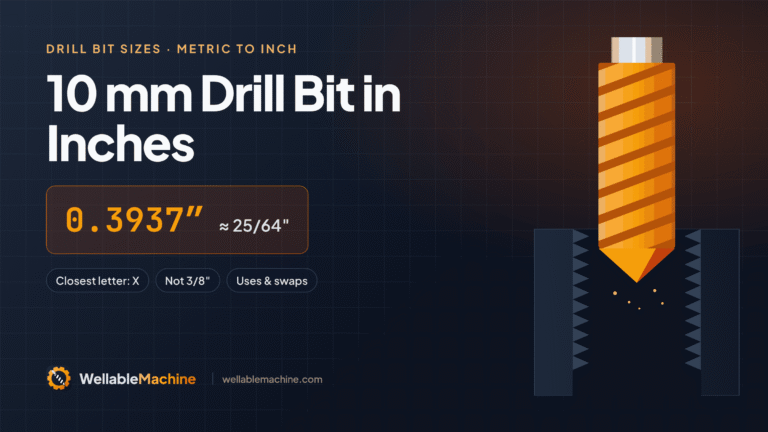
| Closest metric | 6.5 mm (0.2559 in), 0.0011 in smaller |
| Closest fractional | 1/4 in (0.2500 in), 0.0070 in smaller; 17/64 in (0.2656 in), 0.0086 in larger |
| Next smaller letter | E = 0.2500 in |
| Next larger letter | G = 0.2610 in |
| Main use | Tap drill for 5/16-18 UNC (about 77% thread) |
| Other uses | Close-fit clearance for 1/4 in bolts; hole for 1/4 in solid rivets |
How Letter Drill Sizes Work
The US drill system has four series. Fractional drills go up in 1/64 in steps, number drills run from #80 (tiny) to #1 (0.228 in), and letter drills pick up where the number series ends: A is 0.234 in and Z is 0.413 in. Unlike number drills, letter drills get bigger as you go through the alphabet. Metric drills sit alongside all three, usually in 0.1 mm steps.
Letter sizes exist because the fractional steps are too coarse for tap drills and fits. Between 1/4 in and 17/64 in there’s a 0.0156 in gap; the letter series fills it with F, G and H. That’s why so many tap drills for 5/16 in and 3/8 in threads are letters. The full series is listed in this drill bit sizes reference, and in our own number and letter drill size chart.
Sizes Around an F Drill
| Drill | Inches | mm | Difference from F |
|---|---|---|---|
| D | 0.2460 | 6.25 | −0.0110 in |
| E (1/4 in) | 0.2500 | 6.35 | −0.0070 in |
| 6.4 mm | 0.2520 | 6.40 | −0.0050 in |
| 6.5 mm | 0.2559 | 6.50 | −0.0011 in |
| F | 0.2570 | 6.53 | — |
| 6.6 mm | 0.2598 | 6.60 | +0.0028 in |
| G | 0.2610 | 6.63 | +0.0040 in |
| 17/64 in | 0.2656 | 6.75 | +0.0086 in |
| H | 0.2660 | 6.76 | +0.0090 in |
| I | 0.2720 | 6.91 | +0.0150 in |

What Is an F Drill Used For?
1. Tap drill for 5/16-18 UNC
This is the job most people buy an F drill for. A 5/16-18 thread has a 0.3125 in major diameter and 18 threads per inch. Using the thread-engagement formula (76.98 × TPI × (major − drill)), an F drill gives about 77% thread: strong, and still comfortable to tap by hand in mild steel and aluminum. Our 5/16-18 tap drill size guide has the full table with alternatives.
2. Close-fit clearance for 1/4 in bolts
A 1/4 in bolt is 0.250 in. An F hole gives it 0.007 in of total clearance, the standard “close fit” used when parts must line up accurately, such as brackets, fixture plates and hinges. For a looser “free fit” that’s easier to assemble, use an H drill or 17/64 in. Both fits are compared in our clearance hole size chart.
3. Holes for 1/4 in solid rivets
Aircraft and sheet-metal rivet charts call for an F drill for 1/4 in solid rivets, for the same reason: the rivet needs a few thousandths of room to enter, but not so much that it swells unevenly. Blind (pop) rivets of 1/4 in usually want a slightly bigger hole, often a G or 17/64 in drill; check the rivet maker’s hole range.
4. Metric work
Because F and 6.5 mm differ by only 0.001 in, an F drill can stand in for 6.5 mm anywhere: a clearance hole for M6 screws in thin parts, or a pre-drill before a 6.5 mm or 1/4 in reamer in soft materials.
5/16-18 Thread Percentage by Drill
The chart below shows how much thread you get in a 5/16-18 hole with each of the drills you’re likely to have:
| Drill | Diameter | Thread % | Good for |
|---|---|---|---|
| 1/4 in (E) | 0.2500 in | 87% | Too tight in steel; possible in soft plastic |
| 6.5 mm | 0.2559 in | 78% | Same as F in practice |
| F | 0.2570 in | 77% | Standard choice |
| 6.6 mm | 0.2598 in | 73% | Easier tapping, tough steels |
| G | 0.2610 in | 71% | Stainless, deep holes |
| 17/64 in / H | 0.2656 in | 65% | Hard materials, thin-wall parts |

Thread strength barely rises above about 75% engagement, but tapping torque climbs steeply. That’s why going one size up to a G or 6.6 mm is a smart move in stainless steel or when you’re tapping deep blind holes by hand. Going down to 1/4 in is the mistake to avoid: an 87% thread in steel is very hard to tap and a common cause of broken 5/16 taps.
Can You Use a 1/4 in Bit Instead of an F?
For tapping 5/16-18 in metal, no. The thread is too full and the tap is likely to bind or snap. For a clearance hole, a 1/4 in bit is the same size as a 1/4 in bolt, so the bolt won’t go through unless the hole wanders oversize. In soft woods and plastics, a 1/4 in hole can work for 5/16-18 threads or threaded inserts, but follow the insert maker’s chart.
The best substitutes for an F drill are, in order: 6.5 mm (practically identical), 6.6 mm or G (slightly larger, easier tapping), and 17/64 in if you only have fractional bits and are making a clearance hole.
Buying an F Drill
- Single bits: F is one of the most used letter sizes, so it’s easy to buy on its own. Buy two if you tap a lot of 5/16-18 holes.
- Letter sets (A–Z): worth having if you do metalwork. Together with a number set (#1–#60) and a fractional set, you’ll have every common tap drill and clearance size.
- Material: HSS is fine for aluminum, brass, wood and mild steel. For stainless and tough alloys, buy cobalt (M35 or M42). Our HSS vs cobalt guide explains the difference.
- Length: jobber length is standard. A stub (screw-machine) length F drill is stiffer and more accurate for tap holes, especially in a handheld drill.
How to Drill an F Hole for a 5/16-18 Tap
- Mark and center punch the location. A spotting drill or center drill gives the most accurate start.
- Pick the speed. For an HSS F drill: about 2,500–3,500 RPM in aluminum, 1,200–1,500 RPM in mild steel and 450–750 RPM in stainless. See our drill speed chart.
- Use cutting fluid in steel and stainless; a little WD-40 or kerosene in aluminum.
- Drill straight. In a drill press, clamp the part. Handheld, check the angle from two sides. A tap hole that leans makes a tap that leans.
- Peck in deep holes: retract every 2–3 diameters (about 1/2 to 3/4 in) to clear chips.
- Countersink lightly to just over 5/16 in, so the tap starts cleanly and the first thread doesn’t raise a burr.
- Tap with a 5/16-18 plug tap, turning back half a turn every turn or two in steel.
Drilling stainless? Use slow speed, heavy feed and plenty of oil, and never let the bit rub without cutting. Our guide on how to drill stainless steel covers work hardening.
Common Problems With F-Size Holes
- Hole is oversize: usually a bit that isn’t sharpened evenly, or a wobbly chuck. A drill with unequal lips cuts larger than its size. Check with a pin gauge or the shank of a known bit.
- Tap feels very tight: make sure you didn’t grab a 1/4 in bit by mistake. Letter drills are marked on the shank, but the mark wears off; measure with calipers (0.257 in).
- Bolt won’t fit the clearance hole: the F close fit leaves only 0.007 in. Paint, powder coat or plating can close it up. Drill H or 17/64 in for coated parts.
- Rivets loose: the hole may have been drilled with a 17/64 in instead of an F. Use the right drill for solid rivets.
Frequently Asked Questions
7 quick answers from our editors
01What size is an F drill bit in fractions?
There’s no exact fraction. At 0.257 in, it’s just over 1/4 in (0.250 in) and under 17/64 in (0.2656 in).
02What is an F drill in mm?
6.528 mm. A 6.5 mm drill is the closest metric bit.
03What tap uses an F drill?
5/16-18 UNC. The F drill gives about 77% thread.
04Is an F drill the same as 1/4 in?
No. The E drill is 1/4 in. F is 0.007 in larger.
05What drill is used for a 1/4 in bolt clearance hole?
F for a close fit, or H (or 17/64 in) for a free fit.
06Can I use a 6.5 mm drill for a 5/16-18 tap?
Yes. 6.5 mm gives about 78% thread, practically the same as an F drill.
07What drill do I use for 5/16-24?
An I drill (0.272 in). See our 5/16-24 tap drill size guide.
Bottom Line
An F drill is 0.257 in (6.53 mm). Use it as the tap drill for 5/16-18 threads and as a close-fit clearance hole for 1/4 in bolts and 1/4 in solid rivets. If you don’t have one, a 6.5 mm drill is the same in practice, and a G or 6.6 mm drill makes tapping easier in stainless. Don’t swap in a 1/4 in bit for tapping; it’s the most common cause of broken 5/16-18 taps.