#7 Drill Bit Size: Diameter in Inches & mm (0.201″)
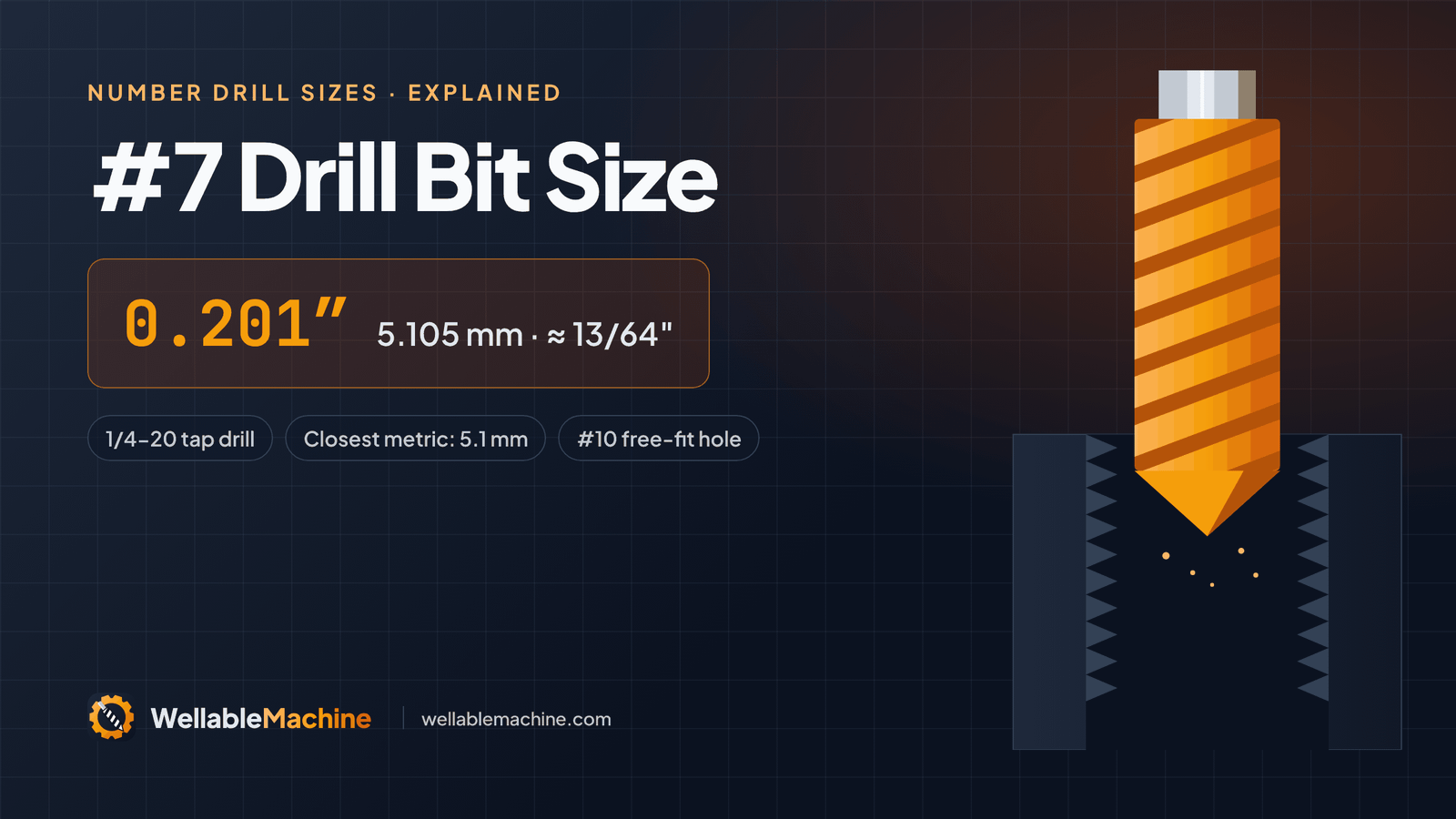
Quick answer: a #7 drill bit is 0.201 in in diameter, which is 5.105 mm. It sits between a #8 (0.199 in) and a #6 (0.204 in), and is just under 13/64 in (0.2031 in). The closest metric drill is 5.1 mm. The #7 is best known as the standard tap drill for 1/4-20 threads, and it’s also a free-fit clearance hole for #10 screws.
If you found “#7” on a chart or a set of plans and aren’t sure what it means, this guide explains it. You’ll learn how number drill sizes work, what a #7 drill is used for, which fractional and metric drills can replace it, and how to pick and use one.
#7 Drill Bit Size at a Glance
| Property | Value |
|---|---|
| Decimal inches | 0.2010 in |
| Millimeters | 5.105 mm |
| Closest fractional | 13/64 in (0.2031 in), 0.002 in larger |
| Closest metric | 5.1 mm (0.2008 in), 0.0002 in smaller |
| Next smaller number drill | #8 = 0.1990 in |
| Next larger number drill | #6 = 0.2040 in |
| Main use | Tap drill for 1/4-20 UNC |
| Other use | Free-fit clearance for #10 screws |
What Do Number Drill Sizes Mean?
In the US, drills come in four series: fractional (1/64 in steps), number (#80 to #1), letter (A to Z) and metric. The number series was created from the old Stubs steel wire gauge, which is why the numbers run backward: the higher the number, the smaller the drill. A #80 is just 0.0135 in, while a #1 is 0.228 in. Letter drills continue from there, starting at A (0.234 in).
Number drills fill the gaps between fractional sizes. Between 3/16 in and 1/4 in, for example, the fractional series has only three steps, but the number series has more than a dozen. That’s what makes them so useful for tap drills and precise clearance holes. You can find the history and the full list in this drill bit sizes reference, or use our own number and letter drill size chart.
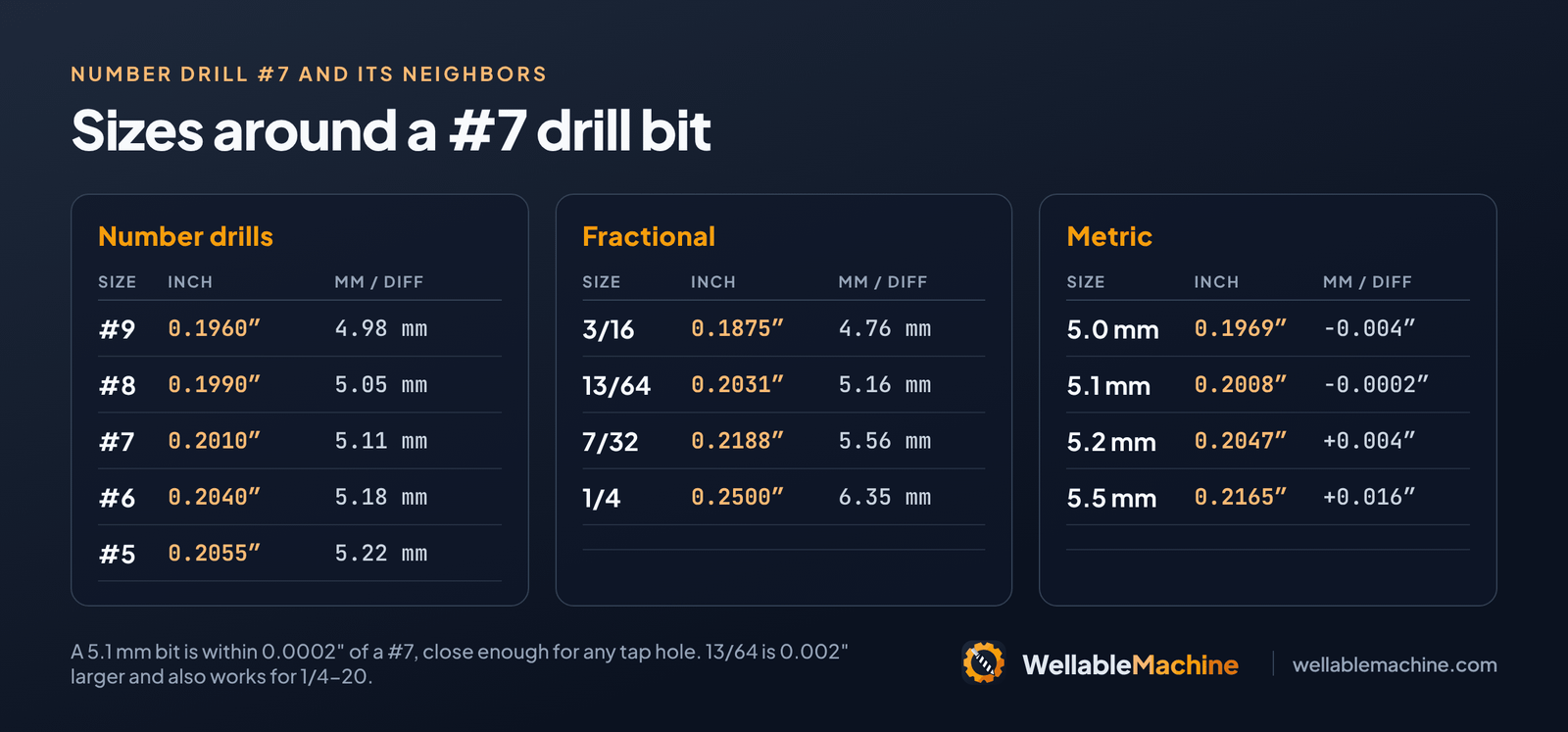
Sizes Around a #7 Drill
| Drill | Inches | mm | Difference from #7 |
|---|---|---|---|
| #10 | 0.1935 | 4.91 | −0.0075 in |
| #9 | 0.1960 | 4.98 | −0.0050 in |
| 5.0 mm | 0.1969 | 5.00 | −0.0041 in |
| #8 | 0.1990 | 5.05 | −0.0020 in |
| 5.1 mm | 0.2008 | 5.10 | −0.0002 in |
| #7 | 0.2010 | 5.11 | — |
| 13/64 | 0.2031 | 5.16 | +0.0021 in |
| #6 | 0.2040 | 5.18 | +0.0030 in |
| 5.2 mm | 0.2047 | 5.20 | +0.0037 in |
| #5 | 0.2055 | 5.22 | +0.0045 in |
| #4 | 0.2090 | 5.31 | +0.0080 in |
What Is a #7 Drill Used For?
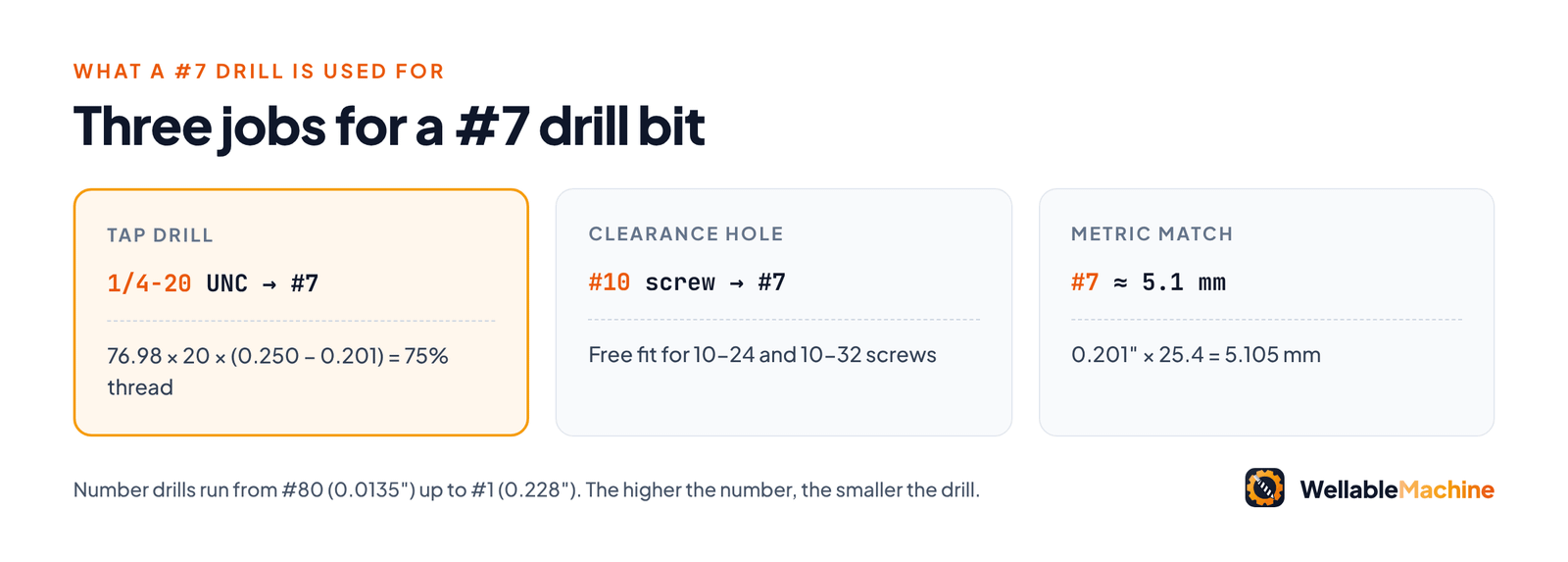
1. Tap drill for 1/4-20 threads
This is by far the most common job. A 1/4-20 UNC thread has a 0.250 in major diameter and 20 threads per inch. Drilling a 0.201 in hole gives about a 75% thread, the standard balance of strength and easy tapping. Our full 1/4-20 tap drill size guide covers the alternatives for stainless and soft metals.
2. Clearance hole for #10 screws
A #10 screw is 0.190 in in diameter. A #7 hole gives it about 0.011 in of room, which is the standard “free fit”. That works for both 10-24 and 10-32 screws. For a tighter “close fit”, use a #9 drill. See the 10-32 tap drill size guide for the full table.
3. Metric work
Because #7 and 5.1 mm are only 0.0002 in apart, a #7 can be used anywhere a 5.1 mm drill is called for, such as an M6 tap hole in steel. The standard M6 drill is 5.0 mm; read the M6 tap drill size guide for details.
Can You Use 13/64 Instead of a #7?
Yes, in most cases. 13/64 in is 0.2031 in, only 0.002 in bigger than a #7. For a 1/4-20 thread, that drops the thread from about 75% to about 72%, which you won’t notice in real use. It’s easier to tap, especially in steel. Because 13/64 is in nearly every fractional set, it’s the most common substitute for a #7 in home shops.
What you shouldn’t use is 3/16 in (0.1875 in). It’s 0.0135 in smaller and would make a 1/4-20 thread around 96%, which is extremely hard to tap and often breaks the tap.
#7 vs. 5.1 mm vs. 13/64: Which Should You Buy?
- A single #7 drill: the right choice if you tap a lot of 1/4-20 holes. Buy a few; it’s a high-use size.
- A 5.1 mm drill: identical in practice, and often cheaper in metric sets.
- 13/64 in: already in most 29-piece fractional sets. Fine for tapping and clearance.
- A full number set (#1–#60): worth it if you do metalwork. You’ll have every tap drill for small screws.
For steel and stainless, choose cobalt (M35 or M42) instead of plain HSS. Our list of the best drill bits for stainless steel explains why.
How to Use a #7 Drill Bit for a 1/4-20 Tap Hole
- Center punch the hole location.
- Set the speed. About 1,800–2,400 RPM in aluminum, 1,000–1,400 RPM in mild steel, 500–800 RPM in stainless.
- Drill with steady pressure and cutting oil in steel. In stainless, never let the bit rub without cutting, or the metal will harden.
- Chamfer the hole slightly so the tap starts straight.
- Tap with a 1/4-20 tap, half a turn forward and a quarter turn back, with tapping fluid.
How to Check If a Bit Is Really a #7
Drill bits lose their markings over time. To identify one:
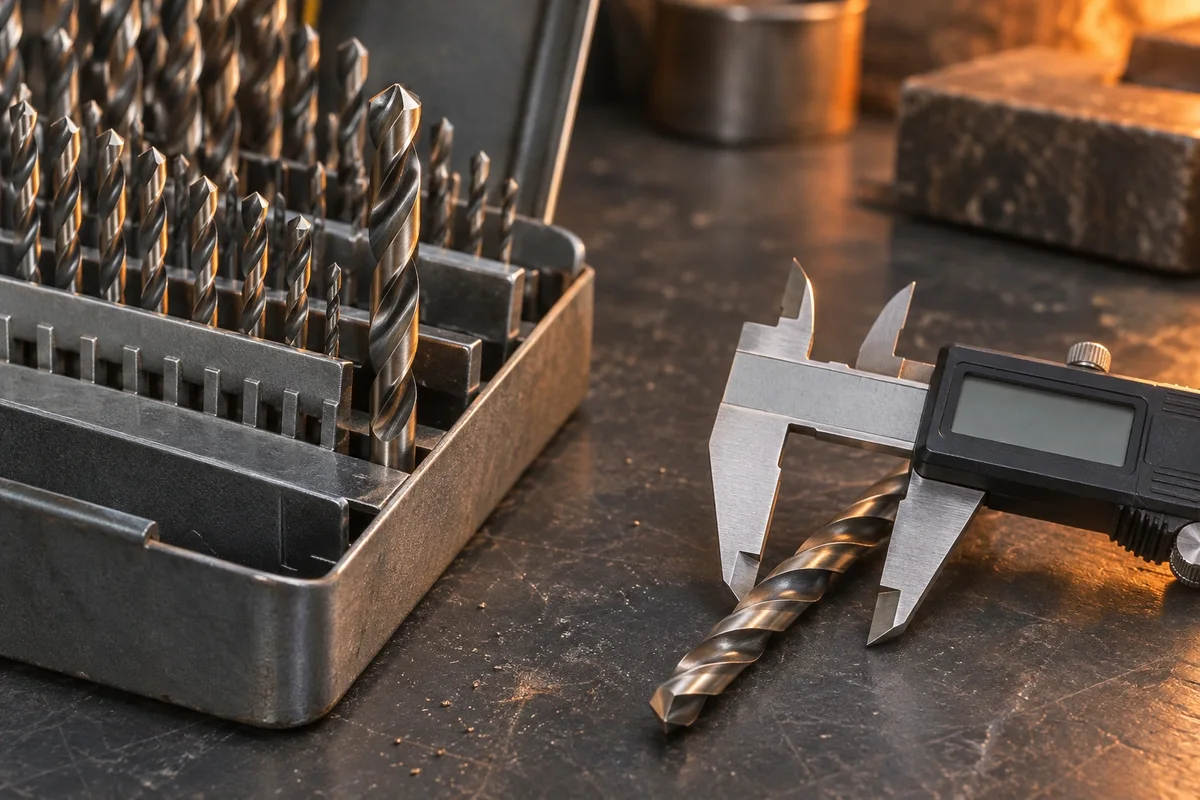
- Measure with a caliper or micrometer across the margins (the narrow lands at the edges of the flutes), not across the flutes. A #7 measures 0.201 in.
- Use a drill gauge plate. These steel plates have a labeled hole for every number size.
- Keep bits in an indexed case so each one goes back to its labeled slot.
A worn or badly sharpened drill can cut a hole several thousandths oversize, which matters for tap holes. If your #7 cuts big, see how to sharpen drill bits to fix uneven lips.
Choosing the Right Type of #7 Drill Bit
The size is only half the story. The bit’s material, length and point style decide how well it cuts and how long it lasts.
| Type | Best for | Notes |
|---|---|---|
| HSS, black oxide | Wood, plastic, aluminum, mild steel | Cheapest; fine for occasional use |
| Cobalt (M35 / M42) | Stainless steel, hard steel | Holds its edge when hot; best for tap holes in steel |
| TiN or TiAlN coated | Production work in steel | Lower friction; coating wears off after sharpening |
| Solid carbide | CNC machines, abrasive materials | Very accurate but brittle; not for hand drills |
Length matters too. Jobber-length bits are the standard. A stub (screw machine) length #7 is shorter and stiffer, so it wanders less and drills a more accurate tap hole. For deep holes, use a taper-length bit and peck often to clear chips.
Point angle: a 118° point is fine for soft metals and wood. A 135° split point starts without a center punch and cuts better in steel and stainless.
Why Tap Drill Charts Use #7 Instead of a Fraction
The ideal hole for a 1/4-20 thread at 75% is 0.2013 in, calculated as 0.250 − 0.974 ÷ 20. A #7 drill (0.201 in) lands almost exactly on that number. The nearest fractions are 13/64 in (0.2031 in) and 3/16 in (0.1875 in), so one is slightly big and the other is far too small. Number drills exist to fill gaps like this, which is why tap charts list so many of them. You’ll see the same pattern with #21 for 10-32, #29 for 8-32 and #36 for 6-32.
Frequently Asked Questions
7 quick answers from our editors
01What size is a #7 drill bit in inches?
0.201 in.
02What size is a #7 drill bit in mm?
5.105 mm. The closest metric drill is 5.1 mm.
03What fraction is closest to a #7 drill?
13/64 in (0.2031 in), about 0.002 in larger.
04What is a #7 drill bit used for?
Mostly as the tap drill for 1/4-20 threads, and as a free-fit clearance hole for #10 screws.
05Is a #7 drill bigger than a #8?
Yes. Number drills get bigger as the number goes down. A #7 is 0.201 in; a #8 is 0.199 in.
06Can I use a 5 mm drill instead of a #7?
For a 1/4-20 tap, 5.0 mm (0.197 in) is a bit small and gives about an 82% thread, which is hard to tap in steel. 5.1 mm is the better choice.
07Is a #7 drill the same as a 7 mm drill?
No. A 7 mm drill is 0.276 in, much bigger than a #7 (0.201 in).
Bottom Line
A #7 drill bit is 0.201 in (5.105 mm). It’s the standard tap drill for 1/4-20 and a free-fit clearance hole for #10 screws. If you don’t have one, a 5.1 mm drill is practically identical and 13/64 in works almost as well. Avoid 3/16 in for tap holes, and measure unmarked bits across the margins. For every number and letter size from #80 to Z, use our number and letter drill size chart.