M6 Tap Drill Size: 5.0 mm Drill Chart for M6 x 1.0 Threads
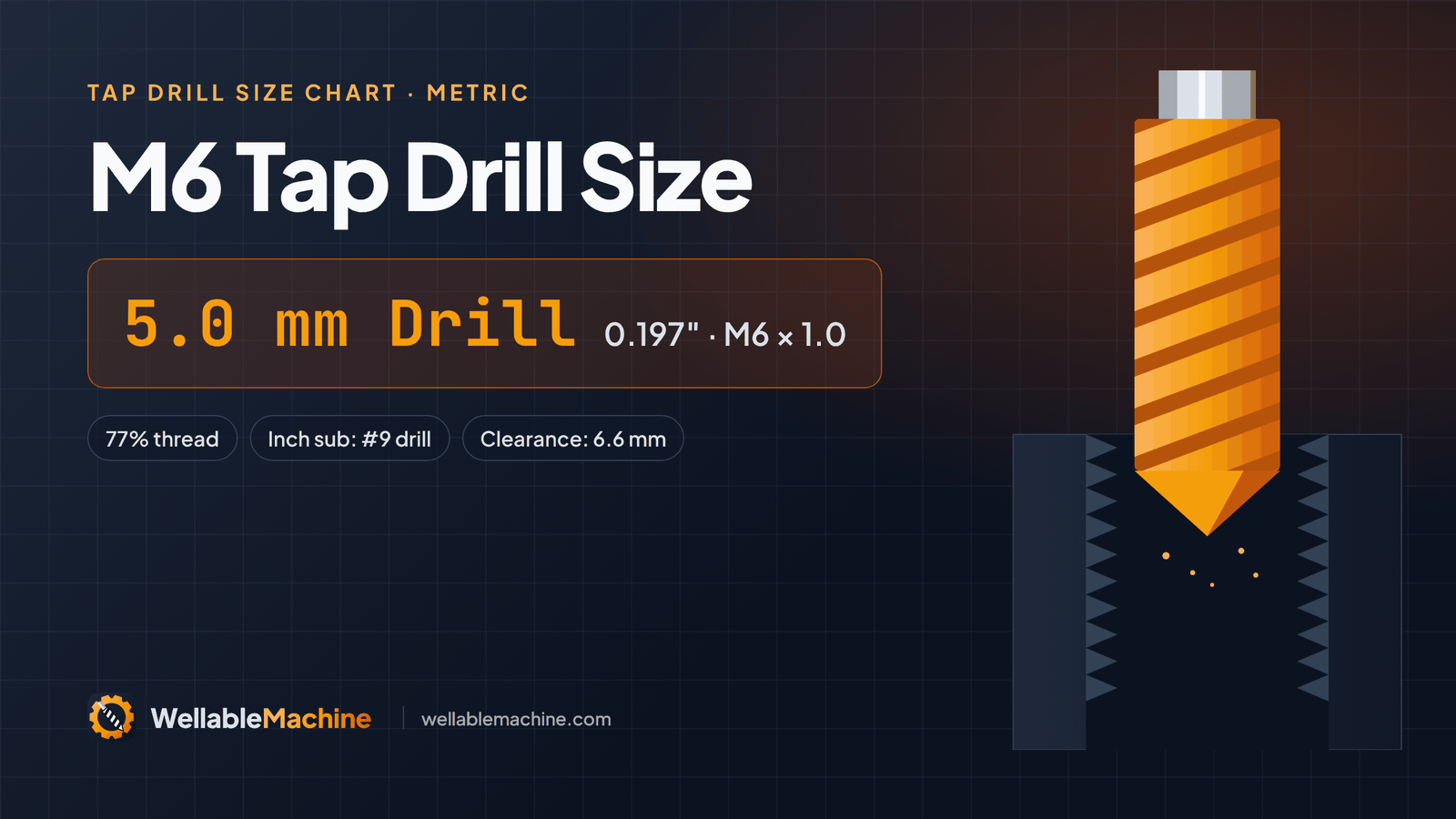
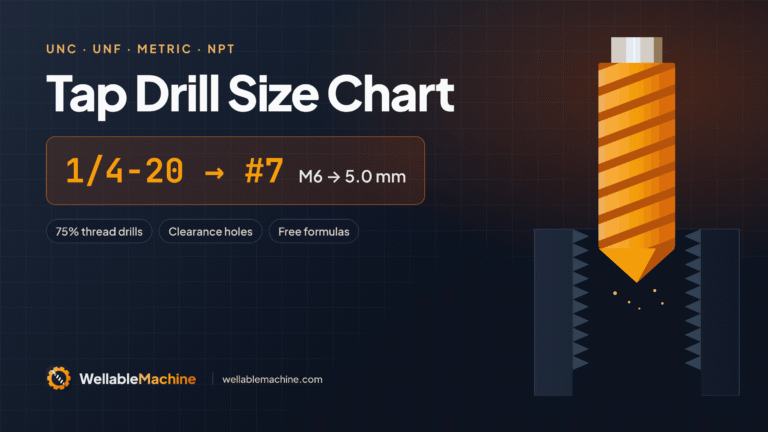
Quick answer: the standard tap drill for an M6 × 1.0 thread is a 5.0 mm drill (0.197 in). It gives about a 77% thread, which is the right choice for aluminum, brass, mild steel and most plastics. If you only own inch drills, a #9 (0.196 in) is a near-perfect match. For stainless steel and other tough metals, step up to 5.1 mm or 5.2 mm to make tapping easier without losing real strength.
This guide covers everything you need to drill and tap an M6 hole: a drill chart by thread percentage, clearance hole sizes, the M6 fine-thread drill, forming-tap and insert sizes, thread depth, and a fix for every common tapping problem.
M6 Thread Specifications at a Glance
“M6” means an ISO metric thread with a 6 mm nominal (major) diameter. When no pitch is written, it is the coarse pitch, which for M6 is 1.0 mm. So “M6” and “M6 × 1” describe the same thread. The profile and tolerances are set by ISO 68-1 and ISO 261, explained in the ISO metric screw thread reference.
| Specification | Value |
|---|---|
| Thread series | ISO metric coarse (M) |
| Major diameter | 6.00 mm (0.236 in) |
| Pitch | 1.0 mm (about 25.4 TPI) |
| Basic minor diameter (internal) | 4.917 mm |
| Tap drill, ~77% thread | 5.0 mm (0.197 in) |
| Inch substitute | #9 = 0.196 in (4.98 mm) |
| Fine-pitch version | M6 × 0.75, tap drill 5.2 mm |
| Clearance hole, normal fit | 6.6 mm |
| Hex key for socket head screw | 5 mm |
M6 Tap Drill Size Chart by Thread Percentage
Thread percentage tells you how much of a full thread profile the tap actually cuts. A smaller hole makes a fuller thread but needs much more torque, and anything above about 75% adds almost no strength. In soft metals a 75–80% thread is normal; in hard metals, machinists often drop to 60–70% so the tap survives. The numbers below come from % thread = (D − drill) ÷ (1.299 × pitch) × 100.
| Drill | mm | Inches | Approx. thread | When to use it |
|---|---|---|---|---|
| 4.9 mm | 4.90 | 0.1929 | 85% | Very soft plastics only; tight in metal |
| #9 | 4.98 | 0.1960 | 79% | Inch-only shops; aluminum and brass |
| 5.0 mm | 5.00 | 0.1969 | 77% | Standard choice for most materials |
| 5.1 mm | 5.10 | 0.2008 | 69% | Steel, cast iron, easier hand tapping |
| 13/64 | 5.16 | 0.2031 | 65% | Inch alternative for stainless |
| 5.2 mm | 5.20 | 0.2047 | 62% | Stainless steel, titanium |
| 5.3 mm | 5.30 | 0.2087 | 54% | Very hard alloys, deep blind holes |
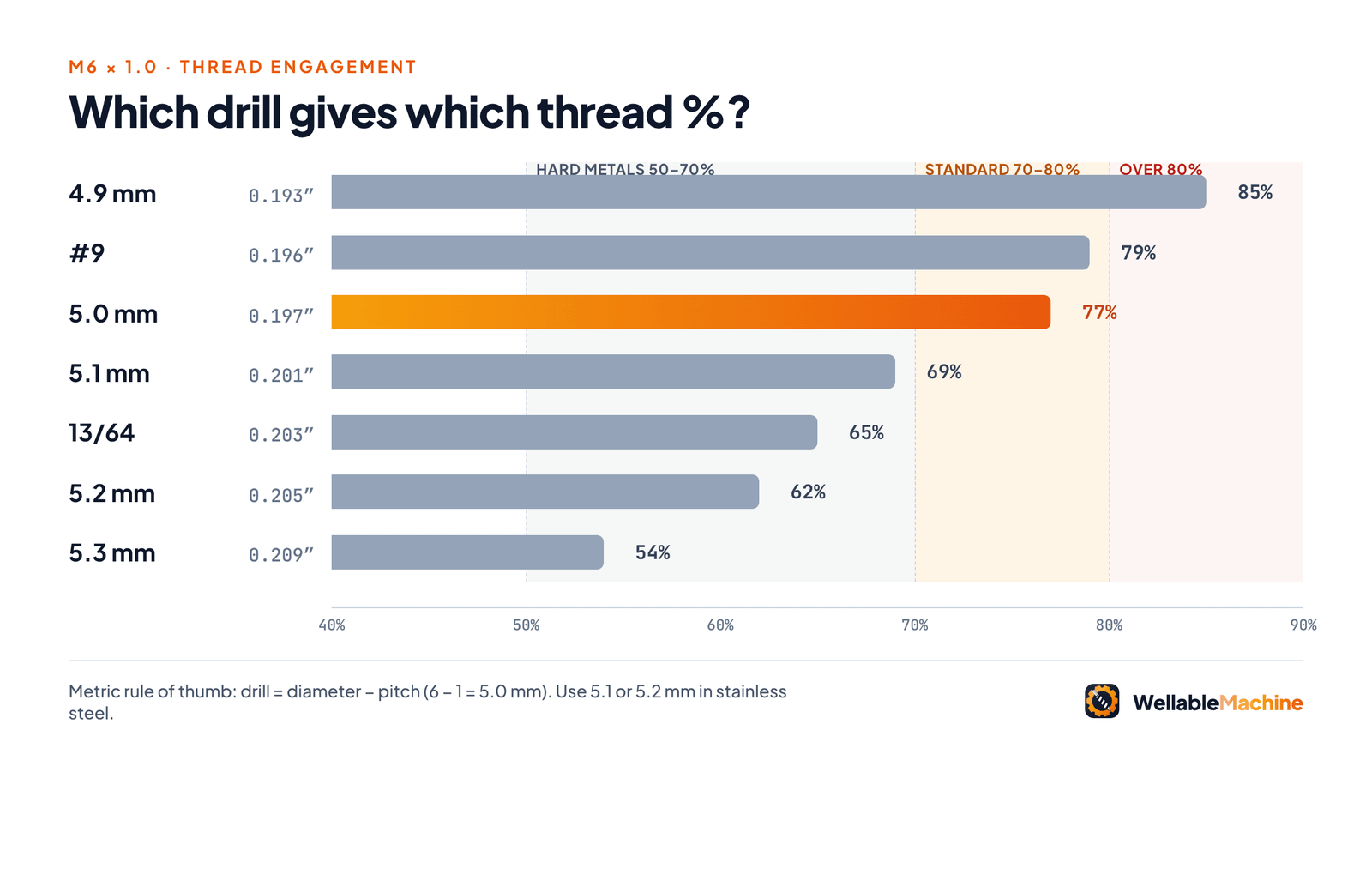
Which drill should you use? Pick 5.0 mm for aluminum, brass, bronze, plastics and mild steel. In 304 or 316 stainless steel, a 5.1 or 5.2 mm drill dramatically lowers the chance of snapping the tap, and the thread is still stronger than the screw in most joints. If your drill index is inch-only, a #9 does the same job as 5.0 mm, and a #7 (0.201 in, which equals 5.1 mm) works for steel. Our guide to the #7 drill bit size explains that overlap.
The Easy Rule for Any Metric Tap Drill
Metric coarse threads have a simple shortcut: tap drill = major diameter − pitch. For M6 × 1.0 that’s 6 − 1 = 5.0 mm. The same rule gives 6.8 mm for M8 × 1.25 (6.75, rounded up) and 8.5 mm for M10 × 1.5. It always lands near a 77% thread, which is why metric charts and the rule agree. You can see the full set in our tap drill size chart.
Clearance Hole Sizes for an M6 Screw
If the screw should pass through a part instead of threading into it, drill a clearance hole. ISO 273 defines three fits:
| Fit | Drill | Inches | Use it for |
|---|---|---|---|
| Close (fine) | 6.4 mm | 0.252 | Precise location, dowel-like alignment |
| Normal (medium) | 6.6 mm | 0.260 | Most assemblies and brackets |
| Loose (coarse) | 7.0 mm | 0.276 | Multi-hole patterns, welded frames |
A 17/64 in (6.75 mm) drill is a good inch substitute for the normal fit.
M6 × 1.0 vs. M6 × 0.75 vs. 1/4-20
These three threads end up in the same parts bins and get confused all the time. A 1/4-20 screw is 0.35 mm larger in diameter and has a coarser pitch, so it will not go into an M6 hole at all. The M6 fine thread starts in a coarse hole and then jams after a turn or two.
| Thread | Diameter | Pitch | Tap drill | Typical use |
|---|---|---|---|---|
| M6 × 1.0 | 6.00 mm | 1.0 mm | 5.0 mm | Machinery, furniture, bikes, 3D printers, general hardware |
| M6 × 0.75 | 6.00 mm | 0.75 mm | 5.2 mm | Thin walls, fine adjustment, some automotive parts |
| 1/4-20 UNC | 6.35 mm | 1.27 mm | #7 (5.1 mm) | US hardware, camera mounts, fixtures |
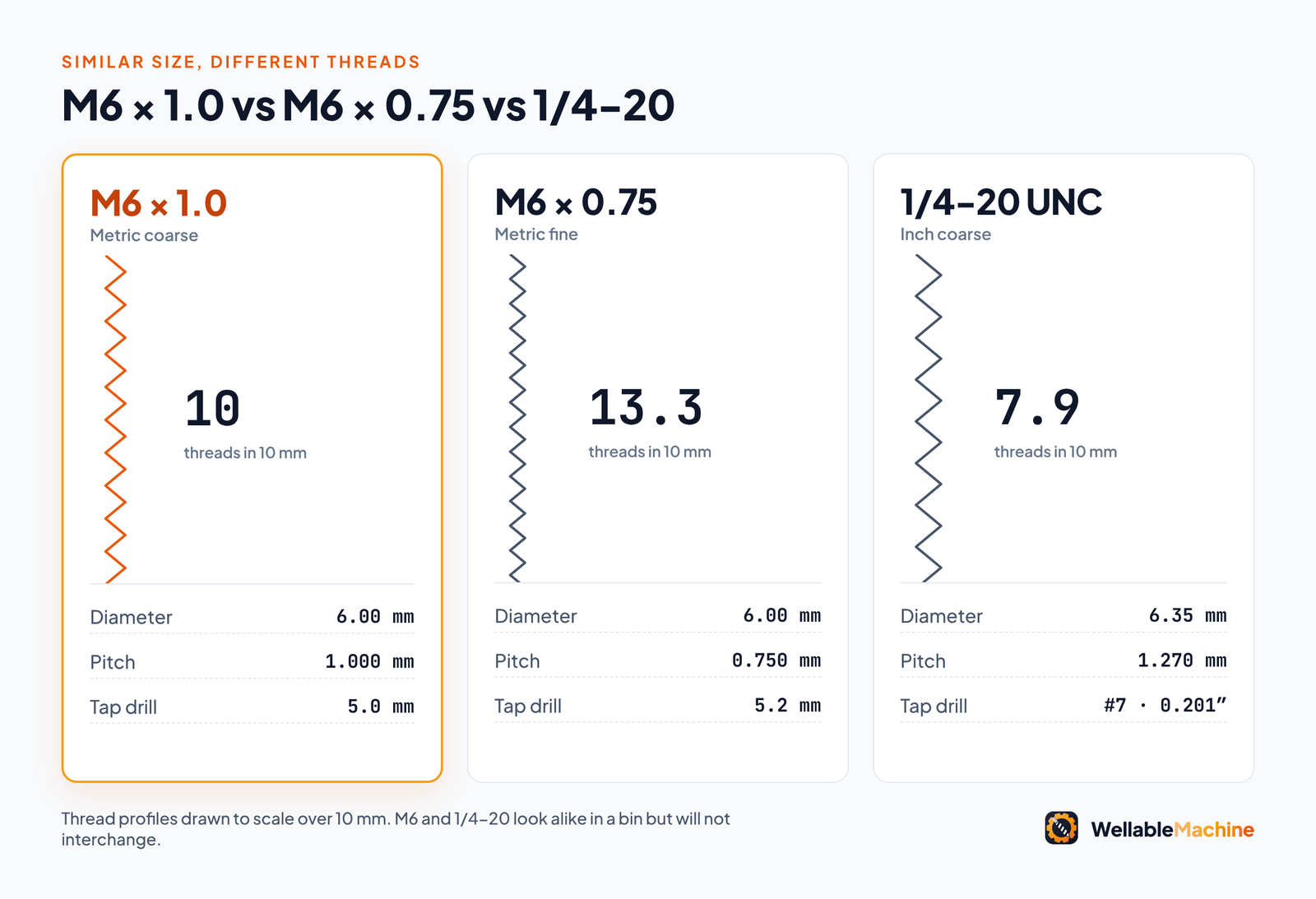
If you work with both systems, keep a thread pitch gauge in your toolbox. For the inch equivalent, see our 1/4-20 tap drill size guide.
Other M6 Hole Sizes You Might Need
- Forming (roll) tap: about 5.5 mm. Forming taps push metal into shape instead of cutting it, so they need a larger hole. Check the tap maker’s chart because it varies slightly by brand.
- Helicoil / wire thread insert: drill 6.3 mm, then use the M6 STI tap that matches the insert kit.
- Threaded insert for wood: usually an 8 mm hole for M6 drive-in or screw-in inserts; follow the insert maker’s spec.
- Counterbore for an M6 socket head cap screw: 11 mm diameter, about 6.5 mm deep.
- Countersink for an M6 flat head screw: 90°, about 12–13 mm outside diameter.
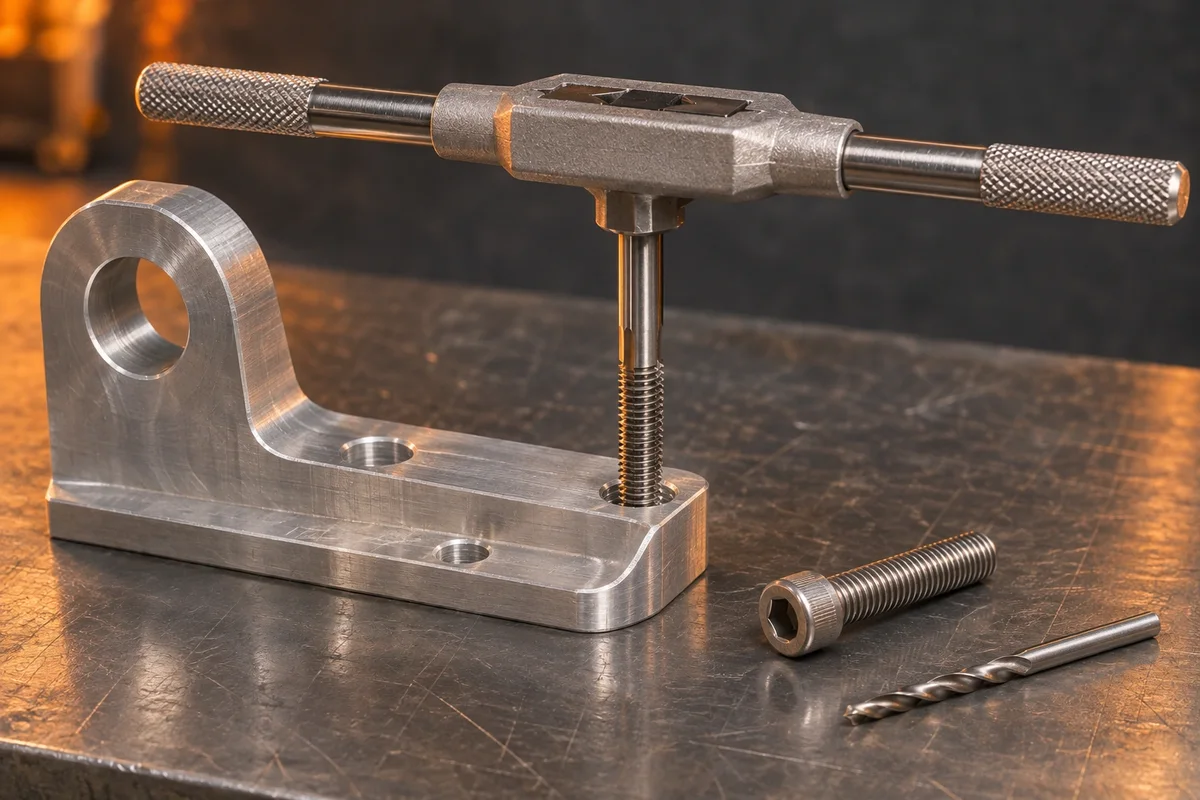
How to Drill and Tap an M6 Hole
- Mark and center punch the hole so the drill starts exactly where you want it.
- Drill with a 5.0 mm bit. In aluminum, run about 2,000 RPM; in mild steel, about 1,200 RPM; in stainless, slow down to 600–800 RPM with firm, steady pressure. Our how to drill stainless steel guide covers speed and coolant.
- Chamfer the top of the hole with a countersink. It helps the tap start square and stops the first thread from lifting.
- Start the tap straight. Use a tap guide, or chuck the tap in a drill press (power off) and turn the chuck by hand for the first two turns.
- Cut and break the chip: half a turn forward, a quarter turn back, with tapping fluid. Aluminum likes a light oil; steel likes a sulfurized cutting oil.
- For blind holes, drill at least 3 mm deeper than the thread you need and finish with a bottoming tap.
Which M6 Tap Should You Use?
| Tap type | Best for | Notes |
|---|---|---|
| Taper tap | Starting threads by hand in hard material | Long chamfer; easiest to start straight |
| Plug tap | Through-holes and most blind holes | The default hand tap |
| Bottoming tap | Full threads to the bottom of blind holes | Use only after a plug tap |
| Spiral point (gun) tap | Through-holes, power tapping | Pushes chips ahead of the tap |
| Spiral flute tap | Blind holes, power tapping | Pulls chips up and out |
| Forming tap | Aluminum, copper, mild steel | No chips; needs a 5.5 mm hole |
HSS taps are fine for aluminum and mild steel. For stainless, pick an HSS-E (cobalt) tap; the same idea applies to drills, which we cover in the best drill bits for stainless steel.
How Deep Should an M6 Thread Be?
Thread engagement matters more than thread percentage. Use these as a starting point:
- Steel: 1 × diameter = 6 mm of full thread.
- Cast iron and brass: 1.5 × diameter = 9 mm.
- Aluminum: 2 × diameter = 12 mm, or use a steel insert for parts that come apart often.
- Plastics: 2–2.5 × diameter, or use a heat-set insert.
Beyond these lengths, extra thread adds almost no holding power because the first few threads carry most of the load.
Common M6 Tapping Problems (and How to Fix Them)
- Tap is very hard to turn: the hole is probably too small or the tap is dull. Check the drill with a caliper and use a 5.1 mm drill in steel.
- Tap broke in the hole: usually from side load or packed chips. Back out more often, use more fluid, and keep the wrench level. A broken HSS tap can sometimes be removed with a tap extractor; carbide is harder.
- Screw is loose or wobbles: the hole was drilled oversize, often because the drill wandered. Center punch, use a spot drill, and drill at the right speed.
- Threads strip in aluminum: add engagement length or install a helicoil.
- Screw starts and then jams: you may have an M6 × 0.75 screw in an M6 × 1.0 hole. Check it with a pitch gauge.
Tapping M6 in Different Materials
A 5.0 mm hole is right for most materials, but fluid and technique change with the metal you are cutting.
| Material | Recommended drill | Tapping fluid | Tips |
|---|---|---|---|
| Aluminum | 5.0 mm | Light oil or WD-40 | Use a spiral point tap for through-holes |
| Mild steel | 5.0 mm | Sulfurized cutting oil | Plug tap, steady rhythm |
| Stainless (304/316) | 5.1–5.2 mm | Heavy tapping paste | Cobalt tap; slow, constant pressure |
| Brass | 5.0 mm | Light oil or dry | Cuts cleanly; avoid high-rake taps |
| Plastics | 5.0 mm | None | Heat-set insert for repeated assembly |
Testing on scrap is always worth it. Tap one hole, thread in a screw by hand, and check that it turns smoothly with no wobble.
Frequently Asked Questions
7 quick answers from our editors
01What size drill bit for an M6 tap?
Use a 5.0 mm drill. It gives about a 77% thread, the standard for most materials.
02What is the inch drill size for an M6 tap?
A #9 drill (0.196 in) is closest. In steel, a #7 (0.201 in) or 13/64 in is easier to tap.
03Is M6 the same as M6 × 1?
Yes. M6 without a pitch means the coarse pitch, which is 1.0 mm.
04What size drill for an M6 × 0.75 fine thread?
Use 5.2 mm (6 − 0.75 = 5.25, rounded down to the nearest common drill).
05What size clearance hole for M6?
6.6 mm for a normal fit, 6.4 mm for a close fit and 7.0 mm for a loose fit.
06Can I use 1/4-20 instead of M6?
No. A 1/4-20 screw is larger and has a different pitch. It will not thread into an M6 hole, and an M6 screw will be loose in a 1/4-20 hole.
07What size drill for an M6 helicoil?
Drill 6.3 mm and use the special STI tap from the insert kit.
Bottom Line
For an M6 × 1.0 thread, drill a 5.0 mm hole and you will get a standard, strong thread in almost any material. Use a #9 if your set is inch-only, go to 5.1–5.2 mm when tapping stainless by hand, and drill 6.6 mm when the screw only needs to pass through. Remember the metric rule (diameter minus pitch) and you’ll rarely need a chart. For the next size up, read our M8 tap drill size guide.