3/4-16 Tap Drill Size: 11/16″ Drill, Clearance & ORB Port Tips
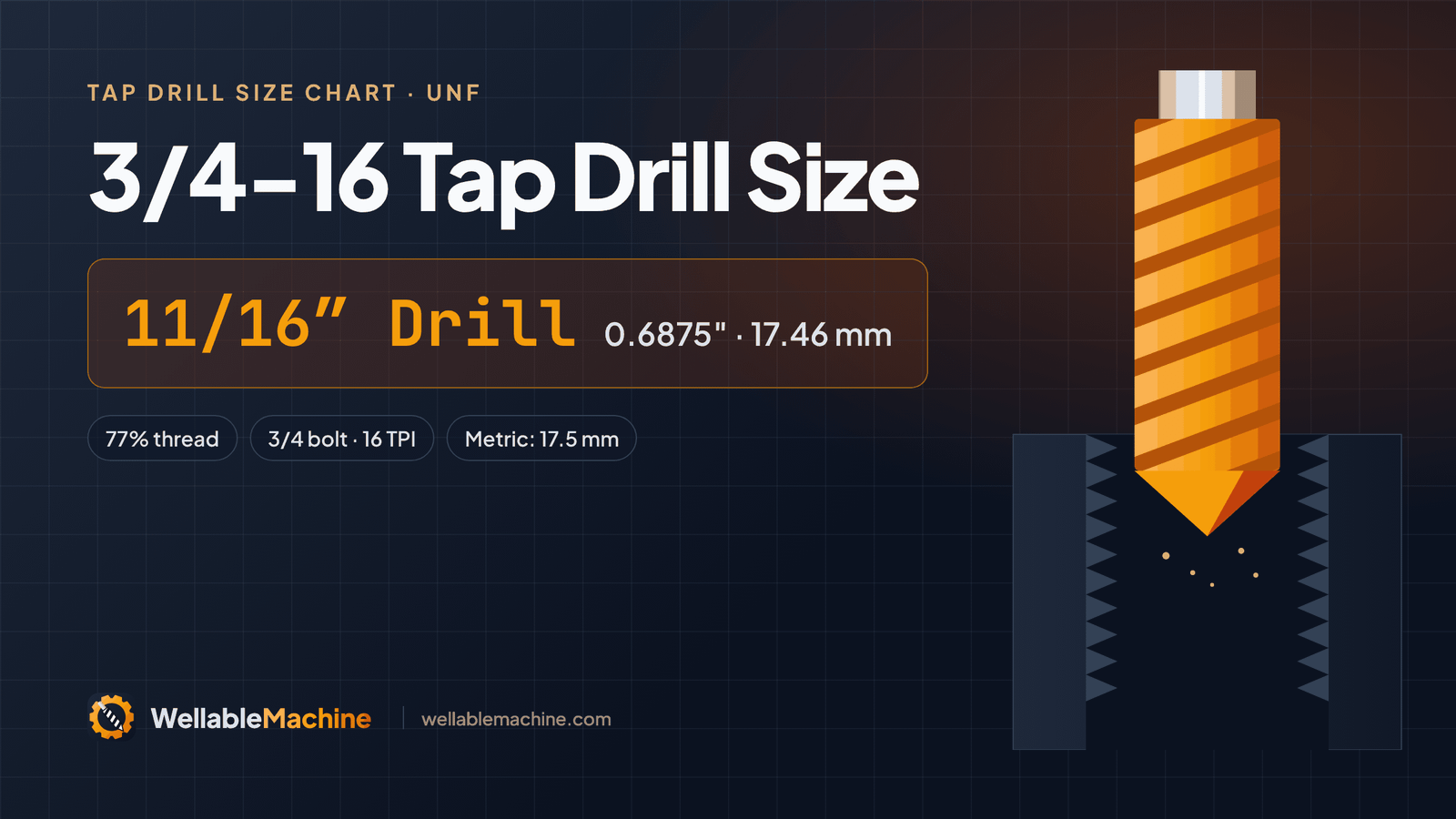
Quick answer: the standard tap drill for a 3/4-16 UNF thread is an 11/16 in drill (0.6875 in / 17.46 mm), which gives about a 77% thread. The metric equivalent is 17.5 mm. In stainless steel, or when hand tapping thick steel, a 17.75 mm drill gives about 63% thread with much less effort.
3/4-16 is the fine-thread version of the 3/4 in bolt, and it is everywhere in vehicles and hydraulics. It is the thread on the oil filter mount of many cars, the SAE -8 O-ring boss port used with 1/2 in hydraulic tube, and many ball joint and tie rod studs. Because the fine pitch has more threads per inch, it holds well in thinner walls and adjusts precisely. This guide covers the tap drill, clearance holes, oil filter and hydraulic port details and how 3/4-16 compares with 3/4-10 and M20 × 1.5.
3/4-16 Thread Specifications at a Glance
“3/4-16” is a 3/4 in (0.750 in) diameter thread with 16 threads per inch, the fine (UNF) pitch for this size in the Unified Thread Standard.
| Specification | Value |
|---|---|
| Thread series | UNF (Unified National Fine) |
| Major diameter | 0.750 in (19.05 mm) |
| Threads per inch | 16 |
| Pitch | 0.0625 in (1.588 mm) |
| Basic minor diameter | 0.6823 in (17.33 mm) |
| Standard tap drill | 11/16 = 0.6875 in (17.46 mm) |
| Metric equivalent | 17.5 mm = 0.689 in |
| Close-fit clearance | 49/64 = 0.7656 in (19.45 mm) |
| Free-fit clearance | 25/32 = 0.7812 in (19.84 mm) |
| Wrench size, hex bolt | 1-1/8 in |
3/4-16 Tap Drill Size Chart by Thread Percentage
Thread percentage tells you how much of a full thread the tap actually cuts. A smaller hole gives a fuller thread but needs much more torque, and anything above about 75% adds almost no real strength. That’s why machinists use about 75% in soft metals and drop to 60–70% in hard ones. The values below use % thread = 76.98 × TPI × (major diameter − drill diameter).
| Drill | Inches | mm | Approx. thread | When to use it |
|---|---|---|---|---|
| 43/64 | 0.6719 | 17.07 | 96% | Far too tight |
| 17.25 mm | 0.6791 | 17.25 | 87% | Very full thread; machine tapping |
| 11/16 | 0.6875 | 17.46 | 77% | Standard choice for most materials |
| 17.5 mm | 0.6890 | 17.50 | 75% | Metric twin of 11/16 |
| 17.75 mm | 0.6988 | 17.75 | 63% | Steel and stainless by hand |
| 45/64 | 0.7031 | 17.86 | 58% | Easy tapping; light loads |
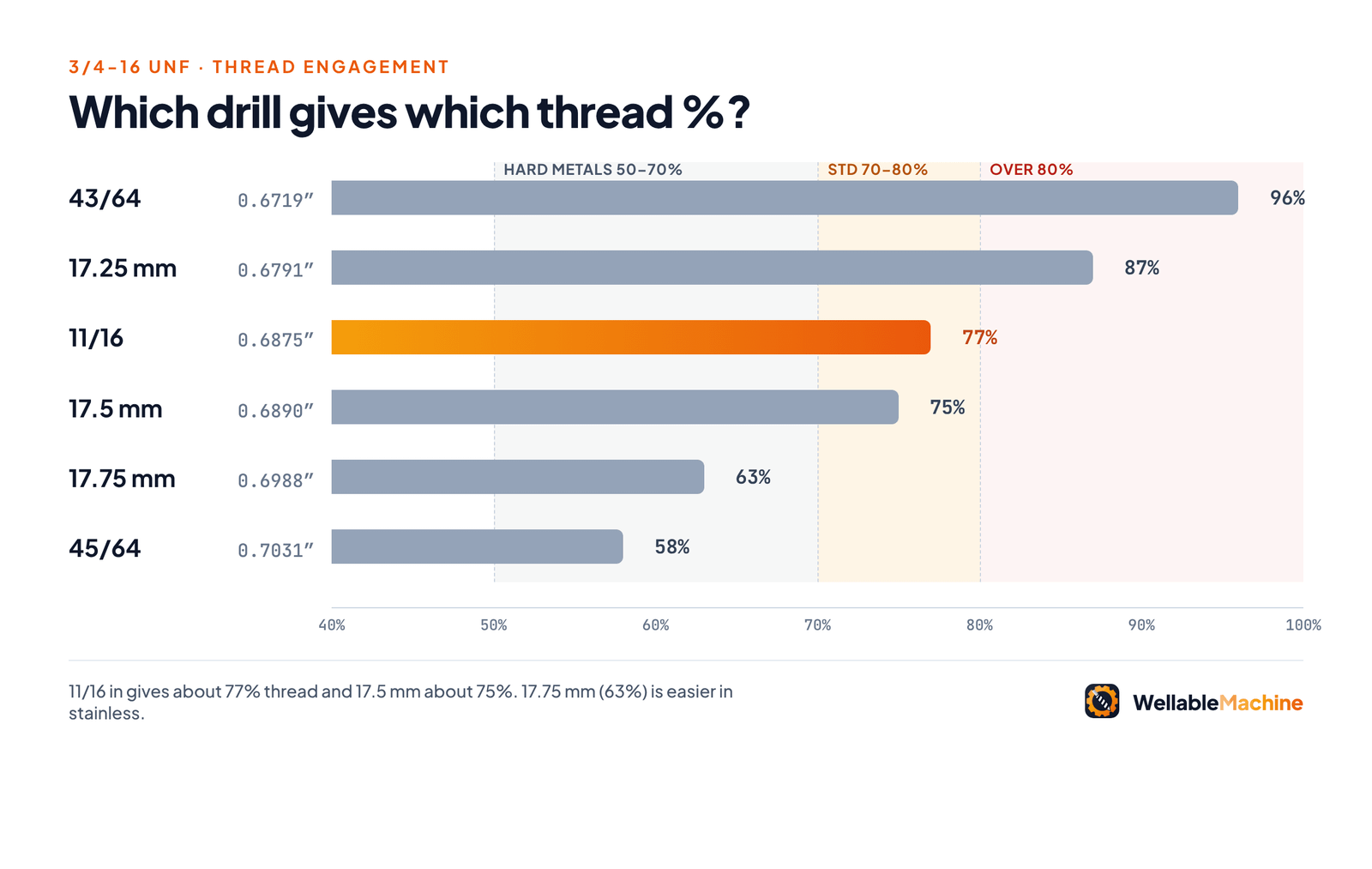
Which drill should you use? Use 11/16 in (or 17.5 mm) for aluminum, cast iron, brass and mild steel, and for every hydraulic port where sealing matters. In stainless steel, 17.75 mm gives about 63% thread and is much easier to tap; that is fine for structural joints, but stick with 11/16 in for ports. Never use 43/64 in, which is smaller than the minor diameter.
3/4-16 Oil Filter Threads
Many cars and light trucks use a 3/4-16 UNF oil filter stud, while others use M20 × 1.5. The two look almost the same but are not interchangeable: a 3/4-16 filter on an M20 × 1.5 stud will start, then bind, and may leak or strip. Check the filter maker’s application chart rather than guessing. If the threaded stud in the filter mount is damaged, it is usually a separate part that unscrews and can be replaced, which is better than trying to chase or re-tap the threads in the block.
SAE -8 O-Ring Boss (ORB) Ports
In hydraulics, a -8 ORB port (SAE J1926) for 1/2 in tube is threaded 3/4-16 UNF. The port is more than a tapped hole: it has a precise spot face and a short counterbore that seats the O-ring. Use a proper -8 port tool (a combined drill, spot face and chamfer cutter) followed by a 3/4-16 tap, or the fitting will weep under pressure. For non-critical holes, an 11/16 in drill and a plug tap are all you need.
Steering and Suspension Threads: Repair or Replace?
Ball joint studs, tie rod ends and adjusting sleeves often use 3/4-16 or similar fine threads. These parts carry steering and suspension loads, so the rule is simple: if a thread on a safety-critical part is damaged, replace the part rather than re-cutting it. A thread chaser can clean rust or paint from a good thread, but re-tapping a stripped knuckle or cutting a new thread on a stud weakens it. When fitting new parts, clean the tapered hole, use a new self-locking or castle nut as the maker specifies, and torque to the service manual value.
Clearance Hole Sizes for a 3/4 in Bolt
Clearance holes are the same for 3/4-16 and 3/4-10 bolts. Steel connections often use standard 13/16 in holes; see our clearance hole size chart for other sizes.
| Fit | Drill | Inches | mm | Use it for |
|---|---|---|---|---|
| Close fit | 49/64 | 0.7656 | 19.45 | Machined parts |
| Free fit | 25/32 | 0.7812 | 19.84 | General assemblies |
| Standard structural | 13/16 | 0.8125 | 20.64 | Steel connections |
3/4-16 vs. 3/4-10 vs. M20 × 1.5
3/4-16 and 3/4-10 share a diameter but not a pitch. The more confusing pair is 3/4-16 and M20 × 1.5: the pitch is nearly identical and the diameter differs by less than 1 mm.
| Thread | Diameter | Pitch | Tap drill | Typical use |
|---|---|---|---|---|
| 3/4-16 UNF | 0.750 in (19.05 mm) | 16 TPI (1.588 mm) | 11/16 in | Oil filters, -8 ORB ports |
| 3/4-10 UNC | 0.750 in (19.05 mm) | 10 TPI (2.54 mm) | 21/32 in | Anchor rods, structural |
| M20 × 1.5 | 20.00 mm | 1.5 mm | 18.5 mm | Metric oil filters, fittings |
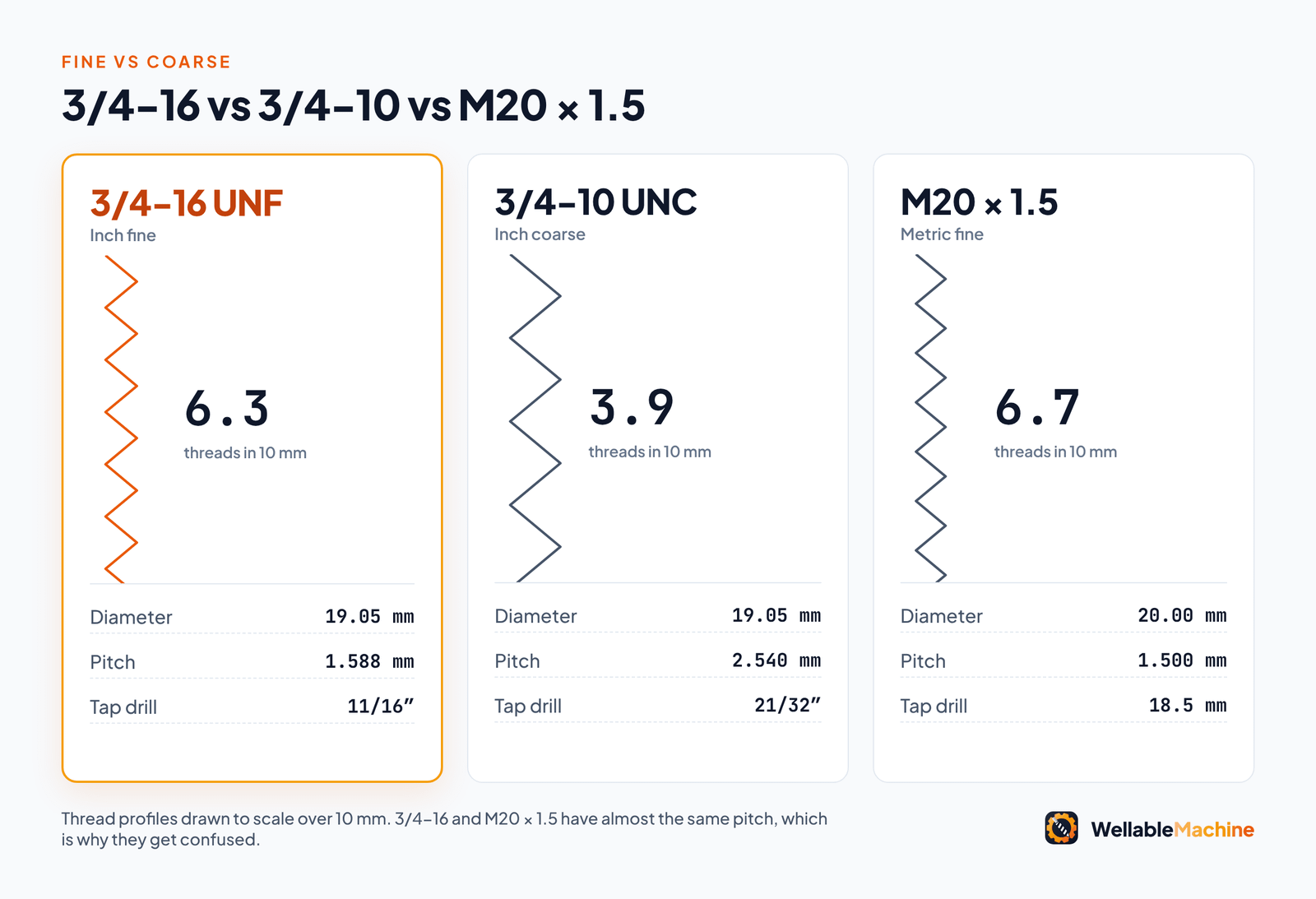
For the coarse thread, see the 3/4-10 tap drill size. For metric, the M20 tap drill size guide covers both pitches.
Other 3/4-16 Hole Sizes You Might Need
- Forming (roll) tap: about 0.703 in (45/64). Check the tap maker’s chart.
- Helicoil / STI insert: about a 25/32 in drill, then the 3/4-16 STI tap.
- -8 ORB port: use a dedicated port tool for the spot face and O-ring seat.
- Die for external threads: start with rod at 0.745–0.750 in and a 3/4-16 round die.
How to Drill and Tap a 3/4-16 Hole
- Mark and center punch the hole so the drill starts exactly where you want it.
- Drill with a 11/16 bit. In aluminum, run about 550 RPM; in mild steel, about 350 RPM; in stainless, slow down to about 150 RPM with steady pressure and cutting oil. Our guide on how to drill stainless steel explains why stainless needs low speed and constant feed.
- Chamfer the top of the hole with a countersink so the tap starts square and the first thread doesn’t lift.
- Start the tap straight. Use a long tap wrench and check square after the first two turns. Fine threads cross-thread easily if the tap leans.
- Cut and break the chip: half a turn forward, a quarter turn back, with tapping fluid. Light oil suits aluminum; sulfurized cutting oil suits steel.
- For blind holes, drill at least 1/4 in (4 pitches) deeper than the full thread you need, and finish with a bottoming tap.
For drilling a hole this size accurately in steel, see our drill speed chart. If you are cutting the matching external thread, read how to use a tap and die.
Tapping 3/4-16 in Different Materials
The 11/16 drill is right for most materials, but each metal behaves differently under the tap. This table sums up what works.
| Material | Recommended drill | Tapping fluid | Tips |
|---|---|---|---|
| Aluminum | 11/16 | Light oil or WD-40 | Light oil; clear chips often |
| Mild steel | 11/16 | Sulfurized cutting oil | Reverse often to break the chip |
| Stainless (304/316) | 17.75 mm | Heavy tapping paste | Cobalt tap; heavy paste |
| Brass | 11/16 | Dry or light oil | Cuts cleanly; tap can grab at the end |
| Cast iron | 11/16 | Dry or air | Common for filter mounts and housings |
How Deep Should a 3/4-16 Thread Be?
Thread engagement matters more than thread percentage. The first few threads carry most of the load, so going much deeper adds effort without adding strength. Use these lengths as a starting point:
- Steel: 1–1.5 × diameter, 3/4–1-1/8 in.
- Cast iron: 1.5 × diameter, about 1-1/8 in.
- Aluminum: 2 × diameter, 1-1/2 in, or use inserts.
Where Is 3/4-16 Used?
3/4-16 UNF is used on oil filter studs, SAE -8 O-ring boss hydraulic ports and fittings, ball joints, tie rod ends, steering components, axle and spindle nuts, adjusting screws and precision machinery.
Common 3/4-16 Tapping Problems (and How to Fix Them)
- Fitting leaks: the port has no proper spot face or O-ring seat. Use a port tool.
- Filter starts then binds: it may be the wrong thread (M20 × 1.5 vs 3/4-16).
- Thread cross-threaded: fine threads need the tap kept dead square; use a guide.
- Tap stiff in stainless: step up to 17.75 mm and use a cobalt tap.
Frequently Asked Questions
8 quick answers from our editors
01What size drill bit for a 3/4-16 tap?
An 11/16 in drill (0.6875 in). It gives about a 77% thread.
02What metric drill for 3/4-16?
17.5 mm.
03What thread is a -8 ORB port?
3/4-16 UNF.
04Is 3/4-16 the same as M20 × 1.5?
No. The pitch is almost the same, but M20 is about 1 mm bigger. They are not interchangeable.
05What clearance hole for a 3/4 in bolt?
49/64 in close, 25/32 in free or 13/16 in for steel connections.
06What size wrench fits a 3/4 in bolt?
1-1/8 in for a standard hex head.
07Is 3/4-16 a common oil filter thread?
Yes, on many cars and light trucks; others use M20 × 1.5 or 13/16-16.
08Can I re-tap a stripped 3/4-16 thread on a ball joint?
No. Replace steering and suspension parts with damaged threads.
Bottom Line
For a 3/4-16 UNF thread, drill 11/16 in or 17.5 mm. Use 17.75 mm in stainless where sealing isn’t critical, and a proper port tool for -8 ORB ports. Don’t confuse 3/4-16 with M20 × 1.5. For every size, see our tap drill size chart.