M10 x 1.25 Tap Drill Size: 8.75 mm Drill & How to Spot Fine Threads
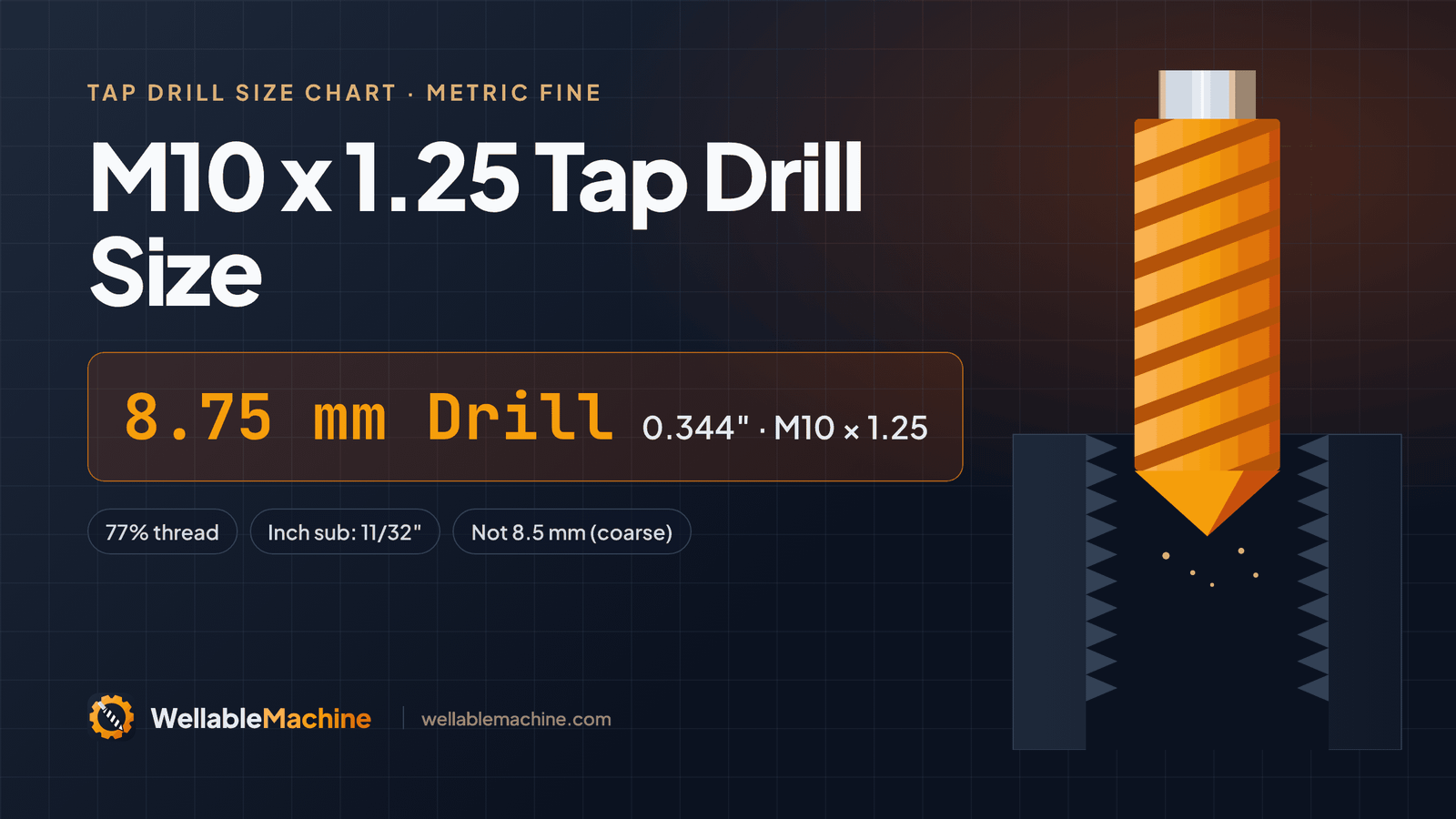
Quick answer: an M10 × 1.25 fine thread needs an 8.75 mm drill (0.344 in), which gives about a 77% thread. If you don’t have 8.75 mm, 8.7 mm or an 11/32 in drill (8.73 mm) works. Don’t use 8.5 mm: that is the drill for coarse M10 × 1.5, and in a 1.25 mm thread it leaves a hole that is much too small.
M10 × 1.25 is the most common fine-pitch M10 thread. You will find it on brake banjo bolts and caliper hardware, motorcycle mirror mounts, suspension bolts, engine sensors and many Japanese and European vehicle parts. Because the coarse M10 (1.5 mm pitch) is far more common in hardware stores, people often drill the wrong hole or try to force a coarse bolt into a fine thread. This guide gives the correct drill, how to tell the pitches apart and where M10 × 1.25 is used.
M10 x 1.25 Thread Specifications at a Glance
“M10 × 1.25” is an ISO metric thread with a 10 mm diameter and a 1.25 mm fine pitch. The coarse M10 has a 1.5 mm pitch, and an extra-fine M10 × 1.0 is also common on brake lines. See the ISO metric screw thread reference.
| Specification | Value |
|---|---|
| Thread series | ISO metric fine (MF) |
| Major diameter | 10.00 mm (0.394 in) |
| Pitch | 1.25 mm (20.3 TPI) |
| Basic minor diameter (internal) | 8.647 mm |
| Tap drill, ~77% thread | 8.75 mm (0.344 in) |
| Inch substitute | 11/32 = 0.344 in (8.73 mm) |
| Coarse M10 × 1.5 drill | 8.5 mm |
| Extra-fine M10 × 1.0 drill | 9.0 mm |
| Clearance hole, normal fit | 11 mm |
| Wrench size | 16 or 17 mm hex head; 8 mm hex key |
M10 x 1.25 Tap Drill Size Chart by Thread Percentage
Every drill in the table below leaves a different amount of metal for the tap to cut. Tests have shown that a 60% thread is only a few percent weaker than a 75% one, yet it takes far less effort to tap, so there is no prize for the tightest hole. Percentages are worked out with % thread = (D − drill) ÷ (1.299 × pitch) × 100.
| Drill | mm | Inches | Approx. thread | When to use it |
|---|---|---|---|---|
| 8.5 mm | 8.50 | 0.3346 | 92% | Coarse M10 drill; too tight here |
| 8.6 mm | 8.60 | 0.3386 | 86% | Fuller thread in aluminum |
| 8.7 mm | 8.70 | 0.3425 | 80% | Common chart size |
| 11/32 | 8.73 | 0.3438 | 78% | Inch match for 8.75 mm |
| 8.75 mm | 8.75 | 0.3445 | 77% | Standard choice (D − P) |
| 8.8 mm | 8.80 | 0.3465 | 74% | Steel by hand |
| 9.0 mm | 9.00 | 0.3543 | 62% | Stainless; light loads |
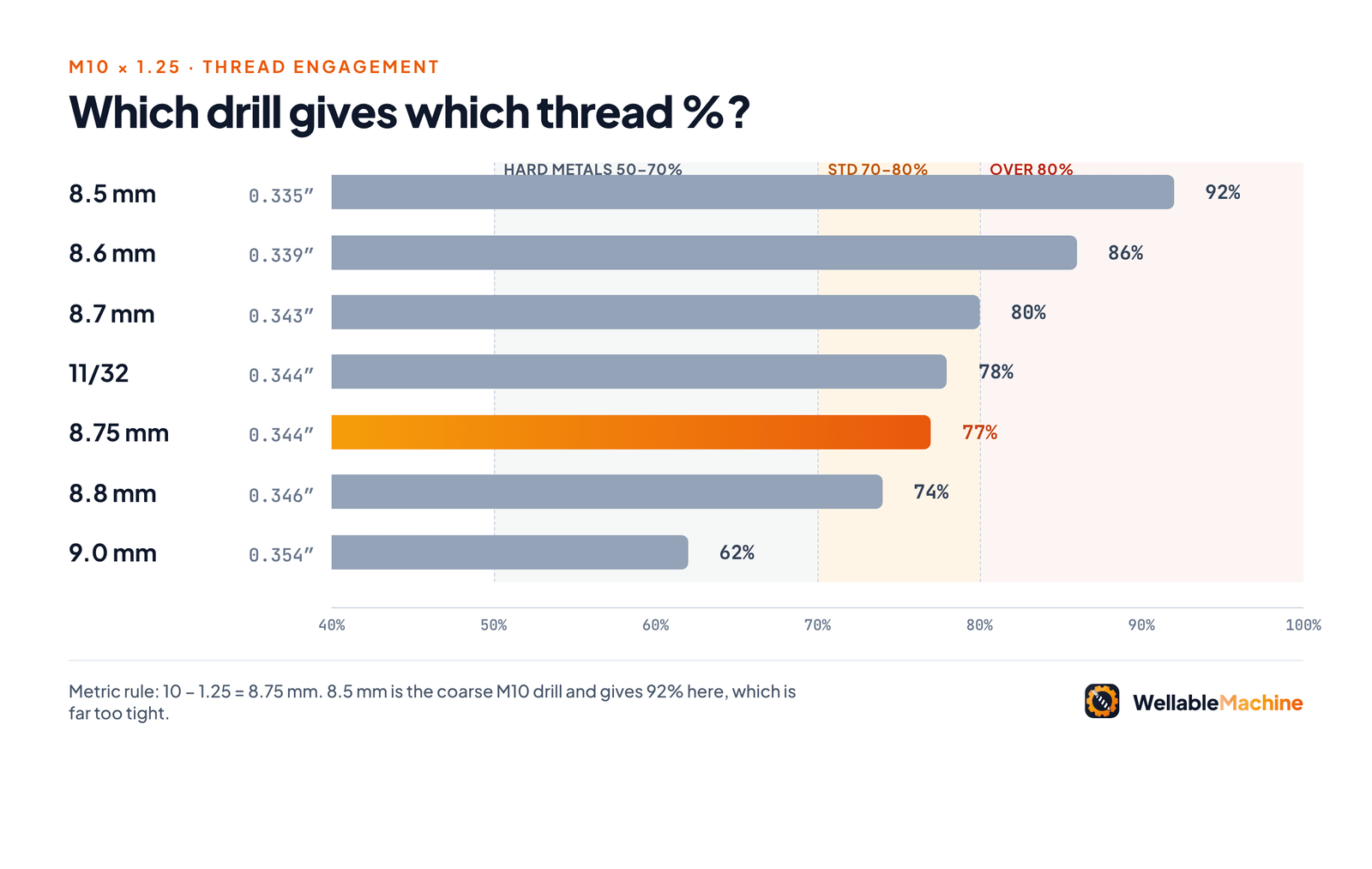
Which drill should you use? Use 8.75 mm (or 8.7 mm / 11/32 in) for aluminum, cast iron and steel. In stainless, 8.8 mm makes tapping easier with little loss of strength. For a fuller thread in soft aluminum castings, 8.6 mm works if tapped carefully. Never use the coarse 8.5 mm drill for M10 × 1.25.
Clearance Hole Sizes for an M10 Bolt
ISO 273 clearance holes are the same for all M10 pitches. For other sizes, see our clearance hole size chart.
| Fit | Drill | Inches | mm | Use it for |
|---|---|---|---|---|
| Close (fine) | 10.5 mm | 0.413 | 10.5 | Precise alignment |
| Normal (medium) | 11 mm | 0.433 | 11.0 | Most assemblies |
| Loose (coarse) | 12 mm | 0.472 | 12.0 | Field fit, slotted brackets |
How to Tell M10 × 1.25 From M10 × 1.5 and M10 × 1.0
All three are 10 mm bolts, and they look nearly identical. Try these checks before you force anything:
- Thread pitch gauge: the quickest and most reliable check. Hold the 1.25 leaf against the bolt; it should sit with no light showing.
- Count threads: over 10 mm of length, M10 × 1.5 has about 6.7 threads, M10 × 1.25 has 8 and M10 × 1.0 has 10.
- Test with a known nut: a coarse M10 nut will start on a 1.25 bolt and then lock after one turn.
- Where it came from: brake lines and bleeders often use M10 × 1.0; banjo bolts and mirrors often use 1.25; general hardware is 1.5.
Banjo Bolts and Motorcycle Mirrors
Brake and clutch banjo bolts on many motorcycles and cars are M10 × 1.25 (some are M10 × 1.0). They seal with crush washers on each side and must be torqued to the maker’s value; never reuse old crush washers. Motorcycle mirrors commonly use M10 × 1.25 threads, and on many bikes the left or right mirror is left-hand threaded, so check before you buy adapters. If a mirror mount is stripped in an aluminum perch or clamp, an M10 × 1.25 thread insert restores the original thread.
Repairing a Stripped M10 × 1.25 Thread
In aluminum housings and calipers, the usual fix is a Helicoil or similar insert. Drill with the insert kit’s drill (about 10.4 mm for M10 × 1.25), tap with the kit’s STI tap, then install the insert so the thread returns to standard M10 × 1.25. For brake components, many workshops replace the part rather than repair it; follow the manufacturer’s guidance for anything safety-critical.
M10 × 1.25 vs. M10 × 1.5 vs. M10 × 1.0
All three share a 10 mm diameter. The tap drill changes with the pitch, because the rule is simply diameter minus pitch.
| Thread | Diameter | Pitch | Tap drill | Typical use |
|---|---|---|---|---|
| M10 × 1.25 | 10.00 mm | 1.25 mm | 8.75 mm | Banjo bolts, mirrors, suspension |
| M10 × 1.5 | 10.00 mm | 1.5 mm | 8.5 mm | General hardware |
| M10 × 1.0 | 10.00 mm | 1.0 mm | 9.0 mm | Brake lines, sensors |
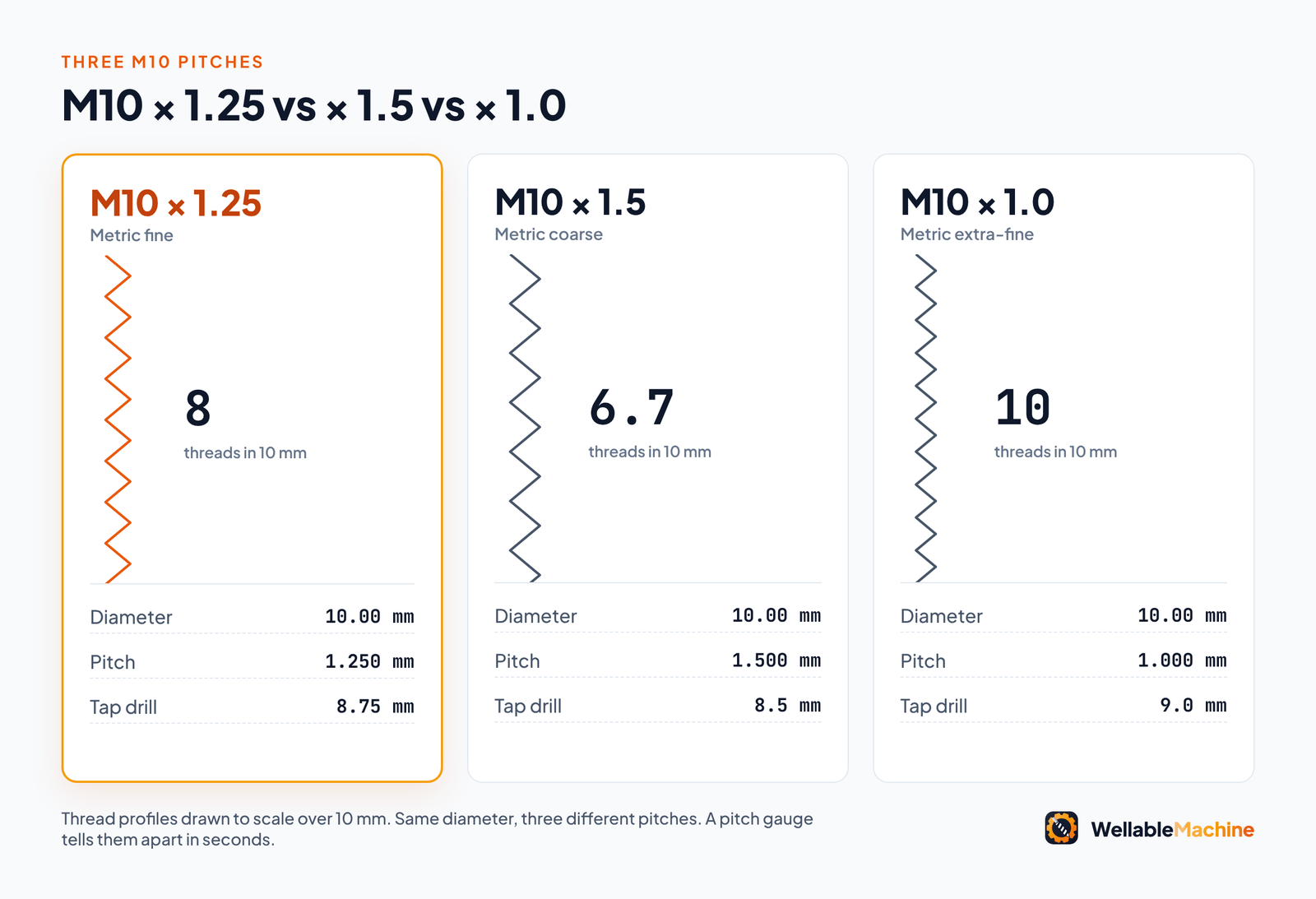
For the coarse thread, see the M10 tap drill size guide. For the next size up, see M12.
Other M10 x 1.25 Hole Sizes You Might Need
- Forming (roll) tap: about 9.4 mm. Check the tap maker’s chart.
- Helicoil / STI insert: about 10.4 mm drill with the M10 × 1.25 STI tap.
- Counterbore for a socket head cap screw: 17.5 mm diameter, 10.5 mm deep.
- Left-hand M10 × 1.25: same 8.75 mm drill; use an LH tap.
How to Drill and Tap a M10 x 1.25 Hole
- Mark and center punch the hole so the drill starts exactly where you want it.
- Drill with a 8.75 mm bit. In aluminum, run about 1,100 RPM; in mild steel, about 650 RPM; in stainless, slow down to about 350 RPM with steady pressure and cutting oil. Our guide on how to drill stainless steel explains why stainless needs low speed and constant feed.
- Break the sharp edge with a countersink. A small chamfer guides the tap in and keeps a raised burr from forming around the hole.
- Start the tap straight. Use a tap guide or start the tap in the drill press chuck. Fine threads cross-thread easily if the tap leans.
- Work in short strokes. Turn forward until you feel resistance build, then reverse slightly to snap the chip. Keep the flutes wet with tapping fluid the whole time.
- For blind holes, drill at least 3.75 mm (3 pitches) deeper than the full thread you need, and finish with a bottoming tap.
If a tap breaks in an expensive part, see how to remove a broken tap. For drill speeds, see our drill speed chart.
Tapping M10 x 1.25 in Different Materials
The hole size rarely changes from one metal to another, but the fluid, tap and technique do. Here is a quick guide for M10 x 1.25 work.
| Material | Recommended drill | Tapping fluid | Tips |
|---|---|---|---|
| Aluminum | 8.75 mm | Light oil or WD-40 | Light oil; 8.6 mm for fuller thread |
| Mild steel | 8.75 mm | Sulfurized cutting oil | Reverse often to break the chip |
| Stainless (304/316) | 8.8 mm | Heavy tapping paste | Cobalt tap; tapping paste |
| Brass | 8.75 mm | Dry or light oil | Cuts cleanly; tap can grab at the end |
| Cast aluminum housings | 8.75 mm | Light oil or kerosene | Use inserts for parts that are opened often |
How Deep Should a M10 x 1.25 Thread Be?
How much thread you need depends on what the hole is made of. Softer materials need longer engagement so the internal thread doesn’t strip before the screw breaks:
- Steel: 1–1.5 × diameter, 10–15 mm.
- Cast iron: 1.5 × diameter, 15 mm.
- Aluminum: 2 × diameter, 20 mm, or use an insert.
Where Is M10 x 1.25 Used?
M10 × 1.25 is used on brake and clutch banjo bolts, motorcycle mirror mounts, suspension and caliper bolts, engine sensors and fittings, and many Japanese and European automotive and machine parts.
Common M10 x 1.25 Tapping Problems (and How to Fix Them)
- Bolt locks after one turn: it is probably M10 × 1.5 in a 1.25 hole.
- Tap very hard to turn: you may have drilled 8.5 mm. Open to 8.75 mm.
- Banjo leaks: replace the crush washers and torque correctly.
- Mirror won’t thread in: it may be left-hand.
Frequently Asked Questions
6 quick answers from our editors
01What size drill for an M10 x 1.25 tap?
8.75 mm, about 77% thread. 8.7 mm or 11/32 in also work.
02Is M10 x 1.25 fine or coarse?
Fine. Coarse M10 has a 1.5 mm pitch.
03Can I use an 8.5 mm drill for M10 x 1.25?
No. 8.5 mm is for M10 × 1.5 and gives about 92% thread in a 1.25 pitch, which is too tight.
04What clearance hole for M10?
10.5 mm close, 11 mm normal or 12 mm loose.
05What thread are motorcycle mirrors?
Commonly M10 × 1.25, sometimes left-hand on one side.
06What drill for M10 x 1.0?
9.0 mm.
Bottom Line
For M10 × 1.25, drill 8.75 mm (or 8.7 mm / 11/32 in), not the 8.5 mm coarse drill. Clearance is 11 mm for a normal fit. Check the pitch with a gauge before forcing any M10 bolt. For every size, see our tap drill size chart.