How to Remove a Broken Tap: 6 Methods That Work

Quick answer: to remove a broken tap, first clean the hole and soak it with penetrating oil. If a piece sticks out, grip it with locking pliers and turn it backward gently. If it’s flush or below the surface, use a tap extractor whose fingers slide into the flutes. If the tap won’t move at all, break it into pieces with a punch, dissolve it with alum (in aluminum or brass parts), or have it burned out with EDM. Don’t try to drill it with a normal bit: a tap is harder than the drill.
Breaking a tap is one of the most frustrating moments in metalwork, but most broken taps can be removed without ruining the part. This guide explains each method from easiest to most drastic, how to choose between them, and how to avoid breaking the next tap.
Why Taps Break
Taps are made from hardened high-speed steel, usually around 62–65 HRC. That makes them very hard but also brittle, so they snap rather than bend. The usual causes are:
- Tap drill too small. A hole that gives more than about 80% thread needs far more torque. Always check a tap drill size chart.
- Packed chips. Not backing out to break the chip, especially in blind holes and in aluminum.
- Side load. A big wrench, one-handed turning or a tap that started crooked.
- Bottoming out. Hitting the bottom of a blind hole and forcing one more turn.
- Work-hardened stainless. A dull drill or slow feed hardens the hole wall before you even start tapping.
- Dull or wrong tap. Using a hand tap in a power tool, or a worn tap in tough metal.
Before You Start: Stop and Assess
- Stop turning. Forcing a cracked tap usually breaks it lower in the hole.
- Clear the chips. Blow out the hole (wear eye protection) and pick out chips with a scribe or a magnet. Packed chips are often the real reason the tap is stuck.
- Soak it. Add penetrating oil and let it sit for 15–30 minutes.
- Look at what’s left. Is a piece sticking out? Is it flush? How many flutes does it have (2, 3 or 4)? Is the part aluminum, brass, steel or stainless? These answers decide the method.
Method 1: Pliers or a Tap Wrench (If Part of the Tap Sticks Out)
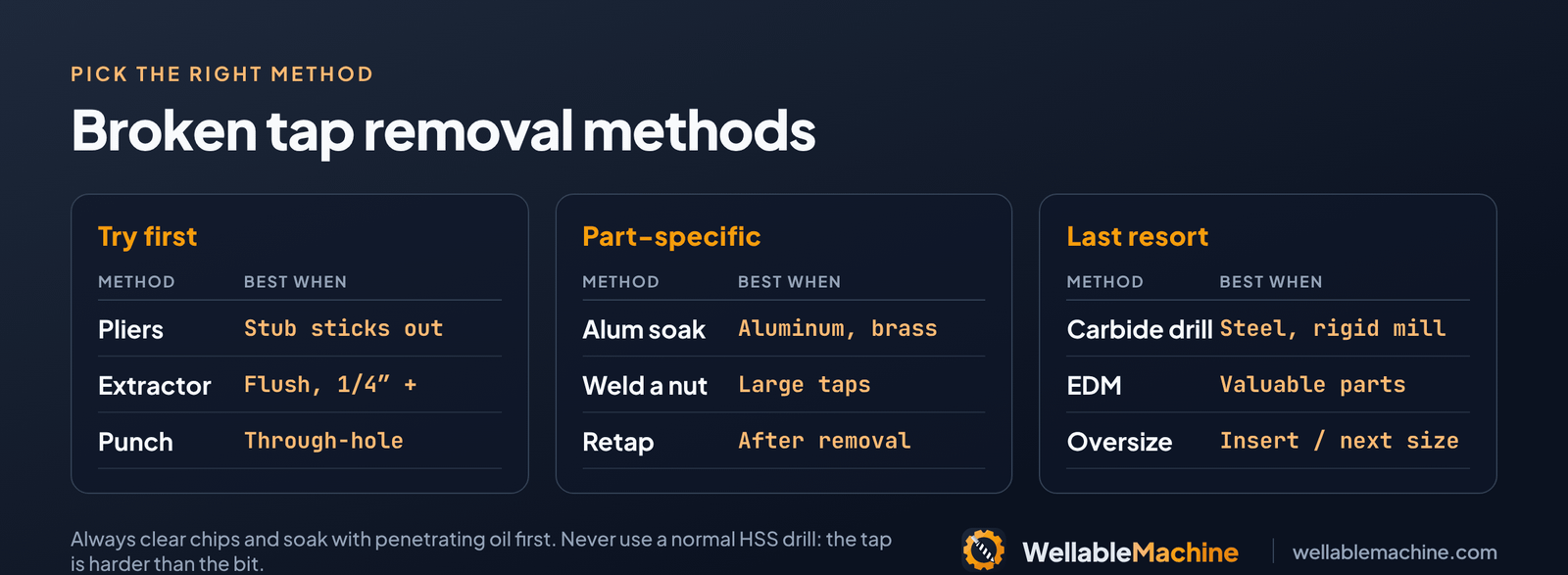
If the break left a stub above the surface, you’re lucky. Grip the stub with locking pliers or a small tap wrench and turn it counterclockwise (for a right-hand thread) in small back-and-forth movements. Rock it a few degrees each way to loosen the chips, then work it out slowly. Keep adding oil. Don’t use a lot of force: if it snaps again, it will break flush.
Method 2: Tap Extractor
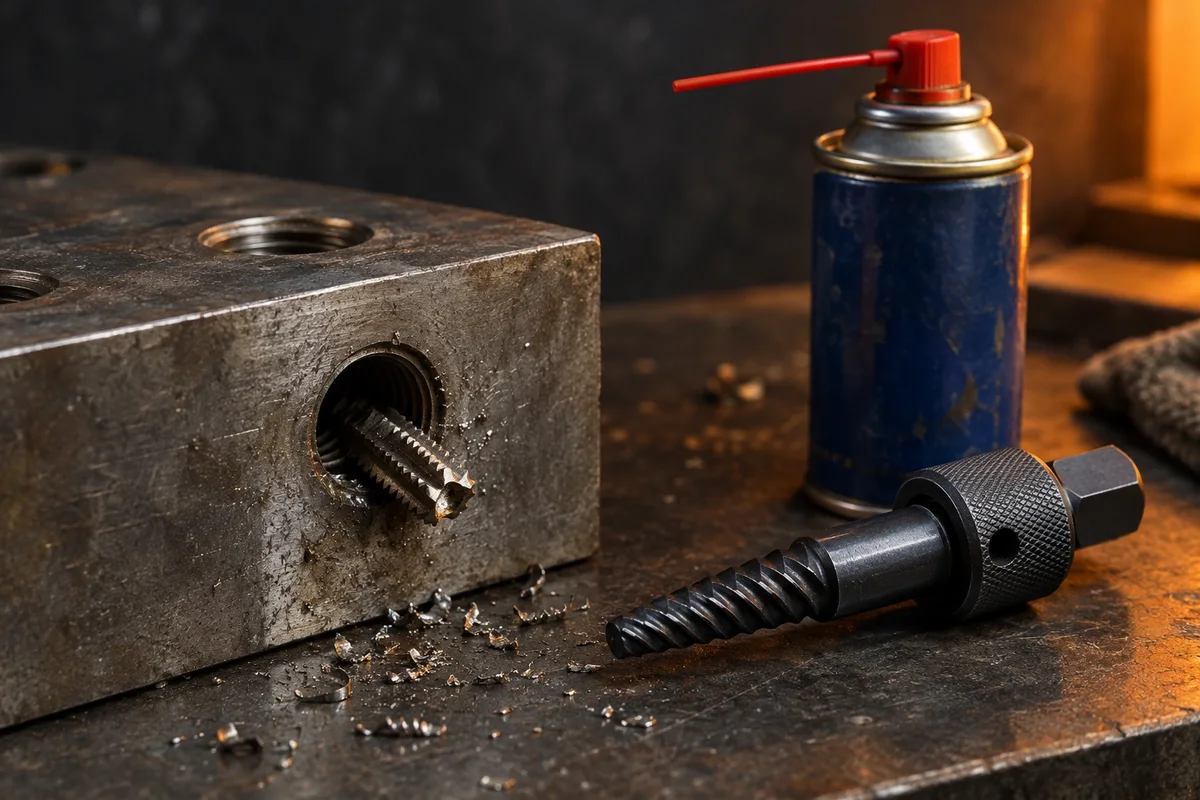
A tap extractor has thin steel fingers that slide down into the tap’s flutes. A collar holds the fingers close to the hole, and you turn the extractor with a wrench to back the tap out.
- Choose the extractor that matches the tap size and number of flutes.
- Slide the fingers into the flutes as deep as possible, at least 1/4 in if you can.
- Slide the collar down to the surface of the part to support the fingers.
- Turn counterclockwise gently, rocking back and forth.
Extractors work best when the tap broke because of packed chips, not because it’s jammed in a hard thread. They’re less useful on taps smaller than about #6 or M3, where the fingers are very fragile.
Method 3: Punch It Out in Pieces
Because taps are brittle, you can often shatter them. Put on safety glasses, set a small pin punch or center punch on the tap’s center, and give it sharp taps with a hammer. The tap breaks into small pieces, which you pick out with a scribe, tweezers or a magnet. This works best on through-holes and on taps larger than about 1/4 in. It can damage the first thread or two, which you can clean up with a new tap afterwards.
Method 4: Dissolve It with Alum (Aluminum and Brass Parts)
If the part is aluminum or brass, you can dissolve a steel tap chemically. A hot, saturated solution of alum (potassium aluminum sulfate, sold in grocery stores for pickling) slowly eats the steel tap while leaving aluminum and brass mostly unharmed.
- Mix alum into hot water until no more dissolves.
- Put the part in a pot so the tap is covered, or build a small dam around the hole.
- Keep the solution hot (just below a simmer) for several hours, topping up water as it evaporates.
- Pick out the softened remains and clean the part thoroughly.
It’s slow, but it saves parts that would otherwise be scrap. It won’t work in steel parts, because the alum attacks the part too.
Method 5: Drill It Out with Carbide
A normal HSS or cobalt drill can’t cut a hardened tap. A solid carbide drill or a carbide end mill can, but only in a rigid machine with the part clamped. Use a bit slightly smaller than the tap’s core, run it at moderate speed with cutting oil, and drill through the center. The remaining shell collapses and can be picked out. Carbide is brittle, so this is a drill press or milling machine job, not a hand drill job. See our guide to the best drill bits for hardened steel for bit choices.
Method 6: EDM (Tap Burner)
Electrical discharge machining burns the tap out with sparks, without touching the part. Many machine shops have a portable “tap disintegrator” and will remove a tap for a modest fee. It’s the best option for valuable parts, deep blind holes and small taps that other methods would wreck.
Which Method Should You Use?
| Situation | Best method |
|---|---|
| Piece sticks out above the surface | Locking pliers or tap wrench |
| Broken flush, tap 1/4 in or larger, chips packed | Tap extractor |
| Through-hole, tap jammed tight | Punch it out in pieces |
| Aluminum or brass part | Alum solution |
| Steel part, access to a mill | Carbide drill or end mill |
| Valuable part or tiny tap | EDM at a machine shop |
| Nothing works | Drill oversize and fit a thread insert or a larger thread |
After Removal: Repairing the Thread
- Chase the thread with a new tap of the same size, going slowly with plenty of fluid.
- If the thread is damaged, drill and tap for a thread insert (Heli-Coil or STI), which restores the original size.
- If an insert won’t fit, move up to the next screw size, for example from 1/4-20 to 5/16-18 (see our 5/16-18 tap drill size guide).
How to Avoid Breaking Taps
- Use the right drill. In steel and stainless, choose a drill that gives 60–70% thread instead of 75–80%. For example, use a #22 instead of a #25 for 10-24 in stainless.
- Start square. Use a tap guide or the drill press spindle.
- Break the chip. Half a turn forward, a quarter turn back. In blind holes, back out completely every few turns to clear chips.
- Use the right tap. Spiral point taps for through-holes, spiral flute taps for blind holes, forming taps in aluminum.
- Use tapping fluid, always, and a heavy paste in stainless.
- Use a small wrench on small taps. For #4–#8 and M3–M4 taps, a pin vise or small T-handle gives better feel. Our 4-40 tap drill size guide has more tips for tiny taps.
- Drill deep enough. Blind holes need extra depth below the thread so the tap never bottoms out.
Frequently Asked Questions
6 quick answers from our editors
01Can you drill out a broken tap?
Not with a normal drill bit. Taps are harder than HSS and cobalt drills. A solid carbide drill or end mill in a rigid machine can do it, or a machine shop can burn it out with EDM.
02Does alum dissolve a broken tap?
Yes. A hot, saturated alum solution slowly dissolves steel taps while leaving aluminum and brass parts largely unharmed. It takes several hours.
03Do tap extractors work?
They work well on taps around 1/4 in and larger when chips are the main problem. They’re less effective on very small or tightly jammed taps.
04How do you remove a broken tap from a blind hole?
Clear the chips first, then try an extractor. If that fails, EDM is the safest choice. Punching it out is harder in a blind hole because the pieces have nowhere to go.
05Can you weld a nut to a broken tap?
Sometimes, on larger taps. The heat can also soften the tap and relieve the jam. It’s harder on HSS taps because the weld may not hold well to hardened steel.
06Why do taps break so easily?
They are very hard and brittle so they can cut steel. A small amount of side force or extra torque from packed chips or an undersized hole is enough to snap them.
Bottom Line
When a tap breaks, stop, clear the chips and soak it with oil before you try anything else. Grip a protruding stub with pliers, use a tap extractor for flush breaks, punch brittle taps out of through-holes, dissolve them with alum in aluminum or brass, and turn to carbide or EDM when the part is valuable. Then avoid the next break by using the right tap drill, starting square and breaking the chip often. Our tap drill size chart lists the right drill for every common thread.