5/16-18 Tap Drill Size: F Drill Chart, Clearance & Metric
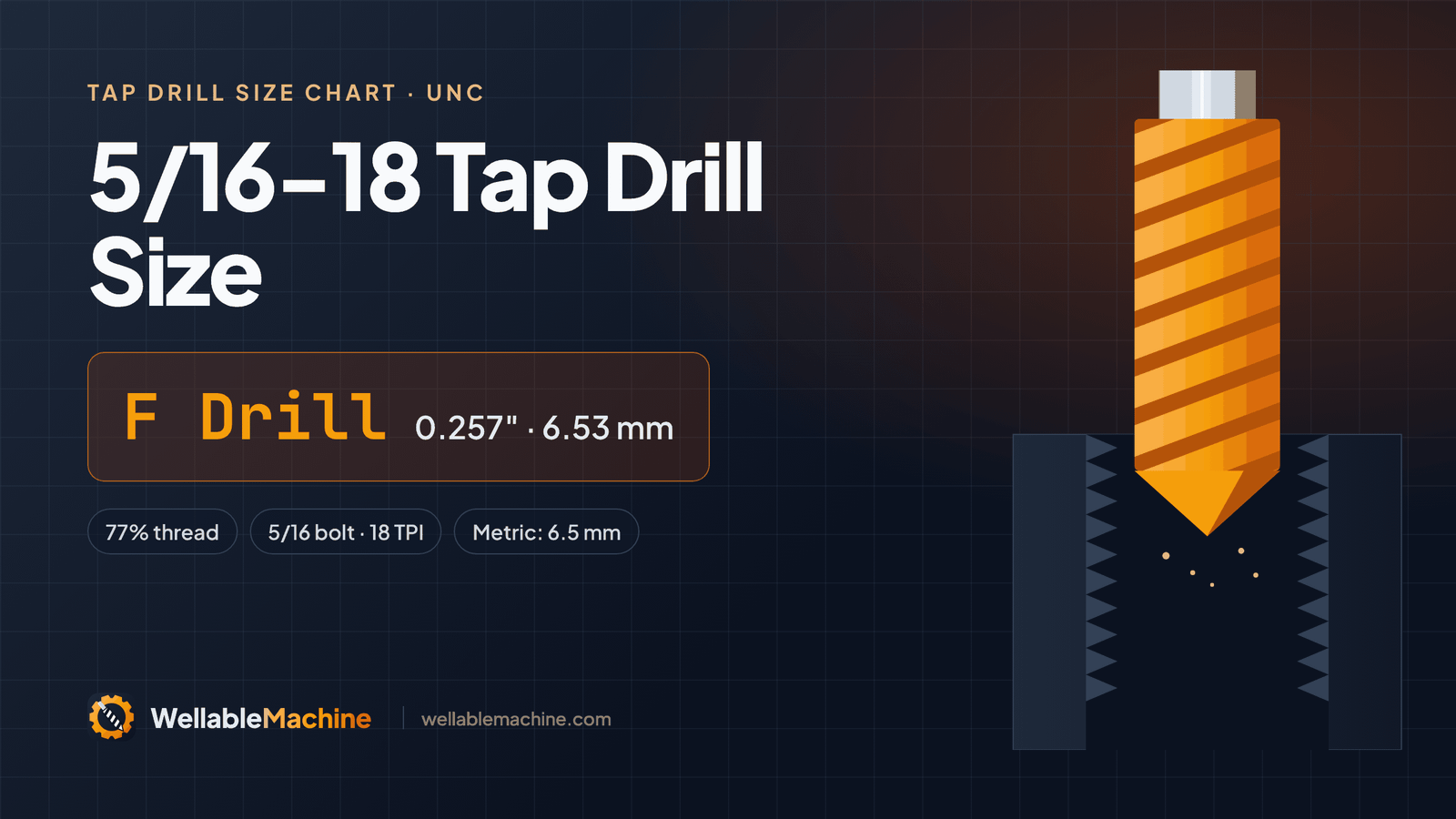
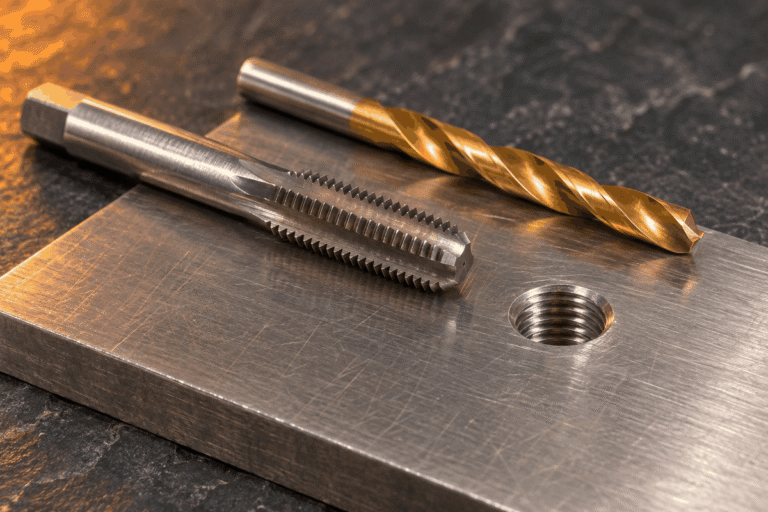
Quick answer: the standard tap drill for a 5/16-18 UNC thread is an F drill (0.257 in / 6.53 mm). It gives about a 77% thread, the normal choice for steel, aluminum, cast iron and brass. If you only have metric drills, use 6.5 mm. For stainless steel or hand tapping in tough alloys, go up to G (0.261 in) or 17/64 in (0.266 in).
Below you’ll find the complete 5/16-18 drill chart by thread percentage, clearance hole sizes for a 5/16 bolt, the drill for 5/16-24 fine thread, forming-tap and Heli-Coil sizes, and a step-by-step tapping method that keeps threads straight and strong.
5/16-18 Thread Specifications at a Glance
“5/16-18” means a 5/16 in nominal diameter bolt with 18 threads per inch. It is the coarse thread (UNC) for this size in the Unified Thread Standard. You’ll find it on lawn mowers, trailers, engine accessories, machine guards and countless brackets.
| Specification | Value |
|---|---|
| Thread series | UNC (Unified National Coarse) |
| Major diameter | 0.3125 in (7.94 mm) |
| Threads per inch | 18 |
| Pitch | 0.0556 in (1.411 mm) |
| Basic minor diameter | 0.2443 in (6.21 mm) |
| Tap drill, 75% thread | F = 0.257 in (6.53 mm) |
| Tap drill, 50% thread | J = 0.277 in (7.04 mm) |
| Close-fit clearance | P = 0.323 in (8.20 mm) |
| Free-fit clearance | Q = 0.332 in (8.43 mm) |
| Hex head wrench size | 1/2 in |
5/16-18 Tap Drill Size Chart by Thread Percentage
The closer the drill is to the bolt’s minor diameter, the fuller the thread. But torque rises fast above 75%, and the real strength gain is tiny. That’s why F is the standard and why many machinists use a slightly larger drill in hard metals. The percentages use % thread = 76.98 × TPI × (major diameter − drill diameter).
| Drill | Inches | mm | Approx. thread | When to use it |
|---|---|---|---|---|
| 1/4 | 0.2500 | 6.35 | 87% | Too tight for metal; risks breaking the tap |
| 6.5 mm | 0.2559 | 6.50 | 78% | Metric substitute for F |
| F | 0.2570 | 6.53 | 77% | Standard for most materials |
| G | 0.2610 | 6.63 | 71% | Steel, easier hand tapping |
| 17/64 | 0.2656 | 6.75 | 65% | Stainless steel; common fractional size |
| H | 0.2660 | 6.76 | 64% | Stainless and hard alloys |
| 6.8 mm | 0.2677 | 6.80 | 62% | Metric option for tough metals |
| I | 0.2720 | 6.91 | 56% | Titanium, deep blind holes |
| J | 0.2770 | 7.04 | 49% | 50% thread; very hard materials only |
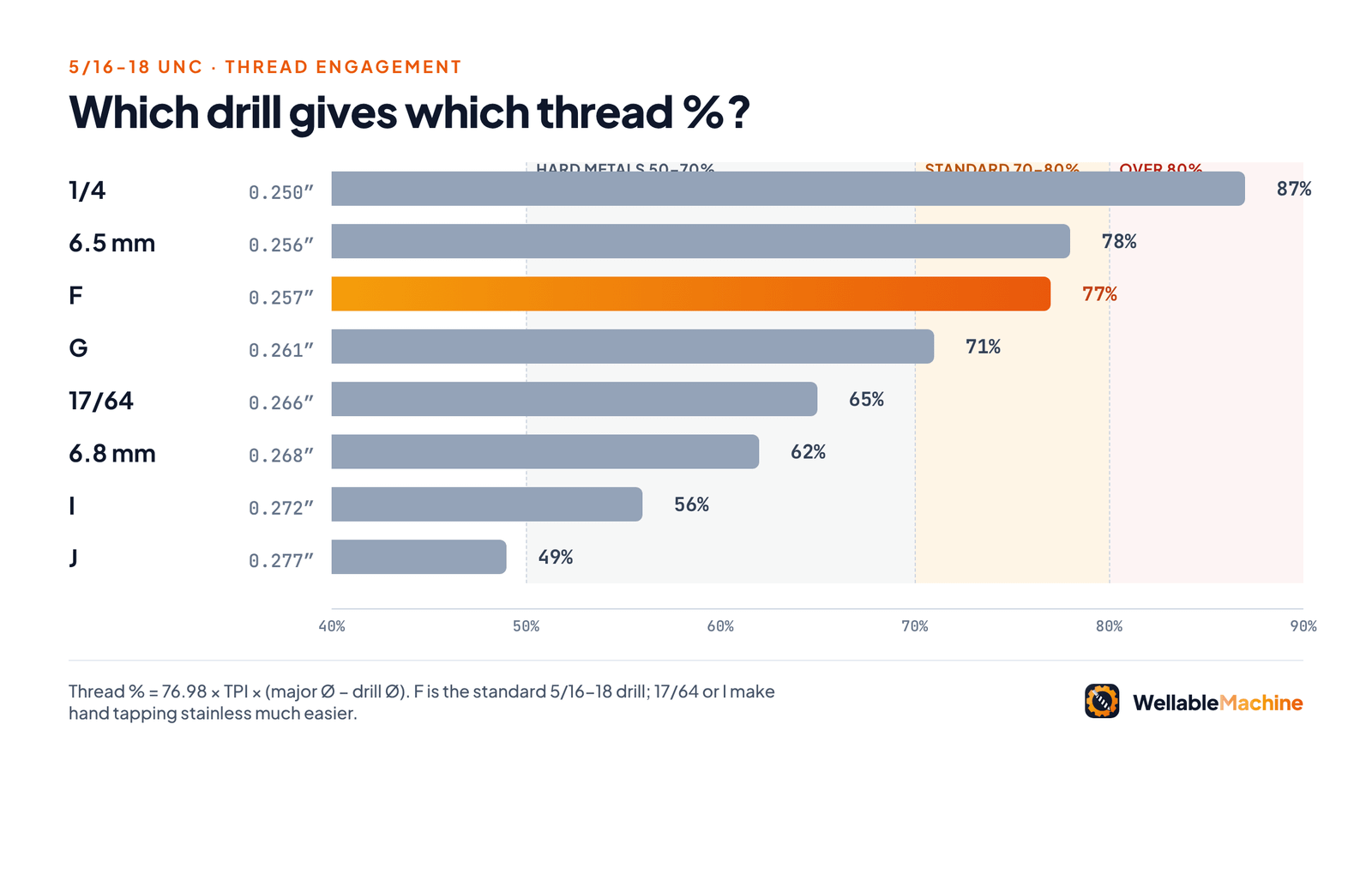
No letter drills? Many fractional sets stop at 1/64 steps. In that case, use 17/64 in. It gives about a 65% thread, which is plenty strong for most work and much easier to tap than a tight hole. Don’t use a 1/4 in drill: at 87% it puts a lot of strain on the tap. Our number and letter drill size chart lists every letter size if you want to add them to your kit.
Clearance Hole Sizes for a 5/16 Bolt
When the bolt passes through the part and threads into a nut or into another part, drill a clearance hole:
| Fit | Drill | Inches | mm | Use it for |
|---|---|---|---|---|
| Close fit | P | 0.3230 | 8.20 | Accurate location of mating parts |
| Free fit | Q | 0.3320 | 8.43 | General assemblies |
| Loose fit | 11/32 | 0.3438 | 8.73 | Hole patterns, frames, easy assembly |
5/16-18 vs. 5/16-24 vs. M8
The fine-thread 5/16-24 and the metric M8 × 1.25 are the two threads most often confused with 5/16-18. All three are within 0.06 mm in diameter, so you need to check the pitch.
| Thread | Diameter | Pitch | Tap drill | Typical use |
|---|---|---|---|---|
| 5/16-18 UNC | 7.94 mm | 1.411 mm (18 TPI) | F (0.257 in) | General hardware, cast iron, aluminum |
| 5/16-24 UNF | 7.94 mm | 1.058 mm (24 TPI) | I (0.272 in) | Automotive, aircraft, thin walls |
| M8 × 1.25 | 8.00 mm | 1.25 mm | 6.8 mm (0.268 in) | Metric machinery and vehicles |
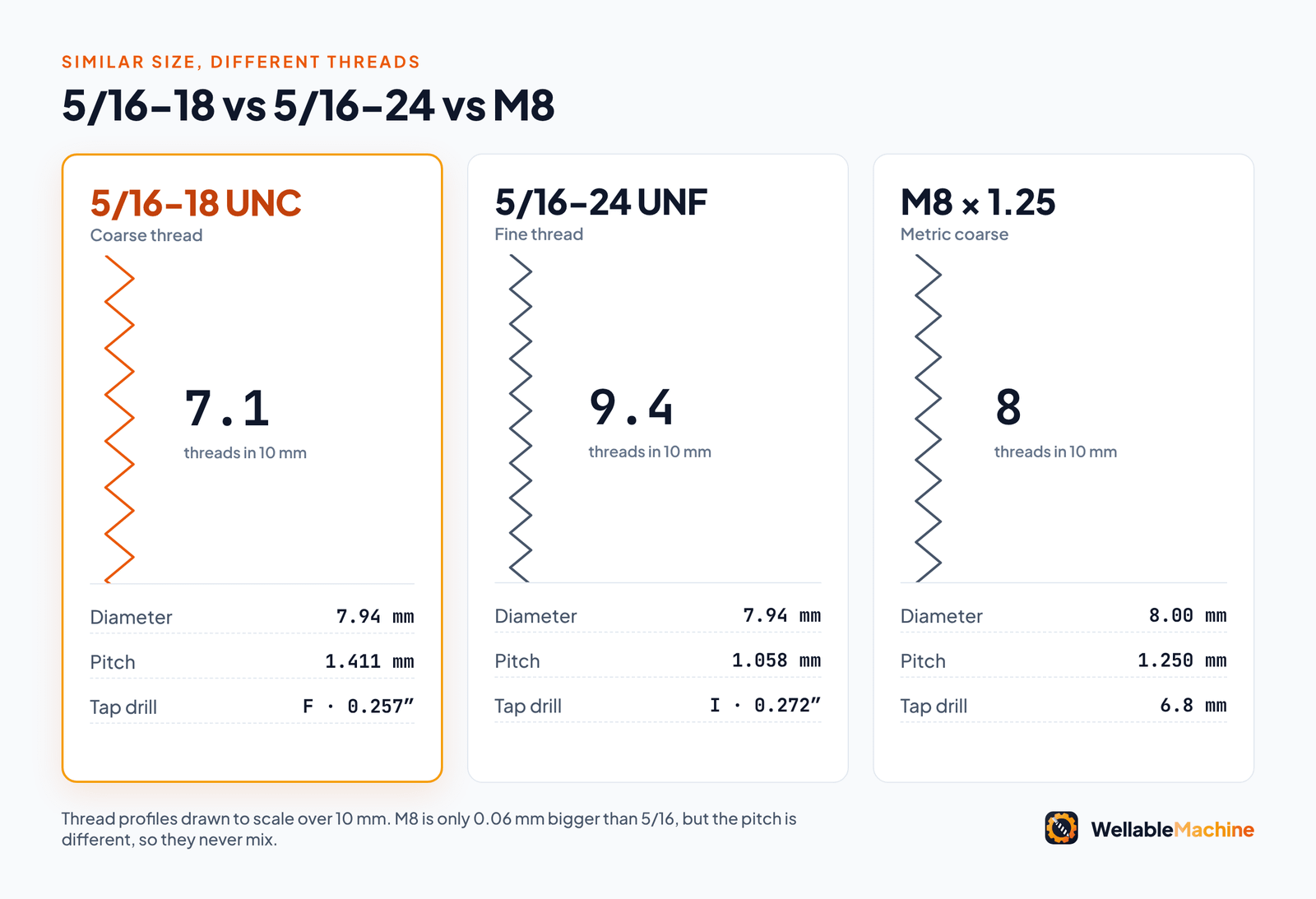
A 5/16-18 bolt may start in an M8 hole and then bind after a couple of turns. If a bolt suddenly gets tight, stop and check it with a pitch gauge. You can find the metric drill in our M8 tap drill size guide.
Other 5/16 Hole Sizes You Might Need
- Forming (roll) tap: about 0.288 in, which is an L drill or 7.3 mm. Always check the forming tap maker’s chart.
- Heli-Coil / STI insert: 21/64 in drill, then a 5/16-18 STI tap.
- Counterbore for a socket head cap screw: 17/32 in diameter, about 5/16 in deep.
- Threaded insert for wood: commonly 1/2 in hole for 5/16-18 inserts; follow the insert’s own spec.
How to Drill and Tap a 5/16-18 Hole
- Center punch the mark and use a small pilot or spot drill on hard metal.
- Drill with an F or 17/64 bit. In aluminum, about 1,800 RPM; mild steel, 900–1,100 RPM; stainless, 450–700 RPM with cutting oil and steady feed.
- Chamfer the hole slightly larger than 5/16 in so the tap starts square and the top thread doesn’t burr up.
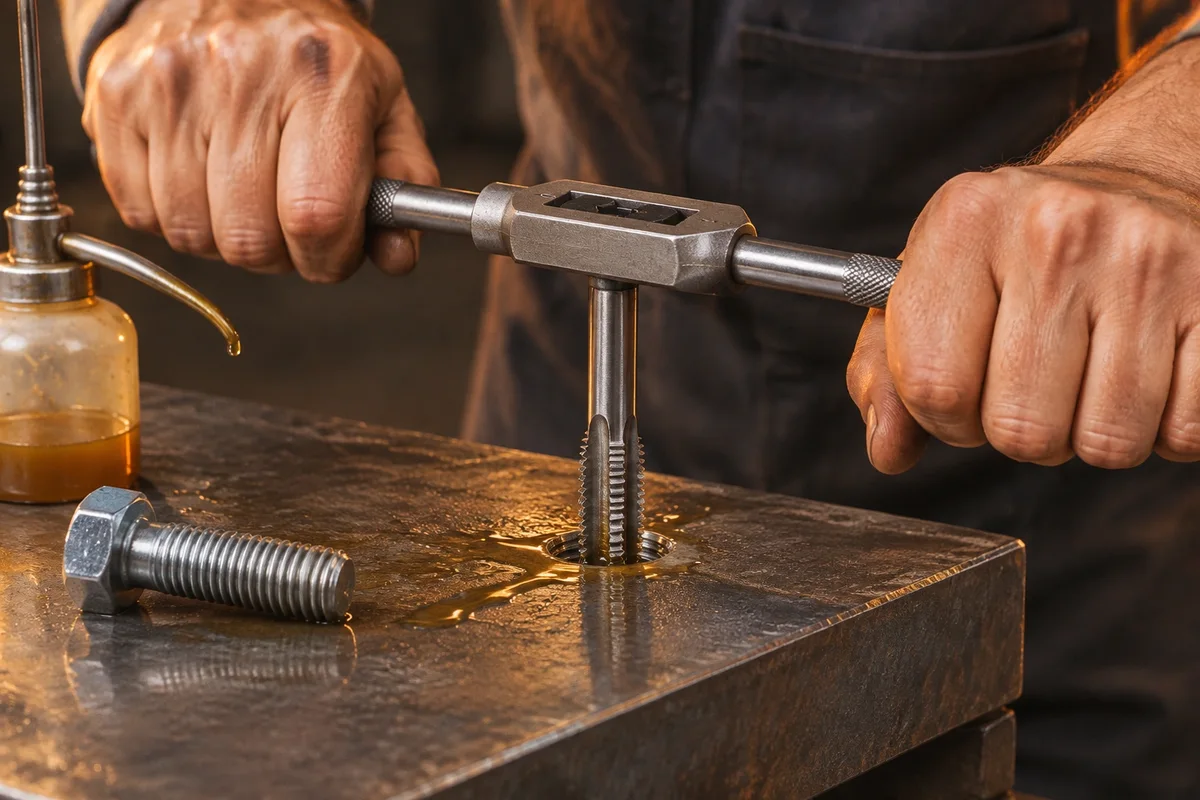
- Start the tap straight with a tap guide or in a drill press. A two-handle wrench gives the best control at this size.
- Turn and break the chip: half a turn forward, a quarter turn back. Add tapping fluid often.
- Blind holes: drill at least 3 pitches (about 0.17 in) deeper than the full thread and finish with a bottoming tap.
Working in stainless? Read our tips on how to drill stainless steel and see the best drill bits for stainless steel. For the next size up, see the 3/8-16 tap drill size.
Which 5/16-18 Tap Should You Use?
| Tap type | Best for | Notes |
|---|---|---|
| Taper tap | Hard materials, hand tapping | Easiest to start straight |
| Plug tap | Most through and blind holes | The standard all-round tap |
| Bottoming tap | Finishing blind holes | Use after a plug tap |
| Spiral point tap | Through-holes, machine tapping | Pushes chips forward, strong |
| Spiral flute tap | Blind holes, machine tapping | Lifts chips out of the hole |
| Forming tap | Aluminum, mild steel | No chips; needs a larger hole |
How Deep Should a 5/16-18 Thread Be?
- Steel: 1 × diameter, about 5/16 in (8 mm).
- Cast iron: 1.5 × diameter, about 15/32 in (12 mm).
- Aluminum: 2 × diameter, about 5/8 in (16 mm).
- Plastics and wood: 2.5 × diameter or use a threaded insert.
More thread than this doesn’t add much strength, because the first few engaged threads carry most of the load.
Common 5/16-18 Tapping Problems (and Fixes)
- Tap binds or squeals: the hole is too small or the chips are packed. Use more fluid, back out more often, or step up to G or 17/64.
- Thread is crooked: the tap started at an angle. Use a tap guide or start it in a drill press.
- Bolt is sloppy: the drill was oversize or wandered. Measure the drill with a caliper and center punch first.
- Stripped thread in aluminum: install a 5/16-18 Heli-Coil, which is stronger than the original thread.
- Tap snapped: soak with penetrating oil and try a tap extractor; for carbide taps you may need EDM removal.
Tapping 5/16-18 in Different Materials
The same F drill works in most metals, but each material behaves differently under the tap. This table sums up what works in the shop.
| Material | Recommended drill | Tapping fluid | Tips |
|---|---|---|---|
| Aluminum (6061) | F or 6.5 mm | Light oil or WD-40 | Clear chips often; aluminum galls and packs flutes |
| Mild steel | F | Sulfurized cutting oil | Standard 77% thread taps easily with a plug tap |
| Cast iron | F | Dry or air blast | Chips are powder; blow them out before the screw goes in |
| Brass and bronze | F | Light oil or dry | Use a tap with less rake to avoid grabbing |
| Stainless (304/316) | 17/64 or H | Heavy tapping paste | Cobalt tap, slow steady turns, never let it rub |
| Plastics (nylon, acetal) | F | None or water | Back out often; consider a heat-set insert |
If you are tapping a lot of 5/16-18 holes in the same material, it pays to test a couple of drills on scrap first. Thread a bolt in by hand: it should turn smoothly with no wobble.
Hand Tapping vs. Power Tapping
A 5/16-18 tap is big enough to be strong but small enough to turn by hand, so either method works well.
- Hand tapping is best for one-off holes, repairs and hard materials. It gives you a feel for the cut, so you can stop before the tap breaks. Use a taper or plug tap and reverse often to break chips.
- Drill press tapping (spindle turned by hand, power off) keeps the tap perfectly square. It is the easiest way to get straight threads without special tools.
- Power tapping with a tapping head, a tapping drill or a CNC machine is much faster for batches. Use spiral point taps for through-holes and spiral flute taps for blind holes, and keep the speed low: roughly 150–300 RPM in steel and up to 500 RPM in aluminum.
- Cordless drill tapping works in thin aluminum and mild steel with a combination drill-tap or a spiral point tap, set to low speed and low clutch. Avoid it in stainless and blind holes.
Frequently Asked Questions
7 quick answers from our editors
01What size drill bit for a 5/16-18 tap?
An F drill (0.257 in). It gives about a 77% thread, the standard for most materials.
02What fractional drill can I use for 5/16-18?
17/64 in. It gives about a 65% thread, which is strong enough for most work and easier to tap.
03What metric drill size is used for a 5/16-18 tap?
6.5 mm is closest to F. In stainless steel, 6.8 mm makes tapping easier.
04What size drill for a 5/16-24 fine thread?
An I drill (0.272 in).
05What size hole does a 5/16 bolt need to pass through?
P (0.323 in) for a close fit, Q (0.332 in) for a free fit, or 11/32 in for a loose fit.
06Can I use a 1/4 in drill for 5/16-18?
It isn’t recommended. A 1/4 in hole makes an 87% thread, which is hard to tap and can break the tap, especially in steel.
07What size Heli-Coil drill is needed for 5/16-18?
21/64 in, followed by a 5/16-18 STI tap.
Bottom Line
For a 5/16-18 thread, drill with an F bit (0.257 in) for a standard 77% thread. Use 6.5 mm from a metric set, 17/64 in if you only have fractional drills, and G or H when tapping stainless by hand. Drill P or Q for clearance holes, and keep 5/16-18, 5/16-24 and M8 hardware in separate bins. For every other size, see our tap drill size chart.