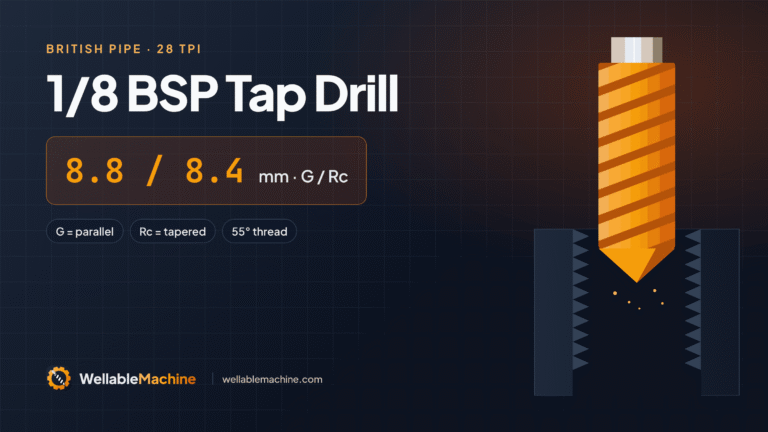
3/8 NPT Tap Drill Size: 37/64″ Drill and Full NPT Chart
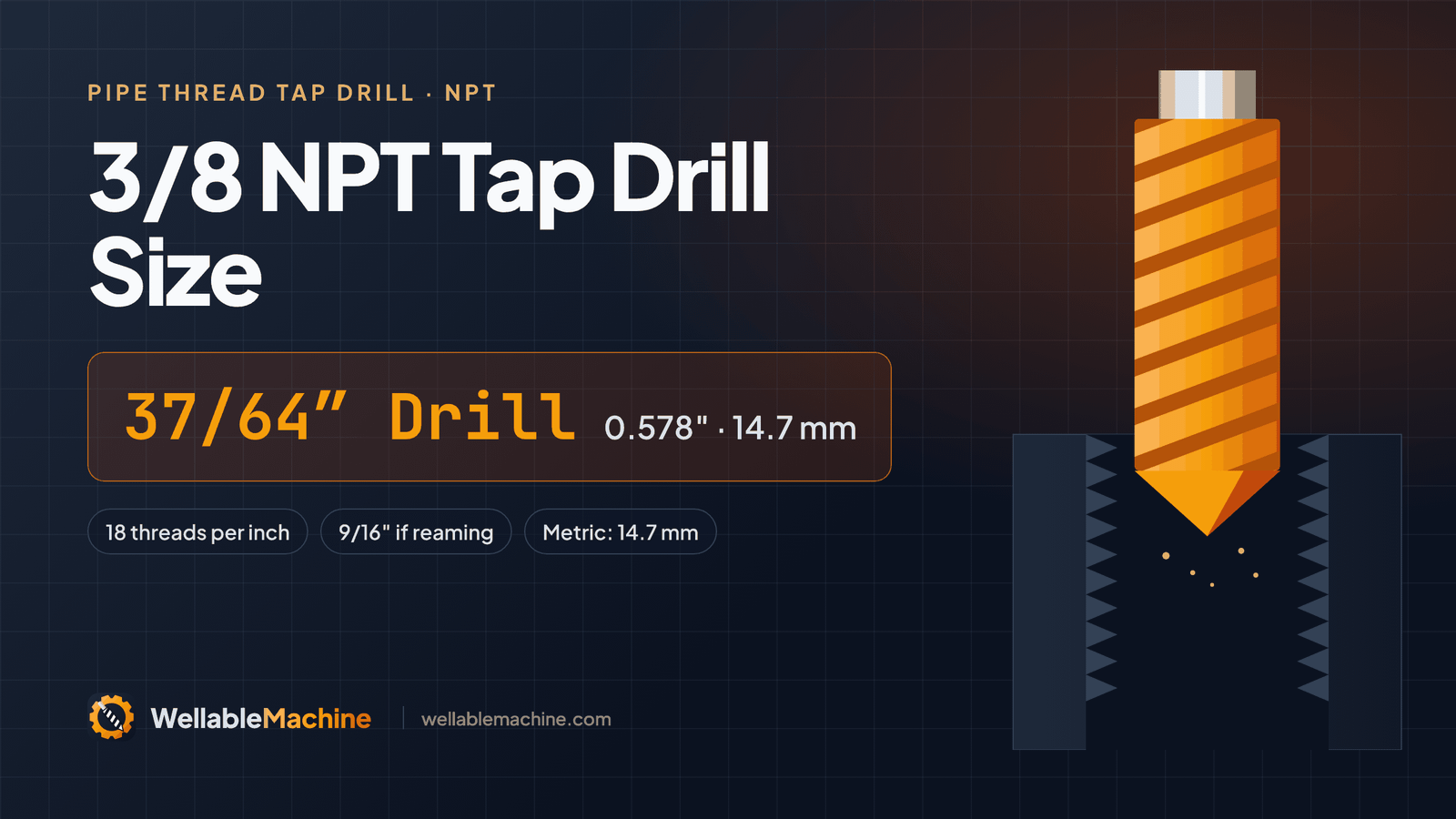
Quick answer: drill a 37/64 in hole (0.578 in / 14.7 mm) for a 3/8-18 NPT pipe tap when you aren’t using a reamer. If you will ream with a 3/8 NPT taper reamer, start with a smaller 9/16 in (0.5625 in) hole. Because 37/64 is missing from most fractional sets, a 14.7 mm or 14.75 mm metric drill is the usual stand-in.
3/8 NPT sits in the middle of the pipe-thread range: big enough that tapping it by hand is real work, small enough that it shows up on everything from shop compressors to engine blocks. Below you’ll find what drill to use and why, how to handle the hard-to-find 37/64 size, how to tap a port that seals on the first try, and how to tell 3/8 NPT apart from look-alike British threads.
3/8 NPT at a Glance
| Item | 3/8 NPT |
|---|---|
| Full designation | 3/8-18 NPT (ASME B1.20.1) |
| Threads per inch | 18 (pitch 1.411 mm), same as 1/4 NPT |
| Pipe outside diameter | 0.675 in (17.1 mm) |
| Taper | 1:16 on diameter |
| Drill, no reamer | 37/64 in = 0.5781 in (14.7 mm) |
| Drill, with reamer | 9/16 in = 0.5625 in (14.3 mm) |
| Hand-tight engagement (L1) | 0.240 in, about 4.3 threads |
| Effective thread length (L2) | about 0.408 in |
| Typical wrench make-up | 2–3 turns past hand tight |
As with all NPT sizes, “3/8” is a trade name from the days when pipe was named by its rough bore. The National Pipe Thread article covers the history if you’re curious why the outside is 0.675 in.
Dealing with the 37/64 Drill Problem
Most people stop at this step: a 29-piece fractional set jumps from 9/16 in straight to 19/32 in, so 37/64 isn’t there. Here’s how the options compare:
| Drill | Size | Verdict |
|---|---|---|
| 9/16 in | 0.5625 in | Too small without a reamer; the tap will be very hard to turn |
| 14.5 mm | 0.571 in | Workable in aluminum and brass; tight in steel |
| 37/64 in | 0.578 in | The standard size |
| 14.7 / 14.75 mm | 0.579 / 0.581 in | Best substitute; easy to buy as a single bit |
| 19/32 in | 0.594 in | Too big; threads may not seal |
A step bit with a 37/64 or 15 mm step also works in thin sheet, and a 9/16 in hole opened with a taper reamer is the cleanest option of all if you tap these ports often.
Full NPT Drill Chart
For reference, here’s the full set of common NPT sizes and their drills:
| NPT size | TPI | Pipe OD | Drill (no reamer) | Drill (with reamer) |
|---|---|---|---|---|
| 1/16 NPT | 27 | 0.3125 in | C (0.242 in) | 15/64 in |
| 1/8 NPT | 27 | 0.405 in | R (0.339 in) | 21/64 in |
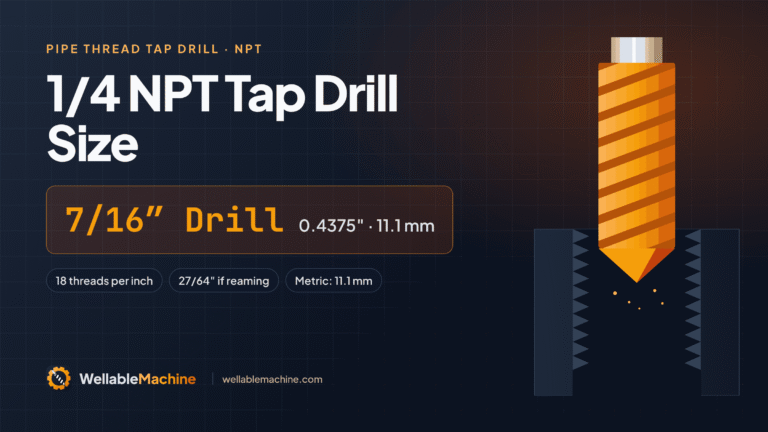
| 1/4 NPT | 18 | 0.540 in | 7/16 in | 27/64 in |
| 3/8 NPT | 18 | 0.675 in | 37/64 in | 9/16 in |
| 1/2 NPT | 14 | 0.840 in | 23/32 in | 11/16 in |
| 3/4 NPT | 14 | 1.050 in | 59/64 in | 57/64 in |
| 1 NPT | 11.5 | 1.315 in | 1-5/32 in | 1-1/8 in |
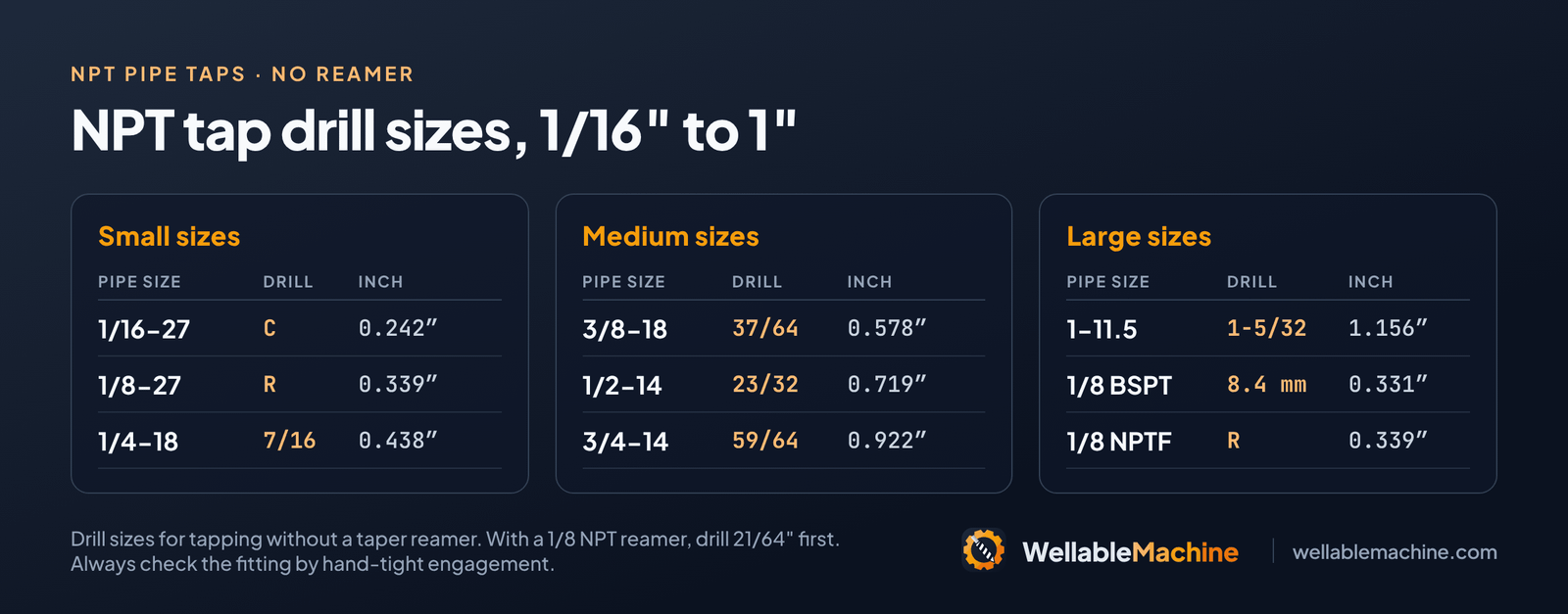
Smaller ports are covered in our 1/8 NPT and 1/4 NPT guides, and the number and letter drill size chart decodes any letter sizes you meet.
Tapping a 3/8 NPT Port Step by Step
At this size the tap removes a lot of metal, so preparation matters more than muscle.
- Clamp everything. A 37/64 drill can grab and spin a part. Use a vise or clamps, even in a drill press.
- Pilot first. Drill a 1/4 in pilot, then open up to 37/64 in. In a hand drill, add a 3/8 in step in between.
- Keep the speed down. Around 700–900 RPM in aluminum, 300–450 RPM in mild steel and 150–250 RPM in stainless, with cutting oil in steel.
- Deburr the edge so the first thread isn’t torn up.
- Use the drill press to align the tap. With the power off, put a center in the chuck and press it into the back of the tap wrench to keep it square for the first few turns.
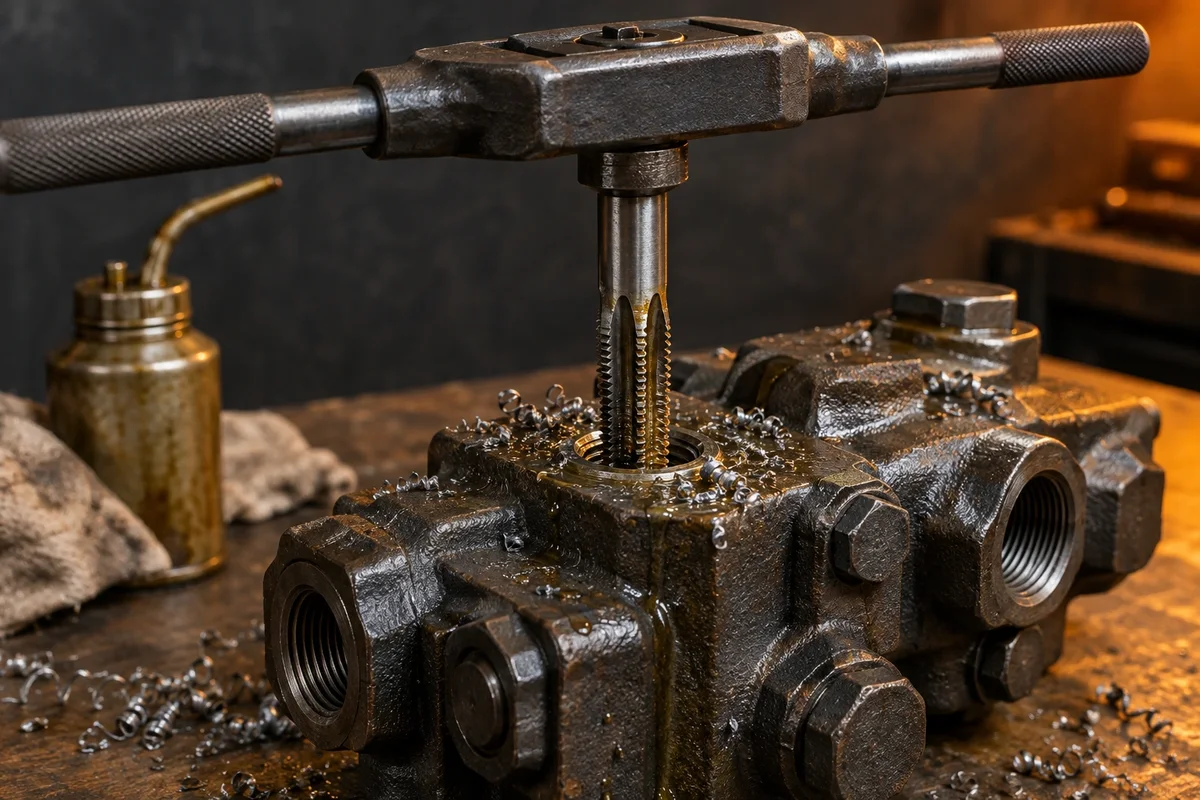
- Use a long wrench and lots of oil. Turn about a quarter turn forward, then back to break the chip. Pipe taps cut along their whole tapered length, so torque climbs as you go.
- Test with a fitting early and often. Stop when a fitting threads in by hand about 4 turns.
Tapping ports in stainless? Read how to drill stainless steel first. A dull drill hardens the hole wall and makes the tap twice as hard to turn.
How 3/8 NPT Compares with BSPT and BSPP
Compressors, pumps and hydraulic parts from outside North America often use British pipe threads. In 3/8 size they’re especially easy to confuse because the outside diameters are within half a millimeter.
| Thread | TPI | Angle | Form | How it seals | Tap drill |
|---|---|---|---|---|---|
| 3/8 NPT | 18 | 60° | Tapered | Wedging threads + sealant | 37/64 in (14.7 mm) |
| 3/8 BSPT (R / Rc) | 19 | 55° | Tapered | Wedging threads + sealant | 14.5 mm |
| 3/8 BSPP (G) | 19 | 55° | Parallel | Bonded washer or O-ring | 15.25 mm |
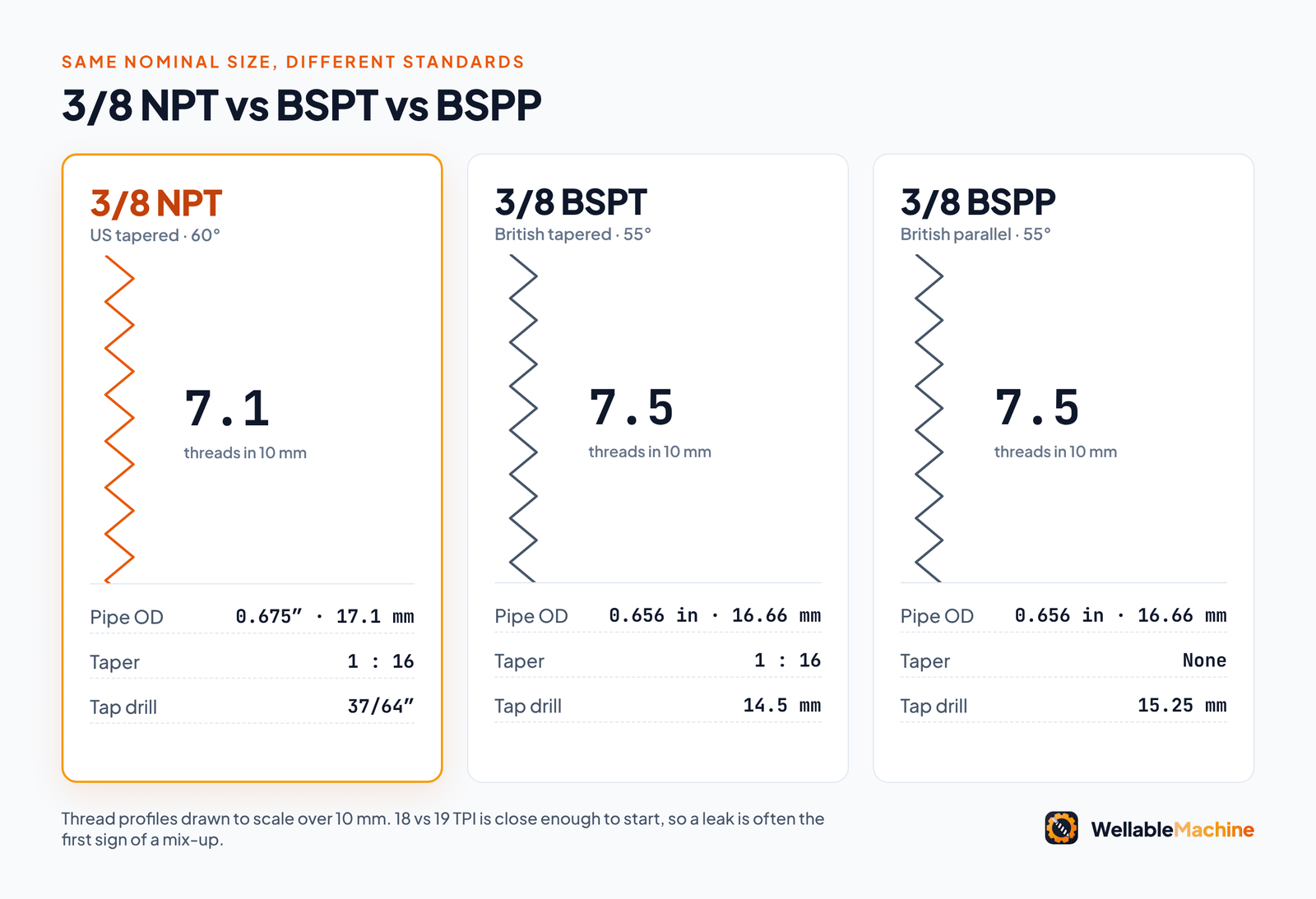
A quick check: count threads over half an inch with a ruler. NPT gives 9, British pipe gives 9.5. A thread gauge is faster and more reliable.
Material Notes
- Aluminum: taps easily, so it’s easy to go too deep. Test fit after every couple of turns once you’re close.
- Cast iron: common for valve bodies and manifolds. Tap dry or with air blast, and never over-tighten fittings, because cast iron cracks rather than stretches.
- Mild steel: use sulfurized cutting oil and back the tap out fully every few turns to clear the long chips.
- Stainless: ream first if at all possible. Tapping a 3/8 NPT port in stainless straight from a drilled hole takes a lot of torque.
- Brass: soft and grabby; tap slightly shallow because brass fittings seat deeper.
Getting a Leak-Free Joint
Most 3/8 NPT leaks come from the joint, not from the tapping. A few rules help:
- Clean both threads of oil and chips before applying sealant.
- Tape: 2–3 wraps clockwise (looking at the open end), leaving the first thread bare.
- Paste: brush onto the male thread only, so excess doesn’t get pushed inside.
- Tighten once. Backing a tapered fitting off to align it breaks the seal; if it must point a certain way, use a swivel fitting.
- Pressure test air and fluid lines with soapy water before putting them into service.
Where 3/8 NPT Shows Up
You’ll find 3/8 NPT on the outlets and tank ports of many shop compressors, on air-line manifolds that feed several tools, on hydraulic pumps and control valves, on fuel and oil lines, on water heaters and plumbing fixtures, and on engine blocks for coolant and oil ports. It moves noticeably more air or fluid than 1/4 NPT, which is why larger compressors step up to it.
Troubleshooting
| Problem | Likely cause | Fix |
|---|---|---|
| Fitting bottoms out and still leaks | Port tapped too deep | Thicker sealant, or fit a bushing and retap |
| Fitting only takes 1–2 turns | Port too shallow | Tap in another quarter to half turn |
| Tap almost impossible to turn | Drilled 9/16 without reaming | Ream, or open the hole to 14.7 mm |
| Leak at a new imported fitting | BSPT fitting in NPT port | Check TPI; use a matching adapter |
| Crack beside the port | Over-tightened in cast iron or aluminum | Replace part; tighten 2–3 turns past hand tight only |
Frequently Asked Questions
6 quick answers from our editors
01What drill size for a 3/8 NPT tap?
37/64 in (0.578 in) without a reamer, or 9/16 in if you ream first.
02Can I use a 9/16 drill for 3/8 NPT?
Only if you ream the hole with a taper reamer. Without reaming, the tap will be extremely hard to turn.
03What metric drill replaces 37/64?
14.7 mm or 14.75 mm. Both are within 0.003 in of 37/64.
04How many threads per inch is 3/8 NPT?
18, the same as 1/4 NPT.
05What is the outside diameter of 3/8 NPT?
0.675 in (17.1 mm).
06Will a 3/8 BSP fitting fit a 3/8 NPT port?
It will start, but it won’t seal. BSP has 19 threads per inch and a 55° angle.
Bottom Line
For a 3/8-18 NPT port, drill 37/64 in, or use a 14.7–14.75 mm bit since 37/64 is hard to find. Drill 9/16 in only when you’ll follow it with a taper reamer. Clamp the part, keep the tap square, and stop when a fitting goes in hand-tight about four turns. Check imported parts for BSP threads before sealing. For every straight thread size, see our tap drill size chart.