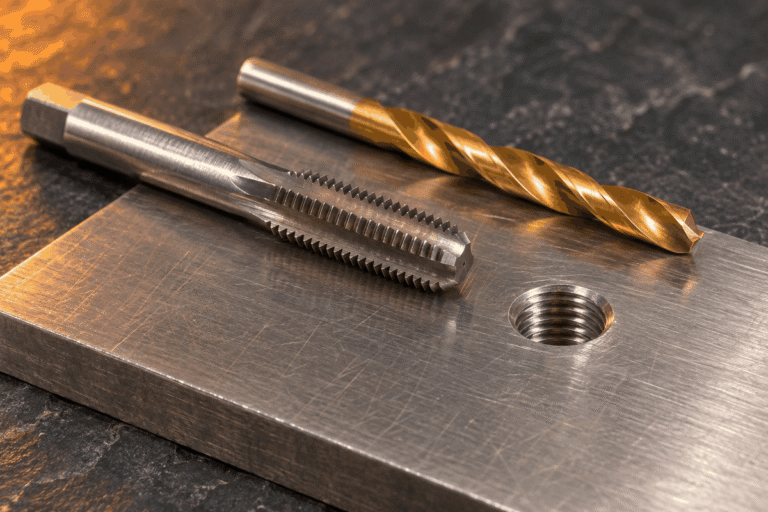
10-32 Tap Drill Size: Chart, Metric & Clearance Holes
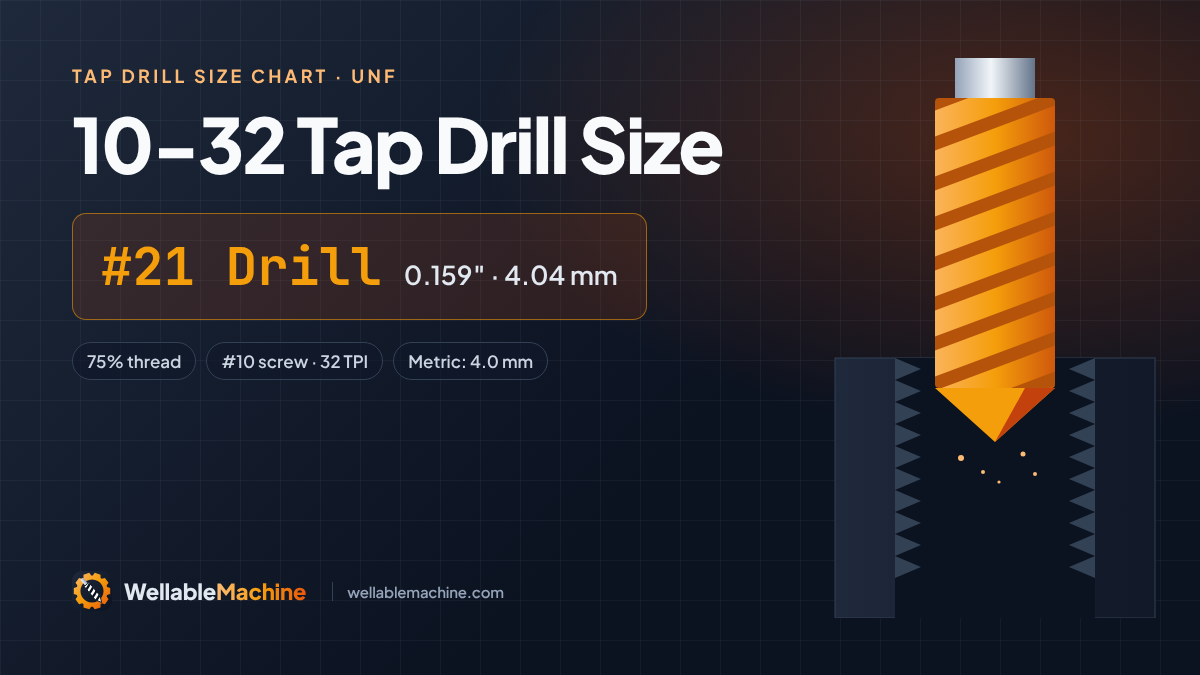
Quick answer: the standard tap drill for a 10-32 UNF thread is a #21 drill (0.159 in / 4.04 mm). It produces about a 75% thread, the normal choice for aluminum, brass, mild steel and plastics. If you’re hand tapping stainless steel or another tough alloy, step up to a #20 (0.161 in) or even a #18 (0.1695 in) to cut tapping torque and protect the tap.
This guide gives you the full 10-32 drill chart by thread percentage, the clearance hole sizes for a #10 screw, metric substitutes, forming-tap and thread-insert sizes, and a clear explanation of how 10-32 differs from 10-24 and M5. Everything is in one place so you can drill the right hole the first time.
10-32 Thread Specifications at a Glance
“10-32” describes a #10 machine screw (0.190 in nominal diameter) with 32 threads per inch. It belongs to the Unified Fine (UNF) series defined in ASME B1.1, the same standard that covers the coarser 10-24 UNC thread. You can read more about how the numbering works in the Unified Thread Standard overview.
| Specification | Value |
|---|---|
| Thread series | UNF (Unified National Fine) |
| Screw gauge | #10 |
| Major diameter | 0.190 in (4.83 mm) |
| Threads per inch | 32 |
| Pitch | 0.03125 in (0.794 mm) |
| Basic minor diameter | 0.1517 in (3.85 mm) |
| Tap drill, 75% thread | #21 = 0.159 in (4.04 mm) |
| Tap drill, 50% thread | #18 = 0.1695 in (4.31 mm) |
| Close-fit clearance | #9 = 0.196 in (4.98 mm) |
| Free-fit clearance | #7 = 0.201 in (5.11 mm) |
10-32 Tap Drill Size Chart by Thread Percentage
Thread percentage is how much of a theoretically full thread the tap cuts. A smaller hole means more thread, but every extra percent above about 75% adds a lot of tapping torque and almost no real strength. That’s why a 75% thread is the default, and why machinists often drop to 60–65% in hard metals. The values below use the standard formula % thread = 76.98 × TPI × (major diameter − drill diameter).
| Drill | Inches | mm | Approx. thread | When to use it |
|---|---|---|---|---|
| 5/32 | 0.1563 | 3.97 | 83% | Too tight for most work; only very soft plastics |
| #22 | 0.1570 | 3.99 | 81% | Soft aluminum and thin sheet |
| 4.0 mm | 0.1575 | 4.00 | 80% | Closest common metric drill |
| #21 | 0.1590 | 4.04 | 76% | Standard choice for most materials |
| #20 | 0.1610 | 4.09 | 71% | Steel, easier hand tapping |
| 4.1 mm | 0.1614 | 4.10 | 70% | Metric alternative for steel |
| #19 | 0.1660 | 4.22 | 59% | Stainless steel, titanium |
| #18 | 0.1695 | 4.31 | 51% | Very hard alloys, deep blind holes |

Which one should you pick? Use a #21 for aluminum, brass, cast iron and mild steel. For 304 or 316 stainless, a #20 or #19 makes the tap far less likely to snap and still gives a joint that is stronger than the screw in most applications. If you only own metric drills, 4.0 mm is a near-perfect substitute for #21 in soft metals, and 4.1 mm is a good choice in steel.
Clearance Hole Sizes for a #10 Screw
When the screw should pass through a part rather than thread into it, drill a clearance hole. The thread pitch doesn’t matter here, so these sizes are the same for 10-32 and 10-24 screws.
| Fit | Drill | Inches | mm | Use it for |
|---|---|---|---|---|
| Close fit | #9 | 0.1960 | 4.98 | Precise location, parts drilled in place |
| Free fit | #7 | 0.2010 | 5.11 | General assemblies, easy alignment |
| Loose fit | 13/64 | 0.2031 | 5.16 | Multi-hole patterns, panels and brackets |
10-32 vs. 10-24 vs. M5: What’s the Difference?
These three sizes look almost the same in a parts bin, and mixing them up is the most common reason a #10 screw cross-threads. A 10-32 screw will not thread into a 10-24 hole, and neither will thread properly into an M5 hole.
| Thread | Diameter | Pitch | Tap drill | Typical use |
|---|---|---|---|---|
| 10-32 UNF | 0.190 in (4.83 mm) | 0.794 mm (32 TPI) | #21 (0.159 in) | Electronics racks, instruments, thin walls, fine adjustment |
| 10-24 UNC | 0.190 in (4.83 mm) | 1.058 mm (24 TPI) | #25 (0.1495 in) | General hardware, electrical boxes, soft materials |
| M5 × 0.8 | 0.197 in (5.00 mm) | 0.8 mm | 4.2 mm (0.165 in) | Metric machinery, bicycles, 3D printers |

Notice that 10-32 and M5 have nearly the same pitch (0.794 mm vs. 0.8 mm), so an M5 screw can start in a 10-32 hole and then bind after a few turns. If a #10 screw feels tight after two or three threads, stop and check it with a thread gauge before you force it.
Other 10-32 Hole Sizes You Might Need
- Forming (roll) tap: about 0.177 in, which is a #16 drill. Forming taps displace metal instead of cutting it, so they need a bigger hole. Always confirm with the tap maker’s chart.
- Heli-Coil / STI insert: a 13/64 in (0.2031 in) drill, followed by a 10-32 STI tap.
- Threaded insert for wood or plastic: follow the insert’s own spec, usually between 1/4 in and 9/32 in for #10 inserts.
- Counterbore for a socket head cap screw: 5/16 in diameter, about 0.19 in deep.
How to Drill and Tap a 10-32 Hole
- Center punch the location so the small drill doesn’t wander.
- Drill with a #21 bit. In aluminum, about 2,500 RPM works well; in mild steel, about 1,500 RPM; in stainless, slow down to 700–1,000 RPM and keep steady pressure. Our guide on how to drill stainless steel covers speeds and cutting oil in detail.
- Chamfer the hole lightly so the tap starts square and the top thread isn’t raised.
- Start the tap straight using a tap guide or the drill press spindle.
- Turn and break the chip: half a turn forward, a quarter turn back, with tapping fluid. #10 taps are small, so let the tap do the work and avoid side pressure on the wrench.
- For blind holes, drill at least 3 pitches (about 0.1 in) deeper than the thread depth, then finish with a bottoming tap.
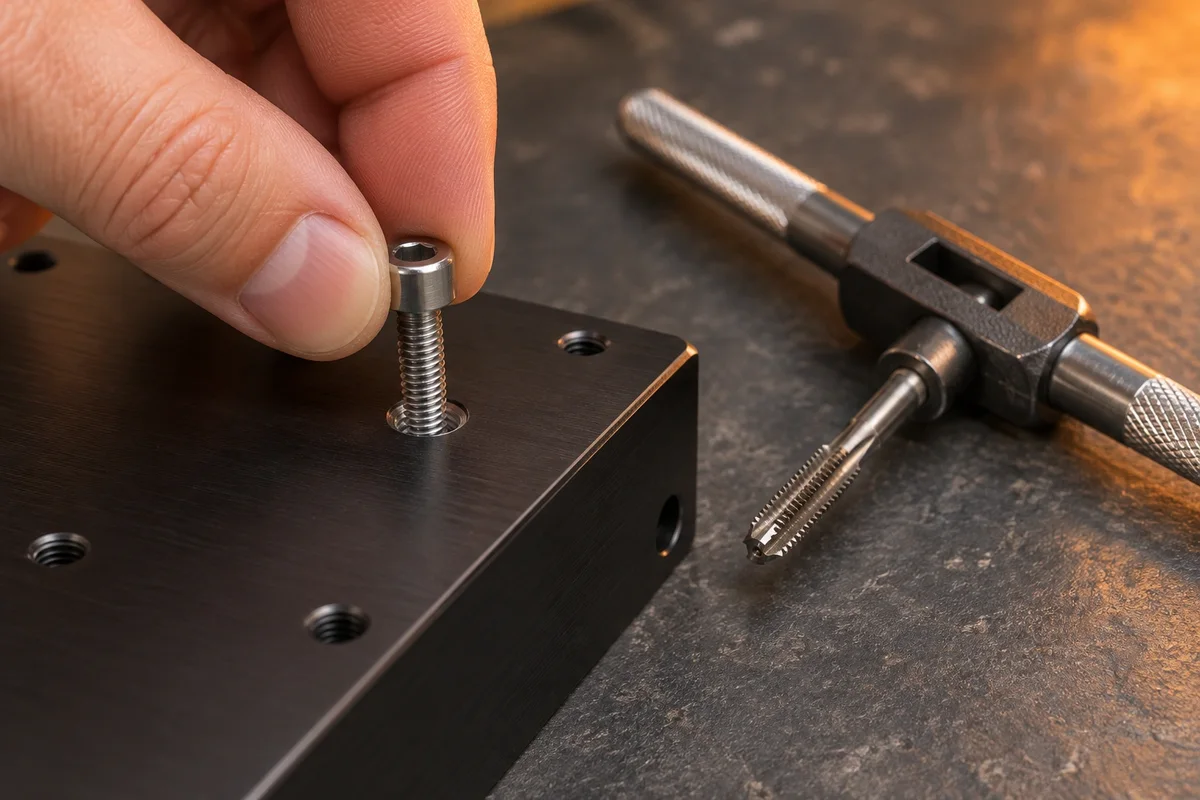
If you are using cobalt bits for steel, our list of the best drill bits for stainless steel explains the difference between M35 and M42 grades. For a larger thread on the same project, see our 1/4-20 tap drill size guide.
Where Is 10-32 Used?
The fine pitch of 10-32 gives more threads per inch of engagement, which makes it a good fit for thin material and for parts that need fine adjustment. You’ll find it on 19-inch equipment racks (10-32 is the traditional rack screw in North America), on optical mounts and lab equipment, on pneumatic fittings, and on many machine tool accessories. 10-24 is more common on general hardware and electrical boxes.
Frequently Asked Questions
What size drill bit for a 10-32 tap?
Use a #21 drill (0.159 in). It gives about a 75% thread, which is the standard for most materials.
What is the metric drill size for a 10-32 tap?
4.0 mm is the closest metric size and gives about an 80% thread. In steel or stainless, 4.1 mm (about 70%) is easier to tap.
Can I use a 5/32 drill for 10-32?
You can in soft plastics, but 5/32 (0.156 in) leaves about 83% thread, which makes tapping metal hard and raises the risk of breaking the tap. A #21 is a better choice.
What size hole does a 10-32 screw need to pass through?
Use a #9 drill (0.196 in) for a close fit or a #7 drill (0.201 in) for a free fit.
Is 10-32 the same as M5?
No. M5 is slightly larger (5.0 mm vs. 4.83 mm) and has a 0.8 mm pitch versus 0.794 mm for 10-32. They are close enough to start threading but will bind, so don’t mix them.
What is the difference between 10-32 and 10-24?
Both are #10 screws with the same diameter. 10-32 is the fine thread (32 threads per inch) and needs a #21 tap drill; 10-24 is the coarse thread (24 threads per inch) and needs a #25 tap drill.
What does the “10” in 10-32 mean?
It is the screw gauge number. A #10 screw has a major diameter of 0.190 in. You can check the full number and letter drill series in this drill bit sizes reference.