1/8 BSP Tap Drill Size: G 1/8 and Rc 1/8 (BSPP vs BSPT)
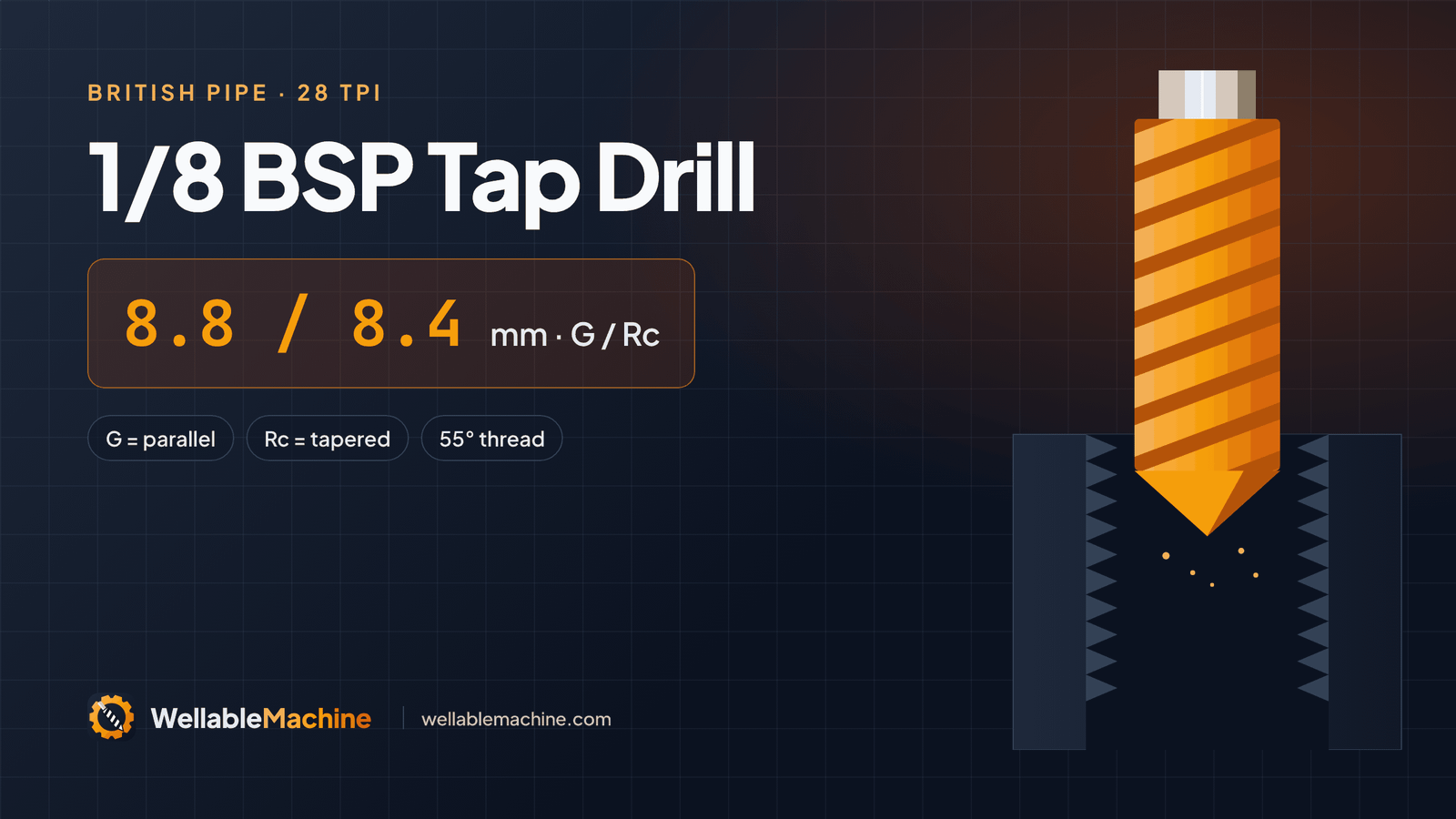
Quick answer: for a 1/8 BSPP (G 1/8, parallel) thread, drill 8.8 mm (11/32 in, 8.73 mm, is the closest inch drill). For a 1/8 BSPT (Rc 1/8, tapered) port, drill 8.4 mm (Q drill, 0.332 in, or 21/64 in); use 8.5 mm if you want easier tapping in soft metal. Both have 28 threads per inch (0.907 mm pitch) and a 55° thread angle.
1/8 BSP is the small British pipe thread you’ll find on air fittings, pressure gauges, airbrush compressors, sensors and grease points on machines from Europe, Asia and Australia. It looks almost identical to 1/8 NPT, and it’s also easily confused with M10 × 1. Choosing the right drill depends first on whether the port should be parallel or tapered, so this guide starts there, then covers drill sizes, tapping, sealing and how to identify which thread you have.
BSPP vs BSPT: Which One Do You Need?
British Standard Pipe threads come in two forms with the same thread profile and pitch:
- BSPP (parallel), marked G under ISO 228-1. The thread is straight. It does not seal on the threads. The seal comes from a bonded washer, an O-ring, a flat gasket or a cone seat under the head of the fitting.
- BSPT (taper), marked R for the male and Rc for a tapered female port under ISO 7-1 and EN 10226. Like NPT, it tapers 1 in 16 on diameter and seals by wedging, with tape or sealant.
- Rp is a parallel female port made to accept a tapered R male. It’s common in plumbing fittings and is drilled slightly smaller than a G port.
Japanese standards use different labels for the same threads: PT = BSPT, PF = BSPP and PS = parallel female for a tapered male. So an air fitting marked “PT 1/8” from a Japanese maker is a 1/8 BSPT thread.
If you’re making a port for a fitting that has a sealing washer, an O-ring or a flat face, you need G (BSPP). If the fitting has a tapered thread and no washer, you need Rc (BSPT). The British Standard Pipe article lists the full set of sizes.
1/8 BSP Specifications
| Item | 1/8 BSP |
|---|---|
| Designations | G 1/8 (parallel), R 1/8 (male taper), Rc 1/8 (female taper), Rp 1/8 |
| Threads per inch | 28 |
| Pitch | 0.907 mm |
| Thread angle | 55° (Whitworth form, rounded crests and roots) |
| Major diameter | 9.728 mm (0.383 in) |
| Minor diameter | 8.566 mm (0.337 in) |
| Thread depth | 0.581 mm |
| Taper (R/Rc) | 1 in 16 on diameter |
| Gauge length (R/Rc) | 4.0 mm, about 4.4 threads |

1/8 BSP Tap Drill Sizes
| Thread form | Recommended drill | Inch alternative | Notes |
|---|---|---|---|
| G 1/8 (BSPP) | 8.8 mm | 11/32 in (8.73 mm) | Standard parallel port; 8.7 mm gives a slightly fuller thread in soft metal |
| Rp 1/8 (parallel for taper male) | 8.6 mm | R drill (0.339 in / 8.61 mm) | Slightly tighter than G so the tapered male seals |
| Rc 1/8 (BSPT) | 8.4 mm | Q (0.332 in / 8.43 mm) or 21/64 in (8.33 mm) | Standard tapered port tapped directly |
| Rc 1/8, easier tapping | 8.5 mm | — | Good in aluminum and brass; check depth carefully |
| Rc 1/8, with taper reamer | 8.2 mm | Q drill is close | Ream to taper, then tap |
The G drill is larger because a parallel thread only needs to cut to its standard minor diameter (8.566 mm) and the thread doesn’t have to wedge. A tapered thread starts from the small end of the taper, so the hole begins smaller and the tap cuts a deeper thread as it goes in.
How to Drill and Tap a 1/8 BSPP (G) Port
- Spot face the surface. A G port seals on the face, so the area around the hole must be flat and smooth. A spot face or counterbore just wider than the bonded washer (about 14–15 mm) is ideal.
- Drill 8.8 mm after a 4 mm pilot. Typical speeds: about 2,000–2,500 RPM in aluminum, 900–1,100 RPM in mild steel and 350–450 RPM in stainless.
- Chamfer lightly, keeping the chamfer smaller than the washer’s inner diameter so the seal still has a flat face to press on.
- Tap with a G 1/8 tap (sometimes sold as “BSP 1/8 × 28” or “BSPP”). Use a plug tap for through holes and a bottoming tap for blind ports.
- Thread depth: give at least 7–8 mm of full thread for a typical adapter.
- Seal with a bonded (Dowty) washer, O-ring or the fitting’s own seal. Don’t use PTFE tape on a G thread; it doesn’t seal parallel threads and stops the face from seating.
How to Drill and Tap a 1/8 BSPT (Rc) Port
- Drill 8.4 mm (or Q, 21/64 in). Pilot first in steel.
- Tap with an Rc 1/8 taper tap (sometimes marked “BSPT” or “PT”). Use plenty of oil and turn back regularly to break chips.
- Test fit often. An R 1/8 male should screw in by hand about 4 turns (the gauge length of 4.0 mm is about 4.4 threads), then take another 1 to 2 turns with a wrench.
- Stop before it goes too deep. A tapered port tapped too far loses its seal.
- Seal with PTFE tape or thread sealant on the male thread, leaving the first thread bare.
The tapping technique is the same as for any small pipe thread. Our 1/8 NPT tap drill size guide and how to use a tap and die cover the basics in more depth.
1/8 BSP vs 1/8 NPT vs M10 × 1
These three threads are all about 10 mm across and turn up in the same places, especially sensor and fitting ports on engines, compressors and hydraulic equipment. Mixing them up is one of the most common reasons a new gauge or sender leaks.
| Thread | Diameter | Pitch / TPI | Angle | Form | Tap drill |
|---|---|---|---|---|---|
| 1/8 BSP | 9.73 mm | 0.907 mm / 28 TPI | 55° | Parallel (G) or taper (R) | 8.8 mm (G), 8.4 mm (Rc) |
| 1/8 NPT | 10.29 mm | 0.941 mm / 27 TPI | 60° | Taper | R drill (8.61 mm) |
| M10 × 1 | 10.00 mm | 1.0 mm / 25.4 TPI | 60° | Parallel | 9.0 mm |
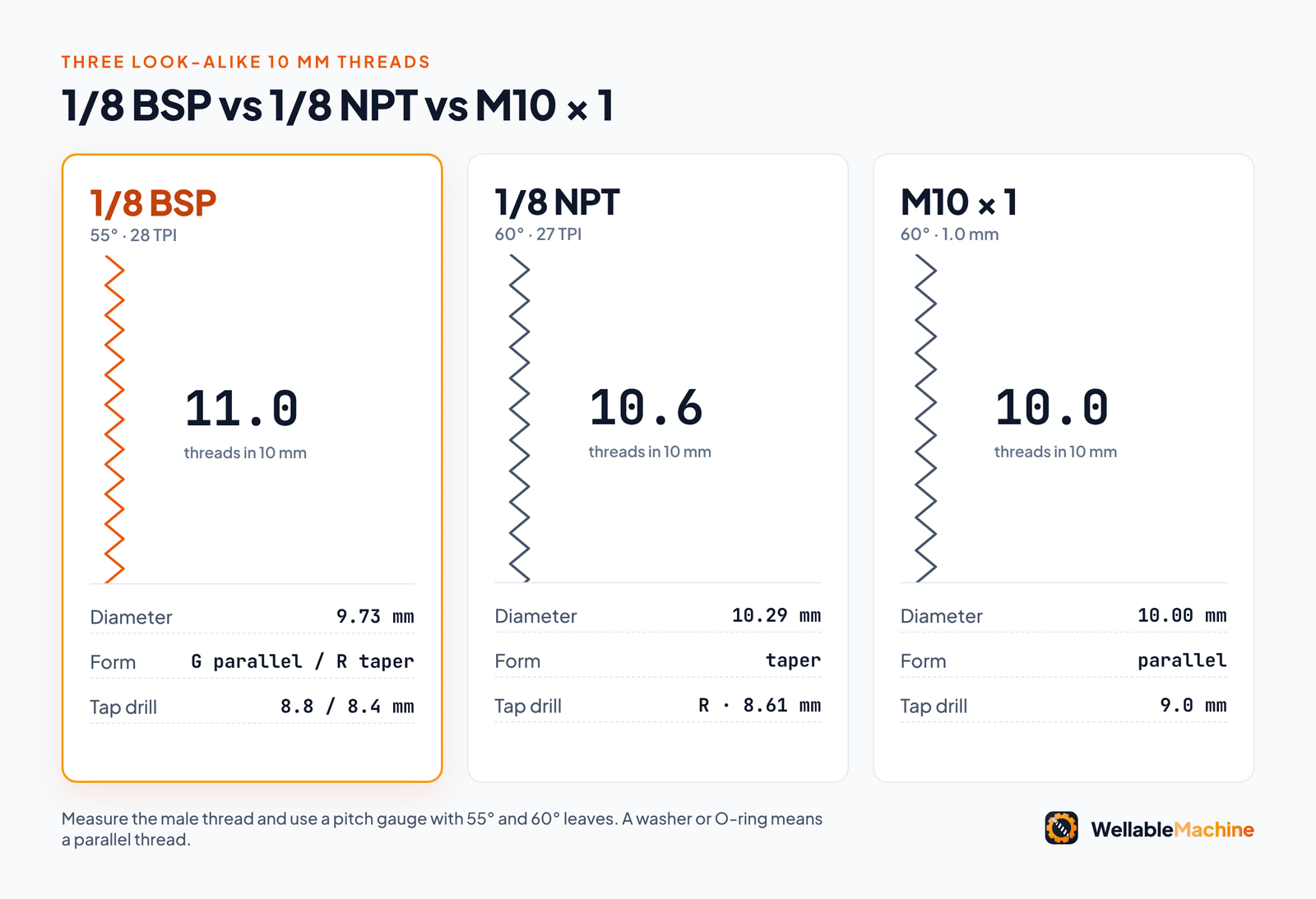
How to tell them apart:
- Measure the male thread with calipers. About 9.7 mm points to BSP; about 10.0 mm to M10; about 10.2–10.3 mm (on the large end of a taper) to NPT.
- Use a thread gauge with both 55° Whitworth leaves (28 TPI) and 60° leaves (27 TPI and 1.0 mm). Hold each one against the thread toward a light; the right one shows no gaps.
- Check for taper. Measure at the start and the end of the thread. A tapered thread grows by 1 mm in diameter for every 16 mm of length, so a 1/8 male is about 0.4 mm bigger at the back of the thread than at the tip.
- Look at the seal. A bonded washer or O-ring means a parallel thread (G or M10). No washer means a tapered thread (R or NPT).
A 1/8 NPT male will usually screw two or three turns into a 1/8 BSPT port, which is just enough to fool you, then bind. The 27 vs 28 TPI mismatch and the different flank angles leave a leak path. Use the correct fitting or a BSP-to-NPT adapter.
Where You’ll Find 1/8 BSP
- Pneumatics: push-in fittings, silencers, flow controls and small cylinders often have G 1/8 or R 1/8 ports.
- Airbrush compressors: the standard airbrush hose fitting is 1/8 BSP, which is why airbrush hoses rarely fit NPT shop air without an adapter.
- Pressure gauges: small 40 mm and 50 mm gauges on regulators and compressors often have a 1/8 BSP back or bottom connection.
- Engines: oil pressure senders and temperature sensors on many European and Asian cars and motorbikes use 1/8 BSPT (or M10 × 1).
- Espresso machines and boilers: sensors, valves and gauges commonly use G 1/8.
- Grease nipples: British and European machines often use 1/8 BSP grease fittings.
Tapping 1/8 BSP in Different Materials
| Material | G 1/8 drill | Rc 1/8 drill | Tips |
|---|---|---|---|
| Aluminum | 8.8 mm | 8.5 mm | Light oil; check depth often in tapered ports |
| Brass | 8.8 mm | 8.4–8.5 mm | Dry or light oil; brass is grabby on breakthrough |
| Mild steel | 8.8 mm | 8.4 mm | Sulfurized cutting oil; clear chips often |
| Stainless | 8.8 mm | 8.5 mm or ream | Low speed, constant feed; see how to drill stainless steel |
| Cast iron | 8.8 mm | 8.4 mm | Tap dry; don’t overtighten fittings |
| Plastic (nylon, acetal) | 8.7 mm | 8.4 mm | Use G with an O-ring where possible |
Common 1/8 BSP Problems
| Problem | Cause | Fix |
|---|---|---|
| G fitting leaks with tape on it | Parallel threads don’t seal; tape stops the washer seating | Remove tape, fit a new bonded washer, spot face the port |
| Fitting binds after 2–3 turns | NPT fitting in BSP port (or the reverse) | Identify the thread and use the correct fitting or an adapter |
| Tapered fitting bottoms out and leaks | Rc port tapped too deep | Use thicker sealant or a slightly oversize fitting; retap a new port |
| Thread strips in aluminum | Thin wall or overtightening | Use a thread insert or a G port with a soft seal |
| Washer weeps | Rough or tilted seat | Spot face square to the thread |
For larger pipe threads, see our 1/4 NPT and 1/2 NPT guides, and for metric straight threads such as M10 × 1, the M10 × 1.25 tap drill page explains how fine metric pitches are drilled.
Frequently Asked Questions
7 quick answers from our editors
01What size drill for a 1/8 BSP tap?
8.8 mm for a parallel G 1/8 (BSPP) thread, or 8.4 mm for a tapered Rc 1/8 (BSPT) thread.
02How many threads per inch is 1/8 BSP?
28 TPI, a pitch of 0.907 mm. 1/8 NPT has 27 TPI.
03Is 1/8 BSP the same as 1/8 NPT?
No. They differ in pitch (28 vs 27 TPI), thread angle (55° vs 60°) and diameter. They may start together but won’t seal.
04What is the outside diameter of 1/8 BSP?
About 9.73 mm (0.383 in).
05What does G 1/8 mean?
G 1/8 is the ISO 228 name for a 1/8 BSP parallel thread, which seals with a washer or O-ring rather than on the threads.
06What is PT 1/8?
It’s the Japanese name for 1/8 BSPT (tapered British pipe). PF 1/8 is the parallel version.
07Is 1/8 BSP the same as M10 × 1?
No. M10 × 1 is a 10 mm metric thread with a 1.0 mm pitch and 60° angle. It’s close in size but not interchangeable.
Bottom Line
Decide first whether the port should be parallel or tapered. For G 1/8 (BSPP), drill 8.8 mm, spot face the seat and seal with a bonded washer or O-ring. For Rc 1/8 (BSPT), drill 8.4 mm (Q drill), tap until a fitting goes in about 4 turns by hand and seal with tape or paste. Always check imported parts for 1/8 NPT or M10 × 1 before fitting anything, because all three look alike.