1/4 BSP Tap Drill Size: G 1/4 and Rc 1/4 (BSPP vs BSPT)
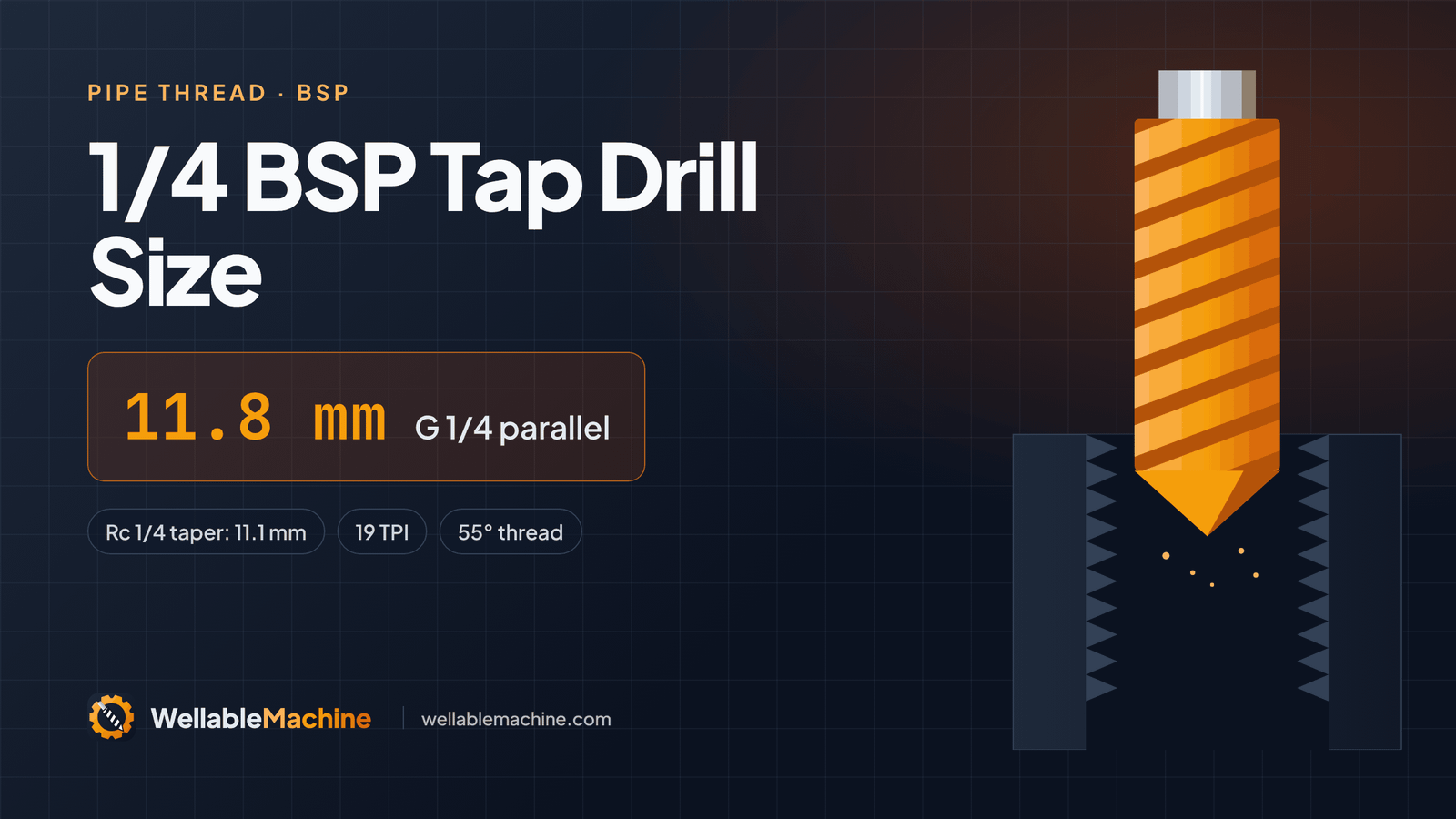
Quick answer: for a 1/4 BSPP (G 1/4) parallel thread, drill 11.8 mm (0.465 in). For a 1/4 BSPT (Rc 1/4) tapered thread, drill 11.1 mm, or use a 7/16 in (11.11 mm) bit, which is the same size. Both are 1/4-19 threads with a 55° thread angle, so use a BSP tap, not an NPT tap.
“BSP” covers two different threads that share a name and a pitch: parallel (BSPP, marked G) and tapered (BSPT, marked R or Rc). They seal in completely different ways, so the drill size, the tap and how deep you go all change. This guide gives the dimensions, the drill sizes for both forms, how to tell which one you need, and how 1/4 BSP compares with 1/4 NPT, which it is often mistaken for.
1/4 BSP Thread at a Glance
| Specification | Value |
|---|---|
| Threads per inch | 19 (pitch 1.337 mm) |
| Thread angle | 55° (Whitworth form, rounded crests and roots) |
| Major diameter | 13.157 mm (0.518 in) |
| Pitch diameter | 12.301 mm |
| Minor diameter | 11.445 mm |
| Thread depth | 0.856 mm |
| Taper (BSPT only) | 1:16 on diameter |
| Gauge length (BSPT) | 6.0 mm, about 4.5 turns |
| G 1/4 (parallel) tap drill | 11.8 mm |
| Rc 1/4 (taper) tap drill | 11.1 mm or 7/16 in |
As with all pipe threads, “1/4” is a nominal pipe size, not a measurement. The actual thread is just over 13 mm across. The parallel thread is defined in ISO 228-1 and the taper thread in ISO 7-1 (also published as EN 10226). The British Standard Pipe page is a good summary of the standards and their letters.
G, R, Rc and Rp: What the Letters Mean
| Marking | Type | Standard | Seals by |
|---|---|---|---|
| G 1/4 | Parallel, internal or external (BSPP) | ISO 228-1 | Bonded washer, O-ring or flat gasket; not on the threads |
| R 1/4 | Taper, external (male BSPT) | ISO 7-1 | Thread interference plus sealant |
| Rc 1/4 | Taper, internal (female BSPT) | ISO 7-1 | Thread interference plus sealant |
| Rp 1/4 | Parallel, internal, to take an R male | ISO 7-1 | Sealant on the threads |
Older markings include BSPP, BSPT, “PF” and “PT” (the Japanese JIS equivalents, which use the same dimensions). If a part is only marked “1/4 BSP”, look at the fitting: a parallel male usually has a sealing face, a bonded washer or an O-ring groove under the hex, while a taper male has no seal and the threads visibly narrow towards the end.
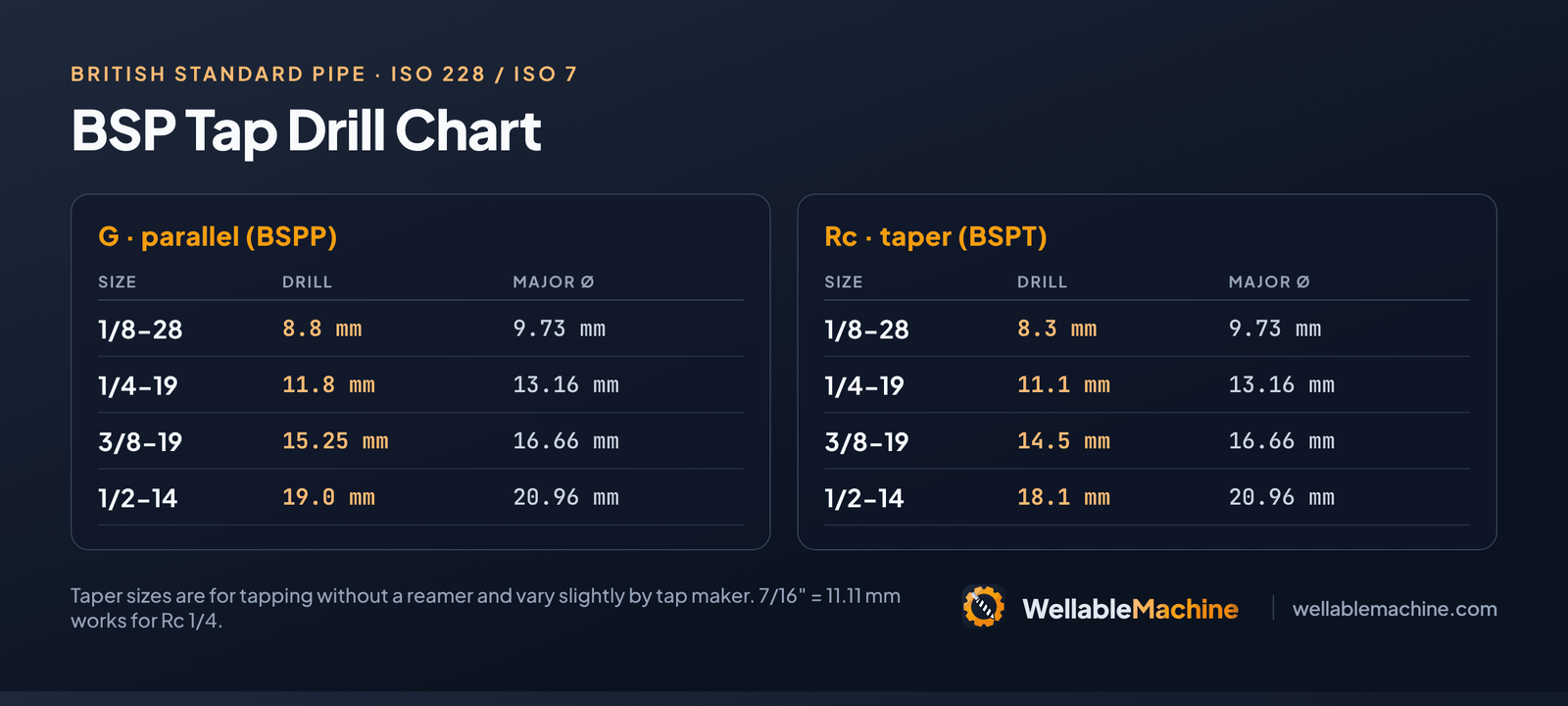
BSP Tap Drill Chart
| Size | TPI | Major dia. | G (parallel) drill | Rc (taper) drill, no reamer |
|---|---|---|---|---|
| 1/8 BSP | 28 | 9.728 mm | 8.8 mm | 8.3 mm |
| 1/4 BSP | 19 | 13.157 mm | 11.8 mm | 11.1 mm |
| 3/8 BSP | 19 | 16.662 mm | 15.25 mm | 14.5 mm |
| 1/2 BSP | 14 | 20.955 mm | 19.0 mm | 18.1 mm |
| 3/4 BSP | 14 | 26.441 mm | 24.5 mm | 23.5 mm |
| 1 BSP | 11 | 33.249 mm | 30.75 mm | 29.6 mm |
Taper drill sizes vary a little between tap makers, because some expect the hole to be reamed and others expect you to tap straight from the drill. If your tap comes with a recommended drill, use it.
Why the Two Forms Use Different Drills
A parallel G thread is cut like any ordinary thread: the hole is close to the minor diameter (11.445 mm) plus a little clearance, so 11.8 mm gives a thread of about 80% depth that is easy to tap and doesn’t need to seal.
A taper Rc thread has to get narrower as it goes in. A fitting’s small end reaches about 6 mm into the port, and at that depth the taper brings the minor diameter down to about 11.07 mm. A straight 11.1 mm hole matches that, and the taper tap then cuts the full taper as it goes in. If you drilled 11.8 mm for a taper port, the threads near the face would be shallow and the joint would leak or the fitting would go in too far. The same approach gives the familiar 7/16 in drill for 1/4 NPT.
How to Tap a 1/4 BSP Port
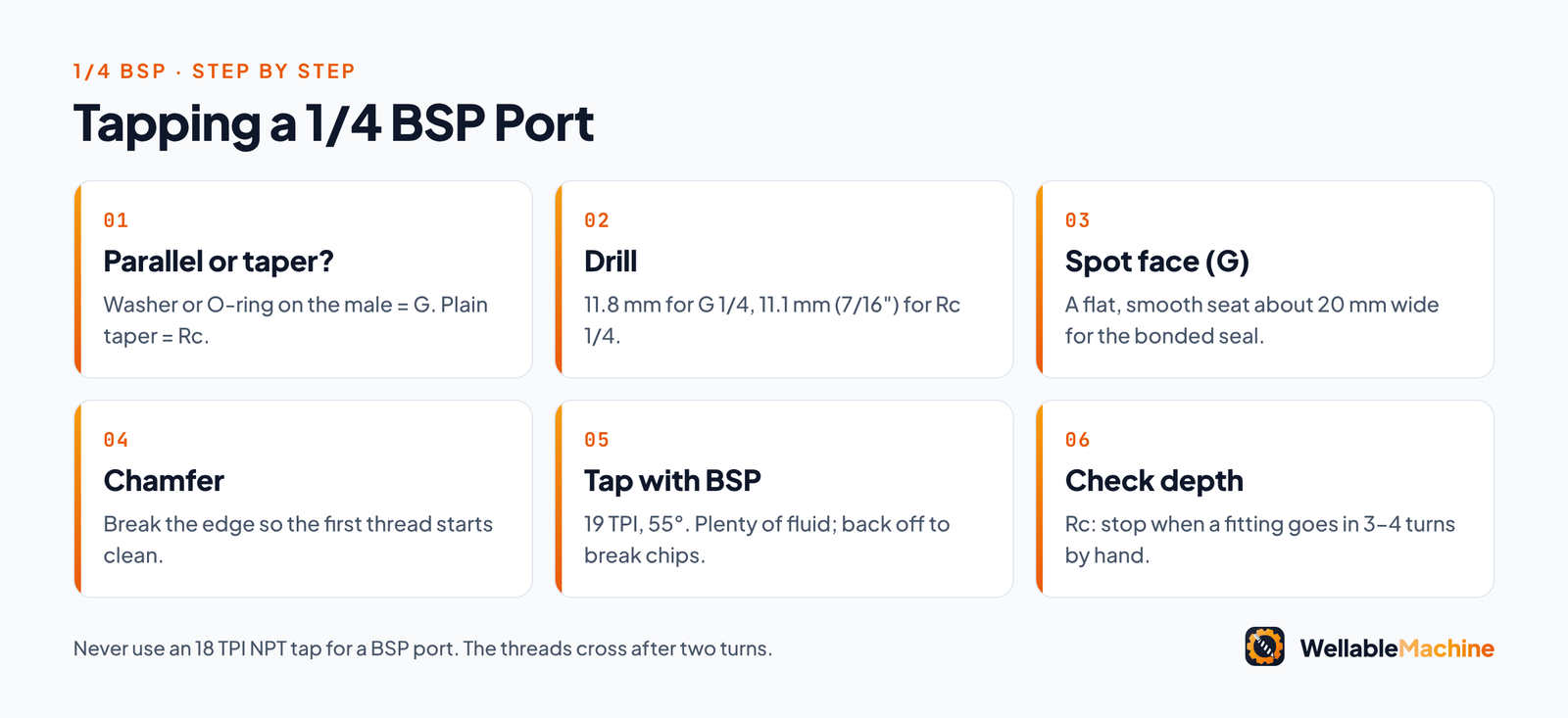
- Decide parallel or taper. Check the fitting that will go in it, or the drawing. If the male has a washer or O-ring, you need G. If it has plain tapered threads, you need Rc.
- Drill the hole: 11.8 mm for G, 11.1 mm (7/16 in) for Rc. At this size, start at about 800 RPM in aluminum, 500 RPM in mild steel and 250 RPM in stainless, with cutting fluid. A pilot hole of 5 to 6 mm helps in steel.
- Spot face for G ports. A parallel port seals on the face, so the area around the hole must be flat and smooth. Use a spot facing tool or an end mill to make a clean seat at least as wide as the bonded washer (about 20 mm for G 1/4).
- Chamfer the hole edge so the first thread doesn’t raise a burr.
- Tap with the right tap. A G 1/4 tap is a straight plug or spiral tap; an Rc 1/4 tap is tapered and longer. Use plenty of fluid and back off to break chips.
- Check depth. Tap a G port to the full thread depth you need (at least 10 mm for most fittings). Tap an Rc port only until a male R fitting goes in hand-tight about 3 to 4 turns, then stop and test again; it should then tighten about 2 more turns with a wrench.
If the port is in a thin wall or tube, a taper port may be better, because it doesn’t need a flat sealing face. For general tapping technique, see our guide on how to use a tap and die.
1/4 BSP vs 1/4 NPT
| 1/4 BSP | 1/4 NPT | |
|---|---|---|
| Threads per inch | 19 | 18 |
| Thread angle | 55° | 60° |
| Crests and roots | Rounded | Flat |
| Outside diameter | 13.16 mm (0.518 in) | 13.72 mm (0.540 in) |
| Taper | BSPT 1:16, BSPP none | 1:16 |
| Tap drill | 11.8 mm (G) / 11.1 mm (Rc) | 7/16 in (11.1 mm) |
The two look close, and an NPT male will start a turn or two into a BSP port. But with 18 vs 19 threads per inch, the threads cross after a couple of turns and the joint binds, leaks or galls. Sealant won’t fix it reliably. If you have mixed equipment, use an adapter, not force. Our 3/4 NPT guide explains why the mix-up gets worse at larger sizes where both threads have 14 TPI.
Where You’ll Find 1/4 BSP
- Pneumatics: G 1/4 is one of the most common port sizes on European and Asian air cylinders, valves, regulators and filter units, as well as push-in air fittings.
- Pressure gauges: many gauges sold outside North America have a 1/4 BSP connection; 1/4 NPT is the US equivalent.
- Hydraulics: G 1/4 ports with bonded seals on pumps, valve blocks and test points.
- Compressors and pressure washers: often 1/4 BSPT on the tank and 1/4 BSPP on quick couplers.
- PC water cooling: the standard thread on blocks, radiators, pumps and fittings is G 1/4, sealed with an O-ring.
- Espresso machines and boilers: sensors, valves and fittings in many European machines.
- UK and Australian plumbing: taper threads on fittings, tap tails and radiator valves (though many are now compression or push-fit).
Sealing 1/4 BSP Joints
- G (parallel): use a bonded seal (Dowty washer), an O-ring in a groove, or the fitting’s elastomer face seal. Don’t use PTFE tape; the threads aren’t meant to seal, and tape can stop the face from seating.
- R into Rc (taper): PTFE tape (3 to 4 wraps) or a thread sealant suited to the fluid, on the male only.
- R into Rp (taper male, parallel female): sealant on the threads; the taper male seals against the parallel female, a combination common in plumbing fittings.
- Never use a taper male in a G port with a bonded washer; it will bottom out on the taper before the seal is tight.
Common Problems
- G fitting leaks at the washer: the port face isn’t flat or square. Spot face it, and replace the bonded seal.
- Taper fitting goes in too far: port tapped too deep or drilled oversize. Use a sealant, a longer fitting or re-tap a size up with an adapter.
- Fitting binds after 2 turns: wrong thread type, usually NPT in BSP. Check with a thread pitch gauge: 19 TPI is BSP, 18 TPI is NPT.
- Torn threads in aluminum: use a sharp tap and lots of fluid, and don’t overtighten fittings.
Inch Drill Equivalents for 1/4 BSP
If you only have inch drills, use 7/16 in (0.4375 in, 11.11 mm) for a taper Rc 1/4 port; it matches 11.1 mm almost exactly. For a parallel G 1/4 port, 15/32 in (11.91 mm) is the closest fraction, about 0.1 mm larger than 11.8 mm, giving a slightly shallower but perfectly usable thread. Avoid 29/64 in (11.51 mm) for G 1/4; it’s undersize and makes the tap work much harder.
Frequently Asked Questions
7 quick answers from our editors
01What size drill for a 1/4 BSP tap?
11.8 mm for G 1/4 (BSPP parallel), and 11.1 mm or 7/16 in for Rc 1/4 (BSPT taper).
02What is the thread pitch of 1/4 BSP?
19 threads per inch, or a pitch of 1.337 mm.
03Is 1/4 BSP the same as 1/4 NPT?
No. BSP has 19 TPI and a 55° angle; NPT has 18 TPI and a 60° angle. They won’t seal together.
04What is the outside diameter of 1/4 BSP?
13.157 mm, about 0.518 in or just over 33/64 in.
05Is G 1/4 the same as 1/4 BSPP?
Yes. G is the ISO 228-1 designation for British parallel pipe threads.
06Can I use 15/32 in for G 1/4?
15/32 in is 11.91 mm, slightly larger than 11.8 mm. It works in most cases but gives a little less thread depth.
07What thread is a water cooling fitting?
G 1/4 BSPP, sealed with an O-ring.
Bottom Line
Drill 11.8 mm for G 1/4 parallel and 11.1 mm (7/16 in) for Rc 1/4 taper. Check which form the fitting needs before you drill: parallel seals on a washer or O-ring against a flat face, taper seals on its threads with sealant. Use a 19 TPI BSP tap, and keep BSP and NPT fittings apart, because 19 and 18 TPI threads don’t mix.