4-48 Tap Drill Size: #42 Drill, Clearance Holes & 4-48 vs 4-40
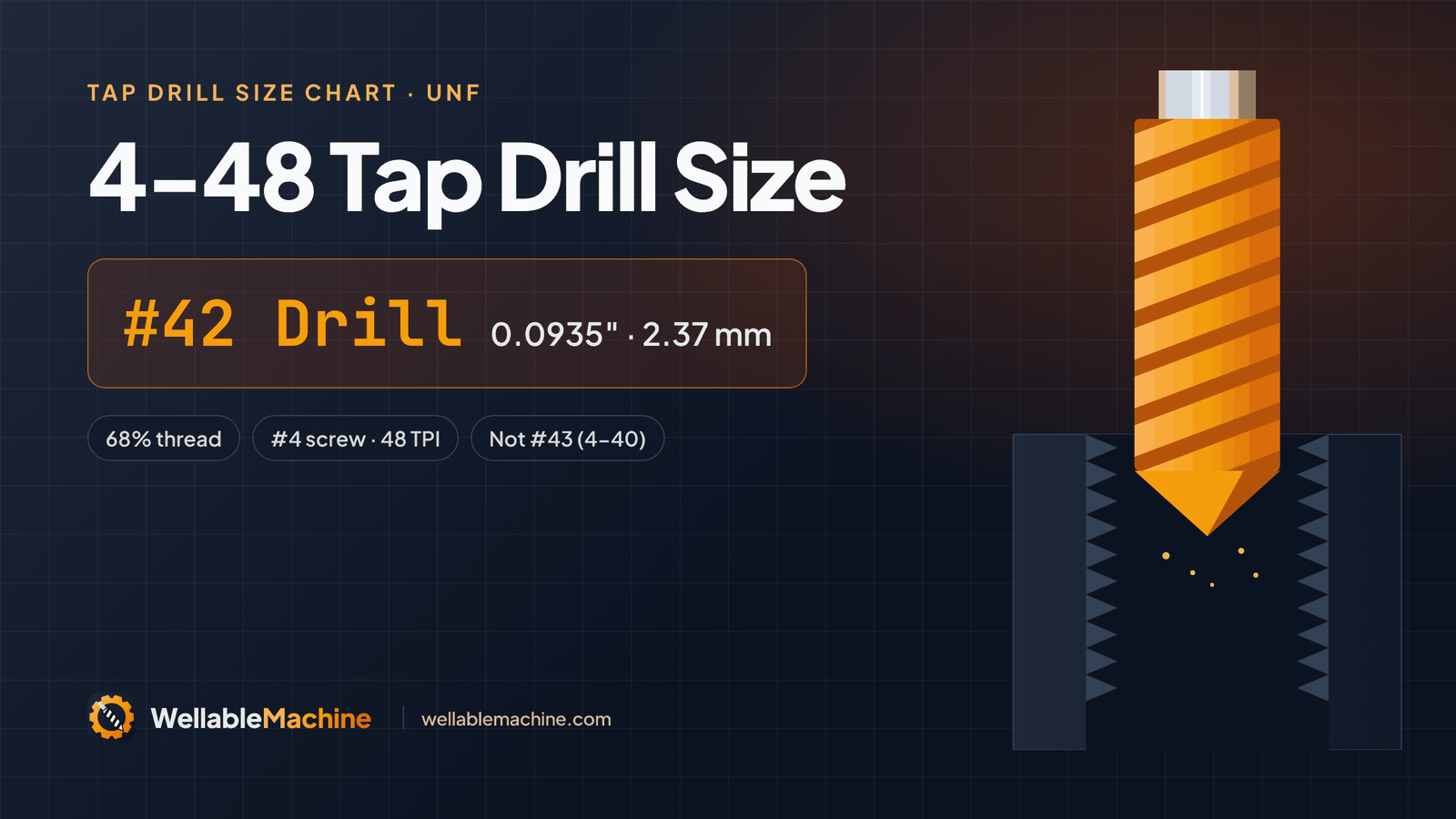
Quick answer: the standard tap drill for a 4-48 UNF thread is a #42 drill (0.0935 in / 2.37 mm), which gives about a 68% thread; a 3/32 in drill is practically the same. Don’t use the #43 drill meant for 4-40: in 4-48 it gives about 85% thread and breaks taps. For a fuller thread in brass, 2.3 mm gives about 79%.
4-48 is the fine-thread #4 screw. It is much rarer than 4-40, but it is used where a small screw needs a finer pitch: in instruments and optics, thin-walled parts, some firearm and RC hardware, and fine adjustment screws. Since 4-48 and 4-40 look identical, the right tap drill depends on knowing which one you have. This guide covers the drill sizes, clearance holes, and how 4-48 compares with 4-40 and M3.
4-48 Thread Specifications at a Glance
“4-48” means a #4 screw (0.112 in diameter) with 48 threads per inch, the fine (UNF) pitch for this size in the Unified Thread Standard.
| Specification | Value |
|---|---|
| Thread series | UNF (Unified National Fine) |
| Major diameter | 0.112 in (2.84 mm) |
| Threads per inch | 48 |
| Pitch | 0.0208 in (0.529 mm) |
| Basic minor diameter | 0.0849 in (2.16 mm) |
| Standard tap drill | #42 = 0.0935 in (2.37 mm) |
| Inch substitute | 3/32 = 0.0938 in |
| Close-fit clearance | #32 = 0.116 in (2.95 mm) |
| Free-fit clearance | #30 = 0.1285 in (3.26 mm) |
| Hex key, socket head screw | 3/32 in |
4-48 Tap Drill Size Chart by Thread Percentage
Every drill in the table below leaves a different amount of metal for the tap to cut. Tests have shown that a 60% thread is only a few percent weaker than a 75% one, yet it takes far less effort to tap, so there is no prize for the tightest hole. Percentages are worked out with % thread = 76.98 × TPI × (major diameter − drill diameter).
| Drill | Inches | mm | Approx. thread | When to use it |
|---|---|---|---|---|
| #44 | 0.0860 | 2.18 | 96% | Far too tight (96%) |
| #43 | 0.0890 | 2.26 | 85% | 4-40 drill; too tight here |
| 2.3 mm | 0.0906 | 2.30 | 79% | Full thread in brass |
| #42 | 0.0935 | 2.37 | 68% | Standard chart size (68%) |
| 2.4 mm | 0.0945 | 2.40 | 65% | Steel and stainless |
| #41 | 0.0960 | 2.44 | 59% | Plastics; light duty |

Which drill should you use? #42 (or 3/32 in) is the right drill in nearly all materials. In free-cutting brass, 2.3 mm gives a fuller thread. In stainless, use 2.4 mm. Never use #43 or #44 for 4-48: both are meant for the coarser 4-40 thread and leave far too much metal.
Clearance Hole Sizes for a #4 Screw
Clearance holes are the same for 4-48 and 4-40 screws. For other sizes, see our clearance hole size chart.
| Fit | Drill | Inches | mm | Use it for |
|---|---|---|---|---|
| Close fit | #32 | 0.1160 | 2.95 | Precise alignment |
| Free fit | #30 | 0.1285 | 3.26 | Most assemblies |
| Loose fit | #27 | 0.1440 | 3.66 | Sheet metal, misalignment |
4-48 vs 4-40: Telling Them Apart
Both are #4 screws, 0.112 in across. The only difference is the pitch: 4-48 has 48 threads per inch and 4-40 has 40. Ways to tell:
- Pitch gauge: the 48 leaf sits flat on a 4-48 thread.
- Count threads: over 1/4 in of length, 4-48 shows 12 crests and 4-40 shows 10.
- Test nut: keep a known 4-40 nut in your toolbox. If it binds after a turn, the screw is 4-48.
For the common coarse thread, see the 4-40 tap drill size.
Drilling and Tapping Tiny Fine Threads
A #42 drill and a 4-48 tap are delicate. Use a stub-length drill in a drill press if you can, at high speed (around 3,000 RPM in aluminum and 1,500–2,000 RPM in mild steel) with light feed. Start the tap square in a pin vise or small tap wrench, turn a quarter turn at a time and back off to break chips. In blind holes, drill at least 1/16 in deeper than the thread. If a tap breaks, how to remove a broken tap explains your options.
4-48 vs. 4-40 vs. M3
4-48 and 4-40 share a diameter. M3 × 0.5 is slightly larger with a pitch very close to 4-48, so an M3 screw can start in a 4-48 hole and then bind.
| Thread | Diameter | Pitch | Tap drill | Typical use |
|---|---|---|---|---|
| 4-48 UNF | 0.112 in (2.84 mm) | 48 TPI (0.529 mm) | #42 | Instruments, optics, fine adjustment |
| 4-40 UNC | 0.112 in (2.84 mm) | 40 TPI (0.635 mm) | #43 | Electronics, general use |
| M3 × 0.5 | 3.00 mm | 0.5 mm | 2.5 mm | Metric electronics |

For metric, see the M3 tap drill size. The next sizes up are 5-40 and 6-32.
Other 4-48 Hole Sizes You Might Need
- Forming (roll) tap: about 0.101 in (#38). Check the tap maker’s chart.
- Helicoil / STI insert: about a #33 drill with the 4-48 STI tap.
- Counterbore for a socket head cap screw: 7/32 in diameter, 0.12 in deep.
- Countersink for a flat head screw: 82°, about 0.23 in diameter.
How to Drill and Tap a 4-48 Hole
- Mark and center punch the hole so the drill starts exactly where you want it. On a part this small, a spot drill or stub drill helps a lot.
- Drill with a #42 bit. In aluminum, run about 4,100 RPM; in mild steel, about 2,500 RPM; in stainless, slow down to about 1,200 RPM with steady pressure and cutting oil. Our guide on how to drill stainless steel explains why stainless needs low speed and constant feed.
- Break the sharp edge with a countersink. A small chamfer guides the tap in and keeps a raised burr from forming around the hole.
- Start the tap straight. Use a pin vise or small tap wrench, or start the tap in the drill press chuck turned by hand.
- Work in short strokes. Turn forward until you feel resistance build, then reverse slightly to snap the chip. Keep the flutes wet with tapping fluid the whole time.
- For blind holes, drill at least 1/16 in (about 3 pitches) deeper than the full thread you need, and finish with a bottoming tap.
Tiny drills need high speed and light feed; see our drill speed chart. For hard materials, see our guide to the best drill bits for stainless steel.
Tapping 4-48 in Different Materials
The hole size rarely changes from one metal to another, but the fluid, tap and technique do. Here is a quick guide for 4-48 work.
| Material | Recommended drill | Tapping fluid | Tips |
|---|---|---|---|
| Aluminum | #42 | Light oil or WD-40 | 2.3 mm for a fuller thread |
| Mild steel | #42 | Sulfurized cutting oil | Reverse often to break the chip |
| Stainless (304/316) | 2.4 mm | Heavy tapping paste | Cobalt tap; 2.4 mm drill |
| Brass | #42 | Dry or light oil | Cuts cleanly; tap can grab at the end |
| Plastic | #41 | Dry | Don’t overtighten |
How Deep Should a 4-48 Thread Be?
How much thread you need depends on what the hole is made of. Softer materials need longer engagement so the internal thread doesn’t strip before the screw breaks:
- Steel: 1.5 × diameter, about 0.17 in.
- Brass and aluminum: 2 × diameter, about 0.22 in.
- Plastic: 2.5–3 × diameter.
Where Is 4-48 Used?
4-48 UNF is used on instruments and optics, fine adjustment screws, thin-walled parts, some firearm sight and accessory screws, and RC and model hardware.
Common 4-48 Tapping Problems (and How to Fix Them)
- Tap snaps: the hole was drilled #43 (the 4-40 size). Use #42.
- Screw jams after a turn: it is probably 4-40 or M3.
- Drill breaks: use a stub drill, high speed and light feed.
- Thread strips in aluminum: increase engagement length.
Frequently Asked Questions
6 quick answers from our editors
01What drill size for a 4-48 tap?
A #42 drill (0.0935 in) or 3/32 in, about 68% thread.
02Can I use the 4-40 drill (#43) for 4-48?
No. It gives about 85% thread in 4-48 and makes tapping very hard.
03Is 4-48 fine or coarse?
Fine (UNF). The coarse #4 thread is 4-40.
04What clearance hole for a #4 screw?
#32 for a close fit or #30 for a free fit.
05Is 4-48 the same as M3?
No. M3 is about 0.16 mm larger with a 0.5 mm pitch.
06What hex key fits a #4 socket head screw?
3/32 in.
Bottom Line
For 4-48 UNF, drill #42 or 3/32 in, not the #43 used for 4-40. Clearance is #30 for a free fit. Confirm the pitch before tapping, use a pin vise and clear chips often. For every size, see our tap drill size chart and number and letter drill size chart.