1/2 NPT Tap Drill Size: 23/32 in, Metric Equivalent and How Deep to Tap

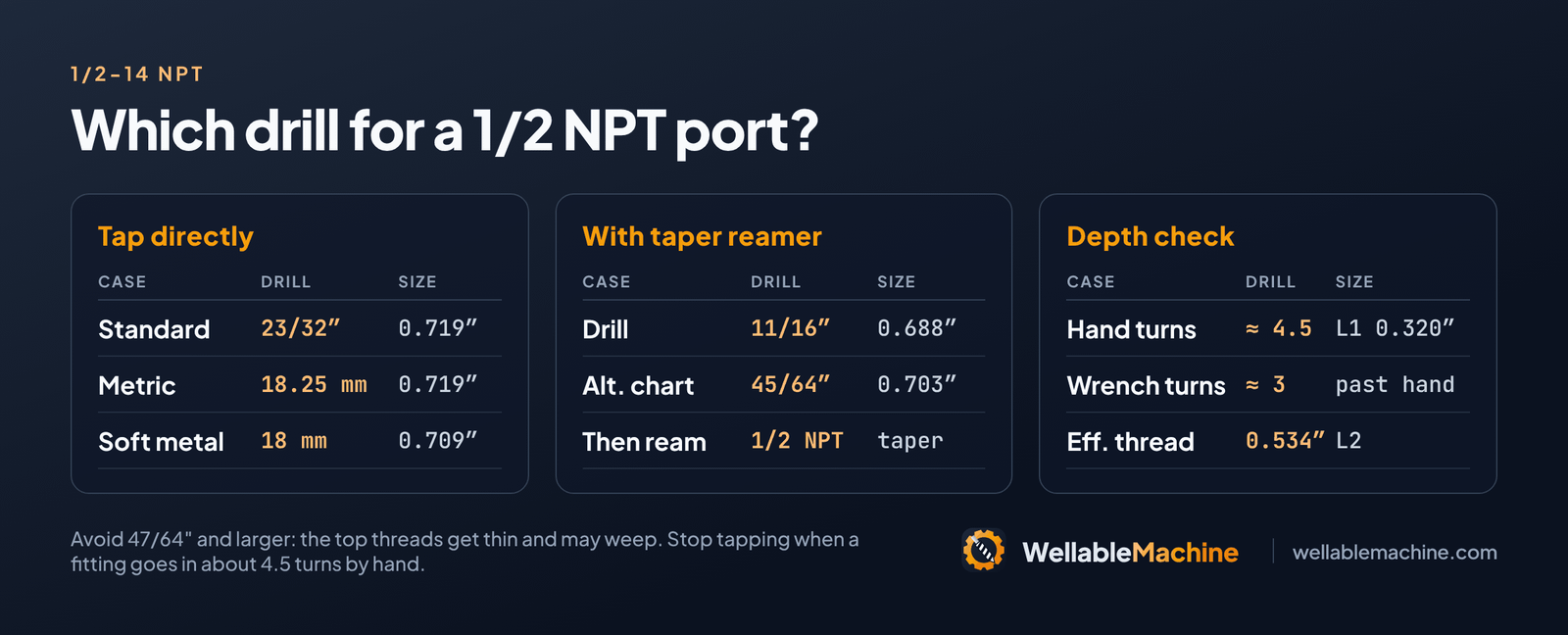
Quick answer: the tap drill for a 1/2-14 NPT pipe tap is 23/32 in (0.7188 in / 18.26 mm) when you tap straight from the drilled hole. If you will run a 1/2 NPT taper reamer first, drill a smaller 11/16 in (0.6875 in) hole. The closest metric drill is 18.25 mm (or 18.3 mm), and an 18 mm bit works in soft brass and aluminum.
1/2 NPT is the size most people meet first in plumbing and the one that turns “tapping a hole” into a real job. The tap is big, the drill is missing from almost every standard drill set, and the tapered thread means the hole has to be tapped to the right depth rather than simply all the way. This guide covers the drill choice, ways to get a 23/32 hole without buying an expensive bit, how deep to tap, and how to make a 1/2 NPT port that seals the first time.
1/2 NPT Thread Specifications
The figures below come from the American pipe thread standard, ASME B1.20.1. They help when you need to check a part, buy a gauge or work out whether a fitting will fit.
| Item | 1/2 NPT |
|---|---|
| Full name | 1/2-14 NPT (National Pipe Taper) |
| Threads per inch | 14 (pitch 0.0714 in / 1.814 mm) |
| Pipe outside diameter | 0.840 in (21.3 mm) |
| Thread angle | 60°, flattened crests and roots |
| Taper | 1 in 16 on diameter (3/4 in per foot) |
| Hand-tight engagement (L1) | 0.320 in, about 4.5 threads |
| Effective thread length (L2) | 0.534 in, about 7.5 threads |
| Wrench make-up | about 3 turns past hand tight |
| Tap drill, no reamer | 23/32 in (0.7188 in / 18.26 mm) |
| Tap drill, with reamer | 11/16 in (0.6875 in / 17.46 mm) |
“1/2 inch” is a trade size, not a measurement. Pipe sizes were named long ago from the rough inside bore of iron pipe, so a 1/2 in pipe is really 0.840 in across the outside. If you measure a male thread and get about 13/16 to 7/8 in, you are almost certainly looking at 1/2 NPT (or its British cousin, covered below). The National pipe thread article explains the history and the full size range.
Why 23/32 and Not Some Other Drill?
A pipe tap is tapered, so the hole you drill only has to match the small end of the thread. The tap then cuts deeper and deeper as it goes in, and the hole ends up with a tapered thread that wedges against the matching taper on the fitting. 23/32 in is a little smaller than the minor diameter at the small end of the tap. That leaves enough metal for full thread crests at the top of the port without making the tap impossibly hard to turn.
If you ream the hole with a 1/2 NPT taper pipe reamer, you can start smaller (11/16 in), because the reamer cuts the same taper the tap needs. The tap then only forms the thread, not the taper, and it turns much more easily. Some published charts list 45/64 in for the reamed hole instead of 11/16. Either works; 11/16 simply leaves a little more for the reamer to clean up.
Drill Options Compared
| Drill | Decimal | mm | Verdict |
|---|---|---|---|
| 11/16 in | 0.6875 in | 17.46 | Only with a taper reamer; too tight to tap directly in steel |
| 18 mm | 0.7087 in | 18.00 | Workable in brass, aluminum and plastic; hard work in steel |
| 23/32 in | 0.7188 in | 18.26 | Standard size for tapping without a reamer |
| 18.25 / 18.3 mm | 0.7185 / 0.7205 in | 18.25 / 18.30 | Best metric substitute; same result as 23/32 |
| 18.5 mm | 0.7283 in | 18.50 | Slightly loose; acceptable in cast iron, risky for gas or air |
| 47/64 in | 0.7344 in | 18.65 | Too big; the top threads will be thin and may weep |
The difference between 23/32 and 18.25 mm is less than a thousandth of an inch, so treat them as the same drill. Buy whichever is cheaper or easier to find where you live.
How to Get a 23/32 Hole Without a Big Drill Set
Standard fractional sets stop at 1/2 in, so a 23/32 bit almost always has to be bought on its own. You have four practical choices:
- Reduced-shank (Silver & Deming) bit. A 23/32 in bit with a 1/2 in shank fits any 1/2 in chuck and is the most common choice for a drill press. Our guide to drill chuck sizes explains why a 3/8 in chuck can’t hold most bits this size.
- Step drill. In sheet metal and thin tube up to about 1/8 in thick, a step bit with a 23/32 or 18 mm step is fast and accurate. See how to use a step drill bit for technique.
- Metric 18.25 mm bit. Often cheaper than the fractional size in Europe and Asia.
- Combination drill-tap. Some suppliers sell a 1/2 NPT tap with a drill on its nose. It saves a step in aluminum and brass but is not a good idea in steel.
Whatever you choose, drill a pilot first. A 1/4 in pilot followed by a 1/2 in step, then the 23/32 in drill, gives a rounder, more accurate hole than going straight in with the big bit. A big drill that grabs on breakthrough can spin a part out of your hand, so always clamp the work.
How to Drill and Tap a 1/2 NPT Port
- Check the wall thickness. A 1/2 NPT port needs at least about 0.55 in of material to hold the full effective thread. On thinner material, weld or braze on a threaded bung or use a half coupling instead.
- Mark, center punch and pilot drill. Use a 1/4 in pilot, then step up.
- Drill 23/32 in at low speed. As a starting point, run about 800–1,200 RPM in aluminum and brass, 350–450 RPM in mild steel and 150–200 RPM in stainless, with cutting oil in steel. The drill speed chart has full numbers.
- Chamfer the top edge slightly, just enough to remove the burr so the tap starts cleanly.
- Square the tap. With the drill press switched off, put a center or the tap itself in line with the spindle and turn the tap by hand for the first two or three turns. In a vise, use a square from two directions.
- Tap with plenty of oil and a long wrench. Turn a quarter to a half turn forward, then back a little to break the chip. Torque rises steadily the deeper you go, because the whole taper is cutting.
- Test fit and stop at the right depth. Clean the port and screw in a clean fitting by hand. When it goes in about 4 to 5 turns before it gets tight, the depth is right.
How Deep Should You Tap a 1/2 NPT Hole?
This is the most common mistake with pipe taps. Unlike a straight thread, you can’t simply tap until the tap stops. Tap too shallow and the fitting won’t screw in far enough to seal; tap too deep and the fitting screws in until the taper no longer wedges, and it leaks no matter how much you tighten it.
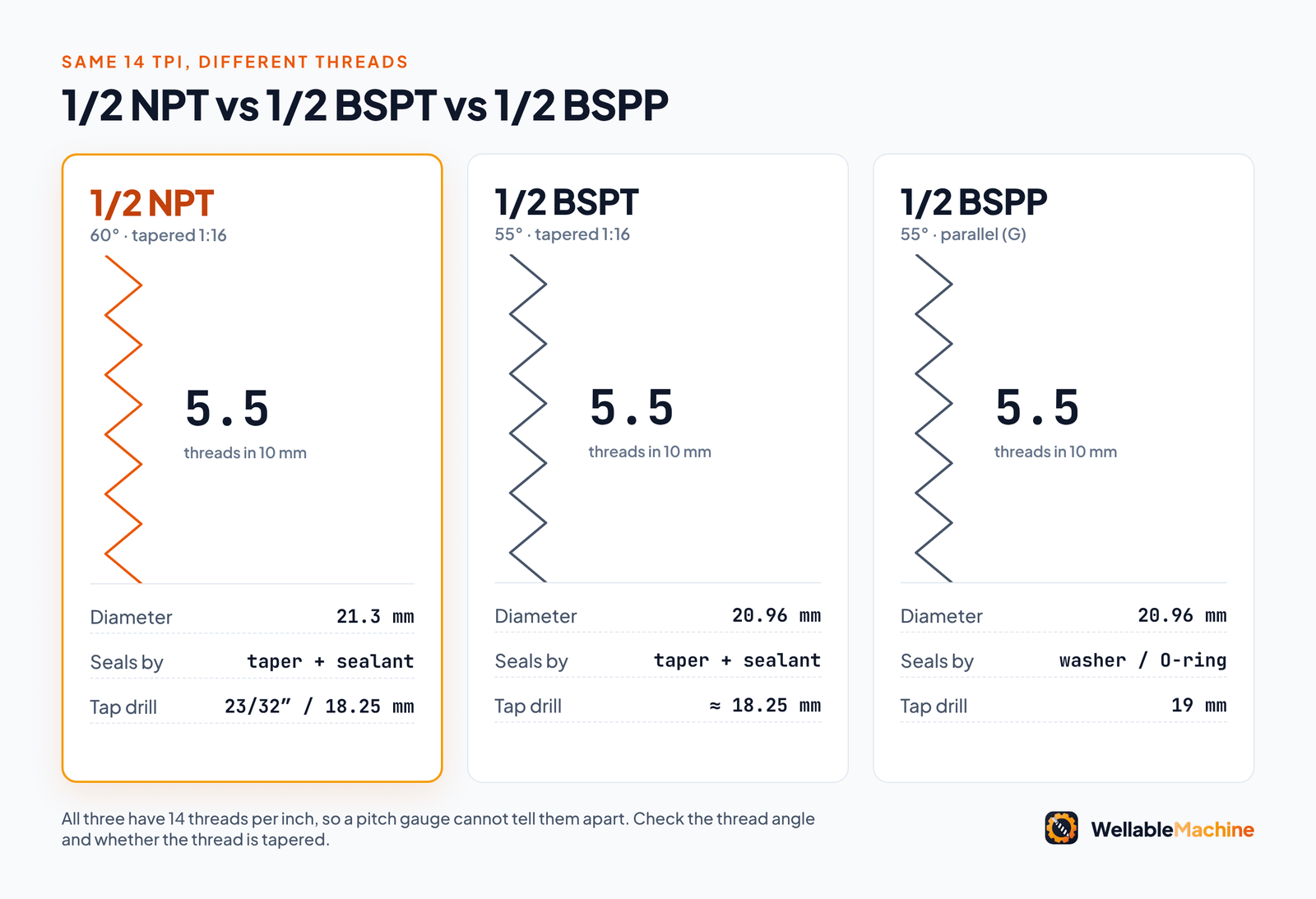
- By turns: a good fitting should go in about 4.5 turns by hand (the L1 length) and then take another 3 turns or so with a wrench.
- By gauge: an NPT L1 plug gauge should screw in until its notch is flush with the face of the part, within one turn either way.
- By the tap: many people mark the tap with a paint pen once they have tapped one good port, so they can repeat the depth on the next ones.
Go deeper in steps. It’s easy to take another quarter turn with the tap, and impossible to put metal back.
1/2 NPT vs 1/2 BSP: The 14 TPI Trap
1/2 in is the most confusing pipe size of all, because 1/2 NPT and 1/2 BSP both have 14 threads per inch. A thread pitch gauge can’t tell them apart. The difference is the thread angle (60° for NPT, 55° for British pipe) and, for BSPP, the fact that the thread is parallel instead of tapered.
| Thread | TPI | Angle | Form | Seals by | Tap drill |
|---|---|---|---|---|---|
| 1/2 NPT | 14 | 60° | Tapered 1:16 | Wedging taper + sealant | 23/32 in (18.26 mm) |
| 1/2 BSPT (R / Rc) | 14 | 55° | Tapered 1:16 | Wedging taper + sealant | about 18.25 mm |
| 1/2 BSPP (G) | 14 | 55° | Parallel | Bonded washer, O-ring or gasket | 19 mm |
| 1/2 NPSM | 14 | 60° | Parallel | Gasket or flare seat | about 3/4 in |
An NPT male will often screw two or three turns into a BSPT port before it binds, which is just enough to fool you. Under pressure the mismatched flanks leave a spiral leak path. If a part came from Europe, Asia or Australia, assume British threads until you prove otherwise. Thread angle gauges or the BSP and NPT thread identification charts in most fitting catalogs settle the question in seconds.
Where You’ll Find 1/2 NPT
- Household plumbing: shower arms, water heater relief valve outlets, ball valves, pipe nipples, tub spouts and the female adapters that join copper or PEX to threaded pipe.
- Gas lines: black-iron gas piping to stoves, dryers and space heaters often runs in 1/2 in. Gas joints need a sealant rated for gas and should be checked for leaks with soapy water or a gas detector before use.
- Industrial instruments: thermowells, pressure transmitters and the larger 4 in and 6 in gauges commonly use 1/2 NPT process connections.
- Air and hydraulics: main air headers on bigger compressors and the suction ports of small hydraulic pumps.
- Engines and radiators: water-pump and heater-hose fittings and some temperature sender bosses.
Note that a garden hose thread is not NPT. Hose bibs end in 3/4-11.5 GHT, a straight thread that seals with a rubber washer, even though the body of the valve may screw onto 1/2 NPT pipe.
Tapping 1/2 NPT in Different Materials
| Material | Drill | Fluid | Notes |
|---|---|---|---|
| Aluminum | 23/32 in | Light oil or kerosene | Taps easily, so check depth often; soft threads gall if fittings are reused many times |
| Brass and bronze | 23/32 in or 18 mm | Dry or light oil | Grabby; use a tap with slight negative rake if you can |
| Cast iron | 23/32 in | Dry, blow chips clear | Easy to tap but brittle; never overtighten a fitting in it |
| Mild steel | 23/32 in | Sulfurized cutting oil | Back the tap out fully every few turns to clear long chips |
| Stainless steel | 11/16 in + reamer | Heavy cutting oil | Ream if possible; work hardening makes a direct tap very hard to turn. See how to drill stainless steel. |
| Plastic (PVC, nylon, acetal) | 23/32 in | Dry | Use thread tape, not paste, unless the paste is rated for the plastic |
Sealing a 1/2 NPT Joint
- PTFE tape: 3 to 4 wraps on 1/2 in, wound clockwise as you look at the open end of the male thread, starting one thread back from the end.
- Pipe dope (thread sealant): brush onto the male thread only. Many plumbers use tape and dope together on water and air lines.
- Anaerobic sealant: good for hydraulic and machinery ports; it cures without air between metal threads and resists vibration.
- Tighten in one direction. Backing a tapered fitting off to line it up opens a leak path. If direction matters, use a union or a swivel fitting.
Common 1/2 NPT Tapping Problems
| Problem | Likely cause | Fix |
|---|---|---|
| Tap stalls halfway in | Hole drilled 11/16 without reaming, or dull tap | Back out, open hole to 23/32 or ream, use fresh oil |
| Fitting bottoms out and still leaks | Port tapped too deep | Use a thicker sealant, fit a bushing, or weld and re-tap |
| Fitting takes only 2 turns | Port too shallow or wrong thread | Tap another quarter turn and retest; check for BSP |
| Torn or ragged threads | No lubricant, chip packing, tap not square | Clear chips more often; start square with a guide |
| Crack next to the port | Overtightened in cast iron or thin aluminum | Replace the part; stop at about 3 turns past hand tight |
Smaller ports follow the same rules. Our 1/8 NPT, 1/4 NPT and 3/8 NPT guides cover those sizes, and how to remove a broken tap helps if a pipe tap snaps in the hole.
Frequently Asked Questions
7 quick answers from our editors
01What size drill bit for a 1/2 NPT tap?
23/32 in (0.719 in, 18.26 mm) when tapping without a reamer, or 11/16 in when you ream the hole first with a 1/2 NPT taper reamer.
02What metric drill do I use for 1/2 NPT?
18.25 mm or 18.3 mm. Both match 23/32 in within a thousandth of an inch. An 18 mm bit is fine in brass and aluminum but makes steel hard to tap.
03How many threads per inch is 1/2 NPT?
14 threads per inch, the same as 3/4 NPT and also the same as 1/2 BSP.
04What is the actual size of a 1/2 NPT thread?
The outside diameter of the male thread is 0.840 in (21.3 mm). The name “1/2 in” is a pipe trade size.
05How far should a 1/2 NPT fitting thread in by hand?
About 4.5 turns by hand, then roughly 3 more turns with a wrench. Much more than that by hand means the port is too deep.
06Can I use a 1/2 BSP fitting in a 1/2 NPT port?
No. They share 14 TPI, so the fitting may start, but the 55° and 60° thread angles don’t match and the joint will leak under pressure. Use an adapter.
07Do I need a reamer for 1/2 NPT?
Not usually. In aluminum, brass, cast iron and mild steel, drilling 23/32 in and tapping directly is fine. A reamer is worth it in stainless steel or when you tap many ports.
Bottom Line
For a 1/2-14 NPT port, drill 23/32 in (or 18.25 mm) and tap directly, or drill 11/16 in and ream first if the material is tough. Pilot drill, clamp the part, start the tap square and test with a fitting as you go: about 4.5 hand turns is the target. Watch out for 1/2 BSP parts, which share the same 14 TPI. For straight threads of every size, see our tap drill size chart.