10-24 Tap Drill Size: #25 Drill Chart, Clearance & Metric

Quick answer: the standard tap drill for a 10-24 UNC thread is a #25 drill (0.1495 in / 3.80 mm). It gives about a 75% thread, the normal choice for aluminum, steel, brass and plastics. With metric drills, use 3.8 mm, which is the same size. For stainless steel, step up to a #22 or 5/32 in (0.156 in) drill.
10-24 is the coarse-thread #10 screw found on electrical boxes, switch plates, hinges and general hardware. This guide gives you the 10-24 drill chart by thread percentage, clearance holes, how it differs from 10-32 and M5, insert and forming-tap sizes, and step-by-step tapping tips.
10-24 Thread Specifications at a Glance
“10-24” means a #10 machine screw (0.190 in diameter) with 24 threads per inch. It is the coarse (UNC) partner of 10-32 UNF in the Unified Thread Standard.
| Specification | Value |
|---|---|
| Thread series | UNC (Unified National Coarse) |
| Screw gauge | #10 |
| Major diameter | 0.190 in (4.83 mm) |
| Threads per inch | 24 |
| Pitch | 0.0417 in (1.058 mm) |
| Basic minor diameter | 0.1389 in (3.53 mm) |
| Tap drill, 75% thread | #25 = 0.1495 in (3.80 mm) |
| Close-fit clearance | #9 = 0.196 in (4.98 mm) |
| Free-fit clearance | #7 = 0.201 in (5.11 mm) |
10-24 Tap Drill Size Chart by Thread Percentage
Thread percentage tells you how much of a full thread the tap actually cuts. A smaller hole gives a fuller thread but needs much more torque, and anything above about 75% adds almost no real strength. That’s why machinists use about 75% in soft metals and drop to 60–70% in hard ones. The values below use % thread = 76.98 × TPI × (major diameter − drill diameter).
| Drill | Inches | mm | Approx. thread | When to use it |
|---|---|---|---|---|
| #26 | 0.1470 | 3.73 | 79% | Soft aluminum, plastics |
| #25 | 0.1495 | 3.80 | 75% | Standard choice for most materials |
| 3.8 mm | 0.1496 | 3.80 | 75% | Metric twin of #25 |
| #24 | 0.1520 | 3.86 | 70% | Steel, easier hand tapping |
| 3.9 mm | 0.1535 | 3.90 | 67% | Metric option for steel |
| #23 | 0.1540 | 3.91 | 67% | Stainless steel |
| 5/32 | 0.1562 | 3.97 | 62% | Fractional option; good in stainless |
| #22 | 0.1570 | 3.99 | 61% | Stainless, hard alloys |
| #20 | 0.1610 | 4.09 | 54% | Very hard alloys, deep blind holes |
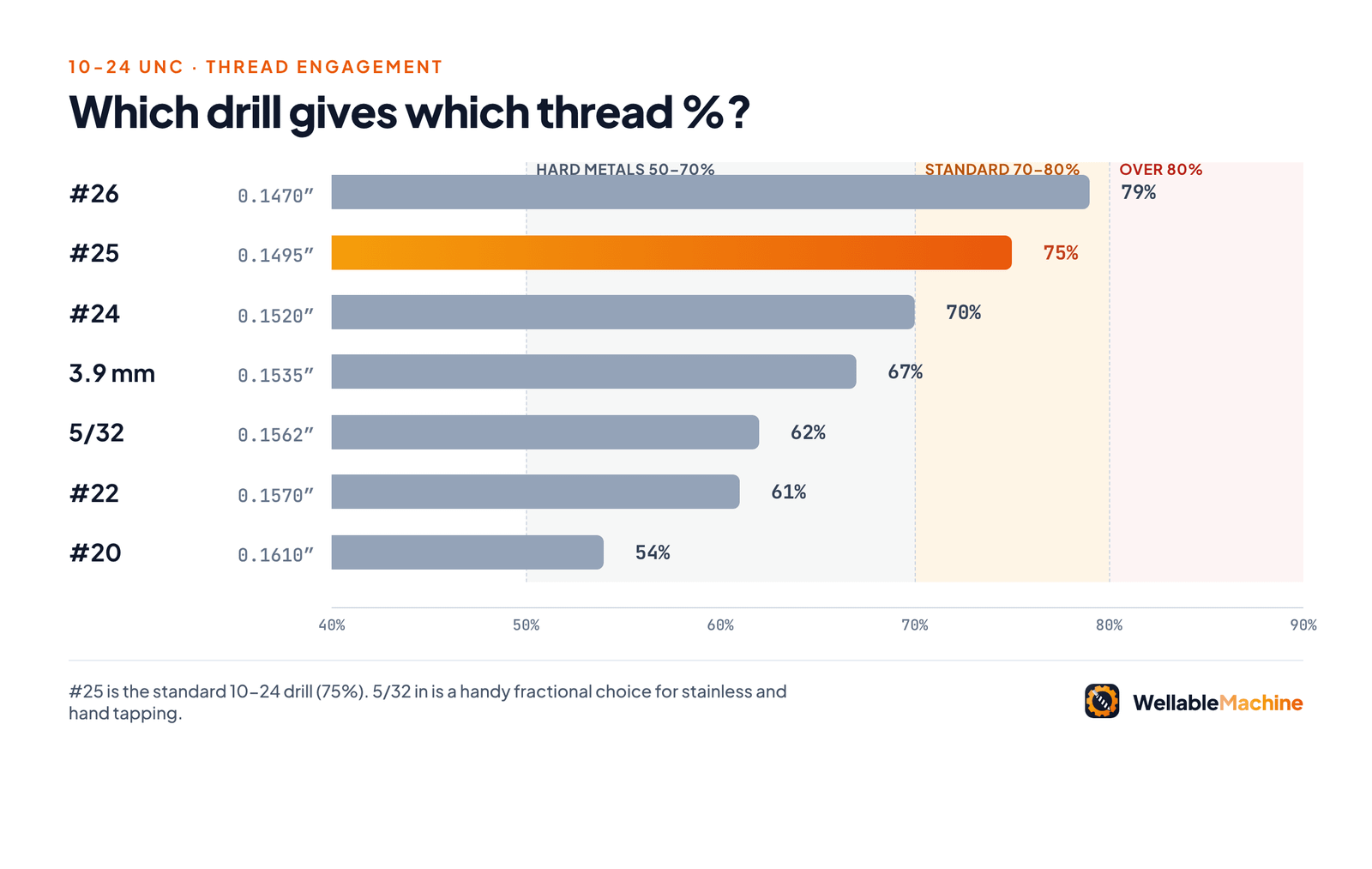
Which drill should you use? Use #25 or 3.8 mm in aluminum, brass, cast iron and mild steel. For stainless steel and hand tapping in tough metals, a #22 or 5/32 in drill gives a 61–62% thread, which cuts torque a lot and is still strong enough for most jobs. Avoid a 9/64 in drill: it is too small and gives over 90% thread.
Clearance Hole Sizes for a #10 Screw
These sizes are the same for 10-24 and 10-32 screws, because clearance doesn’t depend on the thread pitch.
| Fit | Drill | Inches | mm | Use it for |
|---|---|---|---|---|
| Close fit | #9 | 0.1960 | 4.98 | Precise location |
| Free fit | #7 | 0.2010 | 5.11 | General assemblies (#7 drill guide) |
| Loose fit | 13/64 | 0.2031 | 5.16 | Panels and hole patterns |
10-24 vs. 10-32 vs. M5
10-24 and 10-32 share the same diameter but have different pitches, and M5 is the nearest metric size. None of them interchange.
| Thread | Diameter | Pitch | Tap drill | Typical use |
|---|---|---|---|---|
| 10-24 UNC | 4.83 mm | 1.058 mm (24 TPI) | #25 (0.1495 in) | Electrical boxes, hinges, general hardware |
| 10-32 UNF | 4.83 mm | 0.794 mm (32 TPI) | #21 (0.159 in) | Equipment racks, instruments, thin walls |
| M5 × 0.8 | 5.00 mm | 0.8 mm | 4.2 mm | Metric machinery, bikes, 3D printers |

A 10-32 screw will not thread into a 10-24 hole and vice versa, even though they look the same. See our 10-32 tap drill size and M5 tap drill size guides for those threads.
Other 10-24 Hole Sizes You Might Need
- Forming (roll) tap: about 0.172 in, close to a #17 drill. Check the tap maker’s chart.
- Heli-Coil / STI insert: a 13/64 in drill, then a 10-24 STI tap.
- Counterbore for a socket head cap screw: 5/16 in diameter, about 0.19 in deep.
- Wood or plastic insert: follow the insert spec, usually 1/4–9/32 in.
How to Drill and Tap a 10-24 Hole
- Mark and center punch the hole so the drill starts exactly where you want it.
- Drill with a #25 bit. In aluminum, run about 2,600 RPM; in mild steel, about 1,500 RPM; in stainless, slow down to about 750 RPM with steady pressure and cutting oil. Our guide on how to drill stainless steel explains why stainless needs low speed and constant feed.
- Chamfer the top of the hole with a countersink so the tap starts square and the first thread doesn’t lift.
- Start the tap straight. Use a tap guide or the drill press spindle. A small T-handle wrench gives better feel than a bar wrench at this size.
- Cut and break the chip: half a turn forward, a quarter turn back, with tapping fluid. Light oil suits aluminum; sulfurized cutting oil suits steel.
- For blind holes, drill at least 0.13 in (3 pitches) deeper than the full thread you need, and finish with a bottoming tap.
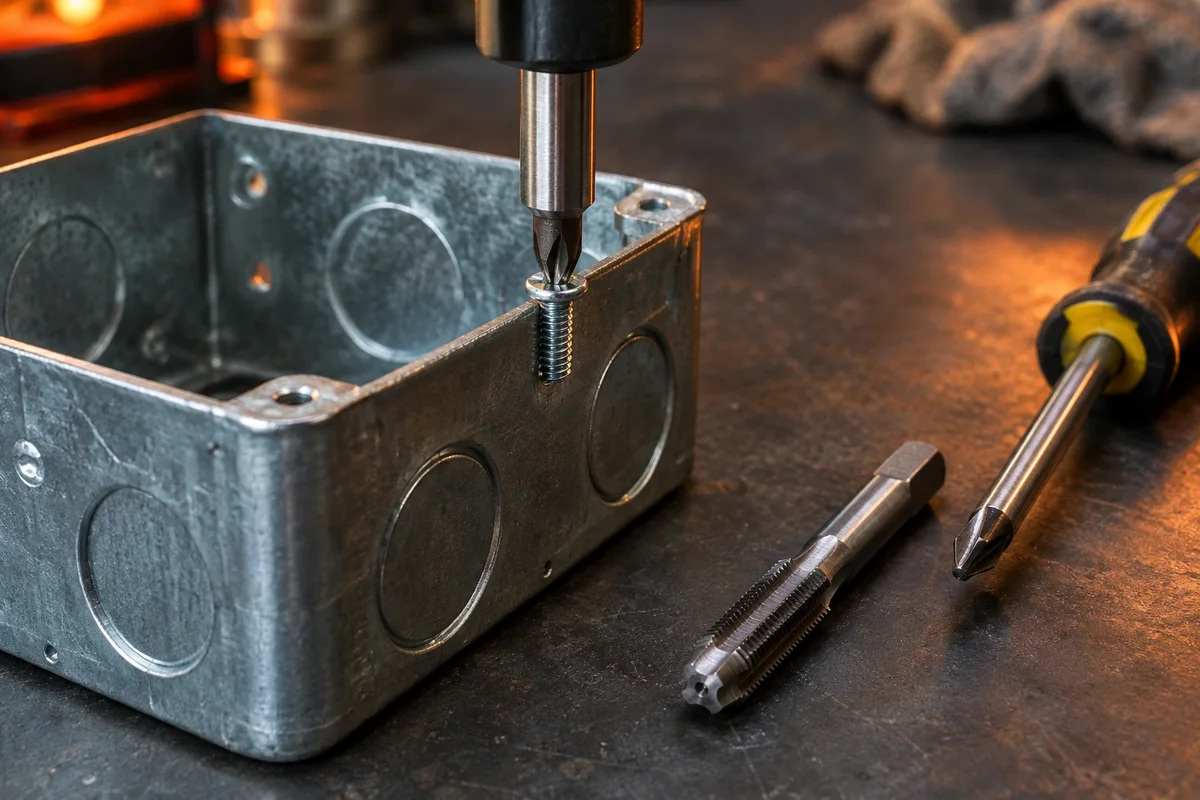
Drilling stainless? Read how to drill stainless steel and see the best drill bits for stainless steel. For the next size up, see the 1/4-20 tap drill size.
Which 10-24 Tap Should You Use?
The coarse 10-24 pitch is easier on taps than 10-32, but the tap is still small. A spiral point tap is the best choice for through-holes.
| Tap type | Best for | Notes |
|---|---|---|
| Taper tap | Starting threads by hand in hard material | Long chamfer; the easiest to start straight |
| Plug tap | Through-holes and most blind holes | The everyday hand tap |
| Bottoming tap | Full threads to the bottom of blind holes | Use only after a plug or taper tap |
| Spiral point (gun) tap | Through-holes, power tapping | Pushes chips ahead; strong core, fewer breaks |
| Spiral flute tap | Blind holes, power tapping | Lifts chips up and out of the hole |
| Forming (roll) tap | Aluminum, brass, mild steel | No chips; needs a larger #17 hole |
Tapping 10-24 in Different Materials
The #25 drill is right for most materials, but each metal behaves differently under the tap. This table sums up what works.
| Material | Recommended drill | Tapping fluid | Tips |
|---|---|---|---|
| Aluminum | #25 | Light oil or WD-40 | Clear chips often |
| Mild steel | #25 | Sulfurized cutting oil | Plug tap, steady rhythm, reverse to break chips |
| Stainless (304/316) | #22 or 5/32 | Heavy tapping paste | Cobalt tap; slow, steady turns |
| Brass and bronze | #25 | Light oil or dry | Cuts cleanly; a low-rake tap stops it grabbing |
| Electrical box steel | #25 | Light oil | Thin wall; consider a self-tapping screw |
How Deep Should a 10-24 Thread Be?
Thread engagement matters more than thread percentage. The first few threads carry most of the load, so going much deeper adds effort without adding strength. Use these lengths as a starting point:
- Steel: about 1 × diameter, 0.19 in (5 mm).
- Aluminum and brass: 1.5–2 × diameter, 0.28–0.38 in.
- Plastic: 2.5 × diameter or an insert.
Where Is 10-24 Used?
10-24 is the standard screw for many US electrical device boxes and grounding screws, hinges, cabinet hardware, light fixtures, guitar hardware and general assembly. The coarse pitch threads quickly and holds well in softer materials like aluminum, plastic and wood inserts.
Common 10-24 Tapping Problems (and How to Fix Them)
- Tap is tight or squeals: the hole is too small. Check that you didn’t use 9/64 in, and use #24 or 5/32 in steel.
- Screw won’t go in: you may have a 10-32 screw. Check with a pitch gauge.
- Thread stripped: repair with a 10-24 Heli-Coil or step up to 1/4-20.
- Tap broke: use more fluid, back out more often and keep the wrench level.
Frequently Asked Questions
6 quick answers from our editors
01What size drill bit for a 10-24 tap?
A #25 drill (0.1495 in). It gives about a 75% thread.
02What metric drill for 10-24?
3.8 mm is the same as #25. 3.9 mm is easier in steel.
03Can I use 5/32 for 10-24?
Yes. 5/32 in gives about a 62% thread, which is easier to tap, especially in stainless.
04Can I use 9/64 for 10-24?
No. It is too small and will make the tap very hard to turn.
05What size clearance hole for a 10-24 screw?
#9 (0.196 in) for a close fit and #7 (0.201 in) for a free fit.
06What is the difference between 10-24 and 10-32?
Same diameter, different pitch. 10-24 is coarse (24 TPI, #25 drill); 10-32 is fine (32 TPI, #21 drill).
Bottom Line
For a 10-24 thread, drill with a #25 bit (0.1495 in) or 3.8 mm. Step up to #22 or 5/32 in in stainless, and drill #9 or #7 for clearance holes. Don’t mix 10-24 and 10-32 screws. For every other size, see our tap drill size chart.