Wrench Size Chart: Socket Sizes for SAE and Metric Bolts
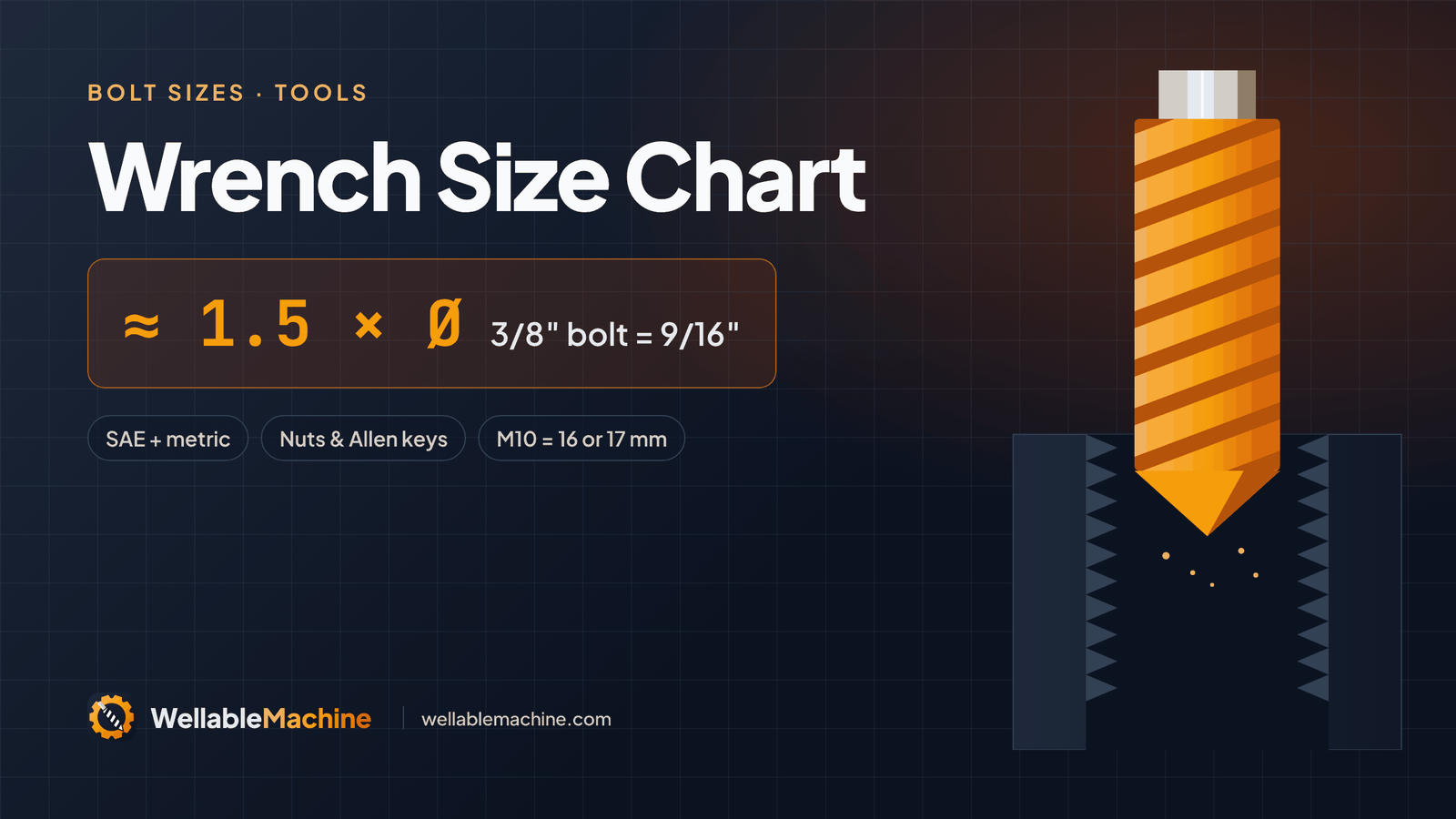
Quick answer: for standard SAE hex bolts, the wrench or socket is about 1-1/2 times the bolt diameter: a 1/4 in bolt takes 7/16 in, 5/16 in takes 1/2 in, 3/8 in takes 9/16 in, 1/2 in takes 3/4 in and 5/8 in takes 15/16 in. For metric bolts, M6 takes 10 mm, M8 takes 13 mm, M10 takes 16 mm (17 mm on older DIN bolts), M12 takes 18 mm (19 mm DIN) and M16 takes 24 mm. Nuts usually match the bolt head, with a few exceptions shown in the charts below.
Grabbing the wrong socket wastes time, and grabbing one that is “close enough” rounds off bolt heads. This guide gives you complete wrench size charts for SAE (inch) and metric hex bolts, nuts, heavy hex structural bolts, socket head cap screws (Allen bolts), and hex washer head screws, plus tips on choosing between 6-point and 12-point sockets and which metric and SAE sizes can be swapped.
SAE (Inch) Bolt Wrench Size Chart
| Bolt size | Hex bolt / cap screw head | Finished hex nut | Heavy hex (structural) bolt and nut | Socket head cap screw (Allen key) |
|---|---|---|---|---|
| #6 | — | 5/16 in | — | 7/64 in |
| #8 | — | 11/32 in | — | 9/64 in |
| #10 | — | 3/8 in | — | 5/32 in |
| 1/4 in | 7/16 in | 7/16 in | — | 3/16 in |
| 5/16 in | 1/2 in | 1/2 in | — | 1/4 in |
| 3/8 in | 9/16 in | 9/16 in | — | 5/16 in |
| 7/16 in | 5/8 in | 11/16 in | — | 3/8 in |
| 1/2 in | 3/4 in | 3/4 in | 7/8 in | 3/8 in |
| 9/16 in | 13/16 in | 7/8 in | — | — |
| 5/8 in | 15/16 in | 15/16 in | 1-1/16 in | 1/2 in |
| 3/4 in | 1-1/8 in | 1-1/8 in | 1-1/4 in | 5/8 in |
| 7/8 in | 1-5/16 in | 1-5/16 in | 1-7/16 in | 3/4 in |
| 1 in | 1-1/2 in | 1-1/2 in | 1-5/8 in | 3/4 in |
Sizes follow ASME B18.2.1 (bolts and screws) and B18.2.2 (nuts) and ASME B18.3 for socket head cap screws. The two most common surprises are 7/16 in and 9/16 in: the bolt head and the nut take different wrenches. Older or imported hardware may also vary, so if a socket feels loose, try the next size down before you lean on it. The ASME codes and standards site lists the current editions.

Metric Bolt Wrench Size Chart
| Bolt size | Hex head / nut (ISO) | Hex head / nut (older DIN / JIS) | Socket head cap screw (Allen key) | Coarse pitch |
|---|---|---|---|---|
| M3 | 5.5 mm | 5.5 mm | 2.5 mm | 0.5 mm |
| M4 | 7 mm | 7 mm | 3 mm | 0.7 mm |
| M5 | 8 mm | 8 mm | 4 mm | 0.8 mm |
| M6 | 10 mm | 10 mm | 5 mm | 1.0 mm |
| M8 | 13 mm | 13 mm (12 mm on JIS flange bolts) | 6 mm | 1.25 mm |
| M10 | 16 mm | 17 mm (14 mm on JIS flange bolts) | 8 mm | 1.5 mm |
| M12 | 18 mm | 19 mm | 10 mm | 1.75 mm |
| M14 | 21 mm | 22 mm | 12 mm | 2.0 mm |
| M16 | 24 mm | 24 mm | 14 mm | 2.0 mm |
| M20 | 30 mm | 30 mm | 17 mm | 2.5 mm |
| M24 | 36 mm | 36 mm | 19 mm | 3.0 mm |
| M30 | 46 mm | 46 mm | 22 mm | 3.5 mm |
ISO 4014/4017 bolts and ISO 4032 nuts use the sizes in the first column. Older DIN 931/933 hardware (still common in Europe and on older machines) uses 17 mm on M10, 19 mm on M12 and 22 mm on M14. Japanese cars and motorcycles often use smaller JIS flange-bolt heads, such as 12 mm on M8 and 14 mm on M10. That is why a mechanic’s 10, 12, 13, 14 and 17 mm sockets get the most wear.
Hex Washer Head and Self-Drilling Screws
Sheet metal screws, self-drilling (Tek) screws and roofing screws usually have a hex washer head that takes a nut driver or a small socket. Typical sizes:
| Screw size | Hex size |
|---|---|
| #6 | 1/4 in |
| #8 | 1/4 in |
| #10 | 5/16 in |
| #12 | 5/16 in |
| #14 and 1/4 in | 3/8 in |
These screws are almost always driven with an impact driver and a magnetic nut setter. Our screw size chart explains the gauge numbers and lengths.
Lag Screws and Carriage Bolts
Lag screws have a standard hex head, so they use the same wrench as hex bolts: 1/4 in lag takes 7/16 in, 5/16 in takes 1/2 in, 3/8 in takes 9/16 in and 1/2 in takes 3/4 in. Carriage bolts have a round head with a square neck, so you only need a wrench for the nut, which follows the finished hex nut column above.
The 1.5× Rule and Why It Works

Across the flats, a standard hex head is roughly 1.5 times the bolt diameter. That ratio gives enough bearing area under the head and enough metal around the wrench flats to take full tightening torque. It is a handy rule for a quick guess: a 3/8 in bolt is about 9/16 in across, and an M10 is about 15–16 mm. Heavy hex structural bolts are bigger, about 1.6 to 1.75 times the diameter, because they are tightened to much higher loads. Flange bolts and some automotive bolts are smaller, because the built-in flange spreads the load instead.
Metric and SAE Sizes That Are Close
| SAE | mm equivalent | Closest metric | Can you swap? |
|---|---|---|---|
| 5/16 in | 7.94 mm | 8 mm | Yes, 8 mm fits a 5/16 in head (slightly loose) |
| 3/8 in | 9.53 mm | 10 mm | No, 10 mm is too loose and will round it |
| 1/2 in | 12.70 mm | 13 mm | In a pinch; 13 mm is loose on 1/2 in |
| 9/16 in | 14.29 mm | 14 mm | 14 mm is too small; 15 mm is too loose |
| 5/8 in | 15.88 mm | 16 mm | Yes, very close |
| 3/4 in | 19.05 mm | 19 mm | Yes, almost identical |
| 7/8 in | 22.23 mm | 22 mm | 22 mm is a snug fit on 7/8 in |
| 15/16 in | 23.81 mm | 24 mm | 24 mm is slightly loose |
Only swap when the fit is snug, and never on a bolt that is seized or tightened to high torque. A loose wrench contacts only the corners of the hex, which is exactly how heads get rounded. If that has already happened, our guide on how to remove a rounded bolt can help.
6-Point vs 12-Point Sockets
- 6-point sockets grip the flats of the hex, not the corners. They are stronger, much less likely to round a head and the only choice for impact wrenches and stubborn bolts.
- 12-point sockets fit onto a bolt in twice as many positions, which helps in tight spots where you can only swing the ratchet a few degrees. They also fit 12-point aircraft and some automotive bolts. But they contact closer to the corners and round off soft or rusty heads more easily.
- Impact sockets (black, thicker wall, chrome-moly steel) are made for impact wrenches and impact drivers. Ordinary chrome sockets can crack under impact.
- Deep sockets reach nuts on long studs and threaded rod.
If you drive bolts with power tools, see impact driver vs drill for which tool suits which fastener.
How to Find the Right Wrench When You Don’t Know the Bolt
- Measure the head across the flats with a caliper. For example, 11.1 mm across the flats is a 7/16 in head, which means a 1/4 in bolt, while 13.0 mm points to an M8. Compare your reading with the charts above.
- Look at the head markings. Radial lines (3 or 6) mean an SAE grade bolt; numbers such as 8.8 or 10.9 mean metric. See the bolt size chart for how to read bolt sizes and grades.
- Test-fit sockets starting with the smallest that might fit. The right one slides on with almost no play.
- Check the thread with a thread gauge if you need to replace the bolt.
Which Type of Wrench to Use
- Combination wrench: open end on one side, box end on the other, same size. The everyday choice. Use the box end to break bolts loose and the open end to spin them once they are free.
- Ratcheting wrench: a box end with a ratchet inside, so you don’t have to lift the wrench off between swings. Great for long bolts in tight places.
- Socket and ratchet: the fastest for most work, and the only practical option for recessed nuts. 1/4 in drive suits 4–14 mm and up to 9/16 in; 3/8 in drive suits 8–19 mm and 5/16–3/4 in; 1/2 in drive suits 10 mm and up and big SAE sizes with higher torque.
- Flare-nut (line) wrench: a box end with a slot, for brake and fuel line fittings, which are soft and round off easily.
- Adjustable wrench: handy to carry, but its jaws flex. Turn it so the force pushes toward the fixed jaw, and don’t use it on tight or rusted bolts.
- Hex keys and bit sockets: for socket head cap screws. Use a T-handle or a bit socket on a ratchet for high torque, and make sure the key is fully seated.
The Sizes You Will Use Most
If you are building a basic kit, these sizes cover the large majority of household, furniture, bike, car and shop fasteners:
- SAE: 3/8, 7/16, 1/2, 9/16, 5/8, 11/16 and 3/4 in.
- Metric: 8, 10, 12, 13, 14, 15, 17 and 19 mm.
- Hex keys: SAE 1/8 to 3/8 in and metric 2 to 10 mm.
Add 16, 18, 21, 22 and 24 mm and 13/16, 7/8, 15/16 and 1-1/8 in when you start working on machinery, trailers or structural bolts. The tap drills for many of these bolts are listed in our tap drill size chart.
Tips for Using Wrenches Without Damage
- Push the socket fully onto the head before you turn it. A socket that rides halfway up will slip.
- Use a box-end wrench or a socket, not an open-end wrench, to break a tight bolt loose. Open-end wrenches touch only two flats.
- Pull a wrench toward you rather than pushing it, so you don’t hit your knuckles if it slips.
- Use a torque wrench when a specification is given, for example on wheels, engines and anchors.
- Soak rusted bolts in penetrating oil first, and give it time to work.
Frequently Asked Questions
7 quick answers from our editors
01What size wrench fits a 3/8 in bolt?
A 9/16 in wrench or socket, for both the bolt head and the standard nut.
02What size socket is a 1/2 in bolt?
3/4 in for a standard hex bolt and nut. Heavy hex structural bolts take 7/8 in.
03What size wrench is an M8 bolt?
13 mm on standard ISO and DIN bolts. Some Japanese flange bolts use 12 mm.
04Is an M10 bolt 16 mm or 17 mm?
Both exist. New ISO bolts are 16 mm, older DIN bolts are 17 mm, and some Japanese bolts are 14 mm.
05What Allen key fits a 1/4 in socket head cap screw?
A 3/16 in hex key.
06What size socket do I need for a 1/4 in lag screw?
7/16 in, the same as a 1/4 in hex bolt.
07Can I use a metric socket on an SAE bolt?
Only where the sizes are nearly the same, such as 19 mm on 3/4 in or 16 mm on 5/8 in. Otherwise use the correct socket to avoid rounding the head.
Bottom Line
For SAE hex bolts, think 1-1/2 times the diameter: 1/4 in → 7/16, 5/16 → 1/2, 3/8 → 9/16, 1/2 → 3/4, 5/8 → 15/16, 3/4 → 1-1/8. For metric, M6 → 10 mm, M8 → 13 mm, M10 → 16 or 17 mm, M12 → 18 or 19 mm, M16 → 24 mm. Watch for the exceptions (7/16 and 9/16 nuts, heavy hex bolts, DIN and JIS heads), use 6-point sockets on tight bolts, and only swap metric and SAE where the fit is truly snug.