Screw Size Chart: Diameters in Inches and mm (#0 to #14)
Quick answer: numbered screw sizes get bigger as the number goes up. A #6 screw is 0.138 in (3.5 mm) across the threads, a #8 is 0.164 in (4.2 mm), a #10 is 0.190 in (4.8 mm) and a #12 is 0.216 in (5.5 mm). You can work out any size with a simple formula: diameter = 0.060 in + (0.013 in × screw number). Above #14, screws are sized in fractions of an inch, starting at 1/4 in.
Screw sizes confuse almost everyone at first. A “#8 × 1-1/4” wood screw, a “10-32” machine screw and an “M5” metric screw all describe size in different ways, and none of them say the diameter in plain inches. This chart translates every common numbered size into inches and millimeters, shows the thread counts for machine screws, and explains how to measure a screw you already have.
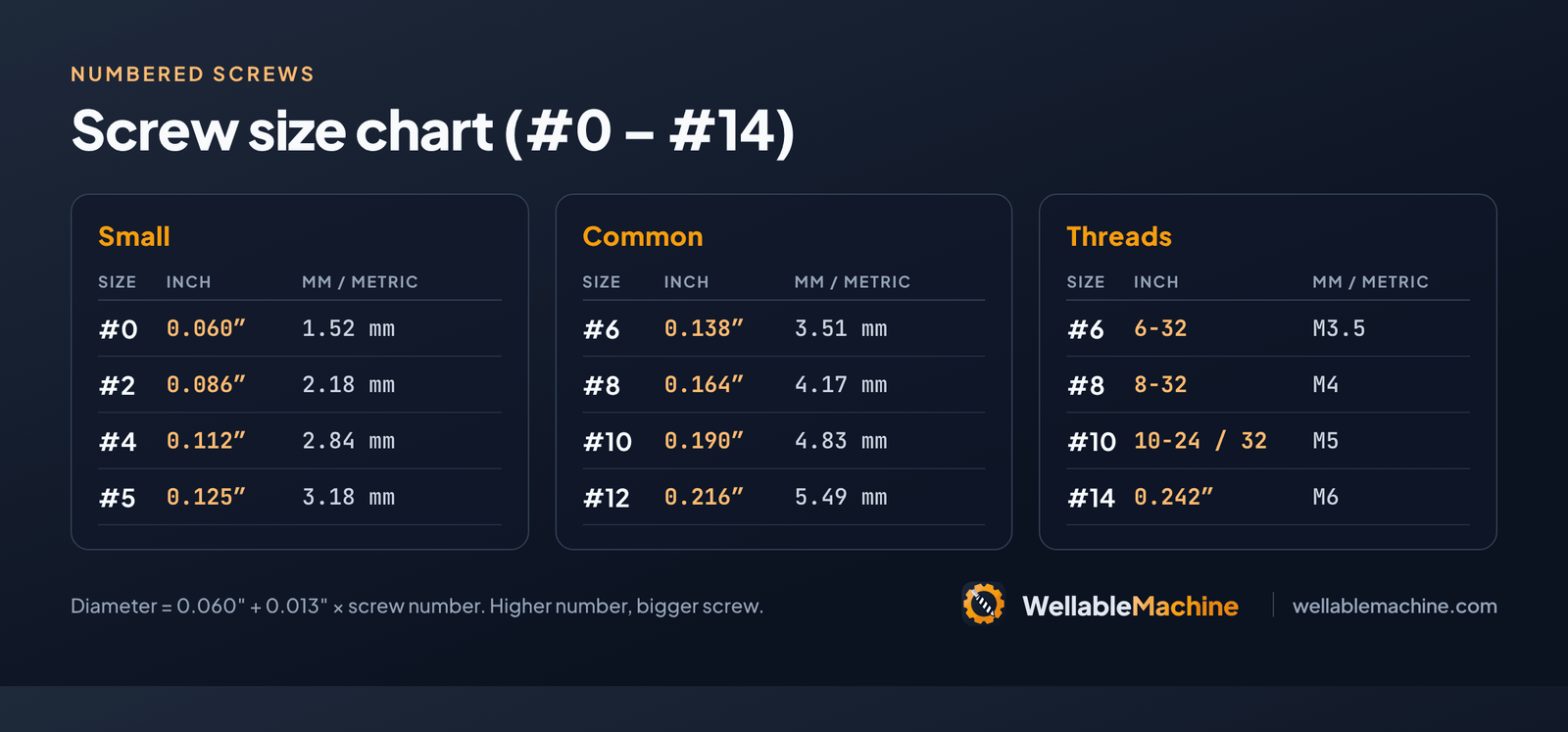
Screw Size Chart: #0 to #14
| Screw size | Diameter (in) | Diameter (mm) | Nearest fraction | Machine screw threads | Closest metric |
|---|---|---|---|---|---|
| #0 | 0.060 | 1.52 | 1/16 (0.0625) | 0-80 | M1.6 |
| #1 | 0.073 | 1.85 | 5/64 (0.078) | 1-64, 1-72 | M1.8 / M2 |
| #2 | 0.086 | 2.18 | 3/32 (0.094) | 2-56, 2-64 | M2 / M2.2 |
| #3 | 0.099 | 2.51 | 3/32+ | 3-48, 3-56 | M2.5 |
| #4 | 0.112 | 2.84 | 7/64 (0.109) | 4-40, 4-48 | M3 (slightly bigger) |
| #5 | 0.125 | 3.18 | 1/8 (0.125) | 5-40, 5-44 | M3 |
| #6 | 0.138 | 3.51 | 9/64 (0.141) | 6-32, 6-40 | M3.5 |
| #8 | 0.164 | 4.17 | 5/32+ (0.156) | 8-32, 8-36 | M4 |
| #10 | 0.190 | 4.83 | 3/16 (0.188) | 10-24, 10-32 | M5 |
| #12 | 0.216 | 5.49 | 7/32 (0.219) | 12-24, 12-28 | M5.5 |
| #14 | 0.242 | 6.15 | 1/4− (0.250) | 14-20 (rare) | M6 |
Wood screws and sheet metal screws use the same numbered diameters, but their threads are coarser and aren’t counted the same way. A #8 wood screw is still 0.164 in across the threads; it just has a different thread form designed to cut its own path.
The Formula Behind the Numbers
The numbered system comes from the old American screw gauge. Each step adds 0.013 in to the diameter, starting from 0.060 in for #0:
Diameter (in) = 0.060 + 0.013 × N
- #6: 0.060 + 0.013 × 6 = 0.138 in
- #8: 0.060 + 0.013 × 8 = 0.164 in
- #10: 0.060 + 0.013 × 10 = 0.190 in
The formula is handy when you meet an unusual size, such as a #9 or #16 wood screw, which some suppliers still sell. The Unified Thread Standard lists the official values for machine screws.
How to Read a Screw Size
| Label | What it means |
|---|---|
| #8 × 1-1/4 in | Wood or sheet metal screw, #8 diameter, 1-1/4 in long |
| 10-32 × 3/4 in | Machine screw, #10 diameter, 32 threads per inch, 3/4 in long |
| 1/4-20 × 1 in | Bolt or machine screw, 1/4 in diameter, 20 threads per inch, 1 in long |
| M5 × 0.8 × 20 | Metric, 5 mm diameter, 0.8 mm pitch, 20 mm long |
Length is measured from the surface the screw will sit flush with. For a flat head (countersunk) screw, that is the whole length including the head. For pan, round, hex and truss heads, length is measured from under the head to the tip.
How to Measure a Screw
- Measure the thread diameter with calipers across the outside of the threads, not the shank.
- Match it to the chart. A reading of 0.160–0.164 in is a #8; 0.185–0.190 in is a #10. Worn or plated screws read slightly small.
- For machine screws, count threads with a thread pitch gauge, or count the crests over 1/2 in and double it.
- Check if it is metric. If the diameter reads close to a round millimeter (3.0, 4.0, 5.0 mm) and the pitch gauge reads in millimeters, it is metric.
- Measure the length the right way for the head type.
No calipers? A drill gauge (a metal plate with holes) works: find the smallest hole the threads pass through.

Which Screw Size Should You Use?
| Job | Typical size |
|---|---|
| Small hinges, cabinet hardware, electrical cover plates | #4 or #6 (cover plates are 6-32 machine screws) |
| Electrical device mounting (outlets, switches) | 6-32 machine screws |
| Electrical boxes, light fixtures, ground screws | 8-32 and 10-32 machine screws |
| Drywall to wood studs | #6 drywall screws, 1-1/4 to 1-5/8 in |
| General woodworking, cabinets | #8, 1-1/4 to 2 in |
| Deck boards, heavier framing | #9 or #10 deck screws, 2-1/2 to 3 in |
| Door hinges into studs | #9 or #10, 2-1/2 to 3 in for security |
| Ledger boards, structural brackets | Structural screws or lag screws (1/4 in and up) |
Pilot and Clearance Holes by Screw Size
Once you know the screw size, the hole size follows. For wood screws, the pilot depends on whether the wood is hard or soft; for machine screws, you need either a tap drill or a clearance hole. Our guides cover every size:
- Pilot hole size chart for wood screws in hardwood and softwood.
- Clearance hole size chart for bolts and machine screws passing through a part.
- Tap drill size chart for threading holes, with individual guides such as 6-32, 8-32, 10-24 and 10-32.
Numbered Screws vs Metric Screws
Numbered and metric screws are close but almost never interchangeable. A #8-32 screw (4.17 mm) and an M4 × 0.7 screw (4.0 mm) look alike, but the thread pitch differs, so one will cross-thread in the other’s hole. The same goes for #10-32 and M5. If you work on both US and imported equipment, keep the two systems in separate, labeled bins.
Head and Drive Types
- Flat (countersunk): sits flush; needs an 82° countersink for inch screws. See how to countersink.
- Pan and truss: sit on the surface; truss heads are wider for thin sheet.
- Hex washer: for sheet metal and self-drilling screws, driven with a nut driver.
- Drives: Phillips, square (Robertson), Torx (star) and combination drives. Square and Torx strip far less often than Phillips.
Metric Screw Size Chart
Metric screws are named by their diameter in millimeters, followed by the thread pitch: an M5 × 0.8 screw is 5 mm across the threads with 0.8 mm between threads. When no pitch is given, the coarse pitch is meant. The table lists the common coarse sizes, the hex key that fits a socket head cap screw of that size, and the inch screw that comes closest. The ISO metric thread standard sets these dimensions.
| Metric size | Coarse pitch | Diameter (in) | Hex key (cap screw) | Closest inch screw |
|---|---|---|---|---|
| M2 | 0.4 mm | 0.079 | 1.5 mm | #2 |
| M2.5 | 0.45 mm | 0.098 | 2 mm | #3 |
| M3 | 0.5 mm | 0.118 | 2.5 mm | #4 to #5 |
| M4 | 0.7 mm | 0.157 | 3 mm | #8 |
| M5 | 0.8 mm | 0.197 | 4 mm | #10 |
| M6 | 1.0 mm | 0.236 | 5 mm | #14 / 1/4 in |
| M8 | 1.25 mm | 0.315 | 6 mm | 5/16 in |
| M10 | 1.5 mm | 0.394 | 8 mm | 3/8 in |
“Closest” does not mean interchangeable. An M4 screw and an 8-32 screw are almost the same diameter, but the threads will not mate. If you need to tap holes for metric screws, see the M4, M5 and M6 tap drill size guides.
Common Screw Lengths by Size
Length is measured from the surface the screw sits flush with to the tip. For flat (countersunk) heads that means the overall length; for pan, round and hex heads it means the length under the head. Each gauge comes in a typical range of lengths:
| Size | Typical lengths | Typical uses |
|---|---|---|
| #4 | 3/8 to 1 in | Small hinges, hobby work, electronics boxes |
| #6 | 1/2 to 2 in | Cabinet hardware, drywall, light trim |
| #8 | 1/2 to 3 in | General woodwork, shelves, furniture, deck boards (with #10) |
| #10 | 3/4 to 4 in | Door hinges into framing, heavier brackets, decking |
| #12 and #14 | 1 to 4 in | Ledgers, heavy shelves, structural brackets, metal roofing |
A good rule for wood is that the screw should pass through the piece you are fastening and go at least half its length into the piece underneath. For a 3/4 in shelf cleat on a wall stud behind 1/2 in drywall, that means at least a 2-1/2 in screw.
Which Driver Bit Fits Which Screw?
A driver bit that is too small cams out and strips the head. As a rough guide:
- Phillips: #1 bit for screws up to #4, #2 bit for #6 to #10 (by far the most common), #3 bit for #12 and #14.
- Square (Robertson): #1 (green) for #6 and #7, #2 (red) for #8 and #10, #3 (black) for #12 and #14.
- Torx (star): T15 for #6 to #8, T20 for #8 to #10, T25 for #10 to #14 on most deck and construction screws. The box usually says which bit is included.
Driving long #10 and #12 screws is much easier with an impact driver; see impact driver vs drill. If a head does strip, our guide to removing a stripped screw can rescue it.
Frequently Asked Questions
8 quick answers from our editors
01What is the diameter of a #8 screw?
0.164 in, or about 4.2 mm.
02Is a #10 screw bigger than a #8?
Yes. Higher numbers are bigger: a #10 is 0.190 in and a #8 is 0.164 in.
03What is a #10 screw in mm?
About 4.8 mm. The closest metric screw is M5.
04What does 10-32 mean?
A #10 diameter (0.190 in) machine screw with 32 threads per inch.
05What size is after #14?
Screws above #14 are usually sized in fractions, starting with 1/4 in.
06Is a #6 screw the same as 1/8 in?
No. A #6 is 0.138 in, a little larger than 1/8 in (0.125 in), which is the size of a #5.
07What size screw do I need for a wall anchor?
Check the anchor package. Most small plastic anchors take a #6 to #8 screw, and larger ones a #10 to #12. Our wall anchor drill bit size chart lists the hole and screw sizes for common anchors.
08What size is an M4 screw in inches?
An M4 screw is 0.157 in across the threads, almost the same as a #8 (0.164 in), but the threads are different and the two are not interchangeable.
Bottom Line
Numbered screw sizes follow one rule: 0.060 in + 0.013 in per number. The sizes you’ll use most are #6 (0.138 in), #8 (0.164 in) and #10 (0.190 in). Measure across the threads, count threads per inch for machine screws, and keep metric and numbered screws apart. With the size known, our pilot, clearance and tap drill charts give the right hole every time.