8-32 Tap Drill Size: #29 Drill Chart, Clearance & Metric
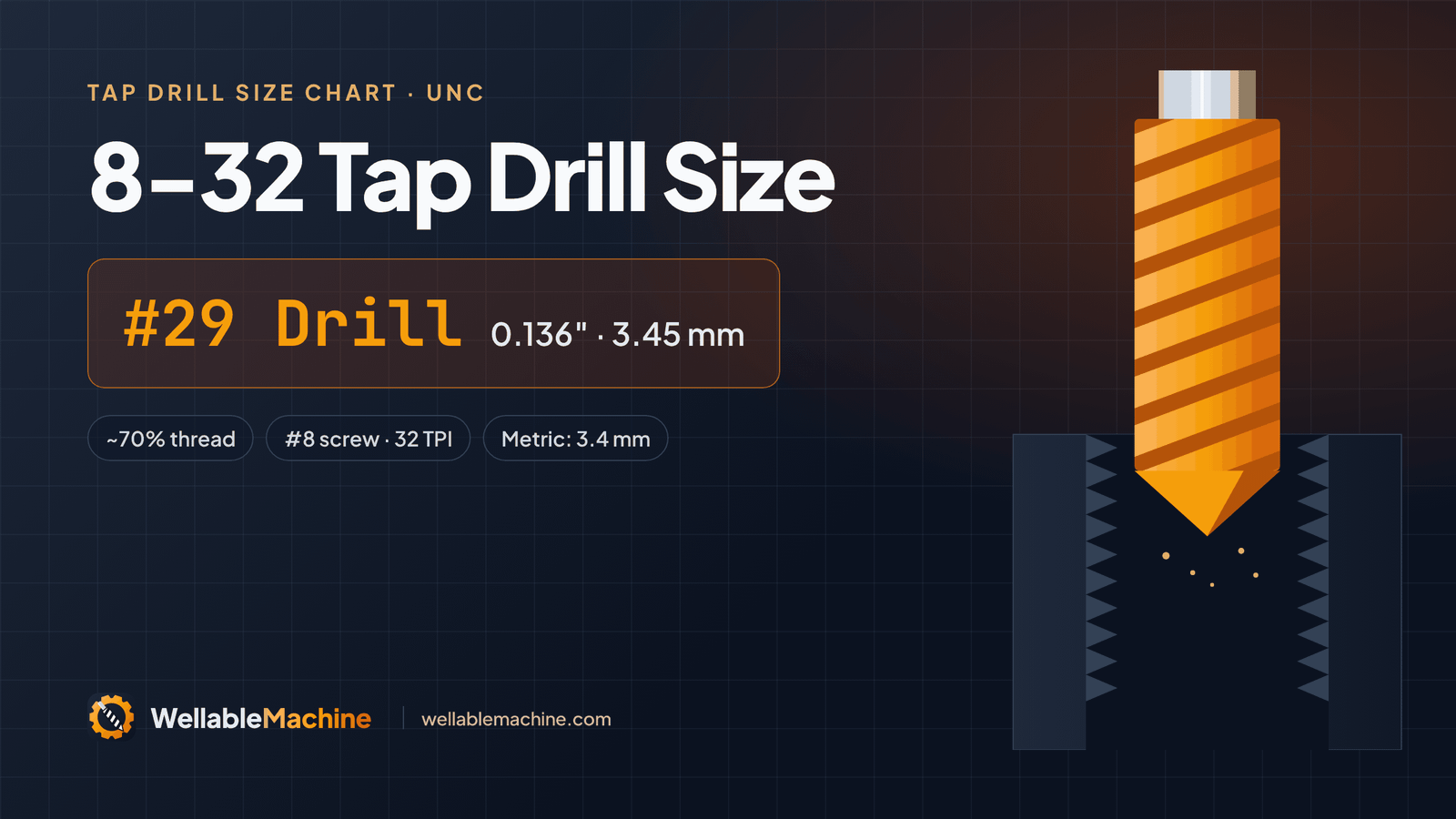
Quick answer: the standard tap drill for an 8-32 UNC thread is a #29 drill (0.136 in / 3.45 mm). It gives roughly a 70% thread, the normal choice for aluminum, steel, brass and plastics. With metric drills, use 3.4 mm for soft metals or 3.5 mm for steel. For stainless steel, a #28 (0.1405 in) makes hand tapping much safer for the small tap.
This guide gives you the full 8-32 drill chart by thread percentage, clearance hole sizes for a #8 screw, the 8-36 fine-thread drill, forming-tap and insert sizes, and practical tips to avoid breaking a small tap.
8-32 Thread Specifications at a Glance
“8-32” means a #8 machine screw (0.164 in major diameter) with 32 threads per inch. It is the coarse (UNC) thread for #8 screws in the Unified Thread Standard, and is very common on electrical boxes, appliances, enclosures and light brackets.
| Specification | Value |
|---|---|
| Thread series | UNC (Unified National Coarse) |
| Screw gauge | #8 |
| Major diameter | 0.164 in (4.17 mm) |
| Threads per inch | 32 |
| Pitch | 0.03125 in (0.794 mm) |
| Basic minor diameter | 0.1257 in (3.19 mm) |
| Standard tap drill | #29 = 0.136 in (3.45 mm) |
| Tap drill, 50% thread | #27 = 0.144 in (3.66 mm) |
| Close-fit clearance | #18 = 0.1695 in (4.31 mm) |
| Free-fit clearance | #16 = 0.177 in (4.50 mm) |
8-32 Tap Drill Size Chart by Thread Percentage
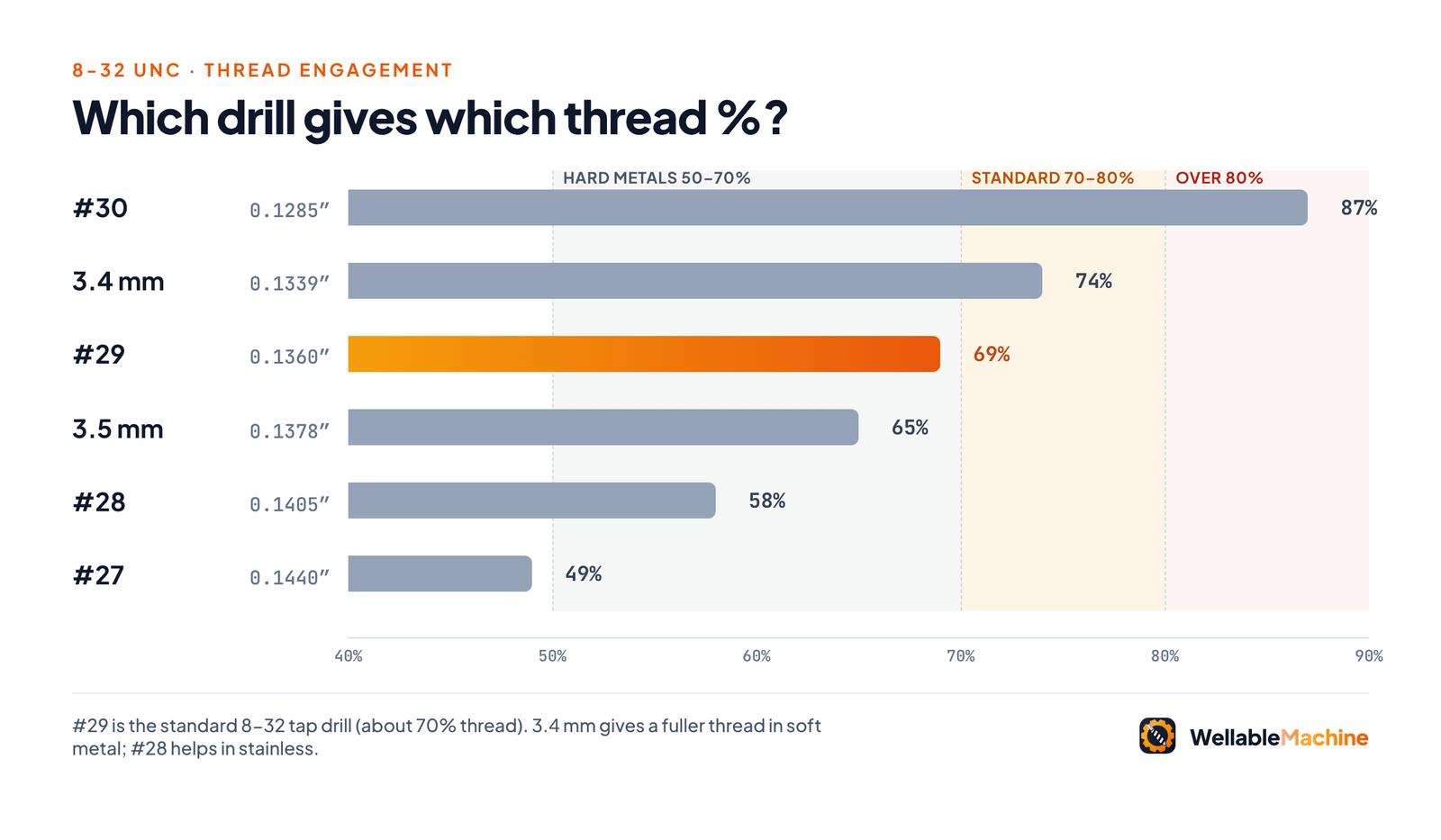
Most charts list #29 for 8-32. By the standard formula it gives about 69–70% thread, slightly less than the usual 75%, but the difference in strength is negligible and the lower torque helps protect a small tap. The values below use % thread = 76.98 × TPI × (major diameter − drill diameter).
| Drill | Inches | mm | Approx. thread | When to use it |
|---|---|---|---|---|
| #30 | 0.1285 | 3.26 | 87% | Too tight for metal; plastics only |
| 3.4 mm | 0.1339 | 3.40 | 74% | Soft aluminum, brass, thin sheet |
| #29 | 0.1360 | 3.45 | ~70% | Standard for most materials |
| 3.5 mm | 0.1378 | 3.50 | 65% | Steel; metric alternative |
| #28 | 0.1405 | 3.57 | 58% | Stainless steel, hand tapping |
| #27 | 0.1440 | 3.66 | 49% | Very hard alloys, deep blind holes |
Can I use 9/64? A 9/64 in drill (0.1406 in) is practically the same as #28. It gives about a 58% thread and is a fine choice for stainless or if your set is fractional only. A 1/8 in drill is too small: it would make a thread over 100%, and the tap will almost certainly break.
Clearance Hole Sizes for a #8 Screw
Clearance holes don’t depend on the thread pitch, so these work for both 8-32 and 8-36 screws.
| Fit | Drill | Inches | mm | Use it for |
|---|---|---|---|---|
| Close fit | #18 | 0.1695 | 4.31 | Precise location of parts |
| Free fit | #16 | 0.1770 | 4.50 | General assemblies and panels |
| Loose fit | 3/16 | 0.1875 | 4.76 | Hole patterns and quick assembly |
8-32 vs. 8-36 vs. M4
The fine-thread 8-36 and the metric M4 × 0.7 are the two screws most often mixed up with 8-32. M4 is slightly smaller (4.0 mm vs. 4.17 mm), so it will feel loose and strip easily in an 8-32 hole.
| Thread | Diameter | Pitch | Tap drill | Typical use |
|---|---|---|---|---|
| 8-32 UNC | 4.17 mm | 0.794 mm (32 TPI) | #29 (0.136 in) | Electrical boxes, appliances, enclosures |
| 8-36 UNF | 4.17 mm | 0.706 mm (36 TPI) | #29 (0.136 in) | Instruments, thin walls, fine adjustment |
| M4 × 0.7 | 4.00 mm | 0.7 mm | 3.3 mm | Metric electronics, 3D printers, bikes |
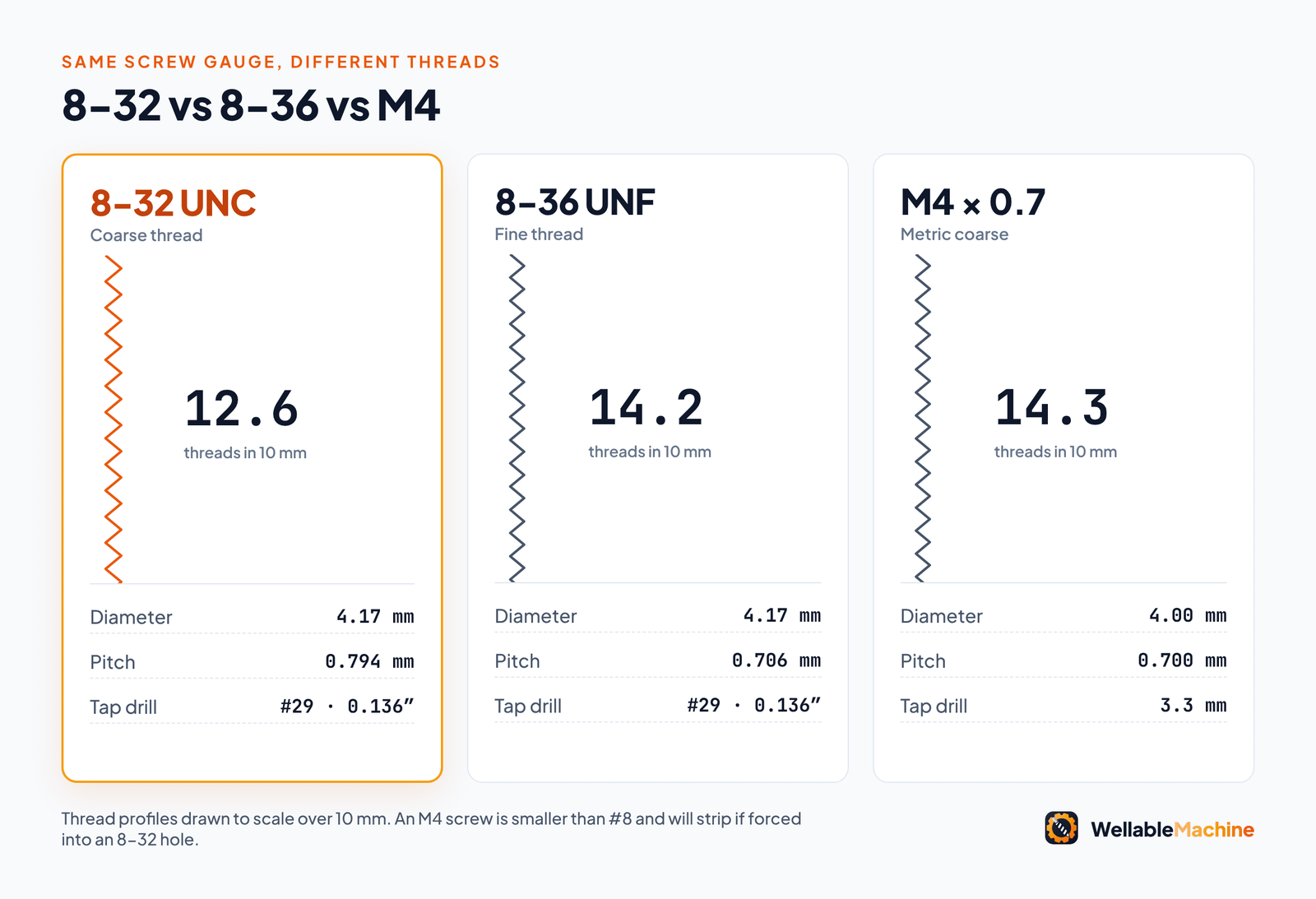
Notice that 8-32 and 8-36 share the same #29 drill. At this small size the difference in thread depth is tiny, so one drill covers both. The 8-36 thread will be slightly fuller.
Other 8-32 Hole Sizes You Might Need
- Forming (roll) tap: about 0.150 in, which is a #25 drill. Confirm with the tap maker.
- Heli-Coil / STI insert: an 11/64 in drill, then an 8-32 STI tap.
- Counterbore for a socket head cap screw: 9/32 in diameter, about 0.164 in deep.
- Self-tapping screw in sheet metal: not a machine-tap situation; use the screw maker’s pilot hole chart.
How to Drill and Tap an 8-32 Hole
- Center punch lightly. Small drills wander easily.
- Drill with a #29 bit. Aluminum: about 3,000 RPM. Mild steel: about 1,800 RPM. Stainless: 800–1,200 RPM with firm feed. Never let the drill rub in stainless; see how to drill stainless steel.
- Deburr or chamfer the hole edge with a countersink.
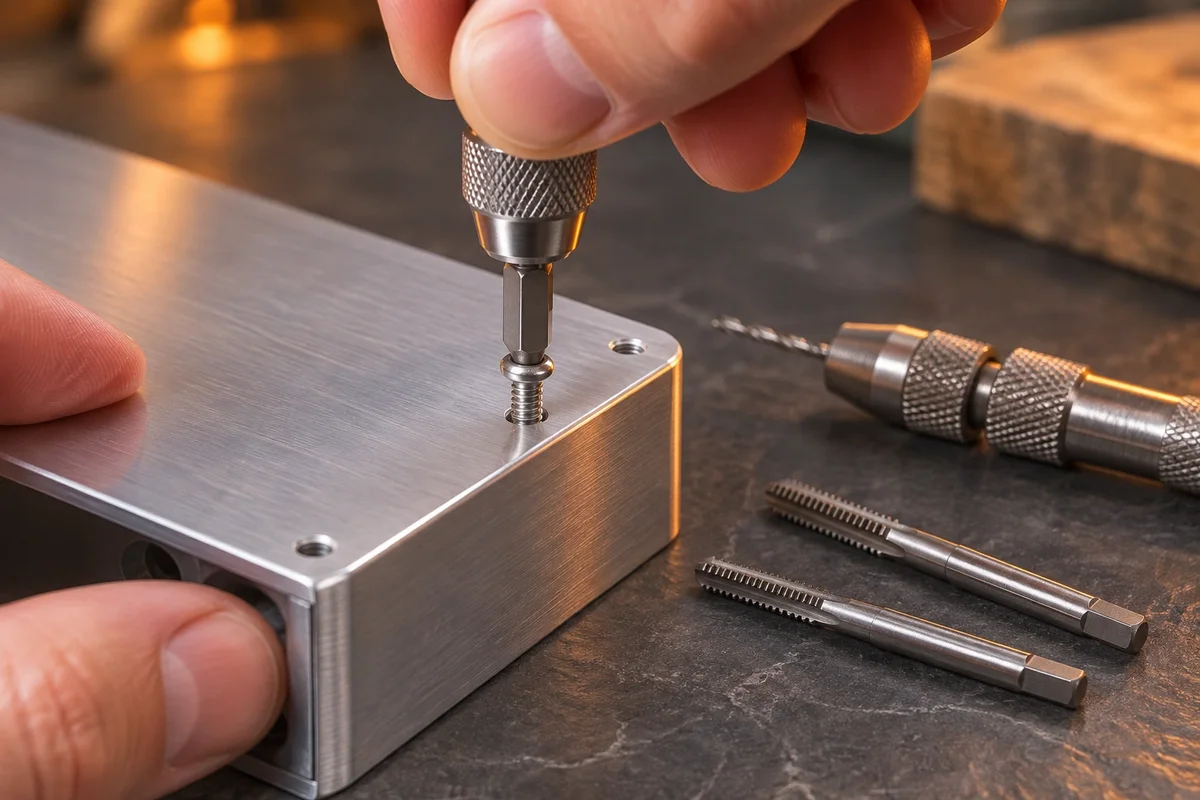
- Use a small T-handle tap wrench. A big wrench gives too much leverage and snaps small taps.
- Turn gently: half a turn forward, a quarter back, with tapping fluid. If you feel a sudden increase in resistance, stop and back out.
- For blind holes, drill at least 0.1 in deeper than the thread, and clear chips often.
Which 8-32 Tap Should You Use?
| Tap type | Best for | Notes |
|---|---|---|
| Plug tap | Most hand tapping | Good balance of starting and depth |
| Taper tap | Starting in hard material | Long lead, cuts gently |
| Bottoming tap | Full threads in blind holes | Use after the plug tap |
| Spiral point tap | Through-holes, power tapping | Stronger core; fewer breaks |
| Forming tap | Aluminum, brass, mild steel | No chips; needs a #25 hole |
A spiral point tap is the single best upgrade for small through-holes. It has a thicker core, pushes chips forward and breaks far less often than a straight-flute hand tap.
How Deep Should an 8-32 Thread Be?
- Steel: about 1 × diameter, 0.164 in (4 mm).
- Aluminum and brass: 1.5–2 × diameter, 0.25–0.33 in.
- Plastics: 2–2.5 × diameter, or use brass heat-set inserts.
- Sheet metal under 1/8 in thick: consider a rivet nut or a clinch nut instead of tapping.
Common 8-32 Tapping Problems (and Fixes)
- Tap snapped: the most common small-tap failure. Use a smaller wrench, more fluid, a #28 drill in steel and a spiral point tap for through-holes.
- Screw spins without tightening: the thread stripped, often in thin aluminum. Use a longer engagement, a Heli-Coil or a nut.
- Screw won’t start: check that it isn’t an M4 or 8-36 screw.
- Drill wanders: use a spot drill or a short, stubby drill bit.
If you use cobalt drills for stainless, our guide to the best drill bits for stainless steel compares M35 and M42 grades. For the next screw size up, see the 10-32 tap drill size.
Tapping 8-32 in Different Materials
Small taps are sensitive to the material you are cutting. The right drill and fluid prevent most broken taps.
| Material | Recommended drill | Tapping fluid | Tips |
|---|---|---|---|
| Aluminum | #29 or 3.4 mm | Light oil or WD-40 | Back out every half turn; aluminum packs the flutes |
| Mild steel | #29 | Sulfurized cutting oil | Small wrench, steady pressure |
| Stainless (304/316) | #28 or 9/64 | Heavy tapping paste | Cobalt spiral point tap, very slow turns |
| Brass | #29 | Light oil or dry | Brass cuts cleanly; watch for grabbing |
| Sheet metal under 1/16 in | #29 | Light oil | Too thin for a strong thread; use a nut or rivet nut |
| Plastics | #29 or 3.4 mm | None | Heat-set insert is stronger for repeated assembly |
For production work in aluminum and mild steel, a forming tap in a #25 hole is the strongest and most reliable 8-32 thread, because there are no chips to jam the tap.
Hand Tapping vs. Power Tapping
At #8 size, a hand tap breaks with very little extra torque, so method matters.
- Hand tapping is best for one-off holes, repairs and hard materials. It gives you a feel for the cut, so you can stop before the tap breaks. Use a taper or plug tap and reverse often to break chips.
- Drill press tapping (spindle turned by hand, power off) keeps the tap perfectly square. It is the easiest way to get straight threads without special tools.
- Power tapping with a tapping head, a tapping drill or a CNC machine is much faster for batches. Use spiral point taps for through-holes and spiral flute taps for blind holes, and keep the speed low: roughly 300–600 RPM in steel and up to 1,000 RPM in aluminum.
- Cordless drill tapping works in thin aluminum and mild steel with a combination drill-tap or a spiral point tap, set to low speed and low clutch. Avoid it in stainless and blind holes.
Where Is 8-32 Used?
8-32 sits between the small 6-32 and the stronger 10-24 and 10-32 threads, and it’s a popular choice when a part needs a little more strength than a #6 screw. You’ll find 8-32 screws in electrical device boxes and switch gear, appliance panels and hinges, sheet metal enclosures, light fixtures, guitar and audio hardware, and many machine guards. The fine 8-36 thread is much rarer and mostly used in instruments and precision assemblies.
If you are designing a part, 8-32 is a good default for thin aluminum brackets and enclosures: it has more thread engagement per inch of material than a 10-24, but the screw is stronger than a 6-32.
Frequently Asked Questions
7 quick answers from our editors
01What size drill bit for an 8-32 tap?
A #29 drill (0.136 in). It is the standard for most materials.
02What metric drill can I use for 8-32?
3.4 mm for soft metals and plastics, or 3.5 mm for steel.
03Can I use a 9/64 drill for 8-32?
Yes. 9/64 in gives about a 58% thread, which is easier to tap and works well in stainless.
04Can I use a 1/8 in drill for 8-32?
No. A 1/8 in hole is too small and will almost certainly break the tap.
05What size clearance hole for an 8-32 screw?
#18 (0.1695 in) for a close fit, #16 (0.177 in) for a free fit.
06Is 8-32 the same as M4?
No. M4 is smaller (4.0 mm vs. 4.17 mm) and has a 0.7 mm pitch. It will strip in an 8-32 hole.
07What drill size for 8-36?
Also a #29 drill (0.136 in).
Bottom Line
For an 8-32 thread, drill with a #29 bit (0.136 in). Use 3.4 or 3.5 mm from a metric set and a #28 or 9/64 in in stainless steel. Drill a #18 or #16 hole when the screw should pass through. Keep the wrench small and the tap well oiled, and an 8-32 thread is easy to get right. For all other sizes, use our tap drill size chart.