12-24 Tap Drill Size: #16 Drill, Clearance Holes & 12-28 Fine Thread
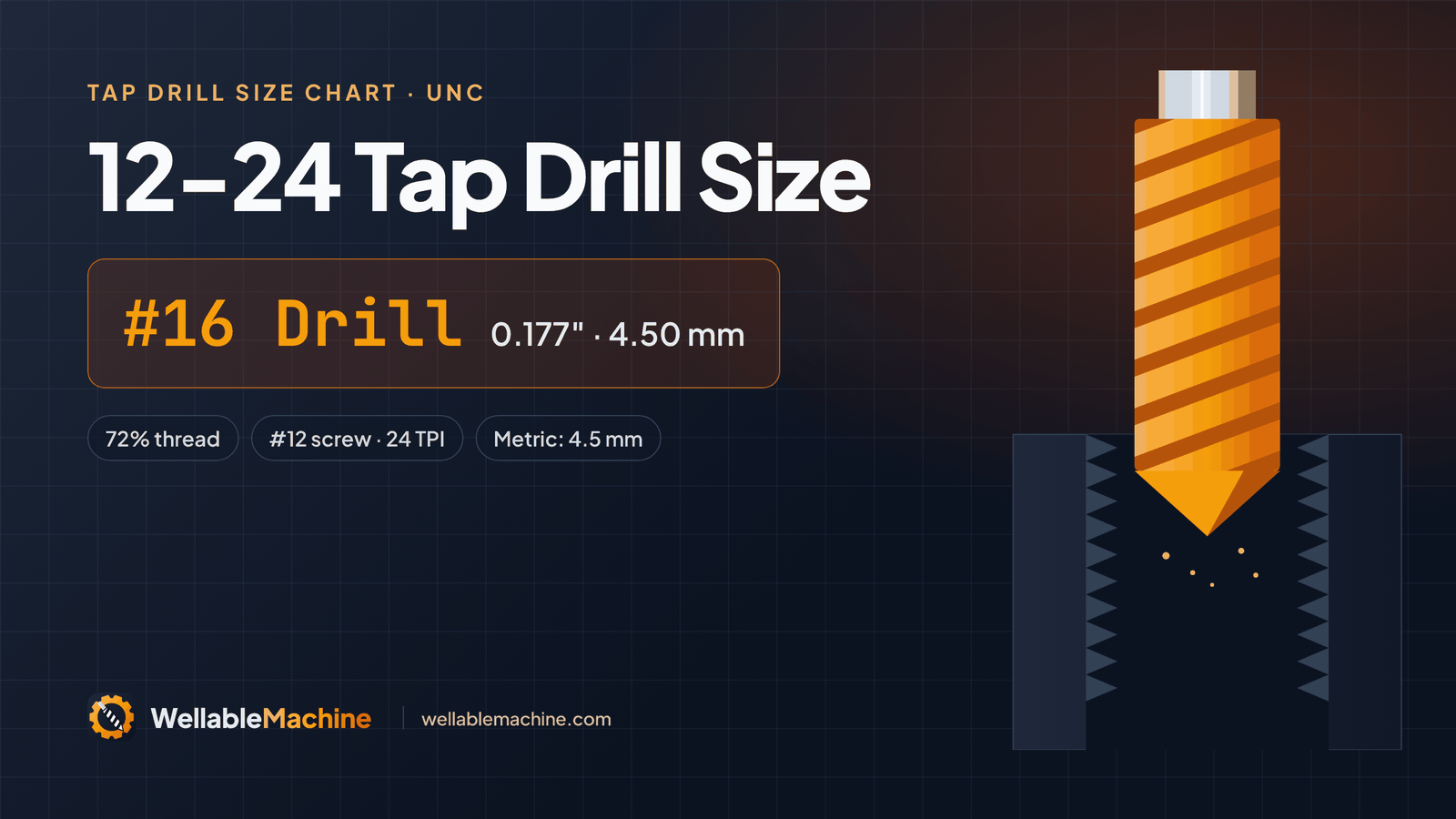
Quick answer: the standard tap drill for a 12-24 UNC thread is a #16 drill (0.177 in / 4.50 mm), which gives about a 72% thread. A 4.5 mm drill is effectively the same size. For stainless steel, a #14 (0.182 in) gives about 63% thread and makes tapping far easier.
12-24 is the largest numbered screw size and sits between #10 and 1/4 in. It is less common than its neighbors, but you will meet it on telecom and older equipment racks, heavy sheet-metal enclosures, steel framing and the self-drilling screws used to fasten heavy-gauge steel. Because 12-24 hardware is rarer, people often find a hole is 12-24 only when a 10-24 or 1/4-20 screw won’t fit. This guide covers the right drill, clearance holes, the 12-28 fine thread and how to tell 12-24 apart from its look-alikes.
12-24 Thread Specifications at a Glance
“12-24” means a #12 screw (0.216 in diameter) with 24 threads per inch, the coarse (UNC) pitch for this size in the Unified Thread Standard. The fine thread is 12-28 UNF.
| Specification | Value |
|---|---|
| Thread series | UNC (Unified National Coarse) |
| Major diameter | 0.216 in (5.49 mm) |
| Threads per inch | 24 |
| Pitch | 0.0417 in (1.058 mm) |
| Basic minor diameter | 0.1619 in (4.11 mm) |
| Standard tap drill | #16 = 0.1770 in (4.50 mm) |
| Easy-tapping drill | #14 = 0.1820 in (4.62 mm) |
| Close-fit clearance | 7/32 = 0.2188 in (5.56 mm) |
| Free-fit clearance | #1 = 0.2280 in (5.79 mm) |
| Hex key, socket head screw | 5/32 in |
12-24 Tap Drill Size Chart by Thread Percentage
Every drill in the table below leaves a different amount of metal for the tap to cut. Tests have shown that a 60% thread is only a few percent weaker than a 75% one, yet it takes far less effort to tap, so there is no prize for the tightest hole. Percentages are worked out with % thread = 76.98 × TPI × (major diameter − drill diameter).
| Drill | Inches | mm | Approx. thread | When to use it |
|---|---|---|---|---|
| #18 | 0.1695 | 4.31 | 86% | Too tight for hand tapping |
| #17 | 0.1730 | 4.39 | 79% | Fuller thread in aluminum |
| #16 | 0.1770 | 4.50 | 72% | Standard choice for most materials |
| 4.5 mm | 0.1772 | 4.50 | 72% | Metric twin of #16 |
| #15 | 0.1800 | 4.57 | 67% | Mild steel by hand |
| #14 | 0.1820 | 4.62 | 63% | Stainless steel |
| #13 | 0.1850 | 4.70 | 57% | Thin sheet with thread-forming screws |
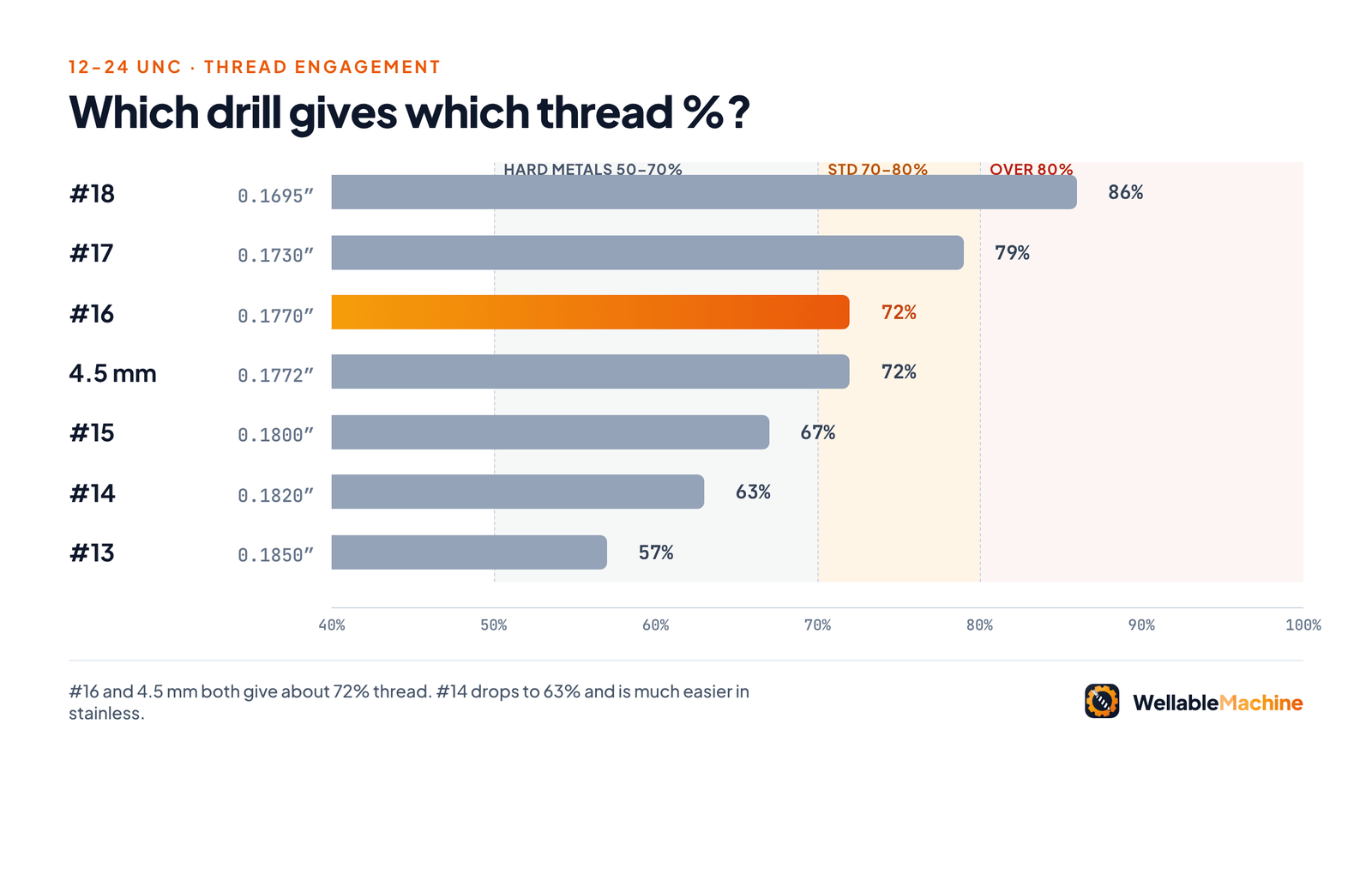
Which drill should you use? Use #16 (or 4.5 mm) in aluminum, brass, cast iron and mild steel tapped by machine. When hand tapping mild steel, #15 gives about 67% and still holds more than the screw can take. In stainless, #14 is the better choice. If you are threading thin sheet with thread-forming screws rather than a tap, #13 or 3/16 in is usually right; follow the screw maker’s chart.
Clearance Hole Sizes for a #12 Screw
Clearance holes are the same for 12-24 and 12-28 screws. Our clearance hole size chart lists the other sizes.
| Fit | Drill | Inches | mm | Use it for |
|---|---|---|---|---|
| Close fit | 7/32 | 0.2188 | 5.56 | Precise alignment |
| Free fit | #1 | 0.2280 | 5.79 | Most assemblies |
| Loose fit | 15/64 | 0.2344 | 5.95 | Sheet metal, slotted brackets |
12-24 Rack Screws and Cage Nuts
Equipment racks use three common thread sizes: 10-32 (the most common in US server and audio racks), 12-24 (common in telecom and older racks) and M6 (cage-nut racks worldwide). They look similar, so check before you buy screws:
- 12-24 is noticeably coarser than 10-32 and slightly smaller than M6.
- A 10-32 screw will drop straight through a 12-24 hole without biting.
- An M6 screw will not start in a 12-24 hole; forcing it cross-threads the rail.
- If a tapped rail is stripped, you can re-tap it to the next size up, or drill it out to a square cage-nut style hole only if the rail is designed for that.
A thread pitch gauge settles the question in seconds: 24 TPI for 12-24, 32 TPI for 10-32 and 1.0 mm for M6.
12-24 Self-Drilling Screws for Heavy Steel
Self-drilling (Tek) screws in #12 size are widely used to fasten roof and wall panels, purlins and brackets to structural steel. Coarse 12-14 threads suit thin and medium steel, while 12-24 threads are made for thicker steel, typically about 1/8 to 1/2 in, because the finer pitch gives more threads in the material. No tap is needed: the drill point cuts a hole close to the #16 size and the screw forms its own thread. Choose a drill-point number (for example #3 or #5) that matches the total steel thickness, and use a screw gun at moderate speed so the point doesn’t burn out.
12-24 vs. 12-28 vs. M5
12-24 sits between M5 and M6 in size. The fine 12-28 thread uses the same diameter with a shallower pitch, so it needs a slightly larger drill.
| Thread | Diameter | Pitch | Tap drill | Typical use |
|---|---|---|---|---|
| 12-24 UNC | 0.216 in (5.49 mm) | 24 TPI (1.058 mm) | #16 | Racks, enclosures, Tek screws |
| 12-28 UNF | 0.216 in (5.49 mm) | 28 TPI (0.907 mm) | #14 | Aircraft, instruments |
| M5 × 0.8 | 5.00 mm | 0.8 mm | 4.2 mm | Metric machines, bikes |

For the sizes either side, see the 10-24 tap drill size and 1/4-20 tap drill size guides.
Other 12-24 Hole Sizes You Might Need
- Forming (roll) tap: about a #9 drill (0.196 in). Check the tap maker’s chart.
- Helicoil / STI insert: about a 15/64 in drill, then the 12-24 STI tap.
- Counterbore for a socket head cap screw: 3/8 in diameter, 0.22 in deep.
- Tap drill for 12-28 UNF: #14 (0.182 in), about 73% thread.
How to Drill and Tap a 12-24 Hole
- Mark and center punch the hole so the drill starts exactly where you want it.
- Drill with a #16 bit. In aluminum, run about 2,200 RPM; in mild steel, about 1,300 RPM; in stainless, slow down to about 650 RPM with steady pressure and cutting oil. Our guide on how to drill stainless steel explains why stainless needs low speed and constant feed.
- Break the sharp edge with a countersink. A small chamfer guides the tap in and keeps a raised burr from forming around the hole.
- Start the tap straight. Use a tap guide block or the drill press spindle to keep the tap square for the first few turns; a #12 tap is strong enough for a normal T-handle wrench.
- Work in short strokes. Turn forward until you feel resistance build, then reverse slightly to snap the chip. Keep the flutes wet with tapping fluid the whole time.
- For blind holes, drill at least 3/16 in (4–5 pitches) deeper than the full thread you need, and finish with a bottoming tap.
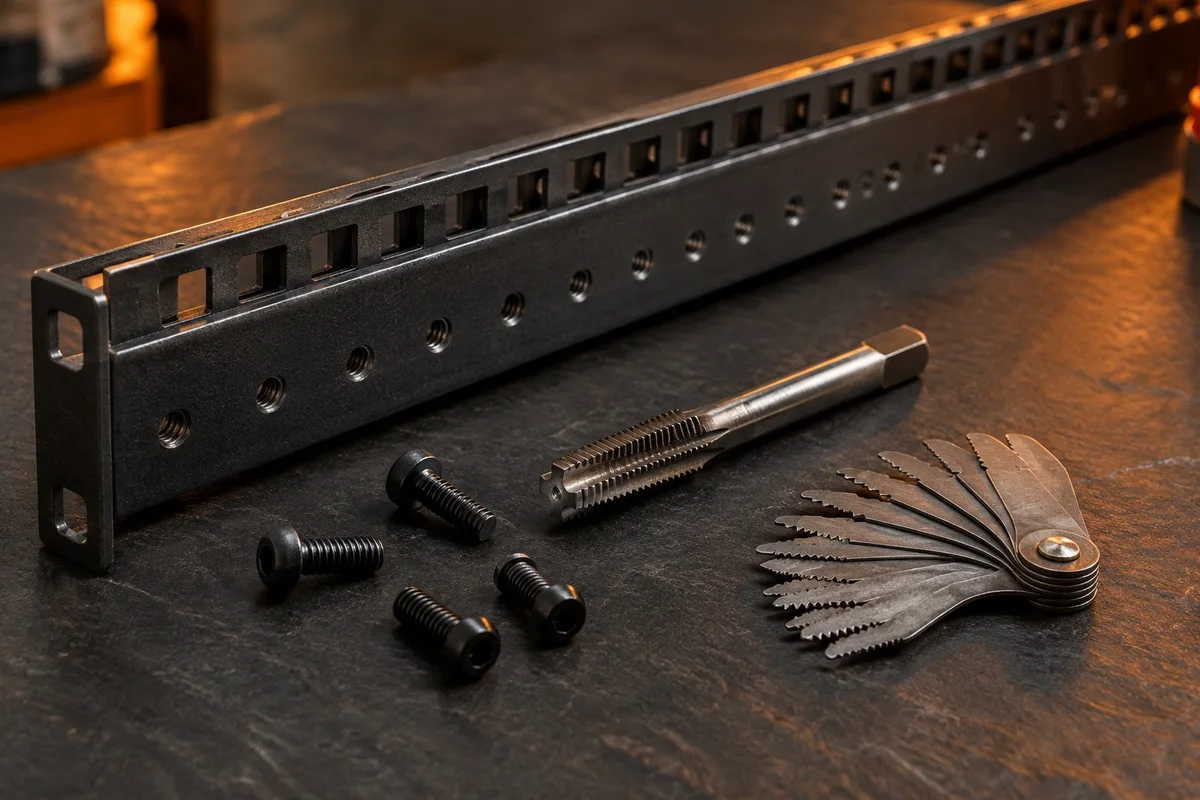
If a tap does break, see how to remove a broken tap. For number-drill sizes either side of #16, use our number and letter drill size chart.
Which 12-24 Tap Should You Use?
A 12-24 tap is not in every small tap set, so buy it on its own. A plug tap handles most work; add a spiral point tap if you thread a lot of through-holes in steel.
| Tap type | Best for | Notes |
|---|---|---|
| Taper tap | Starting threads by hand in hard material | Long chamfer; the easiest to start straight |
| Plug tap | Through-holes and most blind holes | The everyday hand tap |
| Bottoming tap | Full threads to the bottom of blind holes | Use only after a plug or taper tap |
| Spiral point (gun) tap | Through-holes, power tapping | Pushes chips ahead; strong core, fewer breaks |
| Spiral flute tap | Blind holes, power tapping | Lifts chips up and out of the hole |
| Forming (roll) tap | Aluminum, brass, mild steel | No chips; needs a larger #9 (0.196 in) hole |
Tapping 12-24 in Different Materials
The hole size rarely changes from one metal to another, but the fluid, tap and technique do. Here is a quick guide for 12-24 work.
| Material | Recommended drill | Tapping fluid | Tips |
|---|---|---|---|
| Aluminum | #16 | Light oil or WD-40 | Light oil; #17 for fuller threads |
| Mild steel | #16 | Sulfurized cutting oil | Reverse often to break the chip |
| Stainless (304/316) | #14 | Heavy tapping paste | Cobalt tap; low speed |
| Brass | #16 | Dry or light oil | Cuts cleanly; tap can grab at the end |
| Plastic | #15–#14 | Dry | Use deeper engagement or inserts |
How Deep Should a 12-24 Thread Be?
How much thread you need depends on what the hole is made of. Softer materials need longer engagement so the internal thread doesn’t strip before the screw breaks:
- Steel: 1 × diameter, about 0.22 in.
- Aluminum and cast iron: 1.5–2 × diameter, 0.32–0.43 in.
- Plastic: 2–2.5 × diameter, or use threaded inserts.
Where Is 12-24 Used?
12-24 threads are found on telecom and older equipment rack rails, electrical and network enclosures, steel framing and metal building panels (as self-drilling screws), heavy cabinet hardware and some older appliances and machinery.
Common 12-24 Tapping Problems (and How to Fix Them)
- Screw won’t start: it may be M6, 10-32 or 1/4-20. Check with a pitch gauge.
- Tap stiff in steel: drill #15 or #14 instead of #16.
- Thread strips in thin sheet: there are too few threads; use a nut, rivet nut or thread-forming screw.
- Tap breaks in stainless: use a cobalt tap, tapping paste and a #14 hole.
Frequently Asked Questions
7 quick answers from our editors
01What size drill bit for a 12-24 tap?
A #16 drill (0.177 in) or 4.5 mm. It gives about a 72% thread.
02Can I use a 3/16 drill for 12-24?
Only for thread-forming screws or very soft material. 3/16 in (0.1875) gives about 53% thread with a cutting tap.
03What clearance hole for a #12 screw?
7/32 in for a close fit or a #1 drill for a free fit.
04Is 12-24 the same as M6?
No. M6 is 6 mm with a 1.0 mm pitch. 12-24 is 5.49 mm with a 1.058 mm pitch.
05What drill for 12-28?
A #14 drill (0.182 in), about 73% thread.
06Do server racks use 12-24?
Some telecom and older racks do; most US server racks are 10-32 or square holes for M6 cage nuts.
07What hex key fits a #12 socket head screw?
5/32 in.
Bottom Line
For a 12-24 thread, drill a #16 (0.177 in) or 4.5 mm hole, and use #14 in stainless. Clearance is 7/32 in close or #1 free. If a screw won’t fit, check the pitch before reaching for a bigger wrench. For every size, see our tap drill size chart.