M24 Tap Drill Size: 21 mm Drill, Fine Pitch & Clearance Chart

Quick answer: an M24 × 3.0 (coarse) thread needs a 21.0 mm drill (0.827 in), giving about a 77% thread. The inch equivalent is 53/64 in. For the fine M24 × 2.0, drill 22.0 mm. In stainless or tough steel, 21.5 mm makes tapping far more manageable.
M24 is a heavy-industry thread: holding-down bolts, crane and lifting points, large machine frames and steel structures. A hole this size is usually drilled on a radial drill or mag drill and often tapped by machine. This guide gives the drill sizes and clearance holes, and explains how to plan the drilling and tapping so the job goes smoothly.
M24 Thread Specifications at a Glance
“M24” is an ISO metric thread with a 24 mm diameter and a 3.0 mm coarse pitch. Fine pitches of 2.0 and 1.5 mm also exist. See the ISO metric screw thread reference.
| Specification | Value |
|---|---|
| Thread series | ISO metric coarse (M) |
| Major diameter | 24.00 mm (0.945 in) |
| Coarse pitch | 3.0 mm (8.5 TPI) |
| Basic minor diameter (internal) | 20.752 mm |
| Tap drill, coarse | 21.0 mm (0.827 in) |
| Tap drill, M24 × 2.0 | 22.0 mm |
| Inch substitute | 53/64 in = 0.828 in |
| Clearance hole, normal fit | 26.0 mm |
| Hex key / spanner | 19 mm hex key, 36 mm spanner |
M24 Tap Drill Size Chart by Thread Percentage
Thread percentage tells you how much of a full thread the tap actually cuts. A smaller hole gives a fuller thread but needs much more torque, and anything above about 75% adds almost no real strength. That’s why machinists use about 75% in soft metals and drop to 60–70% in hard ones. The values below use % thread = (D − drill) ÷ (1.299 × pitch) × 100.
| Drill | mm | Inches | Approx. thread | When to use it |
|---|---|---|---|---|
| 20.5 mm | 20.50 | 0.8071 | 90% | Far too tight |
| 13/16 | 20.64 | 0.8125 | 86% | Inch drill; very full thread |
| 21.0 mm | 21.00 | 0.8268 | 77% | Standard choice for most materials |
| 53/64 | 21.03 | 0.8281 | 76% | Inch match for 21 mm |
| 21.25 mm | 21.25 | 0.8366 | 71% | Steel by hand |
| 27/32 | 21.43 | 0.8438 | 66% | Inch option for stainless |
| 21.5 mm | 21.50 | 0.8465 | 64% | Stainless and tough steel |
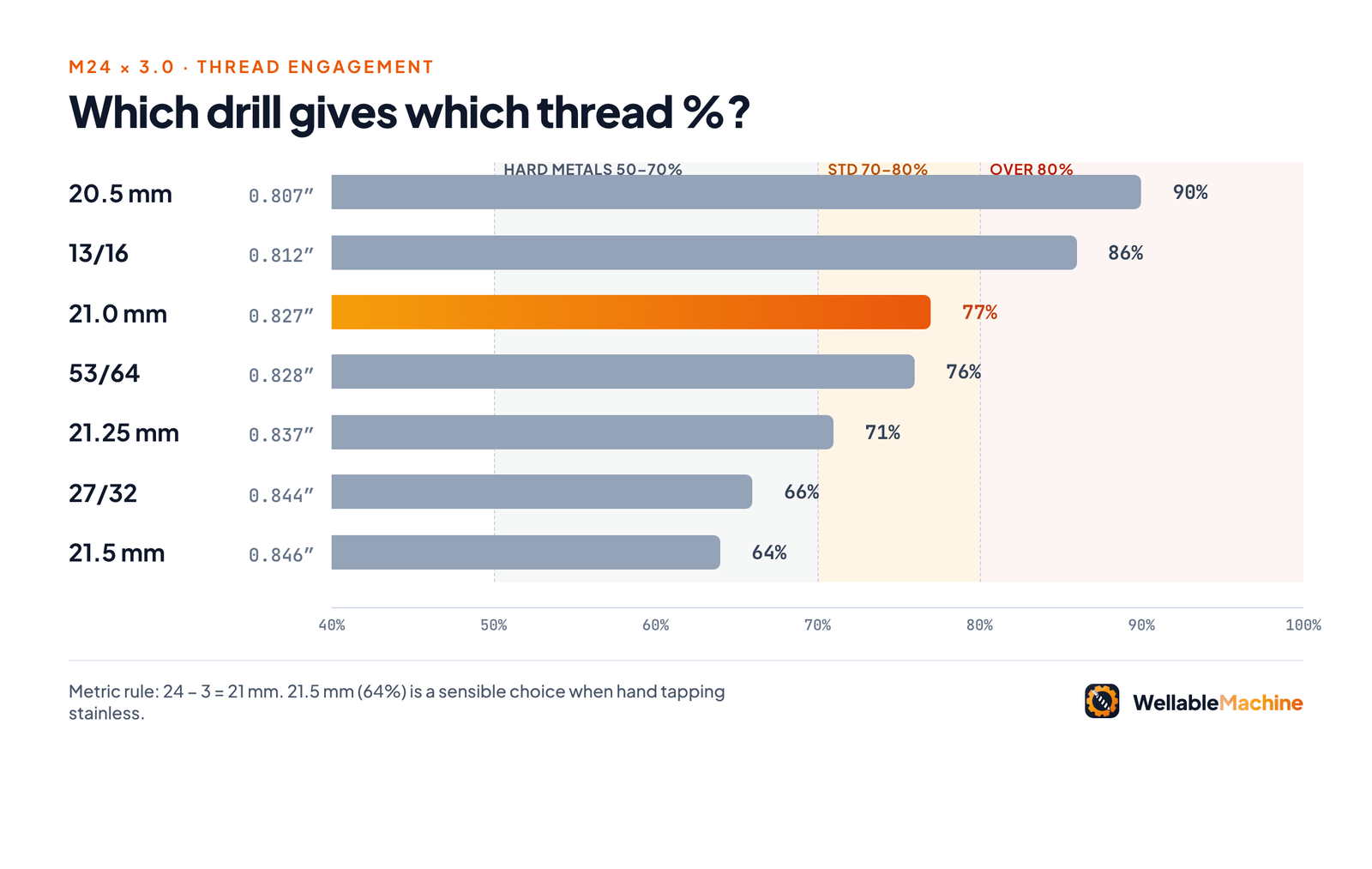
Which drill should you use? Use 21.0 mm in cast iron, aluminum and for machine tapping. For hand tapping mild steel, 21.25 mm cuts the effort while keeping about 71% thread. In stainless, 21.5 mm or 27/32 in is the practical choice. At this size the tap is very strong; the challenge is torque and keeping it square.
Drilling a 21 mm Hole
Most hand drills can’t swing a 21 mm drill. Plan the hole instead:
- Radial or pillar drill: use a Morse taper drill and step up from a 10 mm pilot. Run around 200 RPM in mild steel and 100 RPM in stainless.
- Magnetic drill: an annular cutter is faster in plate, but standard cutters come in whole millimeters; check that 21 mm is available or use 21 mm twist drill on a mag drill with a Weldon adaptor.
- Flood with coolant or cutting oil; a 21 mm drill makes a lot of heat.
- Clamp heavy: a big drill can grab a loose part with enough force to cause injury.
Tapping M24: Machine or Hand?
Hand tapping M24 in steel needs a wrench around 600–700 mm long and real effort, usually in two passes (taper then plug). For more than a couple of holes, a tapping arm or a radial drill with a reversing tapping head is far quicker and keeps the thread square. Spiral-point taps are best for through-holes; spiral-flute taps lift chips out of blind holes.
M24 Holding-Down Bolts
M24 is a common holding-down (anchor) bolt size for columns and heavy machinery. Bolts cast into concrete usually sit in sleeves that allow a little adjustment, and the base plate holes are oversized; follow the structural drawings for hole and washer sizes. For post-installed M24 anchors in existing concrete, use the drill size and embedment the anchor maker specifies; see how to drill into concrete for drilling technique.
Checking Large Threads
For threads this size, a pitch gauge confirms 3.0 mm vs 2.0 mm, but checking fit is best done with a thread plug gauge (go/no-go) or simply with the mating bolt. Run the bolt in by hand for at least three turns before using a wrench; if it binds, stop and find out why rather than forcing it. On critical joints such as lifting points, a damaged or oversize thread means drilling out and fitting a properly rated insert or replacing the part.
Clearance Hole Sizes for an M24 Bolt
ISO 273 clearance holes for M24 bolts:
| Fit | Drill | Inches | mm | Use it for |
|---|---|---|---|---|
| Close (fine) | 25.0 mm | 0.984 | 25.00 | Machined parts |
| Normal (medium) | 26.0 mm | 1.024 | 26.00 | Most assemblies |
| Loose (coarse) | 28.0 mm | 1.102 | 28.00 | Structural steel, base plates |
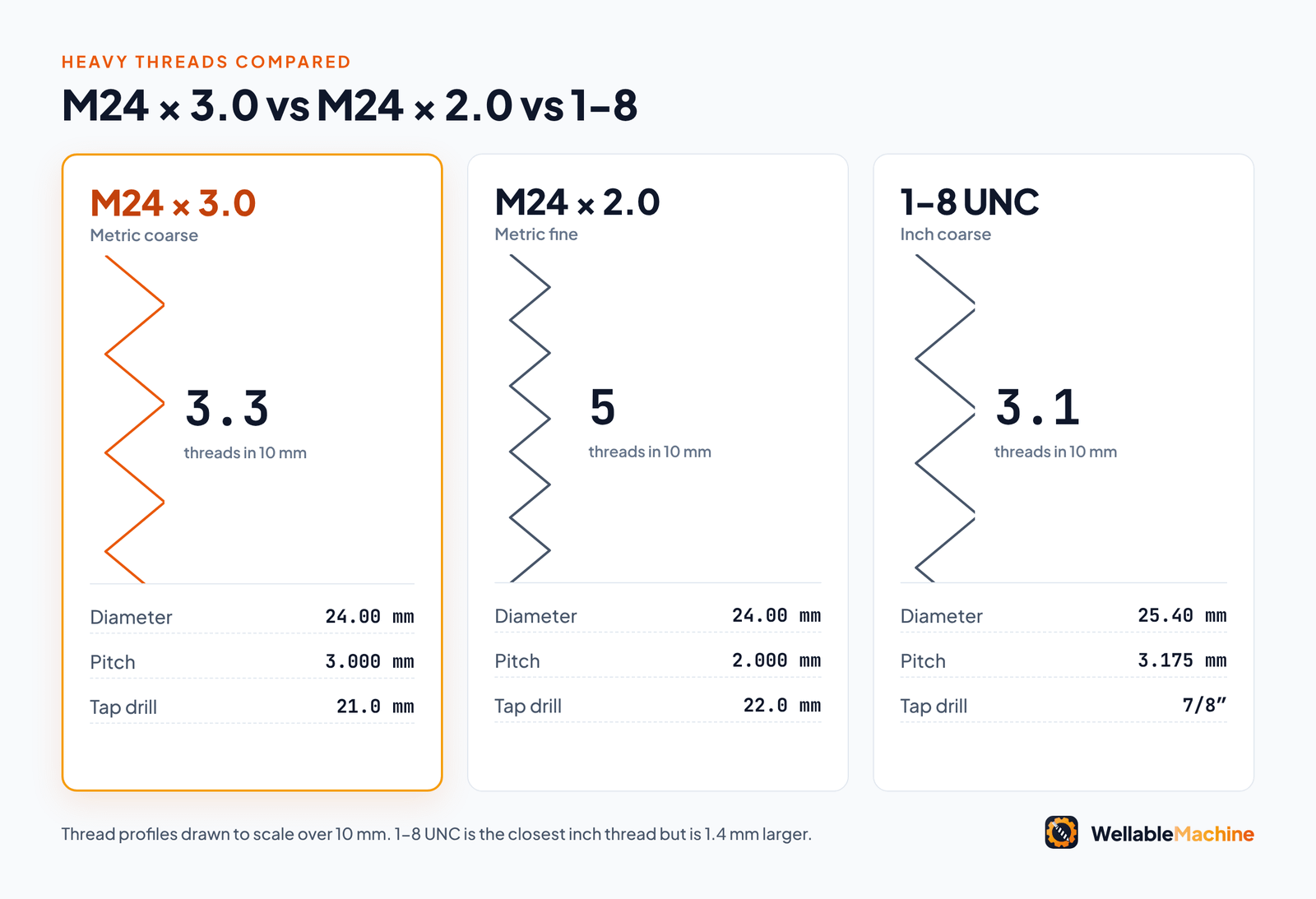
M24 × 3.0 vs. M24 × 2.0 vs. 1-8
The nearest inch size to M24 is 1-8 UNC. It won’t enter an M24 hole, but an M24 bolt in a 1 in hole will be loose and weak, so measure before you buy.
| Thread | Diameter | Pitch | Tap drill | Typical use |
|---|---|---|---|---|
| M24 × 3.0 | 24.00 mm | 3.0 mm | 21.0 mm | Structures, holding-down bolts |
| M24 × 2.0 | 24.00 mm | 2.0 mm | 22.0 mm | Hydraulics, fine adjustment |
| 1-8 UNC | 25.40 mm | 3.175 mm (8 TPI) | 7/8 in | US heavy equipment |
For the next size down, see the M20 tap drill size guide.
Other M24 Hole Sizes You Might Need
- Forming (roll) tap: about 22.6 mm. Check the tap maker’s chart.
- Heli-Coil / STI insert: about 25 mm drill, then the M24 × 3.0 STI tap.
- Counterbore for a socket head cap screw: 40 mm diameter, 25 mm deep.
How to Drill and Tap a M24 Hole
- Mark and center punch the hole so the drill starts exactly where you want it.
- Drill with a 21.0 mm bit. In aluminum, run about 450 RPM; in mild steel, about 300 RPM; in stainless, slow down to about 150 RPM with steady pressure and cutting oil. Our guide on how to drill stainless steel explains why stainless needs low speed and constant feed.
- Chamfer the top of the hole with a countersink so the tap starts square and the first thread doesn’t lift.
- Start the tap straight. Start the tap in the drill spindle or with a tapping guide. At this size, even a degree of tilt shows up as a wobbly bolt.
- Cut and break the chip: half a turn forward, a quarter turn back, with tapping fluid. Light oil suits aluminum; sulfurized cutting oil suits steel.
- For blind holes, drill at least 9 mm (3 pitches) deeper than the full thread you need, and finish with a bottoming tap.

For speeds on big drills, see our drill speed chart. For stainless, our guide on how to drill stainless steel explains why slow speed and steady feed matter.
Tapping M24 in Different Materials
The 21.0 mm drill is right for most materials, but each metal behaves differently under the tap. This table sums up what works.
| Material | Recommended drill | Tapping fluid | Tips |
|---|---|---|---|
| Aluminum | 21.0 mm | Light oil or WD-40 | Light oil; long engagement |
| Mild steel | 21.0 mm | Sulfurized cutting oil | Reverse often to break the chip |
| Stainless (304/316) | 21.5 mm | Heavy tapping paste | Cobalt tap; machine tap if possible |
| Brass | 21.0 mm | Dry or light oil | Cuts cleanly; tap can grab at the end |
| Cast iron machine bases | 21.0 mm | Dry or air blast | Spot-face for nuts and eye bolts |
How Deep Should a M24 Thread Be?
Thread engagement matters more than thread percentage. The first few threads carry most of the load, so going much deeper adds effort without adding strength. Use these lengths as a starting point:
- Steel: 1 × diameter, 24 mm; 1.5 × for lifting points.
- Cast iron: 1.5 × diameter, 36 mm.
- Aluminum: 2 × diameter, 48 mm, or an insert.
Where Is M24 Used?
M24 is used for holding-down bolts, column splices and structural connections, crane and lifting points, large machine frames and press beds, wind turbine and energy equipment, and heavy hydraulic components.
Common M24 Tapping Problems (and How to Fix Them)
- Tap won’t turn by hand: use 21.25–21.5 mm and a longer wrench, or a tapping machine.
- Hole oversize: step-drill on a rigid machine.
- Bolt loose: check it isn’t 1 in (25.4 mm) hardware.
- Thread crooked: start in the spindle or with a guide.
Frequently Asked Questions
7 quick answers from our editors
01What size drill bit for an M24 tap?
21.0 mm for M24 × 3.0. It gives about a 77% thread.
02What drill for M24 x 2?
22.0 mm.
03What inch drill for M24?
53/64 in (0.828 in).
04What clearance hole for M24?
25 mm fine, 26 mm medium or 28 mm coarse.
05What spanner size for M24?
36 mm for a standard hex head; 19 mm hex key for a socket head cap screw.
06Can I drill a 21 mm hole with a hand drill?
Not safely. Use a pillar drill, radial drill or magnetic drill.
07Is M24 the same as 1 inch?
No. 1 in is 25.4 mm with 8 TPI; M24 is 24 mm with a 3.0 mm pitch.
Bottom Line
For coarse M24 × 3.0, drill 21.0 mm (or 53/64 in), and use 21.25–21.5 mm for hand tapping steel and stainless. M24 × 2.0 needs 22.0 mm. Clearance is 26 mm for a normal fit. Step-drill on a rigid machine and tap by machine when you can. For every size, see our tap drill size chart.