9/16-18 Tap Drill Size: 33/64″ Drill, Clearance Holes & Truck Uses

Quick answer: the standard tap drill for a 9/16-18 UNF thread is a 33/64 in drill (0.5156 in / 13.10 mm), which gives about a 65% thread. For a slightly fuller thread in aluminum or cast iron, use a 13 mm drill (about 70%). In stainless steel, 13.25 mm keeps the tapping torque down.
9/16-18 is the fine-thread version of the 9/16 in bolt. It is common on trucks and trailers, where it is used for leaf spring U-bolts, some wheel studs, steering and suspension parts, and on machinery that needs a strong thread with fine adjustment. Because 9/16 in sits between the popular 1/2 in and 5/8 in sizes, the tap drill is one people often have to look up. This guide gives the drill, clearance holes and the differences between 9/16-18, 9/16-12 and M14.
9/16-18 Thread Specifications at a Glance
“9/16-18” means a 9/16 in (0.5625 in) diameter thread with 18 threads per inch. It is the fine (UNF) pitch for this size in the Unified Thread Standard; the coarse pitch is 9/16-12.
| Specification | Value |
|---|---|
| Thread series | UNF (Unified National Fine) |
| Major diameter | 0.5625 in (14.29 mm) |
| Threads per inch | 18 |
| Pitch | 0.0556 in (1.411 mm) |
| Basic minor diameter | 0.4903 in (12.45 mm) |
| Standard tap drill | 33/64 = 0.5156 in (13.10 mm) |
| Fuller-thread drill | 13 mm = 0.5118 in |
| Close-fit clearance | 37/64 = 0.5781 in (14.68 mm) |
| Free-fit clearance | 39/64 = 0.6094 in (15.48 mm) |
| Wrench size, hex bolt | 13/16 in |
9/16-18 Tap Drill Size Chart by Thread Percentage
Thread percentage tells you how much of a full thread the tap actually cuts. A smaller hole gives a fuller thread but needs much more torque, and anything above about 75% adds almost no real strength. That’s why machinists use about 75% in soft metals and drop to 60–70% in hard ones. The values below use % thread = 76.98 × TPI × (major diameter − drill diameter).
| Drill | Inches | mm | Approx. thread | When to use it |
|---|---|---|---|---|
| 1/2 | 0.5000 | 12.70 | 87% | Far too tight; tap will bind |
| 12.75 mm | 0.5020 | 12.75 | 84% | Too tight for hand tapping |
| 13 mm | 0.5118 | 13.00 | 70% | Fuller thread in aluminum and cast iron |
| 33/64 | 0.5156 | 13.10 | 65% | Standard chart size; right for steel |
| 13.25 mm | 0.5217 | 13.25 | 57% | Stainless and very tough steel |
| 17/32 | 0.5312 | 13.49 | 43% | Too loose for real loads |
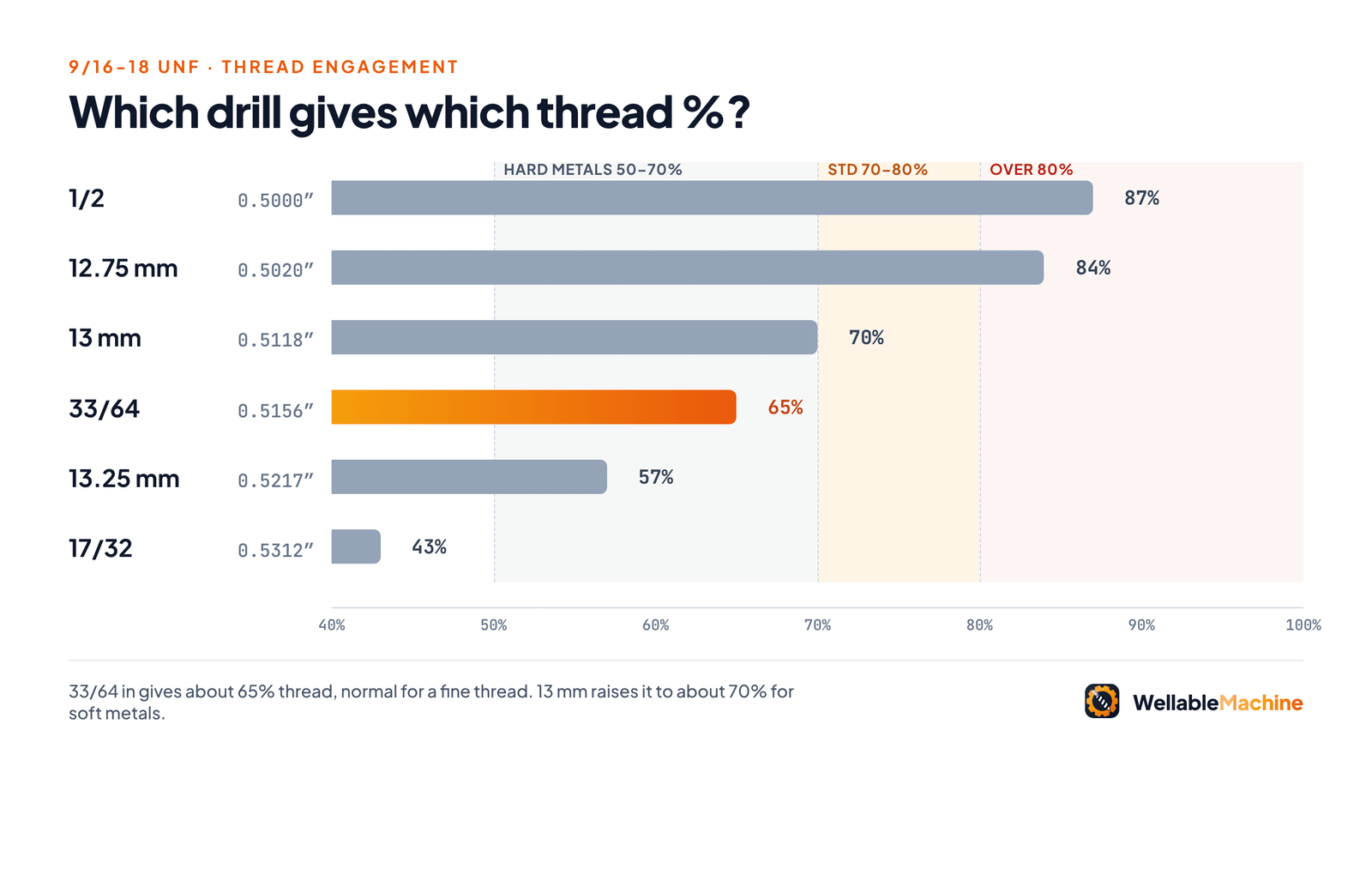
Which drill should you use? 33/64 in is the drill most charts list, and its 65% thread is plenty for a fine thread in steel when you have at least one diameter of engagement. In aluminum, brass or cast iron, a 13 mm drill gives a little more thread for the same effort. In stainless or hardened steel, step up to 13.25 mm. Avoid 1/2 in and 12.75 mm: they leave so much metal that hand tapping becomes a fight.
9/16-18 on Trucks and Trailers
Most people meet 9/16-18 on a vehicle rather than in a machine shop. Common places include:
- Leaf spring U-bolts: 9/16-18 is one of the standard U-bolt threads on pickups and trailers. Always fit new nuts, tighten in a cross pattern and re-torque after the first few hundred miles.
- Wheel studs: some older trucks and many trailers use 9/16-18 studs. Never re-tap a damaged wheel stud; replace it.
- Steering and suspension: tie rod ends, sway bar links and control arm bolts on older American vehicles.
- Hitch and towing hardware: some receivers and brackets use 9/16 in bolts in both pitches, so check before you buy.
For damaged external threads on studs, a thread file or die is the right tool; see our guide on how to use a tap and die. If a stud snaps, see how to remove a broken bolt.
Fine vs Coarse: Which 9/16 Thread Do You Have?
9/16-18 and 9/16-12 bolts look almost the same, but a 9/16-12 nut will spin on for a turn and then jam on an 18 TPI bolt. The quickest check is a thread pitch gauge: the 18 leaf sits flat on a 9/16-18 thread. Without a gauge, count threads over 1 in with a ruler. Fine threads are stronger in tension for the same diameter and resist loosening better, which is why they are used on vehicles. Coarse threads start more easily, tolerate dirt and damage, and are preferred in aluminum and cast iron.
Clearance Hole Sizes for a 9/16 in Bolt
Clearance holes are the same for 9/16-18 and 9/16-12 bolts. For other sizes, see our clearance hole size chart.
| Fit | Drill | Inches | mm | Use it for |
|---|---|---|---|---|
| Close fit | 37/64 | 0.5781 | 14.68 | Machined parts |
| Free fit | 39/64 | 0.6094 | 15.48 | Most assemblies |
| Loose fit | 5/8 | 0.6250 | 15.88 | Fabrication, slight misalignment |
9/16-18 vs. 9/16-12 vs. M14
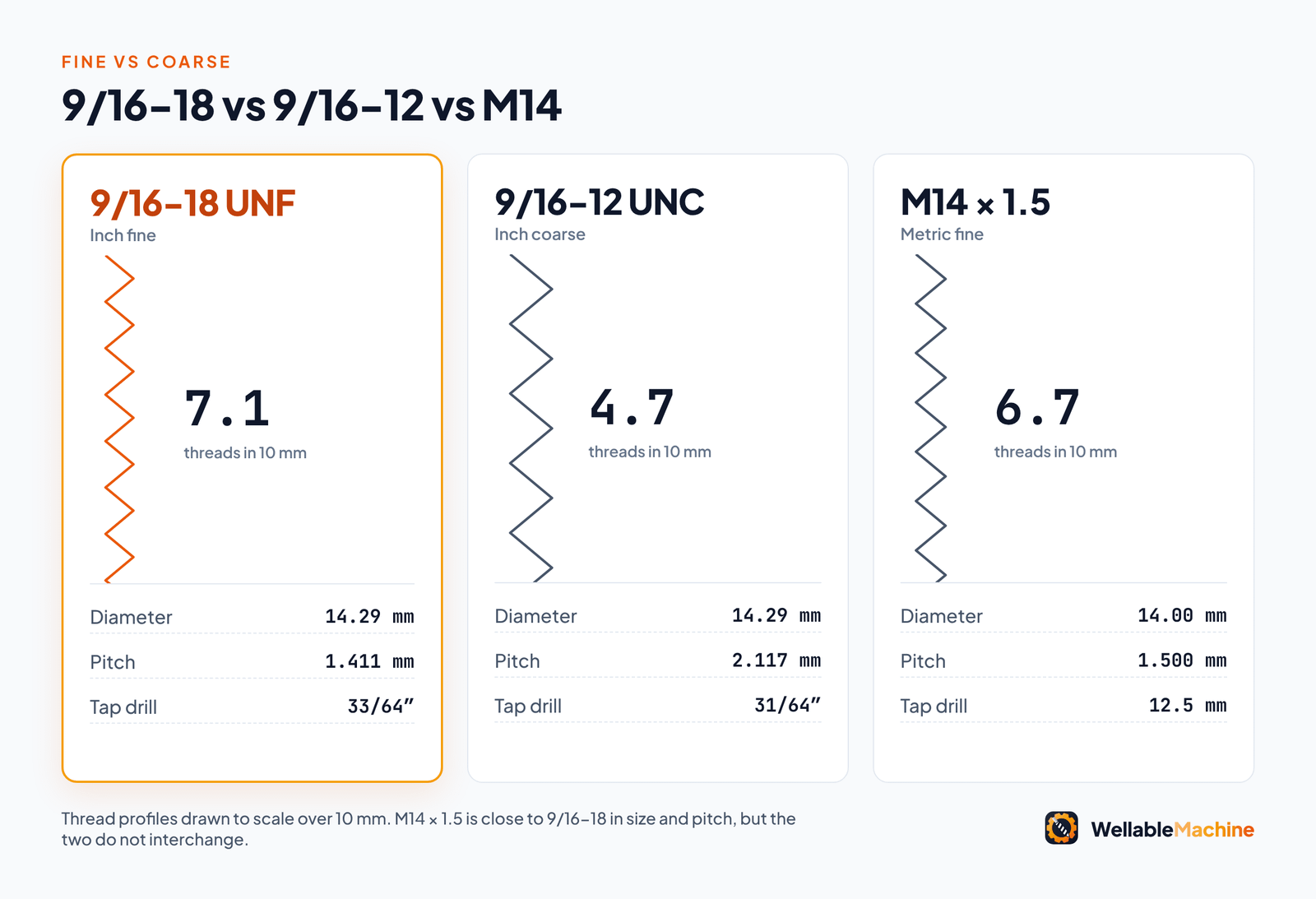
9/16-18 and 9/16-12 share a diameter. M14 × 1.5 is the metric size most often confused with 9/16-18, because the diameter and pitch are both close.
| Thread | Diameter | Pitch | Tap drill | Typical use |
|---|---|---|---|---|
| 9/16-18 UNF | 0.5625 in (14.29 mm) | 18 TPI (1.411 mm) | 33/64 in | U-bolts, wheel studs, suspension |
| 9/16-12 UNC | 0.5625 in (14.29 mm) | 12 TPI (2.117 mm) | 31/64 in | General and structural |
| M14 × 1.5 | 14.00 mm | 1.5 mm | 12.5 mm | Wheel bolts, oil drain plugs |
For the next sizes, see the 1/2-20 tap drill size and 5/8-18 tap drill size guides. For the coarse thread, see 9/16-12.
Other 9/16-18 Hole Sizes You Might Need
- Forming (roll) tap: about 0.531 in (13.5 mm). Check the tap maker’s chart.
- Helicoil / STI insert: about a 37/64 in drill, then the 9/16-18 STI tap.
- Counterbore for a socket head cap screw: 7/8 in diameter, 9/16 in deep.
- Left-hand thread: same 33/64 in drill; use a 9/16-18 LH tap.
How to Drill and Tap a 9/16-18 Hole
- Mark and center punch the hole so the drill starts exactly where you want it.
- Drill with a 33/64 bit. In aluminum, run about 750 RPM; in mild steel, about 450 RPM; in stainless, slow down to about 200 RPM with steady pressure and cutting oil. Our guide on how to drill stainless steel explains why stainless needs low speed and constant feed.
- Chamfer the top of the hole with a countersink so the tap starts square and the first thread doesn’t lift.
- Start the tap straight. Use a long tap wrench and check square in two directions after the first full turn. Fine threads cross-thread easily if the tap leans.
- Cut and break the chip: half a turn forward, a quarter turn back, with tapping fluid. Light oil suits aluminum; sulfurized cutting oil suits steel.
- For blind holes, drill at least 1/4 in (about 4 pitches) deeper than the full thread you need, and finish with a bottoming tap.
Large drills in steel need low speed; check our drill speed chart. If the hole needs to be enlarged in steps, see our fractional drill bit sizes chart for the sizes in between.
Which 9/16-18 Tap Should You Use?
A plug tap handles most jobs. For thick steel, start with a taper tap so the thread starts straight.
| Tap type | Best for | Notes |
|---|---|---|
| Taper tap | Starting threads by hand in hard material | Long chamfer; the easiest to start straight |
| Plug tap | Through-holes and most blind holes | The everyday hand tap |
| Bottoming tap | Full threads to the bottom of blind holes | Use only after a plug or taper tap |
| Spiral point (gun) tap | Through-holes, power tapping | Pushes chips ahead; strong core, fewer breaks |
| Spiral flute tap | Blind holes, power tapping | Lifts chips up and out of the hole |
| Forming (roll) tap | Aluminum, brass, mild steel | No chips; needs a larger 13.5 mm hole |
Tapping 9/16-18 in Different Materials
The 33/64 drill is right for most materials, but each metal behaves differently under the tap. This table sums up what works.
| Material | Recommended drill | Tapping fluid | Tips |
|---|---|---|---|
| Aluminum | 33/64 | Light oil or WD-40 | 13 mm for a fuller thread |
| Mild steel | 33/64 | Sulfurized cutting oil | Reverse often to break the chip |
| Stainless (304/316) | 13.25 mm | Heavy tapping paste | Cobalt tap; heavy paste |
| Brass | 33/64 | Dry or light oil | Cuts cleanly; tap can grab at the end |
| Cast iron | 13 mm | Dry or kerosene | Chips break into powder; clear often |
How Deep Should a 9/16-18 Thread Be?
Thread engagement matters more than thread percentage. The first few threads carry most of the load, so going much deeper adds effort without adding strength. Use these lengths as a starting point:
- Steel: 1–1.5 × diameter, 9/16–7/8 in.
- Cast iron: 1.5 × diameter, about 7/8 in.
- Aluminum: 2 × diameter, about 1-1/8 in, or use a thread insert.
Where Is 9/16-18 Used?
9/16-18 UNF is used on leaf spring U-bolts, some truck and trailer wheel studs, tie rod ends and steering parts, sway bar links, hydraulic and agricultural equipment, and machine adjusting screws.
Common 9/16-18 Tapping Problems (and How to Fix Them)
- Nut jams after one turn: it is probably a 9/16-12 nut on a fine thread. Check with a pitch gauge.
- Tap very hard to turn: the hole may be 1/2 in. Open it to 33/64 in.
- Loose thread in aluminum: use 13 mm, or fit an insert.
- Thread damaged on a stud: chase it with a die or thread file instead of re-tapping the nut.
Frequently Asked Questions
6 quick answers from our editors
01What drill size for a 9/16-18 tap?
A 33/64 in drill (0.5156 in), which gives about 65% thread. 13 mm gives a slightly fuller thread.
02Is 9/16-18 fine or coarse?
Fine (UNF). The coarse 9/16 in thread is 9/16-12.
03What clearance hole for a 9/16 bolt?
37/64 in for a close fit or 39/64 in for a free fit.
04What wrench fits a 9/16 bolt?
13/16 in for a standard hex head and 7/8 in for heavy hex.
05Is 9/16-18 the same as M14 × 1.5?
No. They are close in size and pitch, but the threads will not mate properly.
06What metric drill for 9/16-18?
13 mm, or 13.25 mm for easier tapping in hard steel.
Bottom Line
For 9/16-18 UNF, drill 33/64 in for most work, 13 mm for a fuller thread in soft metals and 13.25 mm in stainless. Clearance is 39/64 in for a free fit. Check the pitch before forcing any 9/16 nut. For every size, see our tap drill size chart.