5/8-18 Tap Drill Size: 37/64″ Drill, Clearance & Rod End Tips
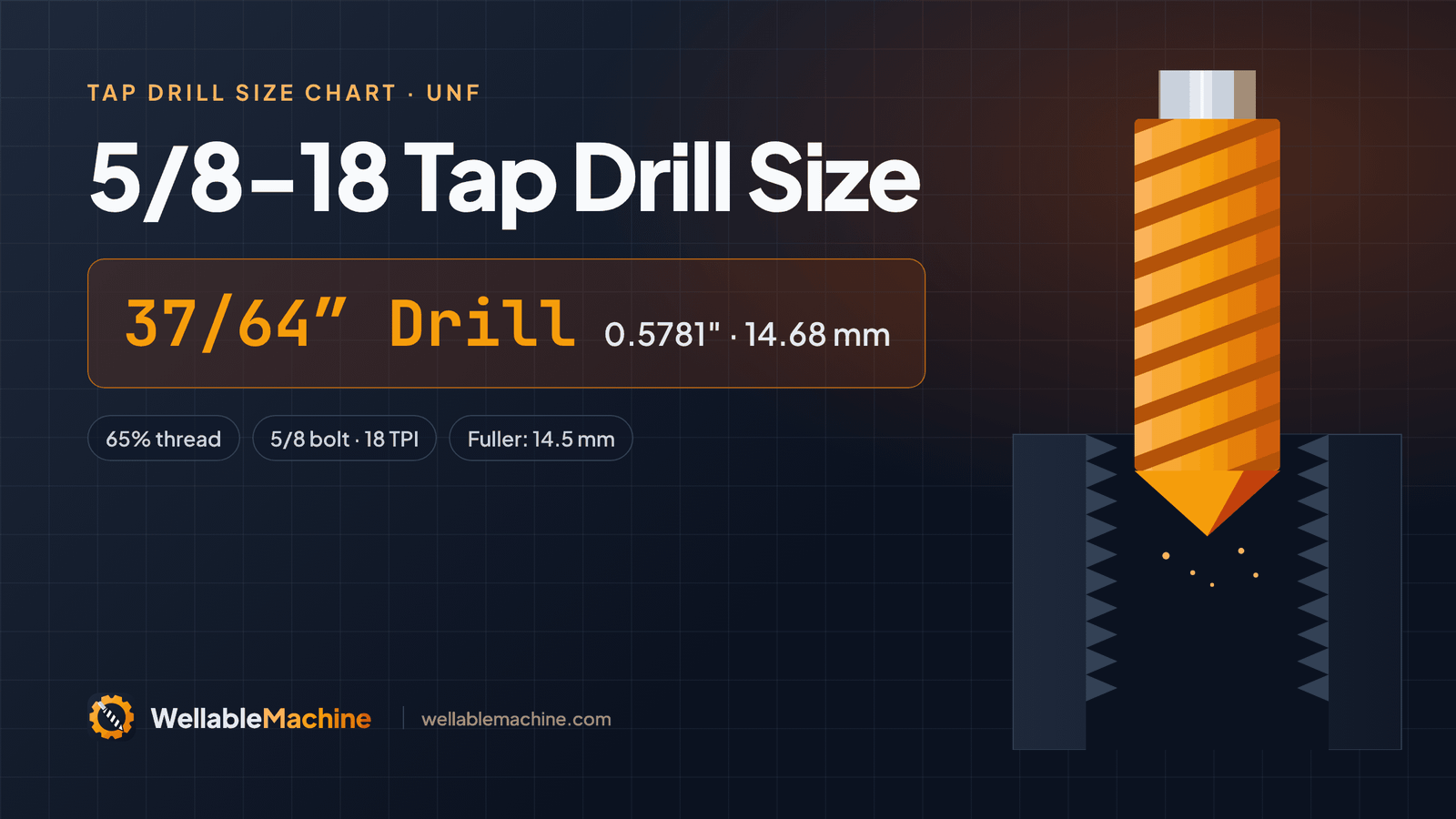
Quick answer: the standard tap drill for a 5/8-18 UNF thread is a 37/64 in drill (0.5781 in / 14.68 mm), which gives about a 65% thread. For a fuller 75% thread in aluminum or cast iron, use a 14.5 mm drill. In stainless, 14.75 mm keeps tapping torque low.
5/8-18 is the fine-thread 5/8 in bolt. It shows up wherever a strong, finely adjustable thread is needed: heim joints and rod ends, tie rods and suspension links, hydraulic cylinder rods, axles and machine leveling feet. Because the fine pitch has a shallow thread, it holds well in thinner walls, but the tap drill is easy to get wrong. This guide explains the drill sizes, clearance holes and how 5/8-18 compares with 5/8-11 and M16.
5/8-18 Thread Specifications at a Glance
“5/8-18” is a 5/8 in (0.625 in) diameter thread with 18 threads per inch, the fine (UNF) pitch for this size in the Unified Thread Standard.
| Specification | Value |
|---|---|
| Thread series | UNF (Unified National Fine) |
| Major diameter | 0.625 in (15.88 mm) |
| Threads per inch | 18 |
| Pitch | 0.0556 in (1.411 mm) |
| Basic minor diameter | 0.5528 in (14.04 mm) |
| Standard tap drill | 37/64 = 0.5781 in (14.68 mm) |
| Fuller-thread drill | 14.5 mm = 0.5709 in |
| Close-fit clearance | 41/64 = 0.6406 in (16.27 mm) |
| Free-fit clearance | 21/32 = 0.6562 in (16.67 mm) |
| Wrench size, hex bolt | 15/16 in |
5/8-18 Tap Drill Size Chart by Thread Percentage
Every drill in the table below leaves a different amount of metal for the tap to cut. Tests have shown that a 60% thread is only a few percent weaker than a 75% one, yet it takes far less effort to tap, so there is no prize for the tightest hole. Percentages are worked out with % thread = 76.98 × TPI × (major diameter − drill diameter).
| Drill | Inches | mm | Approx. thread | When to use it |
|---|---|---|---|---|
| 9/16 | 0.5625 | 14.29 | 87% | Too tight; very hard to tap |
| 14.25 mm | 0.5610 | 14.25 | 89% | Too tight for hand tapping |
| 14.5 mm | 0.5709 | 14.50 | 75% | Fuller thread in aluminum |
| 37/64 | 0.5781 | 14.68 | 65% | Standard chart size; good in steel |
| 14.75 mm | 0.5807 | 14.75 | 61% | Stainless and tough steels |
| 19/32 | 0.5938 | 15.08 | 43% | Too loose for real loads |
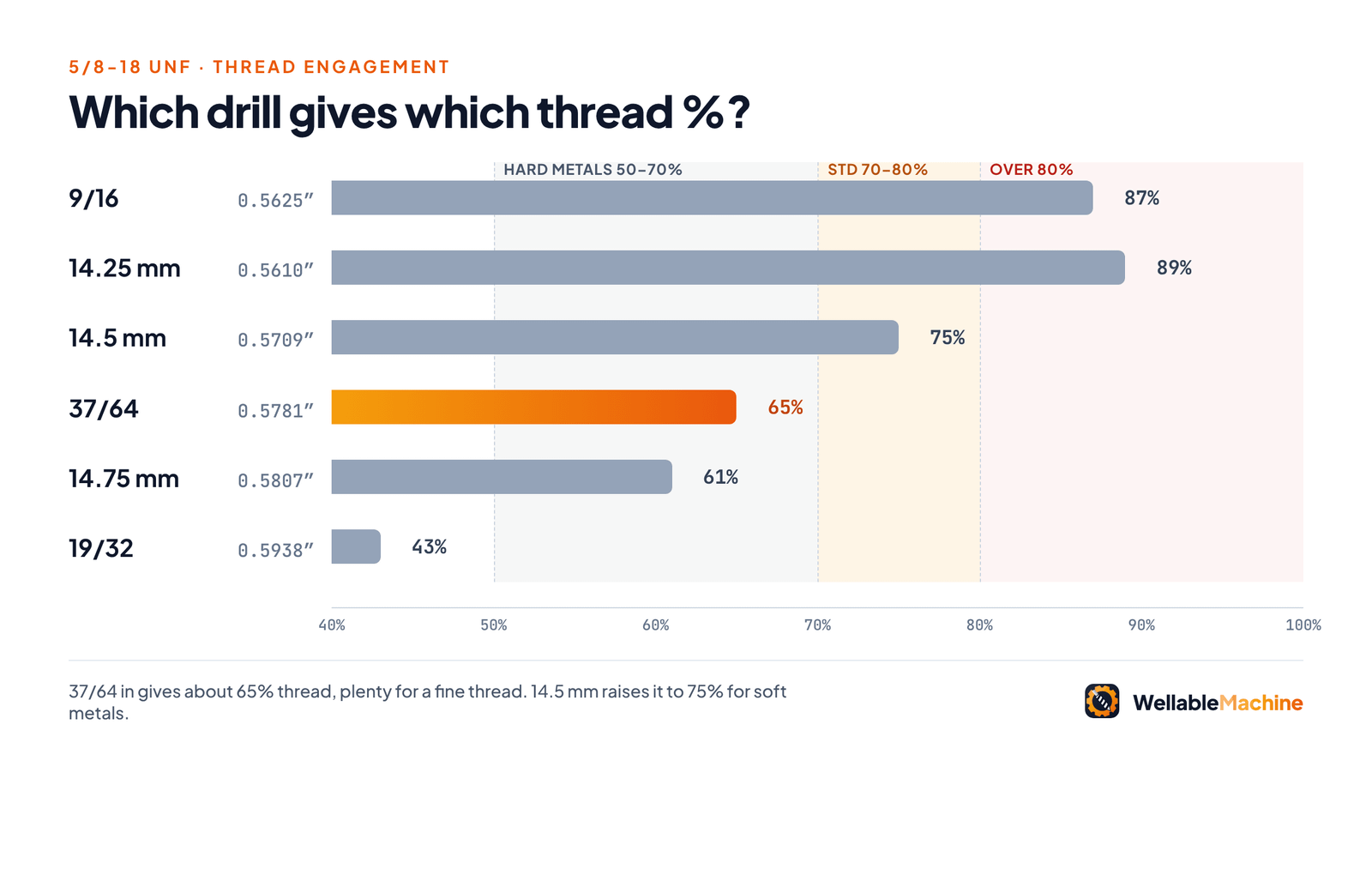
Which drill should you use? 37/64 in is the size most charts list, and its 65% thread is more than strong enough for a fine thread in steel. If you are tapping aluminum, brass or cast iron and want maximum strength, 14.5 mm gives about 75%. In stainless or when hand tapping thick steel, 14.75 mm (61%) is easier still. Avoid 9/16 in, which is close to the minor diameter.
Clearance Hole Sizes for a 5/8 in Bolt
Clearance holes are the same for 5/8-18 and 5/8-11 bolts. For other sizes, see our clearance hole size chart.
| Fit | Drill | Inches | mm | Use it for |
|---|---|---|---|---|
| Close fit | 41/64 | 0.6406 | 16.27 | Machined parts |
| Free fit | 21/32 | 0.6562 | 16.67 | General assemblies |
| Standard structural | 11/16 | 0.6875 | 17.46 | Steel connections |
Why 5/8-18 Uses a Smaller Thread Percentage
On most charts, coarse threads get a drill that gives about 75% thread. On fine threads like 5/8-18, the chart drill often gives a bit less, around 65%. That is deliberate. A fine thread has more threads per inch of engagement, so each thread carries less load, and tests show that a 60–65% fine thread is only slightly weaker than a 75% one. Meanwhile, tapping a fuller fine thread takes much more torque. With 1–1.5 diameters of engagement in steel, a 65% 5/8-18 thread will hold more than the bolt can.
Rod Ends, Heim Joints and Tie Rods
5/8-18 is one of the most common shank threads on rod ends (heim joints) used in race cars, off-road suspension links and steering. They come in right-hand and left-hand versions, so a link with one of each can be adjusted by turning the tube without disconnecting it. If you are making a link from tube:
- Choose tube with an inside diameter just under the tap drill size, or weld in threaded tube adapters (bungs).
- Tap one end with a right-hand 5/8-18 tap and the other with a 5/8-18 LH tap.
- Use jam nuts on both ends and torque them to the maker’s values.
- Engage at least 1.5 times the thread diameter (about 15/16 in) in the tube.
These parts are safety-critical. Use rod ends and adapters rated for the load, and have welding done to a proper standard.
5/8-18 vs. 5/8-11 vs. M16
5/8-18 and 5/8-11 share a diameter. M16 is almost exactly the same size, but its 2 mm pitch matches neither inch thread.
| Thread | Diameter | Pitch | Tap drill | Typical use |
|---|---|---|---|---|
| 5/8-18 UNF | 0.625 in (15.88 mm) | 18 TPI (1.411 mm) | 37/64 in | Rod ends, suspension, hydraulics |
| 5/8-11 UNC | 0.625 in (15.88 mm) | 11 TPI (2.309 mm) | 17/32 in | Structural, anchor rods |
| M16 × 2 | 16.00 mm | 2.0 mm | 14 mm | Metric machinery |
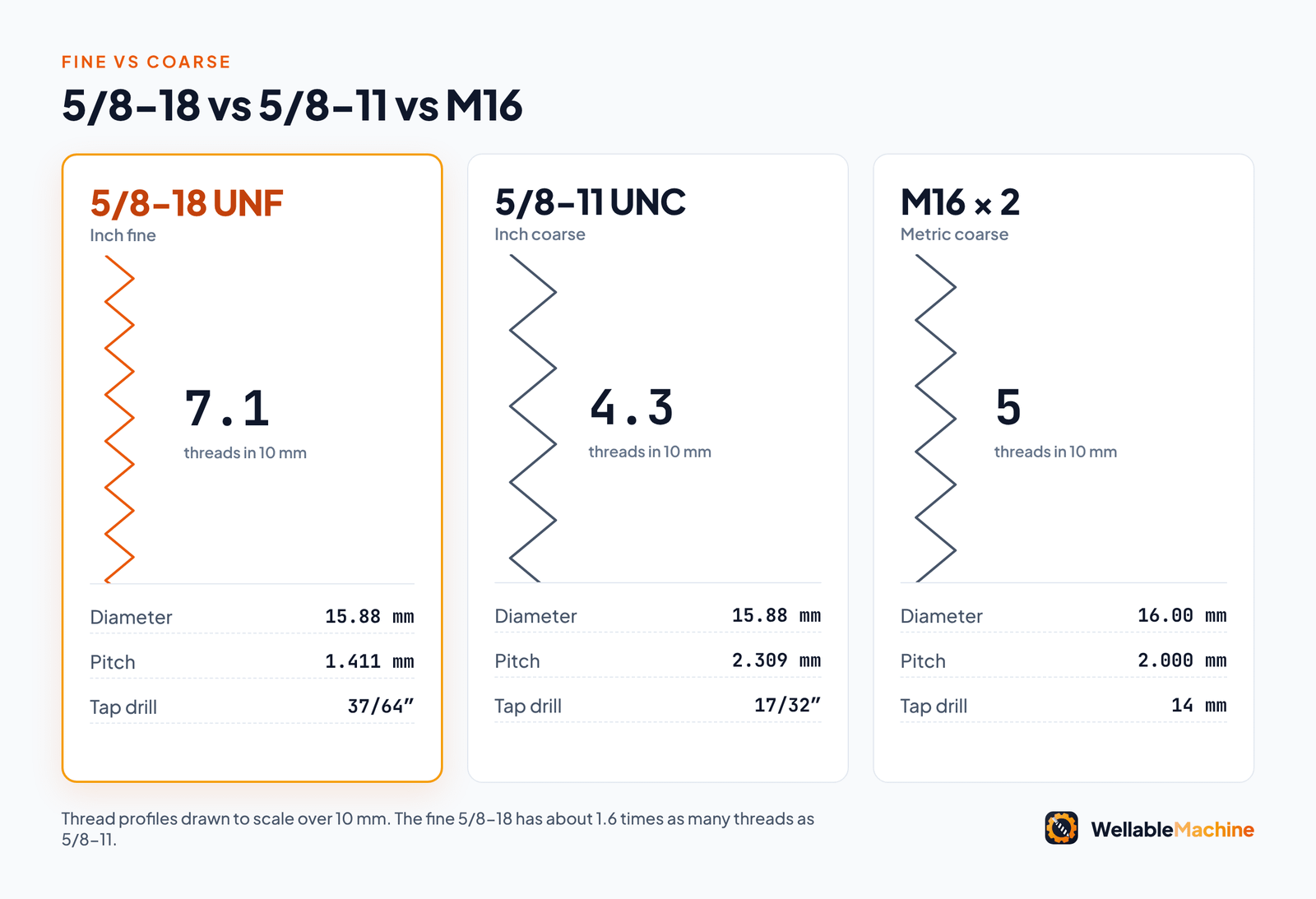
For the coarse thread, see the 5/8-11 tap drill size. For metric, see the M16 tap drill size.
Other 5/8-18 Hole Sizes You Might Need
- Forming (roll) tap: about 0.592 in (15.0 mm). Check the tap maker’s chart.
- Helicoil / STI insert: about a 21/32 in drill, then the 5/8-18 STI tap.
- Counterbore for a socket head cap screw: 1 in diameter, 5/8 in deep.
- Left-hand thread: same 37/64 in drill; use a 5/8-18 LH tap.
How to Drill and Tap a 5/8-18 Hole
- Mark and center punch the hole so the drill starts exactly where you want it.
- Drill with a 37/64 bit. In aluminum, run about 650 RPM; in mild steel, about 400 RPM; in stainless, slow down to about 200 RPM with steady pressure and cutting oil. Our guide on how to drill stainless steel explains why stainless needs low speed and constant feed.
- Break the sharp edge with a countersink. A small chamfer guides the tap in and keeps a raised burr from forming around the hole.
- Start the tap straight. Use a long tap wrench and check square in two directions after the first full turn; fine threads cross-thread easily.
- Work in short strokes. Turn forward until you feel resistance build, then reverse slightly to snap the chip. Keep the flutes wet with tapping fluid the whole time.
- For blind holes, drill at least 1/4 in (4–5 pitches) deeper than the full thread you need, and finish with a bottoming tap.
For large drills in steel, slow down; our drill speed chart has the RPM. If you are cutting the matching thread on rod, see how to use a tap and die.
Which 5/8-18 Tap Should You Use?
A plug tap covers most work. For rod-end links, buy a matched right-hand and left-hand pair.
| Tap type | Best for | Notes |
|---|---|---|
| Taper tap | Starting threads by hand in hard material | Long chamfer; the easiest to start straight |
| Plug tap | Through-holes and most blind holes | The everyday hand tap |
| Bottoming tap | Full threads to the bottom of blind holes | Use only after a plug or taper tap |
| Spiral point (gun) tap | Through-holes, power tapping | Pushes chips ahead; strong core, fewer breaks |
| Spiral flute tap | Blind holes, power tapping | Lifts chips up and out of the hole |
| Forming (roll) tap | Aluminum, brass, mild steel | No chips; needs a larger 0.592 in hole |
Tapping 5/8-18 in Different Materials
The hole size rarely changes from one metal to another, but the fluid, tap and technique do. Here is a quick guide for 5/8-18 work.
| Material | Recommended drill | Tapping fluid | Tips |
|---|---|---|---|
| Aluminum | 37/64 | Light oil or WD-40 | 14.5 mm for fuller thread |
| Mild steel | 37/64 | Sulfurized cutting oil | Reverse often to break the chip |
| Stainless (304/316) | 14.75 mm | Heavy tapping paste | Cobalt tap; heavy paste |
| Brass | 37/64 | Dry or light oil | Cuts cleanly; tap can grab at the end |
| Steel tube (DOM) | 37/64 | Sulfurized oil | Check tube wall thickness first |
How Deep Should a 5/8-18 Thread Be?
How much thread you need depends on what the hole is made of. Softer materials need longer engagement so the internal thread doesn’t strip before the screw breaks:
- Steel: 1–1.5 × diameter, 5/8–15/16 in.
- Aluminum: 2 × diameter, 1-1/4 in.
- Rod-end tubes: at least 1.5 × diameter, about 15/16 in.
Where Is 5/8-18 Used?
5/8-18 UNF is used on rod ends and heim joints, tie rods and suspension links, hydraulic cylinder rod ends, axles and spindles, leveling feet, machine adjusting screws and some wheel and hub hardware.
Common 5/8-18 Tapping Problems (and How to Fix Them)
- Thread too loose: 37/64 in in soft aluminum may feel loose; use 14.5 mm.
- Tap very stiff: you may have used 9/16 in by mistake.
- Link won’t adjust: check one end is left-hand.
- Cross-threaded start: fine threads need the tap kept square.
Frequently Asked Questions
6 quick answers from our editors
01What size drill bit for a 5/8-18 tap?
A 37/64 in drill (0.5781 in), which gives about 65% thread.
02What metric drill for 5/8-18?
14.5 mm for a fuller thread, or 14.75 mm for easy tapping.
03Is 5/8-18 fine or coarse?
Fine (UNF). The coarse 5/8 in thread is 5/8-11.
04What clearance hole for a 5/8 bolt?
41/64 in close or 21/32 in free; 11/16 in for steel connections.
05What wrench fits a 5/8 bolt?
15/16 in for a standard hex head.
06Is 5/8-18 the same as M16 × 1.5?
No. They are close in size and pitch but not interchangeable.
Bottom Line
For 5/8-18 UNF, drill 37/64 in for most work, 14.5 mm for a fuller thread in soft metals and 14.75 mm in stainless. Clearance is 21/32 in for a free fit. Keep the tap square and use a left-hand tap where a link needs one. For every size, see our tap drill size chart.