Drill Torque Explained: In-lb vs Nm and How Much You Need
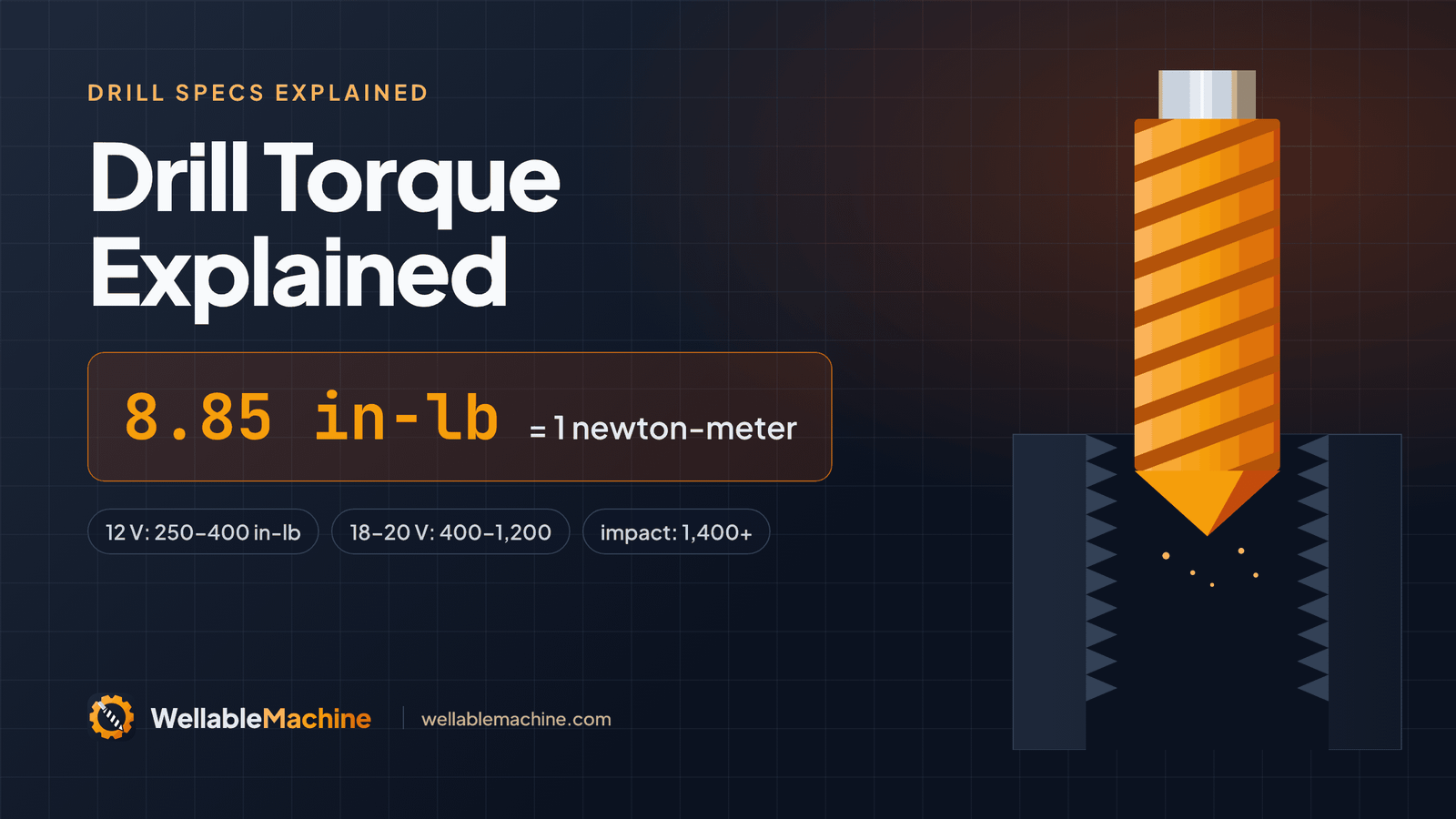
Quick answer: drill torque is the twisting force a drill can put on a bit or screw, usually given in inch-pounds (in-lb) or newton-meters (Nm); 1 Nm is about 8.85 in-lb. Typical maximums: 12 V drills 250–400 in-lb, 18–20 V compact drills 400–650 in-lb, premium 18–20 V drills and hammer drills 800–1,200+ in-lb, and impact drivers 1,400–2,000 in-lb. More torque helps with big bits, hole saws and long screws, but control (clutch and speed) matters just as much.
Torque is the number drill makers love to print on the box, and it’s also the most confusing one. Different brands measure it differently, some use their own power units instead, and a higher number doesn’t always mean a drill is better for your work. This guide explains what torque actually is, how it relates to speed and battery voltage, how much you need for common jobs, and how to use the clutch to control it.
What Torque Means on a Drill
Torque is rotational force: how hard the drill can twist. If you put a wrench 1 ft long on a bolt and push on the end with 10 lb of force, you apply 10 ft-lb (120 in-lb) of torque. A drill’s torque rating is the maximum twisting force its motor and gearbox can deliver, usually measured at the moment the chuck stalls in low gear.
- High torque turns large bits, hole saws, auger bits and long screws without stalling.
- High speed (RPM) drills small holes quickly and cleanly.
- A drill trades one for the other: low gear gives more torque and less speed; high gear gives more speed and less torque.
The torque article explains the physics if you want the details.
Units and Conversions
| Unit | Equals | Where you’ll see it |
|---|---|---|
| 1 newton-meter (Nm) | 8.85 in-lb / 0.738 ft-lb | European and Asian brands, spec sheets |
| 1 inch-pound (in-lb) | 0.113 Nm | North American drills and drivers |
| 1 foot-pound (ft-lb) | 12 in-lb / 1.356 Nm | Impact wrenches, bolt torque specs |
| Watts out / UWO / MWO | Power, not torque | Some brands’ own ratings; combines torque and speed |
Quick check: a drill rated 60 Nm is about 530 in-lb, and one rated 100 Nm is about 885 in-lb.
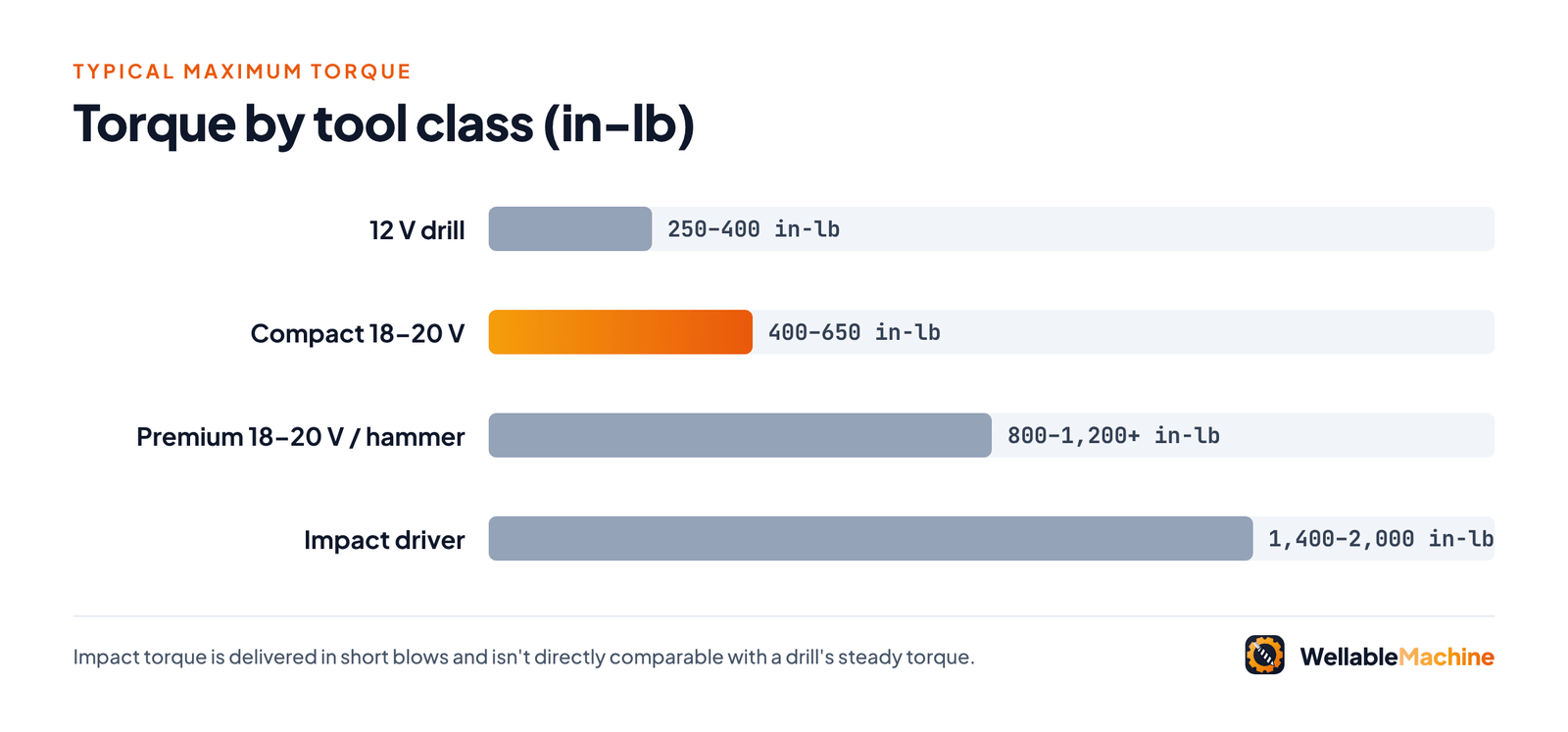
Typical Torque by Tool Class
| Tool | Typical max torque | Good for |
|---|---|---|
| 4–8 V screwdriver | 30–80 in-lb (3–9 Nm) | Furniture assembly, small screws |
| 12 V drill/driver | 250–400 in-lb (28–45 Nm) | Cabinet work, holes up to about 1/2 in in wood, light metal |
| 18–20 V compact drill | 400–650 in-lb (45–73 Nm) | General DIY, spade bits, small hole saws |
| 18–20 V premium drill / hammer drill | 800–1,200+ in-lb (90–135+ Nm) | Large hole saws, augers, self-feed bits, mixing |
| Corded 1/2 in drill | Varies; often high in low gear | Continuous heavy drilling, mixing |
| Impact driver | 1,400–2,000 in-lb (160–225 Nm) | Long screws, lags, structural screws |
| 1/2 in impact wrench | 3,000–12,000+ in-lb | Lug nuts, large bolts |
Impact drivers deliver their torque in short hammer pulses, so their numbers aren’t directly comparable with a drill’s steady torque. See impact driver vs drill and how to use an impact driver.
How Much Torque Do You Actually Need?
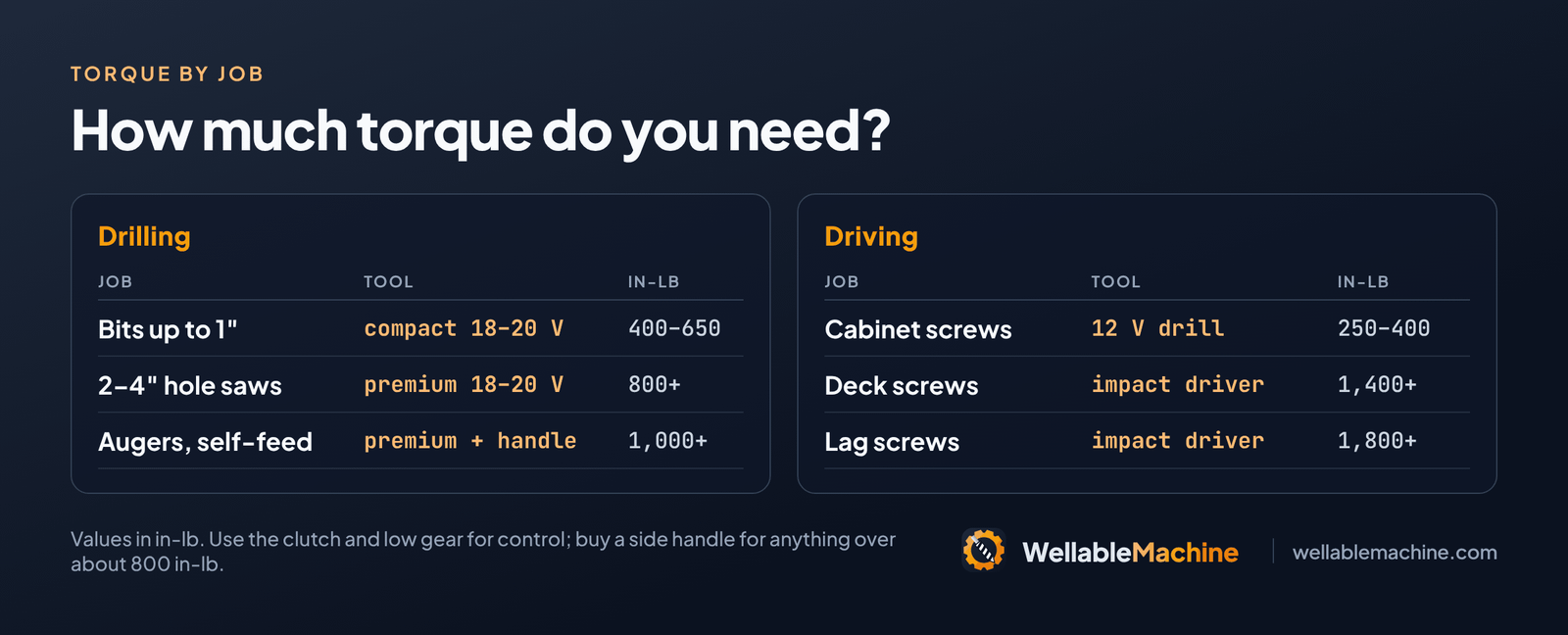
| Job | Rough torque needed | Tool that handles it |
|---|---|---|
| Drilling holes up to 1/4 in in wood or metal | Low (under 150 in-lb) | Any 12 V or 18 V drill |
| Driving 1-1/2 in wood screws | Low to medium | 12 V drill or impact driver |
| 3/4–1 in spade bits in framing | Medium (300–500 in-lb) | 18 V compact drill |
| 2–2-1/2 in hole saws in wood | Medium to high | 18 V drill with side handle |
| Auger and self-feed bits over 1-1/2 in | High (800+ in-lb) | Premium 18 V or corded drill, low gear |
| Hole saws over 3 in, or in steel | High, at low speed | High-torque or corded drill |
| 3–6 in lag and structural screws | High | Impact driver |
| Mixing thinset or mud | High, sustained | Corded mixer or high-torque drill |
Most homeowners never stall a decent 18 V drill doing everyday work. Torque starts to matter when you move to large bits, hole saws and augers. For bit types, see our hole saw size chart, spade bits guide and auger bits guide.
Torque, Speed and Gears
Most drills have a two-speed gearbox:
- Gear 1 (low speed): about 0–450 or 0–600 RPM, with full torque. Use it for driving screws, large bits, hole saws and anything in steel.
- Gear 2 (high speed): about 0–1,500 to 0–2,000 RPM, with roughly a third of the torque. Use it for small holes in wood, plastic and metal.
Using high gear with a big bit is the most common reason a drill stalls, overheats or trips its electronics. Drop to gear 1 and the same drill often handles the job easily. The drill speed chart shows which RPM suits which bit.
Torque and Voltage
Higher voltage platforms usually deliver more torque, but voltage alone doesn’t set it. Motor type, gearing and battery capacity matter too:
- Brushless motors deliver more torque for their size and keep it under load. See brushless vs brushed drills.
- Bigger batteries (higher amp-hour, or high-output cells) can supply more current, which raises usable torque in heavy work.
- 18 V and 20 V are the same class; 20 V is the peak voltage label used in some markets. Our 12V vs 18V vs 20V drills comparison explains it.
Using the Clutch to Control Torque
The numbered collar behind the chuck is the clutch. It limits how much torque reaches the bit; when the screw needs more than the setting, the clutch slips with a ratcheting sound and the screw stops turning.
- Low numbers (1–5): small screws, soft wood, hinges, brass screws.
- Middle numbers: general wood screws.
- High numbers: long screws in hardwood.
- Drill symbol: clutch locked out; full torque for drilling.
Start low and turn up one step at a time until the screw sets at the depth you want. Our drill clutch settings guide goes through each range in detail.
Why Torque Ratings Are Hard to Compare
- Stall vs working torque: some brands publish the maximum torque at stall, which you rarely use; others publish a sustained value.
- Hard vs soft joint: torque measured on a rigid bolt (hard joint) is higher than on wood (soft joint). Impact drivers are often rated one way and drills another.
- Battery used for testing: high-output batteries can add a noticeable amount.
- Power ratings: watts out figures combine torque and speed, so they don’t translate directly into in-lb.
Compare drills within the same brand, or look for independent tests, rather than lining up numbers from different makers.
Safety: When Torque Bites Back
A drill with 1,000 in-lb of torque can twist your wrist hard if a hole saw or auger bit jams. To stay safe:
- Use the side handle for any bit over about 1 in.
- Choose low gear and moderate speed with large bits.
- Brace the drill body so its rotation is stopped by the handle, not your arm.
- Look for drills with kickback control, which cuts power if the body suddenly rotates.
- Clear chips and dust often so bits don’t bind. See how to use a hole saw for big-hole technique.
Torque Checklist When Buying a Drill
- What’s the biggest bit you’ll use? Up to 1 in spade bits and 2 in hole saws: a compact 18–20 V drill is enough. Bigger augers, self-feed bits and large hole saws: choose a high-torque model.
- Is it brushless? Brushless drills hold torque better under load and run cooler.
- Does it have a side handle? Essential for drills over about 800 in-lb.
- Does it have electronic kickback control? It cuts power if the drill body spins suddenly.
- How many clutch settings? More settings give finer control over screws.
- What battery will you use? Larger, high-output packs unlock more of the rated torque.
How to Tell If Your Drill Is Short on Torque
Signs your drill is working at its limit: it stalls when a bit catches, the motor slows a lot under load, the battery or motor gets hot quickly, or the electronics cut out. Before buying a bigger drill, try the simple fixes: switch to gear 1, use a sharp bit, drill a pilot hole for large bits, clear chips more often and use a fully charged, larger battery. If it still struggles, the job needs a more powerful tool.
Torque at the Chuck vs Force at the Bit
The torque figure is measured at the chuck, but what matters for cutting is the force at the edge of the bit, which is torque divided by the radius. A large bit gives the drill less push at its edge. For example, 50 Nm on a 1/2 in (12.7 mm) twist bit gives about 7,900 N at the cutting edge, but the same 50 Nm on a 2 in (51 mm) self-feed bit gives only about 2,000 N. That is why a drill that easily handles small bits can stall on a big auger or hole saw, and why low gear is needed as the diameter goes up.
Frequently Asked Questions
6 quick answers from our editors
01How much torque does a drill need?
For general DIY, 400–600 in-lb (45–70 Nm) is plenty. For large hole saws, augers and mixing, look for 800 in-lb (90 Nm) or more.
02What is a good torque for a cordless drill?
Around 500 in-lb for a compact 18–20 V drill and 1,000 in-lb or more for a heavy-duty model.
03How do I convert Nm to in-lb?
Multiply by 8.85. For example, 60 Nm × 8.85 = 531 in-lb.
04Is more torque always better?
No. Beyond what your bits need, extra torque mostly adds weight and cost and can twist your wrist in a bind. Control and the right speed matter more.
05Why does my drill stall with big bits?
Usually because it’s in high gear. Switch to gear 1, use a sharp bit, and clear chips often.
06Does an impact driver have more torque than a drill?
Yes, typically two to four times as much, delivered in pulses. That suits screws and bolts, not large drill bits.
Bottom Line
Torque is the drill’s twisting force, given in in-lb or Nm (1 Nm ≈ 8.85 in-lb). A 12 V drill (250–400 in-lb) handles light work, an 18–20 V compact drill (400–650 in-lb) covers most DIY, and a premium or hammer drill (800–1,200+ in-lb) is for big bits and hole saws. Use low gear for torque-heavy jobs, the clutch to control screws, and a side handle whenever large bits could bind.