Auger Bits Guide: Types, Sizes, Speeds and How to Use Them

Quick answer: an auger bit is a wood bit with a threaded screw tip that pulls the bit into the wood, spurs that score a clean rim, and a deep spiral flute that lifts chips out of long holes. Use one for deep, straight holes in wood from about 1/4 in to 1-1/2 in: running cables and pipes through studs and joists, drilling posts and beams, and timber framing. Run it slowly (roughly 300–1,000 rpm depending on size) in a high-torque drill with a side handle, and never let it run free.
Spade bits are fast and cheap, Forstner bits are neat, but when you need a long, straight hole through a 4×4, a stack of joists or a log wall, nothing beats an auger bit. This guide explains how auger bits work, the main types, which sizes and lengths to buy, how fast to run them, how to drill safely with them, and how to keep them sharp.
Parts of an Auger Bit
| Part | What it does |
|---|---|
| Lead screw (feed screw) | A threaded point that screws into the wood and pulls the bit forward, so you don’t have to push |
| Spurs | Sharp points on the outer edge that cut the circle of the hole first, leaving a clean rim |
| Cutting lips | Flat cutters that slice the wood inside the scored circle and lift it into the flute |
| Flute (twist) | The deep spiral that carries chips out of the hole |
| Shank | Round, hex, SDS or tapered square (for a hand brace) |
The lead screw is what makes an auger bit different. Each turn of the bit pulls it forward by one pitch of the screw, so the bit feeds itself. That is great for speed and straightness, but it also means the bit can grab hard if it binds, which is why technique and the right drill matter. The design goes back centuries; the auger article on Wikipedia covers its history.
Types of Auger Bits
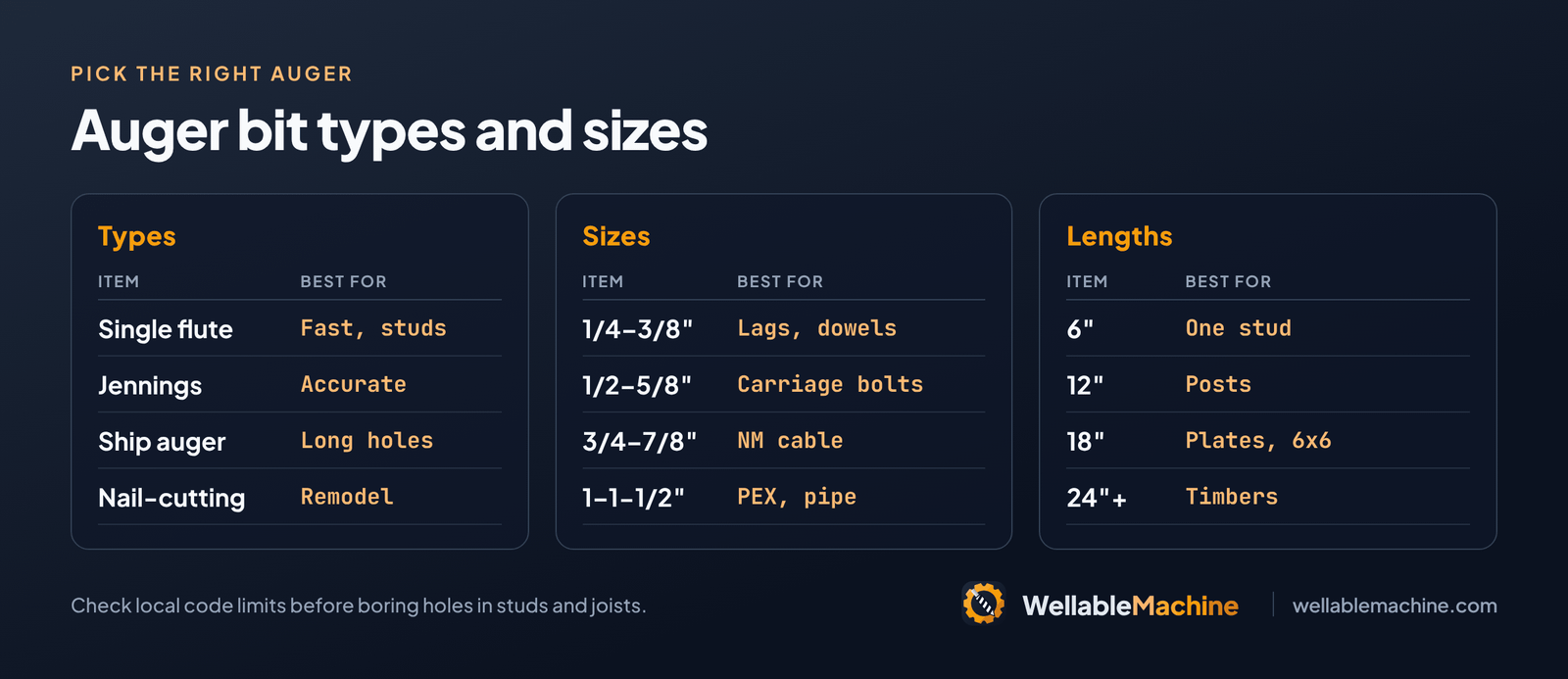
Single-flute (solid center) auger bits
The most common type for power drills. A single wide flute clears chips quickly, which makes these bits fast in wet or resinous wood. Many have one spur and one cutter. They are the standard choice for electricians and plumbers drilling studs and joists.
Double-flute (Jennings pattern) auger bits
Two flutes, two spurs and two cutters. The Jennings pattern makes a smoother, more accurate hole and is common for joinery, furniture and dowel holes. Chip clearance is a little slower in very deep holes.
Ship augers
Long single-flute augers, often without spurs, built for deep holes in timber, docks, log homes and landscape timbers. Without spurs they are less likely to follow the grain off line and they keep cutting through end grain. Lengths of 18 to 24 in and more are common.
Nail-cutting (nail-eater) auger bits
Hardened, often with a tougher cutter, for remodeling work where you may hit a nail or screw. They will survive occasional nails, but they still dull faster than when cutting clean wood. Brands sometimes call these “demolition” or “nail-embedded wood” bits.
Self-feed and power auger variants
Self-feed bits look like a large Forstner bit with a lead screw and are used for big holes (up to about 4-5/8 in) through framing. They are not true augers, since they have no long flute, but they fill the same job in very large sizes. Short “stubby” augers fit between joists in a right-angle drill.
Brace bits (hand augers)
The traditional auger bit with a tapered square tang for a carpenter’s brace. They are still excellent for quiet, controlled work and are often sized in 1/16 in steps, so a “#8” brace bit is 8/16 in, or 1/2 in.
Auger Bit Sizes and Lengths
| Diameter | Common use | Typical lengths |
|---|---|---|
| 1/4–3/8 in | Bolt holes in small timbers, pilot holes for lag screws, dowels | 6, 12, 18 in |
| 1/2–5/8 in | Carriage bolts in deck posts and beams, threaded rod | 6, 12, 18 in |
| 3/4–7/8 in | Electrical cable (NM) through studs and joists | 6, 18 in |
| 1–1-1/8 in | Several cables, 1/2 in PEX, small pipe | 6, 18 in |
| 1-1/4–1-1/2 in | Larger pipe and conduit, timber pegs | 6, 18 in |
A 6 in bit is the most handy for drilling one or two studs. An 18 in bit lets you drill through several plates, or through a 6×6 from one side. Extensions are available for longer reach, but each joint adds wobble, so a single long bit is usually better. If you are wiring through framing, check the rules for hole size and position first: bored holes in studs and joists have limits in building codes, and holes close to the edge need steel nail plates.
Shank Types
- Hex shank (7/16 in or 3/8 in): the most common for power drills; the flats stop the bit from spinning in the chuck under heavy torque.
- Quick-change 1/4 in hex: on smaller augers for impact drivers. Impact drivers can spin auger bits, but they are rough on the bit; see impact driver vs drill.
- SDS-plus: for electricians who drill lots of holes with a rotary hammer in rotation-only mode. Our SDS-plus vs SDS-max guide explains the system.
- Tapered square tang: for a hand brace only.
Auger Bit Speed Guide
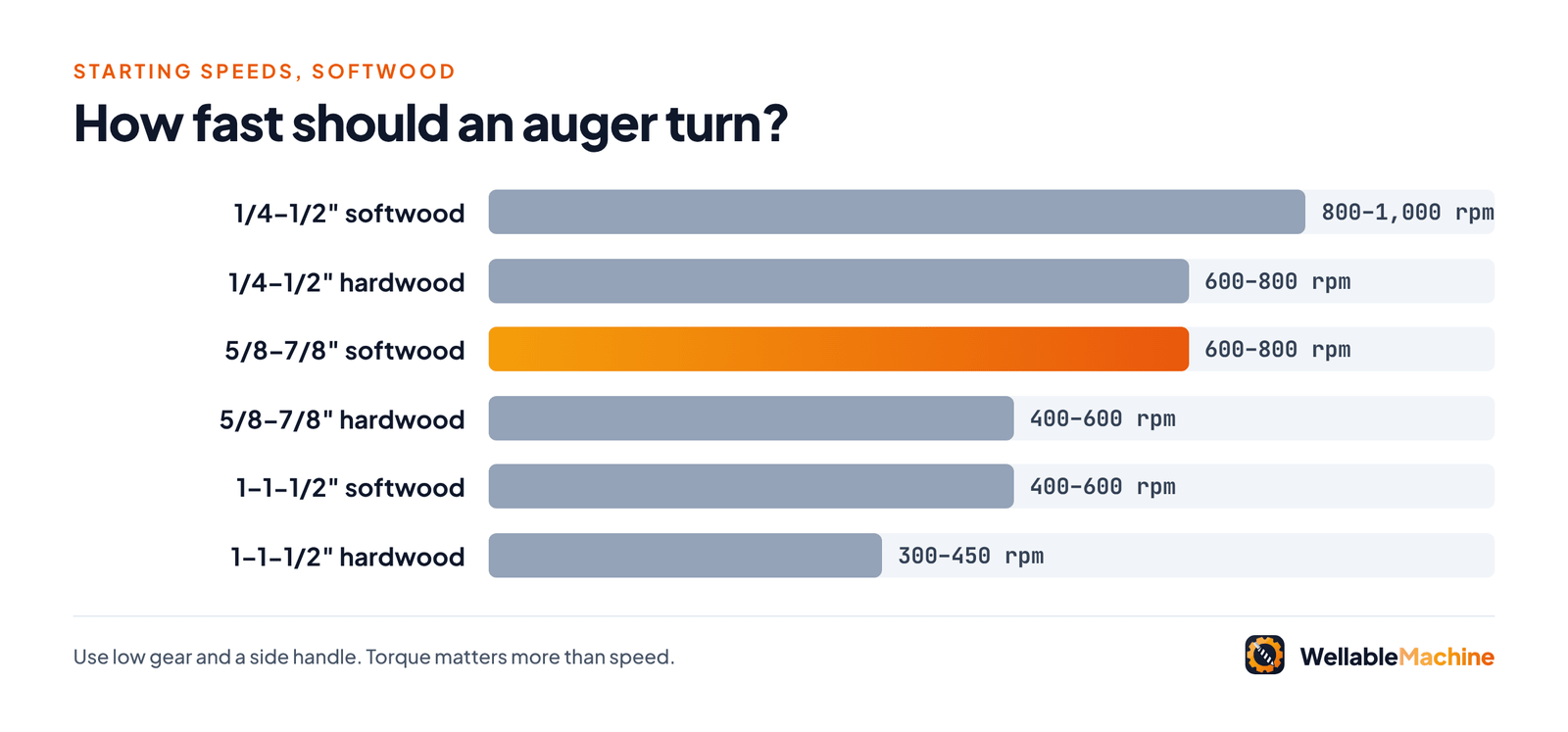
Auger bits pull themselves into the wood, so the drill does not need to spin fast. It needs torque. Use the low gear (setting 1) on a cordless drill and keep the speed down. As a starting point:
| Bit size | Softwood | Hardwood |
|---|---|---|
| 1/4–1/2 in | 800–1,000 rpm | 600–800 rpm |
| 5/8–7/8 in | 600–800 rpm | 400–600 rpm |
| 1–1-1/2 in | 400–600 rpm | 300–450 rpm |
If the drill bogs down, the clutch slips or the motor gets hot, stop and back the bit out to clear chips. Brushless 18V/20V drills with a side handle cope well up to about 1 in. For 1-1/4 in and larger, a corded or high-torque right-angle drill is much safer. Our brushless vs brushed drills guide explains why brushless tools handle heavy bits better.
How to Drill with an Auger Bit
- Check for hazards. Look for nails, screws, wires and pipes in the path. A wire hit by a 7/8 in auger is a serious shock risk.
- Fit the side handle and set the drill to low gear. If the drill has a clutch, set it to a medium setting rather than drill mode so it slips before your wrist does.
- Brace yourself. Stand so that if the bit grabs, the handle hits the stud, not your body. Keep your arms firm and never wrap the cord or your hand around the bit’s path.
- Start the screw on your mark at slow speed and let it pull the bit in. Don’t push.
- Clear chips every few inches by backing the bit out a little while it still turns. In wet wood this matters even more.
- Ease off near the exit. When the screw pokes through, slow right down. For a clean exit hole, stop as soon as the screw tip appears and finish from the other side using the small hole as a guide.
For holes that must be perfectly straight through a thick post, mark both faces, drill halfway from each side, and let the holes meet. Our guide to drilling a straight hole has more tricks, like using a square or a mirror to sight the bit.
Auger Bit vs Spade Bit vs Forstner Bit vs Hole Saw
| Bit | Best for | Speed of cut | Hole quality | Deep holes |
|---|---|---|---|---|
| Auger | Deep holes through framing and timbers | Fast | Good | Excellent |
| Spade | Quick, rough holes through studs | Fast | Rough | Poor without extensions |
| Forstner | Flat-bottom holes, furniture, hinges | Slow | Excellent | Poor |
| Hole saw | Large, shallow holes | Medium | Good | Limited by cup depth |
| Self-feed | Large holes through framing | Fast | Good | Fair |
For an overview of every wood and metal bit, see our types of drill bits guide. For flat-bottomed holes, the Forstner bits guide covers sizes and speeds, and the hole saw size chart covers larger holes.
Sharpening Auger Bits
Auger bits are easy to sharpen by hand with a small auger bit file, which has safe (uncut) edges so you only file where you want to. The rules:
- Spurs: file only on the inside face. Filing the outside reduces the diameter and the bit will bind.
- Cutters (lips): file only on the top face (the side facing the shank), keeping the original angle, and take the same number of strokes on each cutter.
- Lead screw: leave it alone unless the tip is damaged. A small triangular needle file can clean up a bent thread.
Remove only what you need to restore a sharp edge. For more on bits in general, see how to sharpen drill bits.
Common Problems
- Bit grabs and twists the drill: too much speed, a blunt spur or a knot. Use low gear, a side handle and the clutch, and slow down at knots.
- Bit stops feeding: the lead screw is clogged or worn, or the flute is packed. Back out and clean; replace the bit if the screw is stripped.
- Hole wanders off line: the bit followed the grain, or the drill tilted. Use a ship auger without spurs for long holes in end grain, and drill from both sides.
- Bit stuck in the hole: put the drill in reverse at low speed. If it won’t come out, remove the drill from the bit and turn the bit out with a wrench on the hex shank.
- Smoke and burning: the bit is dull or packed with chips. Clear chips more often and sharpen the spurs and cutters.
Frequently Asked Questions
7 quick answers from our editors
01What is an auger bit used for?
Drilling deep, clean holes in wood, such as through studs, joists, posts and beams, for cables, pipes, bolts and pegs.
02Can you use an auger bit in a regular drill?
Yes, in sizes up to about 1 in, with a powerful drill in low gear and a side handle. Larger bits need a high-torque or right-angle drill.
03Can auger bits drill metal?
No. The screw tip can’t bite into metal and the cutters will be ruined. Nail-cutting augers survive the odd nail but are still wood bits.
04What is the difference between an auger bit and a spade bit?
An auger bit has a screw tip and a long spiral flute that clears chips and pulls the bit in. A spade bit is a flat paddle that must be pushed, cuts rougher holes and clogs in deep holes.
05What size auger bit for electrical wire?
3/4 in is common for one or two NM cables, and 7/8 to 1 in for several. Check local code limits on hole size in studs and joists.
06Can I use an auger bit in an impact driver?
Small augers with a 1/4 in hex shank can be used, but impact drivers give a rough feed. A drill with a clutch is safer and kinder to the bit.
07How fast should an auger bit turn?
Slowly: about 300–1,000 rpm depending on the size and the wood. Larger bits and harder wood need lower speeds.
Bottom Line
An auger bit uses a screw tip to pull itself through wood, spurs to score a clean edge and a deep flute to clear chips, which makes it the best bit for deep holes through framing and timber. Pick the type for the job (single-flute for speed, Jennings for accuracy, ship auger for long holes, nail-cutting for remodeling), run it slowly in low gear with a side handle, clear chips often and keep the spurs and cutters sharp with an auger file.