5/16 Drill Bit in mm: 7.94 mm (and When 8 mm Works)
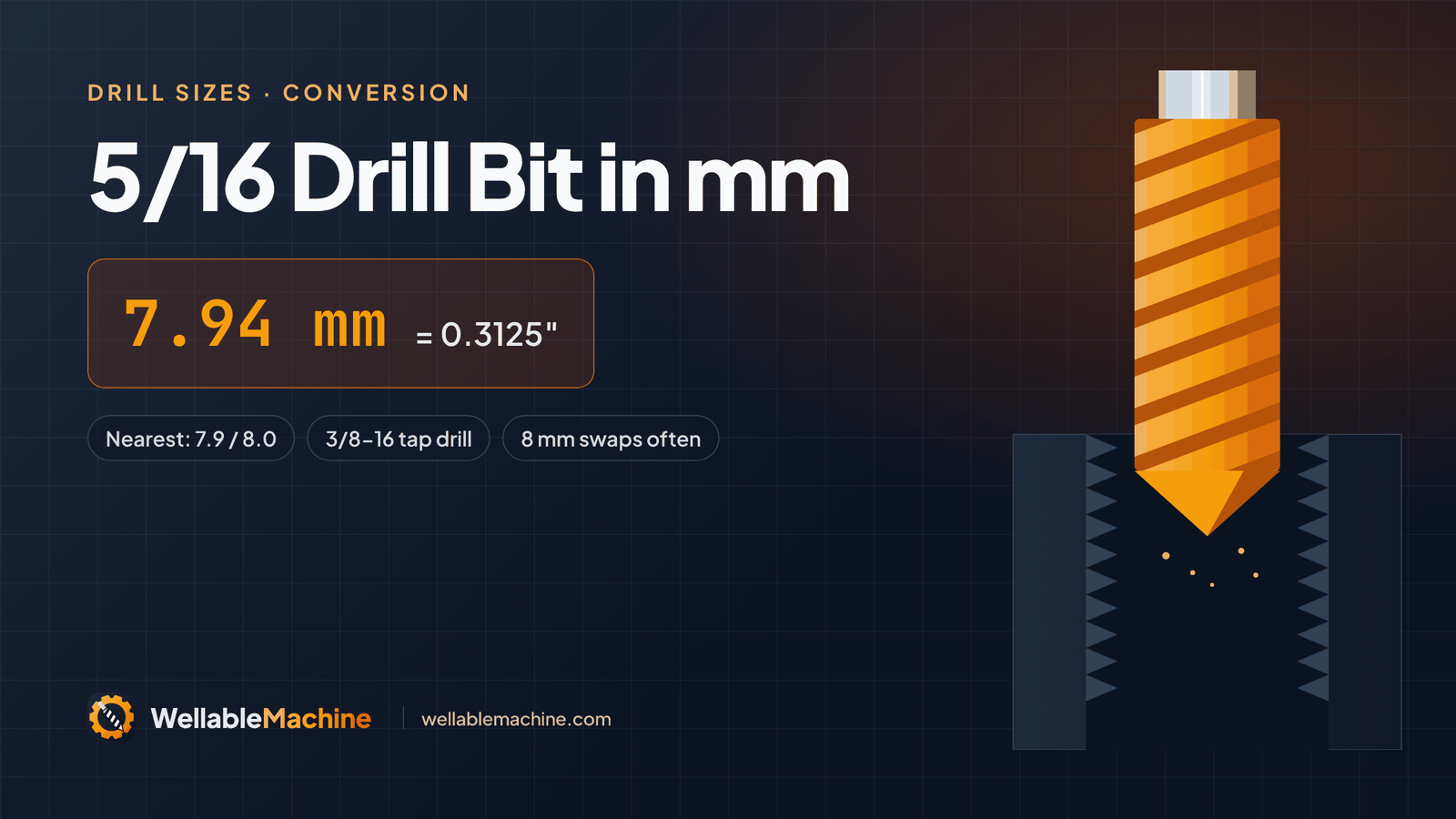
Quick answer: a 5/16 in drill bit is 7.9375 mm, or about 7.94 mm. The nearest metric bits are 7.9 mm (0.04 mm smaller) and 8.0 mm (0.06 mm larger), so in most work an 8 mm bit is the practical metric equivalent. In decimal inches 5/16 is 0.3125 in. Its best-known job is the tap drill for 3/8-16 UNC, where it gives about 77% thread.
Most people search for this because they have one kind of drill set and instructions written in the other system. Maybe a European wall plug says “8 mm” and your bits are fractional, or a US tap chart says 5/16 in and your set is metric. This guide gives the exact conversion, shows which nearby sizes can stand in for each other, and explains when the small difference between 5/16 in and 8 mm actually matters.
5/16 Drill Bit Size at a Glance
| Property | Value |
|---|---|
| Fraction | 5/16 in |
| Decimal inches | 0.3125 in |
| Exact metric size | 7.9375 mm |
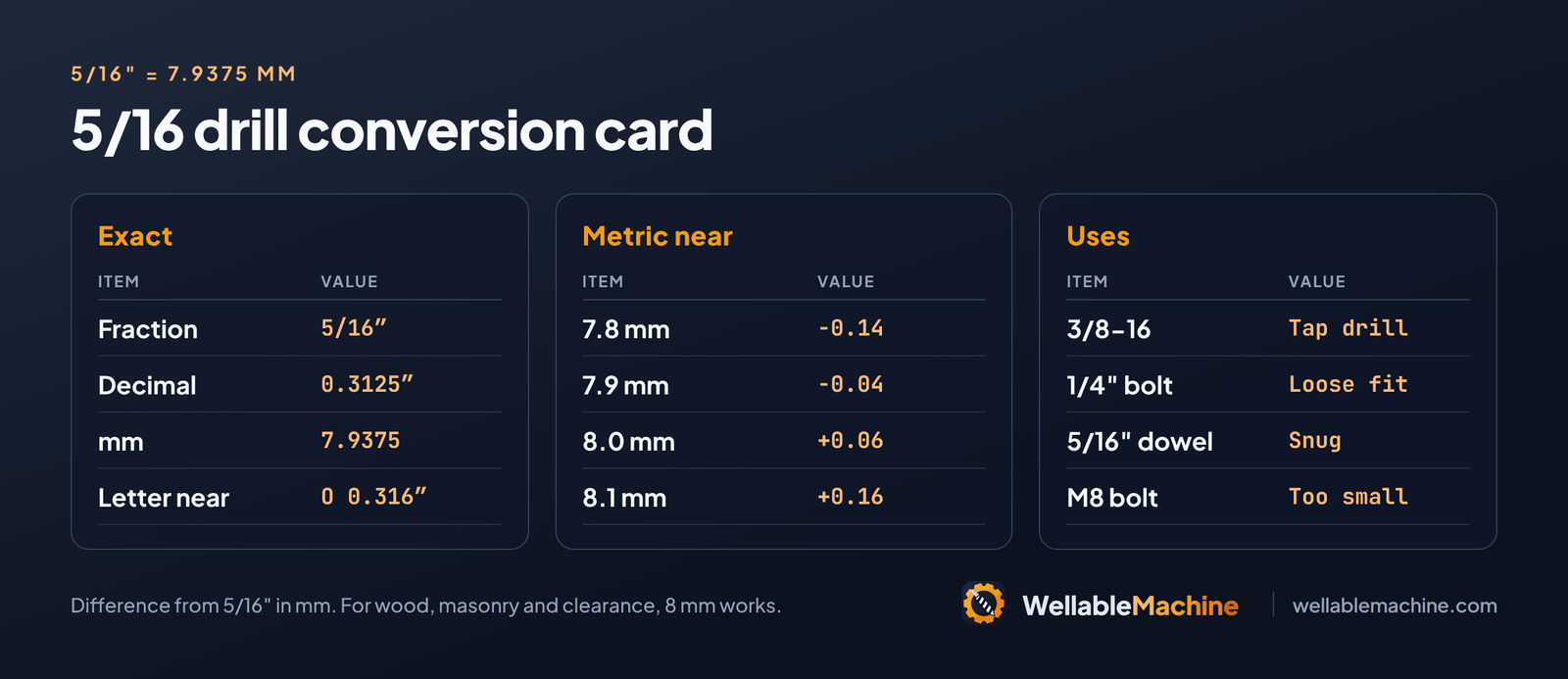
| Nearest metric below | 7.9 mm (0.3110 in), 0.0375 mm smaller |
| Nearest metric above | 8.0 mm (0.3150 in), 0.0625 mm larger |
| Nearest letter drill | O (0.316 in, 8.03 mm) |
| Next fractional sizes | 19/64 in (7.54 mm) below, 21/64 in (8.33 mm) above |
| Main use | Tap drill for 3/8-16 UNC |
How to Convert 5/16 in to mm
One inch is defined as exactly 25.4 mm, so the conversion is simple:
5 ÷ 16 = 0.3125 in, and 0.3125 × 25.4 = 7.9375 mm.
You can use the same method for any fraction: divide the top number by the bottom number to get decimal inches, then multiply by 25.4. Going the other way, divide millimeters by 25.4 to get inches; 8 mm ÷ 25.4 = 0.315 in. The international definition of the inch dates from 1959 and is explained in the inch article on Wikipedia.
5/16 in vs Nearby Metric and Inch Sizes
| Drill | Inches | mm | Difference from 5/16 |
|---|---|---|---|
| 19/64 | 0.2969 | 7.54 | −0.40 mm |
| N | 0.3020 | 7.67 | −0.27 mm |
| 7.8 mm | 0.3071 | 7.80 | −0.14 mm |
| 7.9 mm | 0.3110 | 7.90 | −0.04 mm |
| 5/16 | 0.3125 | 7.94 | — |
| 8.0 mm | 0.3150 | 8.00 | +0.06 mm |
| O | 0.3160 | 8.03 | +0.09 mm |
| 8.1 mm | 0.3189 | 8.10 | +0.16 mm |
| P | 0.3230 | 8.20 | +0.27 mm |
| 21/64 | 0.3281 | 8.33 | +0.40 mm |
For context, a typical new drill bit cuts a hole about 0.02 to 0.08 mm oversize in steel, and more in a hand drill. So the gap between 5/16 in and 8 mm (0.06 mm) is about the same as the normal oversize from drilling. For wood, plastic, masonry and most clearance holes, they are interchangeable. For tapped holes, reamed holes and press fits, read on.
When Is 8 mm a Good Substitute for 5/16?
- Wood and plastic: yes, always. The difference is far smaller than the way wood fibers spring back.
- Masonry and wall plugs: yes. An 8 mm plug goes into a 5/16 in masonry hole, and a US 5/16 in sleeve anchor goes into an 8 mm hole, because carbide masonry bits drill a little oversize anyway. Our wall anchor drill bit size chart covers plug sizes.
- Clearance holes: yes, either works.
- Tapping 3/8-16: yes, but the thread is a bit shallower (about 74% instead of 77%), which is perfectly fine and even makes tapping steel easier.
- Dowels and pins: it depends. A 5/16 in dowel is snug in a 5/16 in hole and slightly loose in an 8 mm hole; an 8 mm dowel will be very tight in a 5/16 in hole. Match the bit to the dowel system you are using, or test in scrap first.
- Reamed holes and bearings: no. If a part needs an exact 8 mm or 5/16 in bore, use the matching reamer, not a drill.
What Is a 5/16 Drill Bit Used For?
Tap drill for 3/8-16 UNC
3/8-16 is one of the most common bolt threads in the US: engine brackets, machinery, trailer parts, shop fixtures. Its standard tap drill is 5/16 in, which gives about 77% thread. Our 3/8-16 tap drill size guide covers the thread in detail, and the tap drill size chart lists every common size.
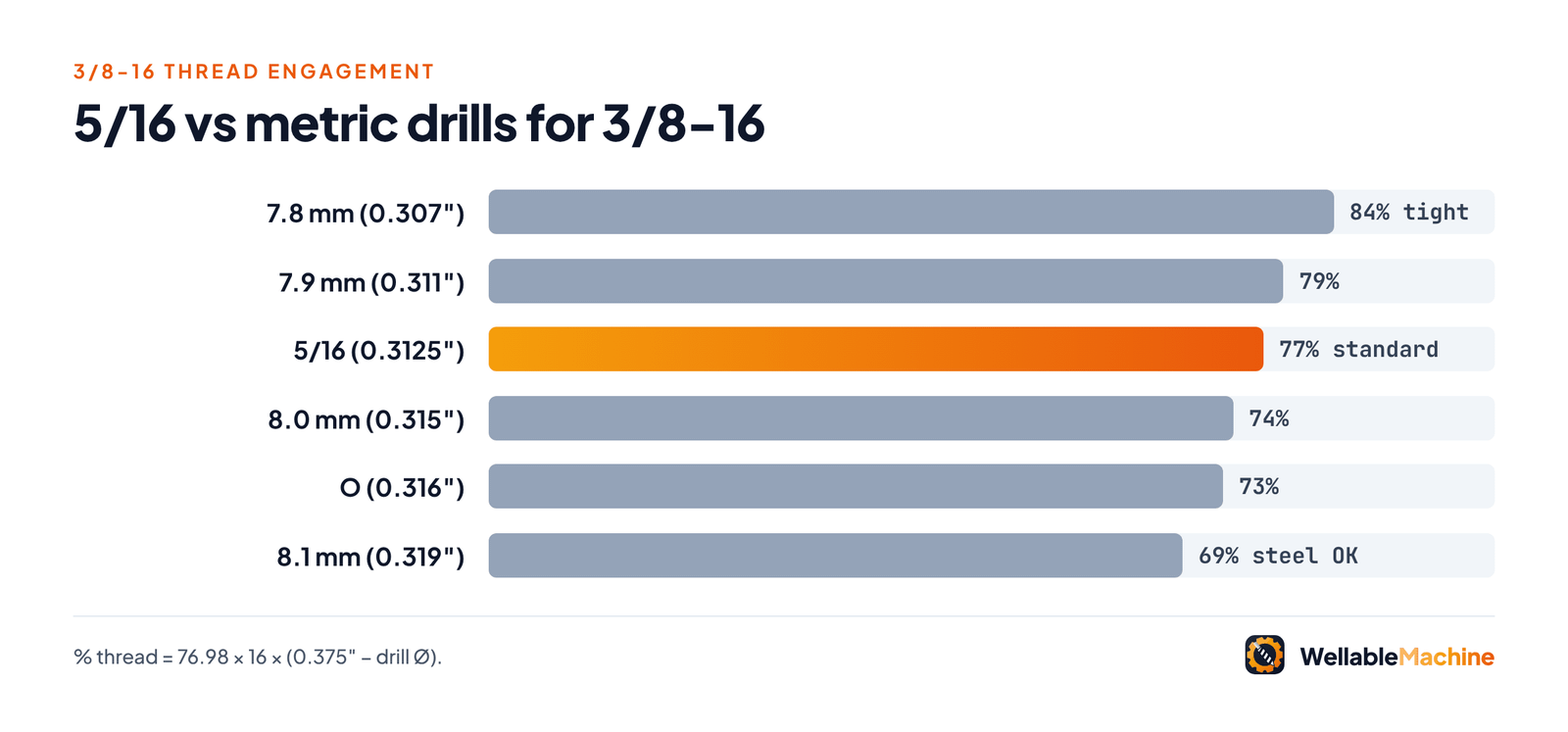
If you only have metric bits, 7.9 mm gives about 79% thread and 8.0 mm about 74%. Both are good. 8.0 mm is easier to tap in steel and stainless; 7.9 mm gives a little more thread in aluminum or cast iron.
Loose clearance hole for a 1/4 in bolt
A 1/4 in bolt passes through a 17/64 in hole for a close fit and a 9/32 in hole for a normal fit. A 5/16 in hole is a loose fit, which is handy when you need some side-to-side adjustment, when holes in two parts don’t line up perfectly, or when the bolt goes through wood that may swell. The clearance hole size chart has close, normal and loose fits for other bolts.
Wood joinery and dowels
5/16 in dowels are common in US furniture and shelving, and a 5/16 in brad-point bit gives a snug glue fit. European flat-pack furniture uses 8 mm dowels, which want an 8 mm bit. If you are repairing knock-down furniture, measure the dowel with a caliper before choosing.
Masonry and anchors
Many US anchors are sized in 5/16 in: sleeve anchors, some plastic plugs and drive anchors. In masonry the anchor diameter usually equals the bit diameter. Use a carbide masonry bit and a hammer drill; see how to drill into concrete.
Things a 5/16 Bit Is Not Right For
- Clearance for M8 bolts: too small. An M8 bolt is 8 mm and needs an 8.4 mm (close) or 9 mm (normal) hole.
- Clearance for 5/16 in bolts: too tight. Use 21/64 in for a close fit or 11/32 in for a normal fit.
- Tapping M10 × 1.5: too small. The M10 coarse tap drill is 8.5 mm. See our M10 tap drill size guide.
- Tapping 5/16-18: far too big. That thread uses an F drill (0.257 in). See the 5/16-18 tap drill size guide.
Mixing up “5/16 drill” and “5/16 bolt” is one of the most common mistakes on tap charts. The drill size and the thread size are two different things.
Fraction to mm Conversion Chart (1/32 in to 1/2 in)
| Fraction | Decimal in | Exact mm | Nearest metric bit |
|---|---|---|---|
| 1/16 | 0.0625 | 1.588 | 1.6 mm |
| 3/32 | 0.0938 | 2.381 | 2.4 mm |
| 1/8 | 0.1250 | 3.175 | 3.2 mm |
| 5/32 | 0.1563 | 3.969 | 4.0 mm |
| 3/16 | 0.1875 | 4.763 | 4.8 mm |
| 7/32 | 0.2188 | 5.556 | 5.5 / 5.6 mm |
| 1/4 | 0.2500 | 6.350 | 6.4 mm (6.5 mm) |
| 9/32 | 0.2813 | 7.144 | 7.1 / 7.2 mm |
| 5/16 | 0.3125 | 7.938 | 7.9 / 8.0 mm |
| 11/32 | 0.3438 | 8.731 | 8.7 / 8.8 mm |
| 3/8 | 0.3750 | 9.525 | 9.5 mm |
| 13/32 | 0.4063 | 10.319 | 10.3 mm |
| 7/16 | 0.4375 | 11.113 | 11.1 mm |
| 15/32 | 0.4688 | 11.906 | 11.9 / 12.0 mm |
| 1/2 | 0.5000 | 12.700 | 12.7 mm |
For every 1/64 in step, see our fractional drill bit sizes chart.
Which Type of 5/16 Bit Should You Buy?
The size is only half the choice. A 5/16 in hole in concrete, oak and stainless steel needs three very different bits:
- Metal: a jobber-length HSS twist drill with a 135° split point is the all-rounder. For stainless steel and hard alloys, choose cobalt; our HSS vs cobalt guide explains why.
- Wood: a brad-point bit gives a clean entry and a hole that is exactly on the mark, ideal for dowels and shelf hardware. A twist drill also works but can tear the surface.
- Masonry: a carbide-tipped masonry bit, used with a hammer drill. In the US these come in 5/16 in; in the rest of the world, buy 8 mm.
- Tile and glass: a spear-point or diamond bit, never hammer mode.
- Tapping 3/8-16 often? Buy a stub-length 5/16 in bit; it is stiffer, wanders less and gives a straighter tap hole.
Outside the US: Using Metric Sets for Inch Plans
If you live in a metric country and follow US plans or tap charts, you will rarely find a 5/16 in bit in a local store. In practice, keep an 8.0 mm bit for all general 5/16 in holes, and add a 7.9 mm bit if you tap 3/8-16 threads in soft metals, where the slightly deeper thread helps. Metric sets in 0.1 mm steps cover every inch size within about 0.05 mm, which is closer than the hole tolerance of most jobs. The reverse also works: in the US, a 5/16 in bit stands in for 8 mm in nearly every case except dowel joints and bearing fits.
Drilling a 5/16 in Hole Cleanly
- Speed: with an HSS bit, start at about 1,100 rpm in mild steel, 500 rpm in stainless and up to 3,000 rpm in aluminum. In wood almost any speed works; around 1,500–2,000 rpm gives a clean hole. Our drill speed chart has the full table.
- Pilot hole: in metal, a 1/8 in pilot helps a 5/16 in bit start on center and cut with less force. Split-point bits can start without one.
- Cutting fluid: use it in steel and stainless to keep the bit cool and the hole size true.
- Chuck: 5/16 in fits both 3/8 in and 1/2 in chucks. Many 5/16 in bits have a 3-flat shank to stop slipping.
How to Tell a 5/16 Bit from an 8 mm Bit
They look almost identical. Read the shank marking if it is still legible. If not, measure across the margins with a caliper: 5/16 in reads 7.94 mm (0.3125 in) and 8 mm reads 8.00 mm (0.315 in). A digital caliper that reads to 0.01 mm separates them easily. A drill gauge plate with both inch and metric holes is a cheap way to keep a mixed set sorted.
Frequently Asked Questions
7 quick answers from our editors
01What is 5/16 in mm?
5/16 in is exactly 7.9375 mm, usually rounded to 7.94 mm.
02Is 5/16 the same as 8 mm?
Not exactly, but very close. 8 mm is 0.06 mm (0.0025 in) larger. They are interchangeable for wood, masonry and clearance holes.
03What metric drill is closest to 5/16?
7.9 mm is the closest (0.04 mm smaller); 8.0 mm is the closest common size.
04What is 5/16 as a decimal?
0.3125 in.
05What size tap uses a 5/16 drill?
3/8-16 UNC. It gives about 77% thread.
06Can I use an 8 mm drill for 3/8-16?
Yes. It gives about 74% thread, which is strong enough for almost any job and easier to tap.
07What size bolt fits a 5/16 hole?
A 1/4 in bolt (or an M6) fits with plenty of clearance. A 5/16 in bolt needs a larger hole, such as 21/64 in or 11/32 in.
Bottom Line
5/16 in = 0.3125 in = 7.9375 mm. The nearest metric bits are 7.9 mm and 8.0 mm, and for wood, masonry, plugs and clearance holes an 8 mm bit is a perfectly good stand-in. 5/16 in is the standard tap drill for 3/8-16 (77% thread), with 7.9 mm or 8.0 mm as metric alternatives, and it makes a loose clearance hole for 1/4 in bolts. Just don’t confuse the drill size with a 5/16 in bolt, which needs a bigger hole, and match dowel bits to the dowel system you are using.