#36 Drill Bit Size: 0.1065″ (2.705 mm) and What It’s For

Quick answer: a #36 drill bit is 0.1065 in, which is 2.705 mm. It sits between 7/64 in (0.1094 in) and 3/32 in (0.0938 in), and it is best known as the standard tap drill for a 6-32 UNC thread, where it gives about 78% thread. The nearest metric bit is 2.7 mm (0.1063 in), only 0.0002 in smaller.
Number drills look odd if you grew up with fractional sets, but they fill the gaps between fractions so machinists can drill exactly the hole a thread or a rivet needs. The #36 is one of the most used numbers in any index because 6-32 is such a common screw. This guide gives the exact size, the drills either side of it, what it’s used for, what you can use instead, and how to get good 6-32 threads with it.
#36 Drill Size at a Glance
| Measurement | Value |
|---|---|
| Decimal inches | 0.1065 in |
| Millimeters | 2.705 mm |
| Nearest fraction | 7/64 in (0.1094 in), 0.0029 in larger |
| Nearest metric | 2.7 mm (0.1063 in) |
| Main use | Tap drill for 6-32 UNC |
| Thread with a 6-32 tap | About 78% |
| Wire gauge origin | Stubs steel wire gauge No. 36 |
How Number Drill Sizes Work
Number drills run from #1 (0.228 in) down to #80 (0.0135 in), and the higher the number, the smaller the drill. The sizes came from the old Stubs steel wire gauge, which is why they don’t follow a neat pattern; the steps between them are only a thousandth or two in the small sizes and up to about six thousandths near #1. Letter drills (A to Z) carry on above #1, from 0.234 in to 0.413 in. Together with fractional and metric bits, they let you hit almost any decimal size. For the complete list, see our number and letter drill size chart or the drill bit sizes reference.
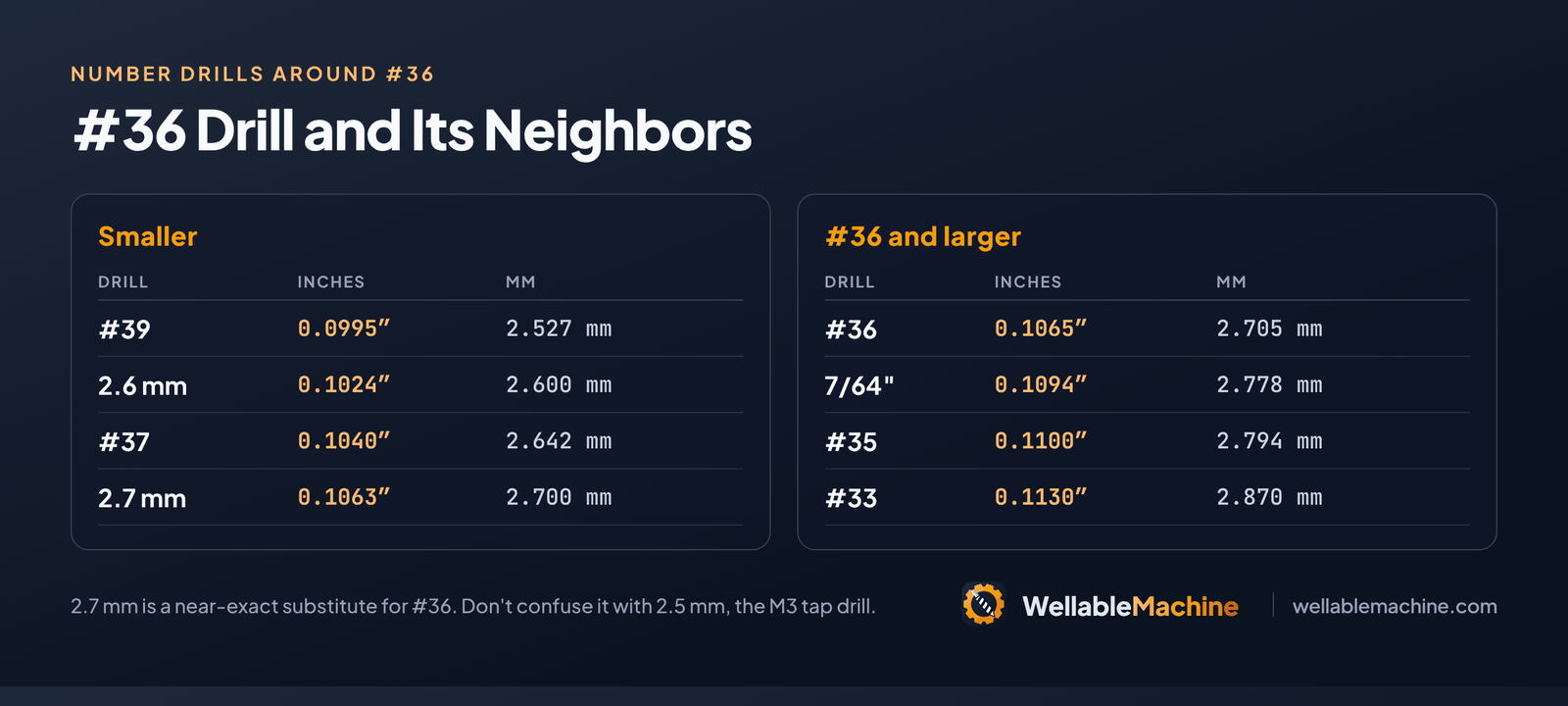
Sizes Around a #36 Drill
| Drill | Inches | mm | Difference from #36 |
|---|---|---|---|
| 3/32 in | 0.0938 | 2.381 | −0.0127 in |
| #39 | 0.0995 | 2.527 | −0.0070 in |
| 2.6 mm | 0.1024 | 2.600 | −0.0041 in |
| #37 | 0.1040 | 2.642 | −0.0025 in |
| 2.7 mm | 0.1063 | 2.700 | −0.0002 in |
| #36 | 0.1065 | 2.705 | — |
| 7/64 in | 0.1094 | 2.778 | +0.0029 in |
| #35 | 0.1100 | 2.794 | +0.0035 in |
| #34 | 0.1110 | 2.819 | +0.0045 in |
| #33 | 0.1130 | 2.870 | +0.0065 in |
| 2.9 mm | 0.1142 | 2.900 | +0.0077 in |
What Is a #36 Drill Used For?
- Tapping 6-32 threads. This is the big one. 6-32 machine screws hold electrical boxes, switch and outlet covers, computer cases, PC fans, guitar pickguards and countless brackets, and #36 is the drill most tap charts list for them. Full details are in our 6-32 tap drill size guide.
- Pilot holes for #6 screws. In hardwood, a #36 is a good pilot for the threads of a #6 wood screw; in softwood, go a little smaller (3/32 in).
- Thread-forming screws in thin metal. Some screw makers call for a hole near #36 for #6 thread-forming or sheet-metal screws in steel around 0.05 to 0.06 in thick. Always check the maker’s chart, because the right hole changes with the sheet thickness.
- Pin and rivet holes. A #36 hole suits some 0.104 in to 0.105 in pins and wire as a close fit, and model makers use it for small brass rod.
- Pilot for a larger drill. On small parts, a #36 is a handy pilot before opening a hole to 1/8 in or 9/64 in.
Why #36 Is the 6-32 Tap Drill
A 6-32 screw has a major diameter of 0.138 in and 32 threads per inch. The percentage of thread a drill gives can be worked out with % thread = 76.98 × TPI × (major diameter − drill). For a #36 that is 76.98 × 32 × (0.138 − 0.1065) = about 78%, right on the shop target of 75% for soft metals. The bars below compare the drills you’re most likely to reach for.

| Drill for 6-32 | Inches | Approx. thread | Best for |
|---|---|---|---|
| #37 | 0.1040 | 84% | Rarely worth it; adds tapping torque |
| #36 | 0.1065 | 78% | Aluminum, brass, plastics, mild steel |
| 7/64 in | 0.1094 | 71% | Steel, when you don’t have a #36 |
| #35 | 0.1100 | 69% | Tough steel, deep holes |
| #34 | 0.1110 | 67% | Stainless steel, hand tapping |
| #33 | 0.1130 | 62% | Hard stainless, very long engagement |
The point to take away is that a slightly larger drill is often the better choice in hard material. A 6-32 tap is small and breaks easily, and a 70% thread is only a few percent weaker than a 78% one. In stainless steel, many machinists use a #34 or #33 and still get threads that strip the screw before they strip themselves.
Can You Use 7/64 in Instead of a #36?
Yes, in most cases. A 7/64 in bit is 0.0029 in larger, which brings the thread down to about 71%. That is still plenty for a 6-32 screw, and it makes the tap easier to turn. The trade-off only matters in very soft materials or very short threads, such as thin aluminum sheet or plastic, where you want every bit of thread you can get. There, stick with a #36 or even a 2.7 mm bit.
Going the other way, a 3/32 in bit is too small for tapping 6-32. It would give over 100% thread on paper, which really means the tap is trying to cut metal below the thread root. It will break taps.
#36 vs 2.7 mm: Are They the Same?
For all practical purposes, yes. 2.7 mm is 0.1063 in, two ten-thousandths smaller than a #36. No one can tell the difference in a tapped hole. If you work mostly in metric or buy drills in metric sets, a 2.7 mm bit is a perfect substitute for 6-32 tapping. Be careful not to mix it up with 2.5 mm, which is the M3 tap drill; a 2.5 mm hole is too small for 6-32.
How to Drill and Tap 6-32 With a #36
- Center punch the mark. A bit this small walks easily, so a spot drill or a short stub-length drill helps, especially on curved or slick surfaces.
- Drill at the right speed. For a 0.1065 in bit, a good starting point is about 3,500 RPM in aluminum, 2,150 RPM in mild steel and 1,100 RPM in stainless. Hand drills rarely reach these speeds; just keep the bit cutting, not rubbing. See our drill speed chart.
- Peck the hole. Back the drill out every one or two diameters of depth to clear chips. Small bits break when their flutes pack up.
- Chamfer the top of the hole lightly with a countersink.
- Tap with a 6-32 plug tap and a small T-handle wrench, turning half a turn forward and a quarter back, with tapping fluid.
- For blind holes, drill at least 1/8 in deeper than the thread you need and finish with a bottoming tap.
If a tap does snap, don’t force it. Our guide on how to remove a broken tap walks through the options.
Choosing a #36 Drill Bit
- HSS jobber length is fine for aluminum, brass, plastic and mild steel, and is the cheapest option.
- Cobalt (M35 or M42) lasts much longer in stainless steel and hard alloys. See HSS vs cobalt drill bits.
- Stub or screw-machine length is stiffer, wanders less and breaks less often in hand drills. Use it whenever the hole depth allows.
- Split point (135°) bits start without a center punch and are good for drilling in thin sheet.
- Buy a few. A single #36 tends to go missing or break at the worst moment. Many shops keep several, or a dedicated 6-32 tap-and-drill set.
How to Check That a Bit Is Really a #36
The size is usually stamped or laser-etched on the shank, but small bits wear and the marking fades. Measure across the shank with calipers or a micrometer: you should read 0.106 in to 0.107 in (2.70 mm to 2.71 mm). Don’t measure across the flutes at the tip, because the margins give a slightly larger reading and worn bits measure smaller there. A drill gauge (a steel plate with numbered holes) is quicker if you sort bits often.
Where #36 Fits in a Number Drill Set
A standard #1–#60 set includes #36, so if you have one, you already own the right drill. Small sets that cover just the common tap drills, such as #43 (4-40), #36 (6-32), #29 (8-32), #25 (10-24) and #21 (10-32), are also popular and cover most electronics and light fabrication. For the bigger picture of how number, letter and fractional bits overlap, our fractional drill bit sizes guide is a useful companion.
Common Mistakes With a #36 Drill
- Grabbing a #35 or #37 by mistake. Number drills look identical; check the shank marking or a drill gauge before tapping.
- Running too slowly in aluminum. A small bit at low RPM rubs and builds up aluminum on the edges. Speed up and use a little lubricant.
- Not clearing chips. Packed flutes snap small drills, especially in deep holes. Peck often.
- Tapping a hole that wandered. If the hole is drilled at an angle, the 6-32 tap will follow it and may break. Use a drill press or guide for critical holes.
Frequently Asked Questions
7 quick answers from our editors
01What size is a #36 drill bit in inches?
0.1065 in.
02What is a #36 drill in mm?
2.705 mm. A 2.7 mm bit is a near-exact substitute.
03What fraction is closest to a #36 drill?
7/64 in (0.1094 in), which is 0.0029 in larger.
04What tap uses a #36 drill?
The 6-32 UNC tap. A #36 gives about 78% thread.
05Is a #36 bigger than a #35?
No. Higher numbers are smaller. A #35 is 0.110 in, slightly larger than a #36.
06Can I use a #36 for 6-40?
It gives over 90% thread on a 6-40 and is likely to break the tap. Use a #33 for 6-40.
07What clearance hole goes with a 6-32 screw?
A #28 (0.1405 in) for a close fit or a #25 (0.1495 in) for a free fit. See our clearance hole size chart.
Bottom Line
A #36 drill is 0.1065 in (2.705 mm), the standard 6-32 tap drill at about 78% thread. A 2.7 mm bit is a perfect substitute, and 7/64 in works well in steel. Go one or two sizes larger (#34 or #33) for stainless, peck the hole to clear chips, and keep a spare, because this is one bit you’ll use again and again.