#21 Drill Bit Size: 0.159 in (4.04 mm), the 10-32 Tap Drill

Quick answer: a #21 drill bit is 0.159 in in diameter, which is 4.039 mm. It sits between a #22 (0.157 in) and a #20 (0.161 in), and is just over 5/32 in (0.1563 in). The closest metric drill is 4.0 mm. The #21 is best known as the tap drill for 10-32 UNF threads (about 76% thread), and it is also the standard drill for 5/32 in solid aircraft rivets.
The #21 is one of the most used number drills in any machine shop, because 10-32 is one of the most common small threads in electronics, instruments, optics and aerospace hardware. If a chart tells you to use a #21 and you only own fractional and metric bits, this guide explains how big it is, what you can use instead, and how to drill and tap a clean 10-32 hole.
#21 Drill Bit Size at a Glance
| Property | Value |
|---|---|
| Decimal inches | 0.1590 in |
| Millimeters | 4.039 mm |
| Closest fractional | 5/32 in (0.1563 in), 0.0027 in smaller |
| Closest metric | 4.0 mm (0.1575 in), 0.0015 in smaller |
| Next smaller number drill | #22 = 0.1570 in |
| Next larger number drill | #20 = 0.1610 in |
| Main use | Tap drill for 10-32 UNF |
| Other use | Drill for 5/32 in solid rivets (aircraft practice) |

Where #21 Fits in the Number Drill Series
Number drills run from #80 (0.0135 in) up to #1 (0.228 in), and they run backward: the bigger the number, the smaller the bit. The series came from the old Stubs steel wire gauge, and it survives because it gives fine steps exactly where small taps and rivets need them. Between 9/64 in and 11/64 in, for instance, the fractional series has just one size (5/32 in), while the number series has eleven.
For the complete list, see our number and letter drill size chart. If you want to understand the fractional side as well, our guide to fractional drill bit sizes explains the 1/64 in steps. Background on how the systems developed is in the drill bit sizes article on Wikipedia.
Sizes Around a #21 Drill
| Drill | Inches | mm | Difference from #21 |
|---|---|---|---|
| #23 | 0.1540 | 3.91 | −0.0050 in |
| 5/32 | 0.1563 | 3.97 | −0.0027 in |
| #22 | 0.1570 | 3.99 | −0.0020 in |
| 4.0 mm | 0.1575 | 4.00 | −0.0015 in |
| #21 | 0.1590 | 4.04 | — |
| #20 | 0.1610 | 4.09 | +0.0020 in |
| 4.1 mm | 0.1614 | 4.10 | +0.0024 in |
| 4.2 mm | 0.1654 | 4.20 | +0.0064 in |
| #19 | 0.1660 | 4.22 | +0.0070 in |
Notice how close everything is. Five different drills sit within 0.005 in of the #21. With small threads, though, those few thousandths make a big difference in thread depth, as the next section shows.
What Is a #21 Drill Used For?
1. The tap drill for 10-32 UNF
A 10-32 thread has a major diameter of 0.190 in and 32 threads per inch. With a #21 drill the hole gives roughly 76% thread, which is the classic target in steel and aluminum. Because the thread is fine, each thousandth of an inch on the drill changes engagement by about 2.5%, so the right bit really matters here. Our detailed 10-32 tap drill size guide covers clearance holes and thread depth too.
Where will you see 10-32? Everywhere in electronics: rack-mount panels in 19 in equipment racks, chassis and heat sinks. It is also standard for optical breadboards and lab equipment (outside metric countries), firearm scope rings and mounts, model engines, RC hardware, and a huge range of small aerospace fittings, because the fine pitch resists vibration better than 10-24.
2. 5/32 in solid rivets
In aircraft sheet-metal work, solid rivets are installed in holes drilled just slightly larger than the rivet. The standard drills are #40 for 3/32 in, #30 for 1/8 in, #21 for 5/32 in and #11 for 3/16 in. The FAA’s advisory circular AC 43.13-1B lists these drill sizes in its rivet tables, and the general background is in the rivet article on Wikipedia. Blind (pop) rivets often use a slightly bigger hole, so always check the rivet maker’s chart for those.
3. Metric substitute for 4.0–4.05 mm holes
If a metric drawing calls for a 4.05 mm hole, or you want a hole a hair over 4 mm for a 4 mm pin to slide in, a #21 does the job. For a press fit on a 4 mm pin, choose 3.9 mm or a #23 instead.
Thread Percentage: #21 vs Other Drills for 10-32
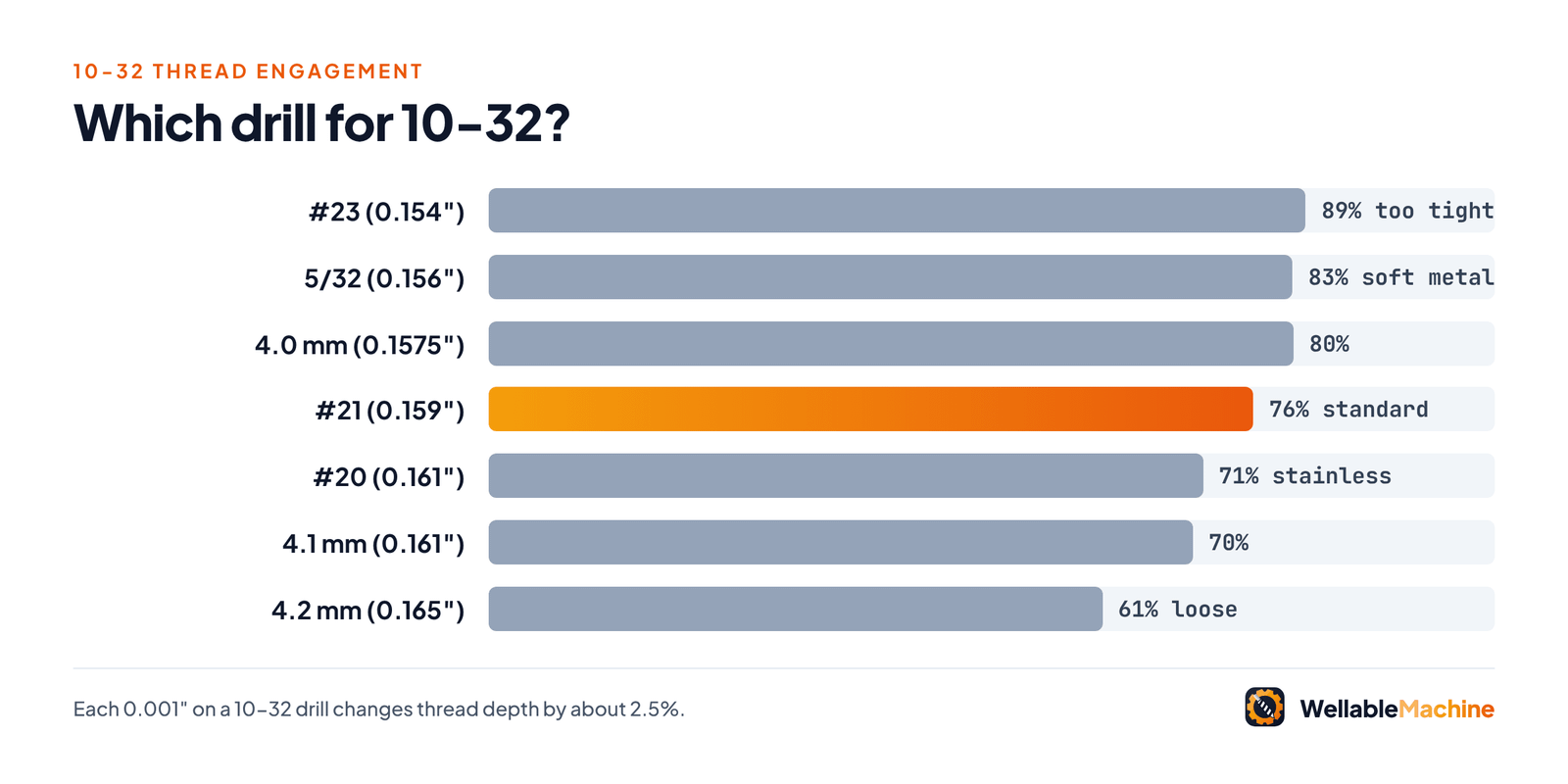
The percentage of thread for a given drill comes from % thread = 76.98 × TPI × (major diameter − drill). Here is how the nearby bits compare for 10-32:
| Drill for 10-32 | Diameter | Approx. thread | Verdict |
|---|---|---|---|
| #23 | 0.154 in | 89% | Too tight; tap breakage likely |
| 5/32 | 0.1563 in | 83% | Tight; soft metals only |
| #22 | 0.157 in | 81% | Tight but workable in aluminum |
| 4.0 mm | 0.1575 in | 80% | Good metric substitute in soft metals |
| #21 | 0.159 in | 76% | Standard choice |
| #20 | 0.161 in | 71% | Easier tapping; good in stainless |
| 4.1 mm | 0.1614 in | 70% | Good metric choice in steel and stainless |
| 4.2 mm | 0.1654 in | 61% | Too loose for most jobs |
Small holes almost always drill a little oversize, so real engagement tends to be a few percent lower than these figures. That is one reason the #21, rather than the #20, is the textbook choice: after normal oversize it still delivers around 70–75% thread.
Can You Use 5/32 Instead of a #21?
You can, but be careful. A 5/32 in bit gives about 83% thread, and that extra depth roughly doubles the torque needed to turn a small tap. A 10-32 tap is only about 0.19 in across and snaps easily. In aluminum, brass and plastics, a 5/32 in hole usually taps fine if you use fluid and back the tap out often. In steel, and especially in stainless, step up to a #21 or #20, or to 4.1 mm. If you do break a tap, our guide on how to remove a broken tap walks you through getting it out.
#21 vs 10-24: Don’t Mix Up the Tap Drills
The #10 screw comes in two common pitches: 10-24 (coarse) and 10-32 (fine). They need different drills. 10-24 uses a #25 (0.1495 in) and 10-32 uses a #21 (0.159 in). If you drill #21 and tap 10-24, you will end up with only about 57% thread, which strips easily. If you drill #25 and try to tap 10-32, the hole is so tight that the tap will almost certainly break. Label your bits and taps in pairs. See the 10-24 tap drill size guide for the coarse thread.
How to Drill and Tap a 10-32 Hole with a #21
- Center punch the location. With small bits, a good punch mark is often enough to start without a spot drill.
- Drill at the right speed. A #21 HSS bit runs at about 2,000 rpm in mild steel, 900–1,000 rpm in stainless and as fast as your drill allows (up to about 6,000 rpm) in aluminum. Use the drill speed chart for other materials.
- Peck drill in holes deeper than about 1/2 in, backing out every 1/8 in or so to clear chips. Small bits break when chips pack the flutes.
- Deburr the hole with a small countersink, just enough to remove the sharp edge.
- Tap by hand with a T-handle tap wrench and cutting fluid. A 10-32 tap is fragile, so use a tap guide and stop at the first sign of binding. In through holes, a spiral-point (gun) tap pushes chips ahead and rarely needs backing out.
- Test with a 10-32 screw. It should turn in smoothly by hand.
Choosing a #21 Drill Bit
- Buy several. Small number drills are cheap and wear fast. Shops often buy #21 bits by the dozen.
- Stub (screw-machine) length bits are shorter and much stiffer, so they flex less and give truer holes. Use jobber length only when you need the reach.
- Cobalt is worth it for stainless and tough alloys; plain HSS is fine for aluminum and mild steel. Our HSS vs cobalt guide explains the difference.
- Tap-and-drill sets that pair a 10-32 tap with a #21 drill are handy and remove the risk of grabbing the wrong bit.
Common Problems
- Tap breaks in the hole: the hole was too small, too shallow or the tap was not square. Use a #21 or #20, drill blind holes deeper and use a tap guide.
- Stripped threads: the hole was too big (for example a #21 used with a 10-24 tap), or too few threads are engaged in thin material. In sheet thinner than about 1/16 in, use a rivet nut or a nut instead.
- Bit snaps: too much feed, chips packed in the flutes, or a wobbly hand drill. Peck, clamp the work and use a drill press if you can.
- Hole wanders: the punch mark was too small or the bit is a long jobber. Punch deeper or spot drill first.
#21 Drill for Metric Threads?
People sometimes ask whether a #21 works for M5 threads, since M5 is close to a #10 screw. It doesn’t. The M5 × 0.8 tap needs a 4.2 mm hole, which is 0.006 in larger than a #21. Tapping M5 into a #21 hole would give about 90% thread and a very high chance of breaking the tap. Use 4.2 mm (or a #19 at 0.166 in) for M5, and keep the #21 for 10-32. Our M5 tap drill size guide has the details. A #21 hole is also slightly too small for an M4 clearance hole done properly; M4 screws want 4.3 mm (close) to 4.5 mm (normal).
How to Identify a #21 Bit
Number markings on small shanks are tiny and wear off fast. Measure across the margins with a caliper or micrometer: a #21 reads 0.159 in. A #20 reads 0.161 in and a #22 reads 0.157 in, so you need a tool that reads to 0.001 in. A drill index or gauge plate with numbered holes makes sorting much faster.
Frequently Asked Questions
7 quick answers from our editors
01What size is a #21 drill bit in inches?
A #21 drill is 0.159 in in diameter.
02What size is a #21 drill in mm?
It is 4.039 mm. The closest standard metric drill is 4.0 mm.
03What fraction is closest to a #21 drill?
5/32 in (0.1563 in) is the closest fraction, about 0.003 in smaller.
04What tap uses a #21 drill?
The 10-32 UNF tap. The 10-24 UNC tap uses a #25 drill instead.
05Can I use a 4 mm drill for 10-32?
Yes, in aluminum, brass and plastic. It gives about 80% thread. In steel and stainless, 4.1 mm is the better metric choice.
06Is a #21 drill bigger than a #20?
No. Number drills get smaller as the number goes up, so a #21 (0.159 in) is slightly smaller than a #20 (0.161 in).
07What size rivet uses a #21 drill?
A 5/32 in solid rivet, in standard aircraft practice.
Bottom Line
A #21 drill is 0.159 in (4.04 mm), just over 5/32 in. It is the standard 10-32 tap drill, giving about 76% thread, and the usual drill for 5/32 in solid rivets. A #20 or 4.1 mm bit is a good alternative in stainless, while 5/32 in or 4.0 mm work in soft metals. Never use the #21 for a 10-24 tap, and treat small taps gently: right drill, fluid, and a square start.