U Drill Bit Size: 0.368 in (9.35 mm) and What It Is For
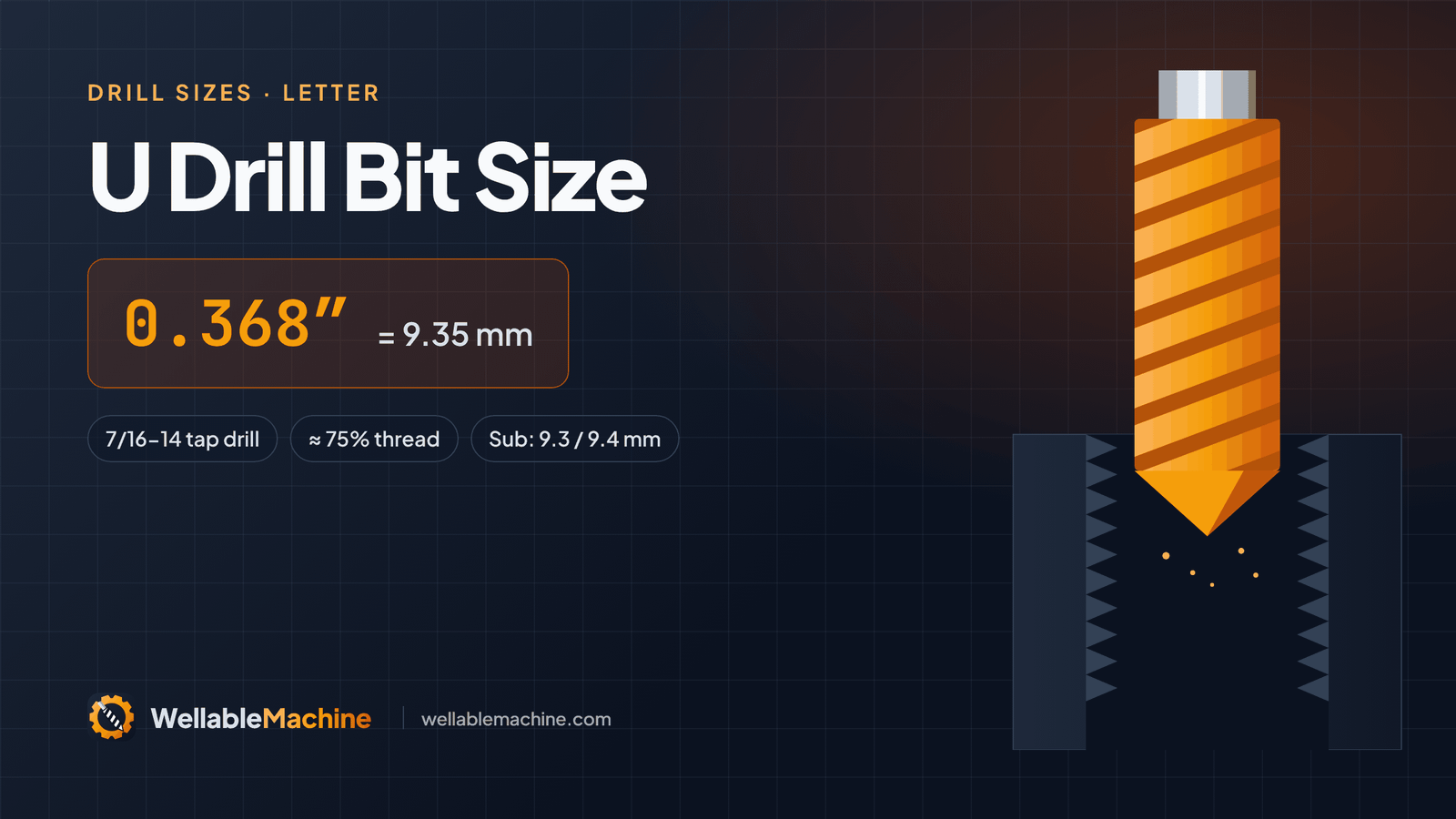
Quick answer: a U drill bit is 0.368 in in diameter, which is 9.347 mm. It sits between a T drill (0.358 in) and a V drill (0.377 in), and is a little under 3/8 in (0.375 in). The closest metric drills are 9.3 mm and 9.4 mm. The U drill is the standard tap drill for 7/16-14 UNC threads, where it gives about 75% thread.
Letter drills confuse a lot of people, because nothing in the name tells you how big the bit is. If a drawing, a tap chart or a parts list calls for a “U drill” and you are wondering whether a 3/8 in bit from your fractional set will do, this guide answers that. You will find the exact size, the drills on either side of it, what the U drill is used for, which substitutes are acceptable, and how to drill and tap a clean 7/16-14 hole with one.
U Drill Bit Size at a Glance
| Property | Value |
|---|---|
| Decimal inches | 0.3680 in |
| Millimeters | 9.347 mm |
| Closest fractional | 3/8 in (0.3750 in), 0.007 in larger |
| Closest fractional below | 23/64 in (0.3594 in), 0.0086 in smaller |
| Closest metric | 9.3 mm (0.3661 in) and 9.4 mm (0.3701 in) |
| Next smaller letter drill | T = 0.3580 in |
| Next larger letter drill | V = 0.3770 in |
| Main use | Tap drill for 7/16-14 UNC (about 75% thread) |

How Letter Drill Sizes Work
American drill sizes come in four series: fractional (in 1/64 in steps), number (#80 up to #1), letter (A to Z) and metric. Letter drills pick up where the number series stops. The largest number drill, #1, is 0.228 in, and the letter series starts just above it with A at 0.234 in and climbs to Z at 0.413 in. Unlike number drills, letter drills get bigger as you go through the alphabet, so U is one of the larger ones.
The point of the letter series is to fill the gaps between fractional sizes. Between 23/64 in and 3/8 in the fractional series has nothing at all, a gap of 0.016 in. The letter series puts the U drill right in the middle of that gap, which is exactly where a 7/16-14 tap needs its hole. You can see every size in our number and letter drill size chart or in the drill bit sizes reference on Wikipedia.
Sizes Around a U Drill
| Drill | Inches | mm | Difference from U |
|---|---|---|---|
| S | 0.3480 | 8.84 | −0.0200 in |
| T | 0.3580 | 9.09 | −0.0100 in |
| 23/64 | 0.3594 | 9.13 | −0.0086 in |
| 9.2 mm | 0.3622 | 9.20 | −0.0058 in |
| 9.3 mm | 0.3661 | 9.30 | −0.0019 in |
| U | 0.3680 | 9.35 | — |
| 9.4 mm | 0.3701 | 9.40 | +0.0021 in |
| 9.5 mm | 0.3740 | 9.50 | +0.0060 in |
| 3/8 | 0.3750 | 9.53 | +0.0070 in |
| V | 0.3770 | 9.58 | +0.0090 in |
| W | 0.3860 | 9.80 | +0.0180 in |
Two metric drills bracket the U drill within about 0.002 in on each side. That matters if you live outside the US or buy metric sets: a 9.3 mm or 9.4 mm bit does the same job.
What Is a U Drill Used For?
1. The tap drill for 7/16-14 UNC
This is the reason most people go looking for a U drill. A 7/16-14 thread has a major diameter of 0.4375 in and 14 threads per inch. For a class 2B internal thread, the minor diameter of the hole may be anywhere from about 0.360 in to 0.376 in. The U drill lands at 0.368 in, close to the middle of that band, and gives roughly 75% thread engagement. That is the usual target: strong enough for almost any job, while still easy on the tap. Our full 7/16-14 tap drill size guide covers the thread in more detail, and the tap drill size chart lists it next to every other UNC and UNF size.
You will meet 7/16-14 threads on older American machinery, on engine and transmission parts (some cylinder head and bell housing bolts), on trailer hitches and suspension brackets, and in heavy fixtures and jigs. It is less common than 3/8-16 or 1/2-13, which is exactly why the U drill is often the one bit missing from a set.
2. Pre-drilling for a 3/8 in reamer (light stock)
A reamer only removes a small amount of metal, so the hole has to be drilled just under size first. For a 3/8 in reamer the usual pre-drill is 23/64 in, which leaves about 0.016 in for the reamer. A U drill leaves only 0.007 in. Machinists use it when they want the reamer to take a light finishing cut, for example with a hand reamer in a vise or when the drill is known to cut slightly oversize. For a machine reamer under power, 23/64 in is the safer choice.
3. Holes for thread-forming taps and inserts
Thread-forming (roll) taps push metal into shape instead of cutting it, so they need a larger hole than a cutting tap. Some makers list hole sizes for metric M10 form taps in the 9.3 to 9.4 mm range, which is right where a U drill sits. Threaded inserts for wood and soft metals also call for odd sizes now and then. In both cases, follow the maker’s chart exactly, because the correct hole for a form tap or insert varies between brands.
4. Drawings that call for 9.35 mm
If you are working from a metric drawing that asks for a 9.35 mm hole and you only own inch drills, the U drill is a 0.003 mm match. That is as close as two drill series ever get.
Thread Percentage: U vs the Alternatives for 7/16-14
The thread percentage you get with a given drill can be estimated with a simple formula: % thread = 76.98 × TPI × (major diameter − drill diameter). For 7/16-14 that means each thousandth of an inch you add to the drill removes just over 1% of thread.

| Drill for 7/16-14 | Diameter | Approx. thread | Verdict |
|---|---|---|---|
| T | 0.358 in | 86% | Too tight, high tap breakage risk |
| 23/64 | 0.3594 in | 84% | Tight; only in soft metals, with care |
| 9.3 mm | 0.3661 in | 77% | Excellent substitute |
| U | 0.368 in | 75% | Standard choice |
| 9.4 mm | 0.3701 in | 73% | Excellent substitute, easier tapping |
| 9.5 mm | 0.374 in | 68% | Fine in steel and stainless |
| 3/8 | 0.375 in | 67% | Acceptable in hard or tough metal |
| V | 0.377 in | 65% | Weak; only for light loads |
Real holes usually come out a little larger than the drill, often 0.001 to 0.003 in, so the true thread percentage is slightly lower than the table. That works in your favor with the tighter options and against you with the looser ones.
Can You Use a 3/8 in Drill Instead of a U?
Yes, in many cases. A 3/8 in bit is 0.007 in larger and gives about 67% thread. Tests on threaded joints show that going from 75% to 65% thread loses only a small share of strip strength, because the bolt usually breaks before a well-engaged thread strips. In tough materials like stainless steel or alloy steel, a slightly bigger hole actually helps: it cuts tapping torque a lot and reduces the chance of snapping the tap.
Where you should not cut corners is in soft or weak materials, such as aluminum, cast iron, brass or plastics, and in short holes where only a few threads are engaged. There, the extra thread depth from a true U drill or a 9.3 mm bit is worth having. If you only have fractional bits and the joint matters, buy the U drill. It costs little and it removes the guesswork.
Can You Use 23/64 Instead?
23/64 in is the next fractional size down, and it gives about 84% thread. That is tight. The tap will need much more torque, the risk of breaking it goes up, and the extra thread adds almost no strength. Use 23/64 in only in soft material like aluminum or brass, with plenty of cutting fluid, and back the tap off often. In steel, choose the U, 9.3 mm, 9.4 mm or 3/8 in instead.
How to Drill and Tap 7/16-14 with a U Drill
- Mark and center punch the hole location so the drill starts exactly where you want it.
- Spot or pilot drill. A U drill has a chisel edge about 0.06 in wide, which tends to wander on flat stock. Start with a center drill or spot drill, or drill a 1/8 in to 5/32 in pilot first.
- Drill at the right speed. With a high-speed steel bit, start near 900–1,000 rpm in mild steel, around 400 rpm in stainless and up to about 2,500 rpm in aluminum. Our drill speed chart gives speeds for other materials.
- Use cutting fluid in steel and stainless, and clear chips by pecking every few diameters of depth.
- Chamfer the hole slightly with a countersink so the tap starts straight and the first thread doesn’t burr. See how to countersink.
- Tap straight. Use a tap guide or start the tap in the drill press (by hand, with the power off) to keep it square. Turn forward half to one turn and back a quarter turn to break chips, unless you are using a spiral-point tap in a through hole.
- Check the thread with a 7/16-14 bolt or a plug gauge, then clean out the chips.
For blind holes, drill deeper than the thread you need, at least three to four thread pitches (about 1/4 in) extra, so the tap’s tapered lead and the chips have somewhere to go.
Choosing a U Drill Bit
- Length: a jobber-length U drill is about 4-7/8 in overall. A screw-machine (stub) length bit is much stiffer and wanders less, which is ideal in a drill press or on a lathe.
- Material: plain HSS is fine for mild steel, aluminum and brass. For stainless and hard alloys, choose cobalt (M35 or M42).
- Point: a 135° split point starts more cleanly without a pilot hole. A 118° point is fine with a pilot.
- Shank: at 0.368 in, a U drill fits any 3/8 in or 1/2 in chuck. Reduced-shank and 3-flat shank versions are also available.
If you tap a lot of sizes, a full letter drill set is a good investment. Otherwise buy the U drill on its own together with the 7/16-14 tap, so the pair always stays together in the drawer.
How to Check That a Bit Is Really a U
Letter markings on the shank wear away quickly. Measure across the margins (the narrow lands behind the cutting edges) with a caliper or micrometer, not across the flutes. A U drill should read 0.368 in. If it reads 0.358 in, it is a T; 0.377 in is a V. A drill gauge plate with letter holes is another quick way to sort loose bits, and a cheap way to keep your letter drills organized.
Common Problems When Drilling with a U Drill
- Hole comes out oversize: the point is ground off-center or the lips are unequal. A hole that is 0.005 in oversize drops 7/16-14 thread engagement to about 70%. Resharpen the bit, or check it with the guide on how to sharpen drill bits.
- Bit chatters or makes a triangular hole: common in thin sheet. Clamp the work down, use a backing block, and slow down.
- Bit squeals and turns blue: speed is too high or feed too light, especially in stainless. Lower the rpm and feed firmly so the bit keeps cutting.
- Tap binds partway down: chips are packing the flutes or the hole is tapered. Back out, clean, add fluid and continue.
Frequently Asked Questions
7 quick answers from our editors
01What size is a U drill bit in inches?
A U drill is 0.368 in in diameter.
02What size is a U drill in mm?
It is 9.347 mm. The closest standard metric drills are 9.3 mm and 9.4 mm.
03What fraction is closest to a U drill?
3/8 in (0.375 in) is the closest fraction, about 0.007 in larger. 23/64 in (0.359 in) is the closest fraction below it.
04What is a U drill used for?
Mainly as the tap drill for 7/16-14 UNC threads. It is also used to pre-drill for a 3/8 in reamer when only a light finishing cut is wanted.
05What tap uses a U drill?
The 7/16-14 UNC tap. For the fine thread, 7/16-20 UNF, use a W drill (0.386 in) instead.
06Is a U drill bigger than 3/8?
No. A U drill (0.368 in) is slightly smaller than 3/8 in (0.375 in). The V drill (0.377 in) is the first letter drill larger than 3/8 in.
07Can I use a 9.5 mm drill for 7/16-14?
Yes. It gives about 68% thread, which is fine in steel. In soft metals a 9.3 mm or 9.4 mm drill is better.
Bottom Line
A U drill is 0.368 in (9.35 mm), the letter size between T and V and just under 3/8 in. Its main job is the 7/16-14 tap hole, where it gives about 75% thread. If you don’t have one, a 9.3 mm or 9.4 mm drill is an almost perfect substitute, and a 3/8 in bit will do in steel and stainless at about 67% thread. Avoid 23/64 in except in soft metals, and always spot the hole, use cutting fluid and start the tap square.