3/8 Drill Bit in mm: 9.525 mm and the Best Metric Substitute

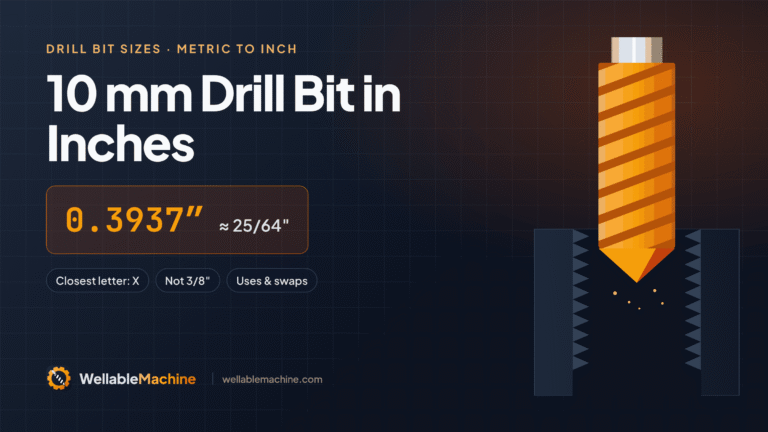
Quick answer: a 3/8 inch drill bit is 9.525 mm (0.375 in). The closest metric drill is 9.5 mm, which is only 0.025 mm (0.001 in) smaller and can be used in its place for almost any job. A 10 mm bit is 0.475 mm (0.019 in) larger and is not a direct substitute when the fit matters.
3/8 in is one of the most used drill sizes there is. It’s the largest bit a 3/8 in chuck can hold without a reduced shank, the standard size for 3/8 in masonry anchors and dowels, and a common clearance hole for 5/16 in and M8 bolts. If you work with both metric and inch hardware, knowing exactly how 3/8 in compares with 9 mm, 9.5 mm and 10 mm saves a lot of loose bolts and stuck dowels.
3/8 Drill Bit Conversion at a Glance
| Measurement | Value |
|---|---|
| Fraction | 3/8 in (also written 24/64 or 6/16) |
| Decimal inch | 0.3750 in |
| Exact millimeters | 9.525 mm |
| Nearest metric drill | 9.5 mm (0.3740 in), 0.025 mm smaller |
| Next metric up | 9.6 mm (0.3780 in), then 10 mm (0.3937 in) |
| Nearest letter drill | V (0.3770 in / 9.576 mm) |
| Next fractions | 23/64 (0.3594 in) below, 25/64 (0.3906 in) above |
The math is simple: inches × 25.4 = millimeters, so 0.375 × 25.4 = 9.525 mm. One inch has been defined as exactly 25.4 mm since 1959, so the conversion is exact, not rounded. The NIST unit conversion page lists the official factors.
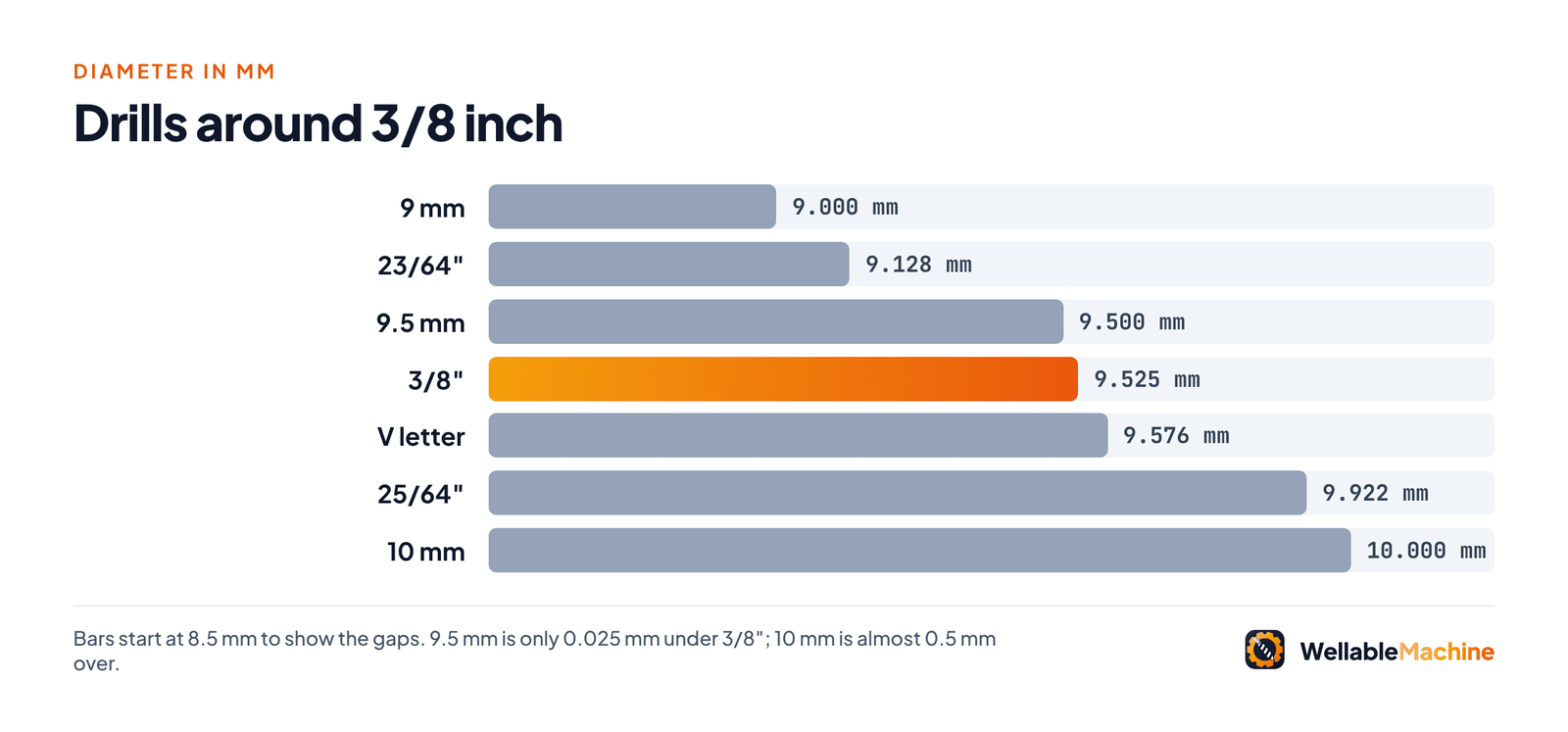
Sizes Around 3/8 Inch
| Drill | mm | Inches | Difference from 3/8 |
|---|---|---|---|
| 9 mm | 9.000 | 0.3543 | 0.021 in smaller |
| 23/64 in | 9.128 | 0.3594 | 0.016 in smaller |
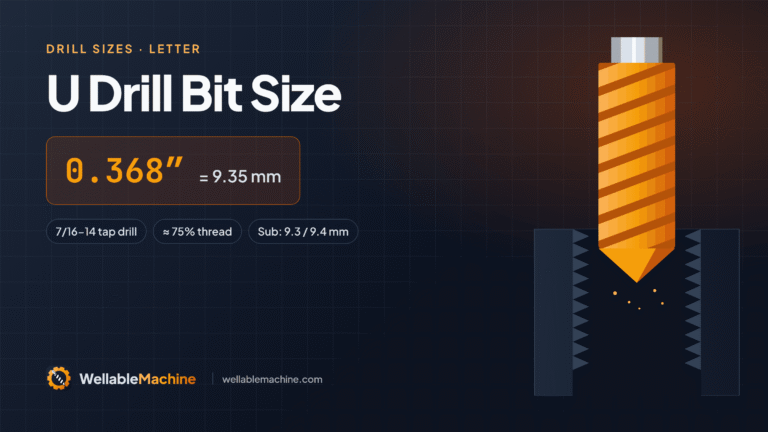
| U | 9.347 | 0.3680 | 0.007 in smaller |
| 9.5 mm | 9.500 | 0.3740 | 0.001 in smaller |
| 3/8 in | 9.525 | 0.3750 | — |
| V | 9.576 | 0.3770 | 0.002 in larger |
| 9.6 mm | 9.600 | 0.3780 | 0.003 in larger |
| W | 9.804 | 0.3860 | 0.011 in larger |
| 25/64 in | 9.922 | 0.3906 | 0.016 in larger |
| 10 mm | 10.000 | 0.3937 | 0.019 in larger |
For a complete list of inch sizes see our fractional drill bit sizes chart, and the number and letter drill size chart for letters like U, V and W.
Can You Use 9.5 mm Instead of 3/8 in?
Yes, for practically everything. A difference of 0.025 mm is smaller than the normal tolerance of a jobber drill and smaller than the oversize a hand drill produces through wobble. A hole drilled with a 9.5 mm bit in a hand drill will usually measure closer to 3/8 in than to 9.5 mm.
The only cases where it matters are precision fits, such as a reamed hole for a 3/8 in dowel pin or bearing. There you’d drill undersize (for example 23/64 in or 9.2 mm) and ream to exactly 0.375 in anyway, so the drill choice is not critical.
Can You Use 10 mm Instead of 3/8 in?
Only when a looser hole is fine. 10 mm is nearly 0.020 in bigger. That’s enough to cause problems in several common jobs:
- Masonry anchors: a 3/8 in wedge or sleeve anchor in a 10 mm hole can spin or pull out. Always use a 3/8 in carbide bit. Our wedge anchor size chart lists the right bit for each size.
- Dowels: a 3/8 in wooden dowel in a 10 mm hole is loose and relies entirely on glue fill.
- Tap holes: 3/8 in is a common tap drill for 7/16-14 in hard metals; 10 mm would leave almost no thread.
The reverse is also worth knowing: a 10 mm dowel or 10 mm anchor will not fit in a 3/8 in hole.
What Is a 3/8 Drill Bit Used For?
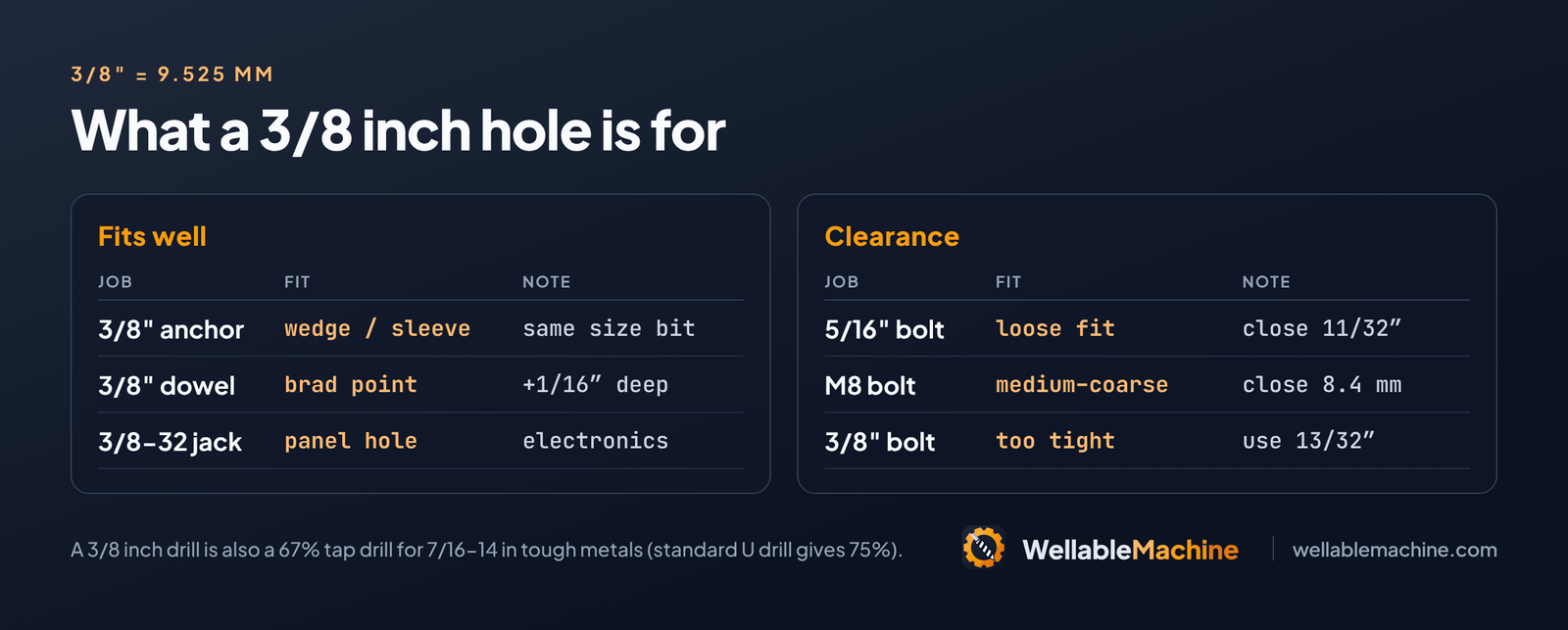
Clearance holes for 5/16 in and M8 bolts
A 3/8 in hole is a loose (free) fit for 5/16 in bolts and sits between the normal (9 mm) and coarse (10 mm) clearance for M8. That makes it a good choice when you need to line up several holes across two parts. For a tighter fit use 11/32 in for 5/16 in bolts or 9 mm for M8. See the clearance hole size chart for all sizes.
Not for 3/8 in bolts
A 3/8 in bolt will not fit a 3/8 in hole in metal unless the threads are tiny and the hole is oversize. Use 25/64 in (close) or 13/32 in (normal) for 3/8 in bolts.
3/8 in masonry anchors
Wedge anchors, sleeve anchors and drop-in anchors in 3/8 in size all use a 3/8 in carbide masonry bit. Drill with a hammer drill and keep the bit square so the hole doesn’t bell out.
Dowels and joinery
3/8 in dowels are the standard size for furniture, shelf supports and cabinet carcasses. Use a brad point bit for a clean, accurate hole, and drill about 1/16 in deeper than the dowel so glue has somewhere to go.
Tap drill for 7/16-14 in hard metals
The standard 7/16-14 tap drill is U (0.368 in), giving about 75% thread. A 3/8 in drill gives about 67%, which is easier to tap in stainless and tough steel and still strong. Our 7/16-14 tap drill size guide has the details.
Electrical and audio work
Many panel-mount jacks, toggle switches and potentiometers with 3/8-32 bushings mount in a 3/8 in hole, which is why it’s a staple size for guitar pedals and electronics enclosures. A step bit gives a cleaner hole in thin aluminum boxes.
Running cables and lines
A 3/8 in hole fits a single low-voltage cable, a speaker wire or a 1/4 in tube. For thicker cable runs through studs, step up to 3/4 in or larger.
Speeds for a 3/8 in Drill Bit
| Material | Bit | Approx. RPM | Tips |
|---|---|---|---|
| Softwood | Brad point or twist | 1,500–2,500 | Back the exit with scrap to stop tear-out |
| Hardwood | Brad point | 1,000–1,500 | Clear chips often in deep holes |
| Aluminum | HSS | 2,000–2,500 | Light oil or WD-40 stops chips welding to the bit |
| Brass | HSS, dubbed edge if possible | 1,500–2,000 | Grabs at breakthrough; clamp the part |
| Mild steel | HSS or cobalt | 800–1,000 | Cutting oil; pilot with 1/8 in first |
| Stainless | Cobalt | 300–450 | Constant pressure, never let it rub; see how to drill stainless steel |
| Concrete | Carbide masonry | 600–1,000, hammer on | Pull out to clear dust |
| Acrylic | Modified (zero rake) bit | 800–1,000 | Slow, light pressure; see how to drill acrylic |
These come from cutting speeds of about 100 SFM in mild steel and 250 SFM in aluminum. The drill speed chart has the formula and other sizes.
Drilling a Clean 3/8 in Hole in Metal
- Center punch the mark firmly.
- Pilot with 1/8 in or 5/32 in. The chisel edge on a 3/8 in bit is about 0.06 in wide and won’t cut well on its own; a pilot removes that problem and keeps the hole on location.
- Open to 3/8 in at the right speed with cutting oil.
- Ease off at breakthrough. A 3/8 in bit can grab thin sheet and spin it.
- Deburr both sides with a countersink or a larger drill turned by hand.
In sheet metal under about 1/16 in thick, a twist drill tends to make a triangular hole. A step bit or a step drill gives a round one.
3/8 in Bits and 3/8 in Chucks
A drill “with a 3/8 in chuck” can hold shanks up to 3/8 in. A 3/8 in twist drill fits, but anything bigger needs a reduced shank. Many compact drills and older corded drills have 3/8 in chucks, while most 18 V and 20 V drills now have 1/2 in chucks. The drill chuck sizes guide explains the differences.
Choosing the Right Type of 3/8 in Bit
| Bit type | Use it for | Why |
|---|---|---|
| Brad point | Dowels, furniture, visible holes in wood | The center spur locates exactly and the spurs cut a clean rim |
| HSS twist (jobber) | General wood, plastic, aluminum, mild steel | Cheap and versatile; fits a 3/8 in chuck |
| Cobalt twist | Stainless and tough steels | Keeps its edge when the cut gets hot |
| Carbide masonry | Concrete, brick, block for 3/8 in anchors | Hard tip survives aggregate; use with hammer mode |
| Spade bit | Quick rough holes in framing lumber | Fast, cheap, but tears out at the exit |
| Step bit | Sheet metal and thin plastic boxes | Round, burr-free holes without grabbing |
| Reduced-shank sizes | Not needed at 3/8 in | A full 3/8 in shank already fits 3/8 and 1/2 in chucks |
For a full overview of bit styles, see types of drill bits. If you’re drilling stainless or tool steel often, a cobalt 3/8 in bit is worth the extra cost; our HSS vs cobalt drill bits comparison explains why.
Other Common Inch Bits in Millimeters
If you’re converting one size, you’re probably converting a few. These are the inch sizes that most often get swapped for metric bits, with the closest metric drill and how far off it is:
| Inch bit | Exact mm | Closest metric | Difference |
|---|---|---|---|
| 1/8 in | 3.175 | 3.2 mm | 0.025 mm larger |
| 3/16 in | 4.763 | 4.8 mm | 0.04 mm larger |
| 1/4 in | 6.350 | 6.4 mm | 0.05 mm larger |
| 5/16 in | 7.938 | 8.0 mm | 0.06 mm larger |
| 3/8 in | 9.525 | 9.5 mm | 0.025 mm smaller |
| 7/16 in | 11.113 | 11.1 mm | 0.013 mm smaller |
| 1/2 in | 12.700 | 12.7 mm | exact |
Notice that 3/8 in and 9.5 mm are one of the closest pairs in the whole list, which is why the swap is so safe.
Common Mistakes
- Using a 10 mm bit for a 3/8 in anchor. The hole is too big for the anchor to grip.
- Drilling a 3/8 in hole for a 3/8 in bolt. You need 25/64 or 13/32 in.
- Using a twist drill for dowels in plywood. It wanders and tears the face veneer. Use a brad point bit.
- Skipping the pilot in steel. The bit walks, overheats and drills oversize.
Frequently Asked Questions
6 quick answers from our editors
01What is 3/8 inch in mm?
Exactly 9.525 mm.
02Is 9.5 mm the same as 3/8 inch?
Nearly. 9.5 mm is 0.025 mm (0.001 in) smaller, so the two are interchangeable for almost all drilling.
03Is a 10 mm drill bigger than 3/8?
Yes. 10 mm is 0.3937 in, about 0.019 in larger than 3/8 in.
04What size drill bit is closest to 3/8?
9.5 mm in metric and the V letter drill (0.377 in) in the letter series.
05What size bolt fits a 3/8 inch hole?
A 5/16 in or M8 bolt, with some clearance. A 3/8 in bolt needs a 25/64 or 13/32 in hole.
06What size is a 3/8 drill bit in decimal?
0.375 in.
Bottom Line
A 3/8 in drill bit is 9.525 mm. Use 9.5 mm as a direct metric replacement, but don’t swap in 10 mm for anchors, dowels or tap holes where the fit matters. 3/8 in is the right hole for 3/8 in masonry anchors and dowels and a loose clearance for 5/16 in and M8 bolts, but a 3/8 in bolt needs a bigger hole. Pilot first in metal and choose the bit type to suit the material.