How to Drill Hardened Steel: Test, Choose a Method and Drill

Quick answer: to drill hardened steel, first confirm how hard it is with a file. If a file skates off without biting, the steel is above roughly 55 HRC and you need a carbide bit (solid carbide in a drill press, or a carbide-tipped “hard metal” bit in a hand drill), low speed, heavy, steady pressure and cutting oil. If the file just barely bites (about 40–50 HRC), an M42 cobalt bit can work. If the part allows it, softening the spot with heat first makes the job easy with an ordinary bit.
Most people find out a part is hardened when a new drill bit squeals, glows and goes blunt in five seconds. Saw blades, leaf springs, hardened pins, axles, bearing races, chisels, broken bolts and some tool steels all fall in this group. The good news is that almost any of them can be drilled with the right method. This guide walks through testing the steel, picking a method, setting up, drilling and dealing with what goes wrong.
Step 1: Find Out How Hard the Steel Is
You don’t need a hardness tester. A few simple checks put the part in the right bracket:
| Test | What you see | Approx. hardness | What it means |
|---|---|---|---|
| File test | File cuts easily, leaves bright marks | Under 30 HRC | Not hardened; any good HSS bit will drill it |
| File test | File bites but feels hard and slippery | 40–50 HRC | Cobalt bit at low speed, or carbide |
| File test | File skates and won’t cut at all | Over 55 HRC | Carbide only, or soften first |
| Spark test | Bright, bushy, branching sparks on a grinder | High-carbon steel | Likely heat-treatable; may be hardened |
| Look and use | Springs, blades, bearings, chisels, punches | Usually 45–62 HRC | Treat as hardened until proven otherwise |
| Grade marks | Grade 8 bolt (6 radial lines), class 10.9 or 12.9 | About 33–44 HRC | Tough but drillable with cobalt |
File-test sets with graded files exist, but an ordinary good-quality mill file gives a useful answer. Test in an inconspicuous spot and on the exact area you want to drill: some parts are only case hardened, with a hard skin about 0.010–0.060 in deep over a soft core. Those get much easier once you’re through the skin. The Rockwell scale article explains what the HRC numbers mean.
Step 2: Choose a Method
| Method | Works up to | Tools | Best for |
|---|---|---|---|
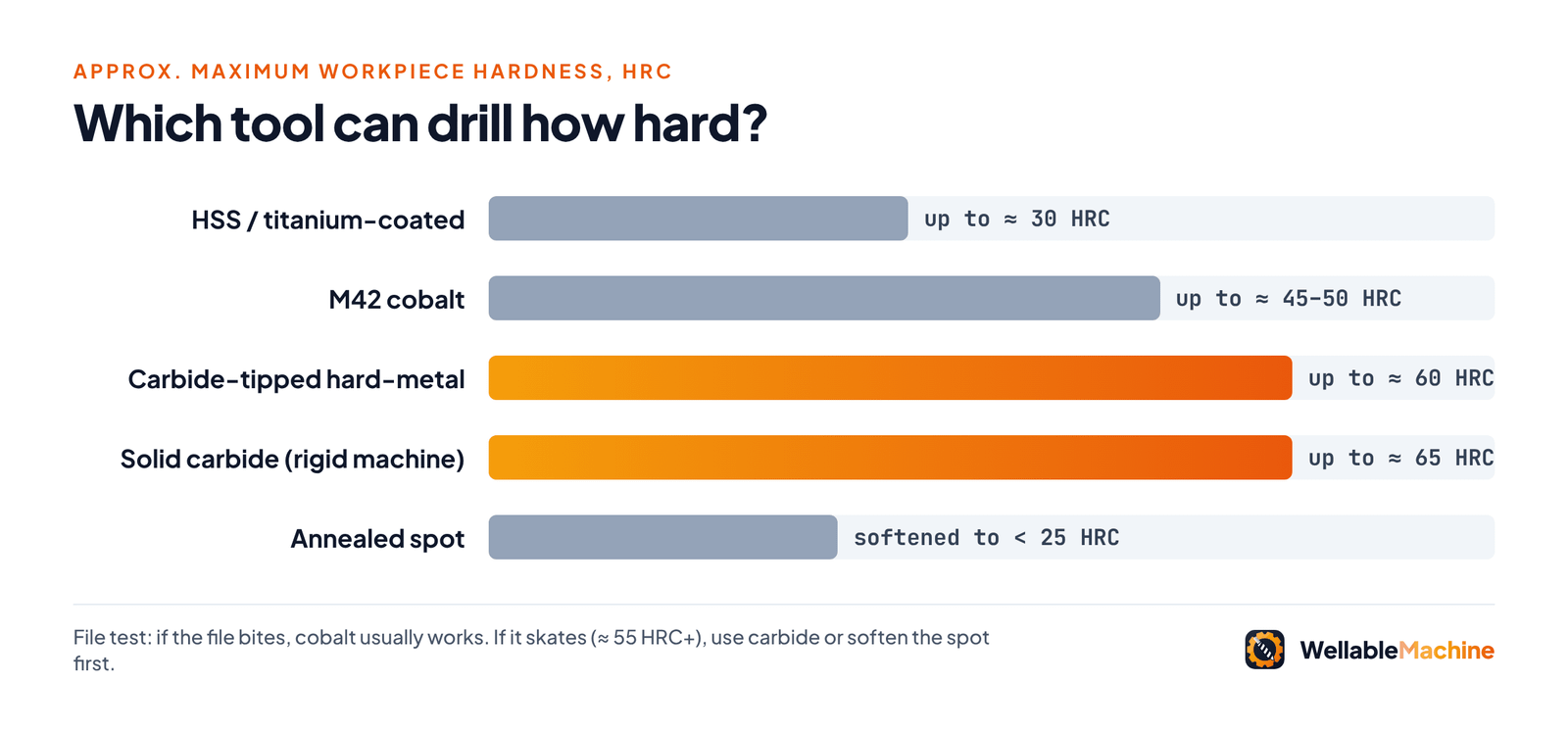
| M42 cobalt bit | About 45–50 HRC | Hand drill or drill press | Grade 8 bolts, tough alloy steel, spring steel that isn’t fully hard |
| Carbide-tipped hard-metal bit | About 60 HRC | Hand drill (no hammer) or drill press | Saw blades, springs, hardened brackets, one-off holes |
| Solid carbide drill | About 65 HRC | Rigid drill press or mill only | Accurate holes in tool steel, dies, hardened shafts |
| Spot annealing (heat) | Any hardness | Propane/MAPP or oxy-acetylene torch | Parts where a small soft spot doesn’t matter |
| Carbide end mill or burr | About 60 HRC | Mill, or die grinder for burrs | Starting a flat on curved surfaces; enlarging holes |
| EDM (electrical discharge) | Any | Machine shop service | Broken taps, precision holes in fully hard tools |
If you are still choosing bits, our best drill bits for hardened steel guide compares the options in detail, and carbide drill bits explains solid versus tipped carbide.
Step 3: Set Up Properly
With hardened steel, setup matters more than the drill. A good bit in a shaky setup will chip; a modest bit in a rigid one will often succeed.
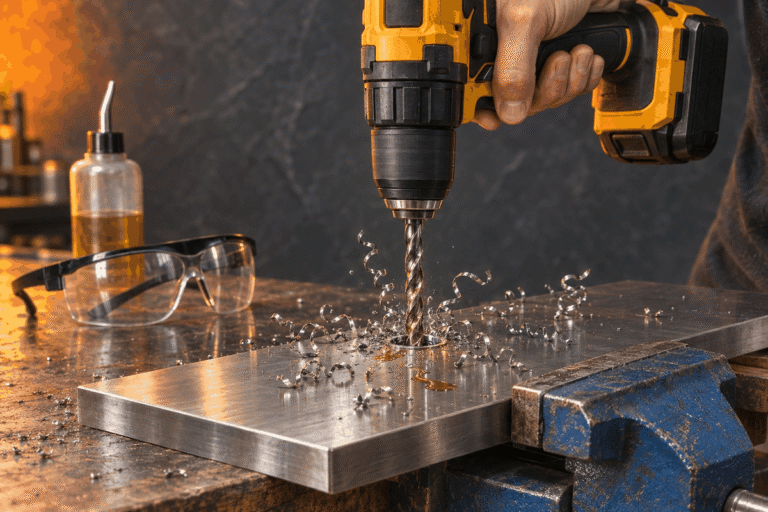
- Use a drill press if at all possible. It keeps the bit square and lets you apply heavy, even pressure. See how to use a drill press.
- Clamp the part in a vise, and clamp the vise to the table. Thin blades should be clamped close to the hole on both sides so they can’t flex.
- Back up the work with a scrap of wood or aluminum so the bit doesn’t chip as it breaks through.
- Choke the bit up in the chuck so the minimum length sticks out. Short bits flex less.
- In a hand drill, brace yourself, use the side handle and turn the hammer function off. Hammer action destroys carbide tips in steel.
Step 4: Drill the Hole

- Make a starting point. A center punch won’t dent fully hardened steel, so grind a small dimple with a carbide burr or a diamond point, or use a carbide spot drill in a drill press.
- Start with the final size if you can. In hard steel, small pilot bits break easily and the pilot hole edges can chip larger carbide bits. For holes up to about 1/4 in, go straight in with the finished size. For larger holes, pilot with a carbide bit about one third of the final diameter.
- Run slowly. As a starting point for carbide-tipped bits in a hand drill: about 400–600 RPM for 1/4 in, 250–400 RPM for 3/8 in and 200–300 RPM for 1/2 in. Solid carbide in a drill press can run faster (around 1,500–2,300 RPM for 1/4 in at 100–150 SFM), but only with a rigid setup.
- Push hard and keep pushing. The bit must cut a chip every revolution. Letting it rub, even for a few seconds, glazes the surface and work-hardens it further.
- Use cutting oil. Sulfurized cutting oil or a tapping fluid works best. Apply it constantly, not in bursts on a hot bit.
- Ease off at breakthrough so the tip doesn’t catch and chip.
Small curled or needle-like chips mean the bit is cutting. Fine powder and a squealing noise mean it’s rubbing: stop, check the bit and increase pressure or lower the speed.
Option: Soften the Spot With Heat
If the part’s hardness isn’t needed at the spot you’re drilling, annealing it is often the fastest method of all. It is how many people drill old leaf springs, files and saw blades for knife or tool projects.
- Protect anything that must stay hard. Wrap the rest of the part in a wet rag or sit it in water, so only the drill area heats up.
- Heat the spot to a dull cherry red (around 1,400–1,500 °F, roughly 760–815 °C) with a MAPP or oxy-acetylene torch. Plain propane may not get thick parts hot enough.
- Let it cool slowly. Don’t quench it. Leave it in still air, or better, bury it in dry sand, wood ash or vermiculite so it cools over an hour or more.
- Test with a file. If the file bites, drill with an ordinary cobalt or HSS bit.
Don’t anneal safety-critical parts such as suspension springs, lifting hooks, chain or structural bolts. Softening changes their strength permanently, and it doesn’t always show. Use a carbide bit instead, or replace the part.
Common Hardened Steel Jobs
Saw blades and circular saw plates
Steel saw plates are often 40–50 HRC. A carbide-tipped bit in a drill press, sandwiched between two pieces of scrap plywood, gives a clean hole without bending the plate. Clamp right next to the hole.
Leaf and coil springs
Spring steel is tough and springy rather than glass-hard. Cobalt works on many springs at low speed; if it doesn’t, carbide does. Spot annealing is common for projects that reuse old springs.
Hardened pins, shafts and axles
These are often case hardened. Once you’re through the skin, the core can be quite soft. A carbide bit for the first 1/16 in, then a cobalt bit, saves the expensive carbide.
Broken bolts and studs
High-grade bolts (Grade 8, class 10.9 or 12.9) are hard but drillable with cobalt. Broken easy-outs and taps are much harder and usually need carbide or EDM. See how to remove a broken bolt and how to remove a broken tap.
Tool steel and dies
Fully hardened tool steel at 58–64 HRC needs solid carbide in a rigid machine, or EDM. If you’re making a tool yourself, drill all holes before heat treatment.
What Goes Wrong (and How to Fix It)
| Problem | Cause | Fix |
|---|---|---|
| Bit glows and goes blunt in seconds | HSS or titanium-coated bit in hard steel; speed too high | Switch to cobalt or carbide; halve the speed |
| Carbide tip chips | Hammer mode on, flexing part, tilted drill or catch at breakthrough | Hammer off, clamp rigidly, use a drill press, ease off at exit |
| Bit won’t start; skates around | No starting dimple on a hard surface | Grind a dimple with a carbide burr or use a spot drill |
| Hole goes in a little, then stops | Surface work-hardened by rubbing | Use a fresh carbide bit with heavy pressure; don’t dwell |
| Hole drills fine, then gets easier | Case-hardened part | Switch to cobalt once through the skin |
| Part cracks | Brittle steel, too much pressure near an edge | Move the hole away from edges; anneal if allowed |
Safety
- Wear safety glasses or a face shield. Carbide fragments and hard chips fly fast.
- Clamp, don’t hold. A bit that catches in hard steel can spin a part with real force.
- Hot chips and oil smoke: work with ventilation, keep a rag handy and don’t touch chips or the bit right after drilling.
- Torch work: keep a fire extinguisher nearby and heat away from flammable materials and fuel lines.
Making Bits Last
- Use the slowest speed that still produces chips, and the heaviest pressure the bit can take.
- Never let a bit dwell or spin without feeding.
- Keep oil on the cut the whole time.
- Have bits resharpened by someone with a diamond wheel; don’t touch carbide on a normal grinder.
- Save carbide for the hard part of the job. For mixed jobs, a cobalt bit handles the softer areas well.
Hardened steel is easier if you already know the basics of drilling difficult metals. Our guide on how to drill stainless steel uses the same principles of low speed and constant feed, and the drill speed chart gives starting speeds for normal steels.
Frequently Asked Questions
7 quick answers from our editors
01What is the best way to drill hardened steel?
Use a carbide bit (solid carbide in a drill press, or carbide-tipped by hand) at low speed with heavy, steady pressure and cutting oil. If the part allows it, anneal the spot first.
02Can a cobalt drill bit drill hardened steel?
Up to about 45–50 HRC, yes. For fully hardened steel that a file won’t scratch, cobalt fails quickly and you need carbide.
03How do you know if steel is hardened?
Try a file on it. If the file skates and won’t cut, it’s hardened (roughly 55 HRC or more). If it bites easily, it isn’t.
04What speed should I use to drill hardened steel?
Slow. With a carbide-tipped bit by hand, about 400–600 RPM for a 1/4 in hole and less for bigger holes.
05Can I drill hardened steel with a hand drill?
Yes, with carbide-tipped bits, hammer mode off, a firm grip and steady pressure. Solid carbide bits should only be used in a drill press or machine.
06Does heating steel make it easier to drill?
Yes, if you heat it to cherry red and let it cool slowly, it softens (anneals). Heating it and quenching it in water does the opposite and makes it harder.
07Why does my drill bit just polish the steel?
It’s rubbing instead of cutting, either because the steel is too hard for the bit, the speed is too high or the pressure is too light.
Bottom Line
Start every hardened-steel job with a file test. If the file bites, a cobalt bit at low speed is usually enough. If it skates, use carbide with a rigid setup, a ground starting dimple, slow speed, heavy pressure and oil, or anneal the spot when the part allows it. Never let the bit rub, keep hammer mode off and clamp the work. For safety-critical parts, drill with carbide or replace the part rather than softening it.