How to Drill a Hole in Sheet Metal (Clean, Round Holes)
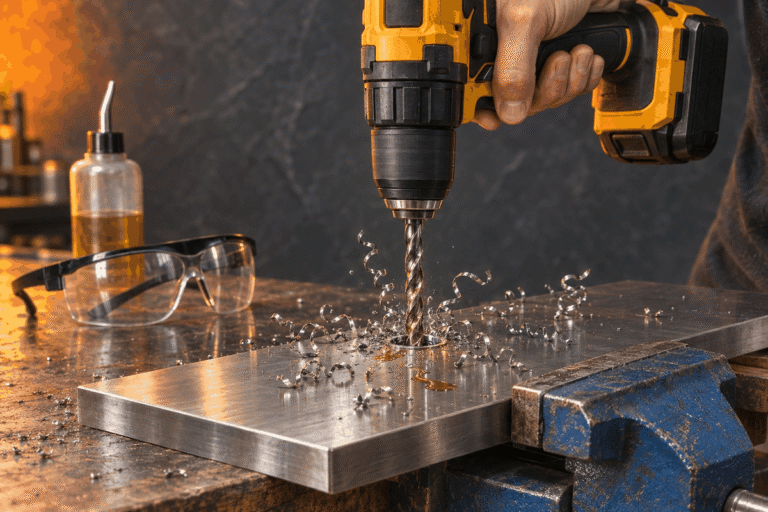
Quick answer: to drill a clean hole in sheet metal, center punch the mark, clamp the sheet to a wood backer board, and drill with a sharp 135° split-point HSS or cobalt bit at a moderate speed with light, steady pressure and a drop of cutting oil. For holes over about 1/4 in in thin sheet, use a step drill bit instead of a twist drill, because a large twist drill grabs and tears thin metal into a triangle. Finish by deburring both sides.
Thin metal is easy to cut but hard to drill well. The drill wants to skate across the shiny surface, the tip punches through before the full diameter starts cutting, and big bits catch, spin the sheet, and leave a jagged, out-of-round hole. The good news is that a few simple habits fix all of that. This guide covers the right bits for each hole size, speeds for steel, aluminum and stainless, the steps for a clean hole, and how to stop the most common problems.
What You Need
- Drill: a cordless drill is fine. A drill press is better for many holes or thicker sheet.
- Bits: HSS or cobalt twist drills with a 135° split point for small holes, and a step bit for larger ones.
- Center punch: an automatic (spring) punch is easiest on thin sheet.
- Backer board: a scrap of plywood or MDF under the sheet.
- Clamps: at least two. Never hold sheet metal by hand while drilling.
- Cutting fluid: cutting oil, tapping fluid or even light machine oil for steel and stainless; WD-40 or paraffin for aluminum.
- Deburring tool: a hand deburrer, a countersink bit or a larger drill turned by hand.
- Safety glasses and gloves for handling sharp edges and swarf (not while the drill is running near the gloves).
Choosing the Right Bit
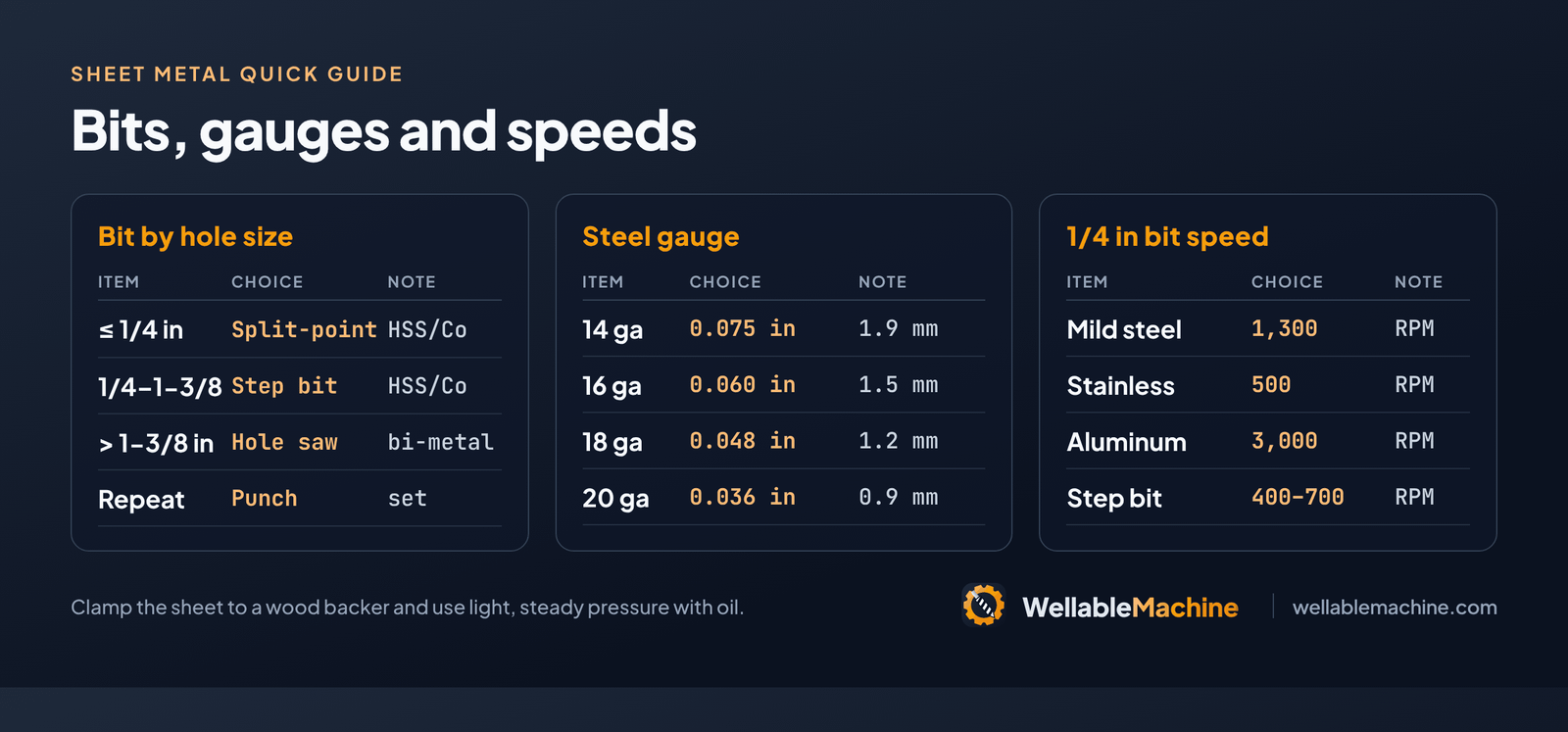
| Hole size | Best bit | Why |
|---|---|---|
| Up to 1/4 in (6 mm) | 135° split-point HSS or cobalt twist drill | Starts without walking; clean hole at low cost |
| 1/4–1-3/8 in (6–35 mm) | Step drill bit | Cuts round, burr-light holes in thin sheet and deburrs as it goes |
| Over 1-3/8 in (35 mm) | Bi-metal hole saw or a punch (knockout) set | Large holes without distortion |
| Many identical holes | Sheet metal punch or a drill press with a jig | Fast and repeatable |
Twist drills ground with a standard 118° point work, but they tend to wander and leave a bigger exit burr. A 135° split point starts on the mark and pushes less. For hard or stainless sheet, cobalt (M35 or M42) bits last much longer; see HSS vs cobalt drill bits. Step bits have their own technique, covered in how to use a step drill bit.
Sheet Metal Gauge Thickness
Sheet metal is often sold by gauge. The higher the number, the thinner the sheet. The gauge also tells you whether a twist drill will grab: as a rule of thumb, once the hole is more than about three times the sheet thickness, a twist drill starts to misbehave.
| Gauge | Steel thickness | Aluminum thickness | Typical uses |
|---|---|---|---|
| 10 | 0.135 in (3.4 mm) | 0.102 in (2.6 mm) | Brackets, trailer parts |
| 12 | 0.105 in (2.7 mm) | 0.081 in (2.1 mm) | Heavy enclosures, frames |
| 14 | 0.075 in (1.9 mm) | 0.064 in (1.6 mm) | Toolboxes, shelving |
| 16 | 0.060 in (1.5 mm) | 0.051 in (1.3 mm) | Car panels, electrical boxes |
| 18 | 0.048 in (1.2 mm) | 0.040 in (1.0 mm) | Body panels, enclosures |
| 20 | 0.036 in (0.9 mm) | 0.032 in (0.8 mm) | Appliance skins |
| 22–24 | 0.024–0.030 in (0.6–0.8 mm) | 0.020–0.025 in (0.5–0.6 mm) | HVAC duct, flashing |
| 26–29 | 0.014–0.018 in (0.35–0.45 mm) | — | Roofing and siding panels |
Steel and aluminum gauges are different scales, which is why the same gauge number is a different thickness. Galvanized steel is slightly thicker than bare steel of the same gauge because of its zinc coating. The sheet metal reference explains how the gauge systems came about.
Drill Speeds for Sheet Metal
| Bit size | Mild / galvanized steel | Stainless steel | Aluminum |
|---|---|---|---|
| 1/8 in (3 mm) | 2,500 RPM | 1,000 RPM | 5,000+ RPM (as fast as the drill goes) |
| 3/16 in (5 mm) | 1,800 RPM | 700 RPM | 4,000 RPM |
| 1/4 in (6 mm) | 1,300 RPM | 500 RPM | 3,000 RPM |
| Step bit (up to 1 in) | 400–700 RPM | 200–350 RPM | 800–1,200 RPM |
These are starting points for HSS. Slow down if the chips turn blue, the bit squeals, or smoke comes off the oil. For other sizes and materials, use the drill speed chart. In stainless the most common mistake is running too fast with too little pressure: the metal work-hardens and the bit stops cutting. For more on that, see how to drill stainless steel.
How to Drill a Hole in Sheet Metal, Step by Step
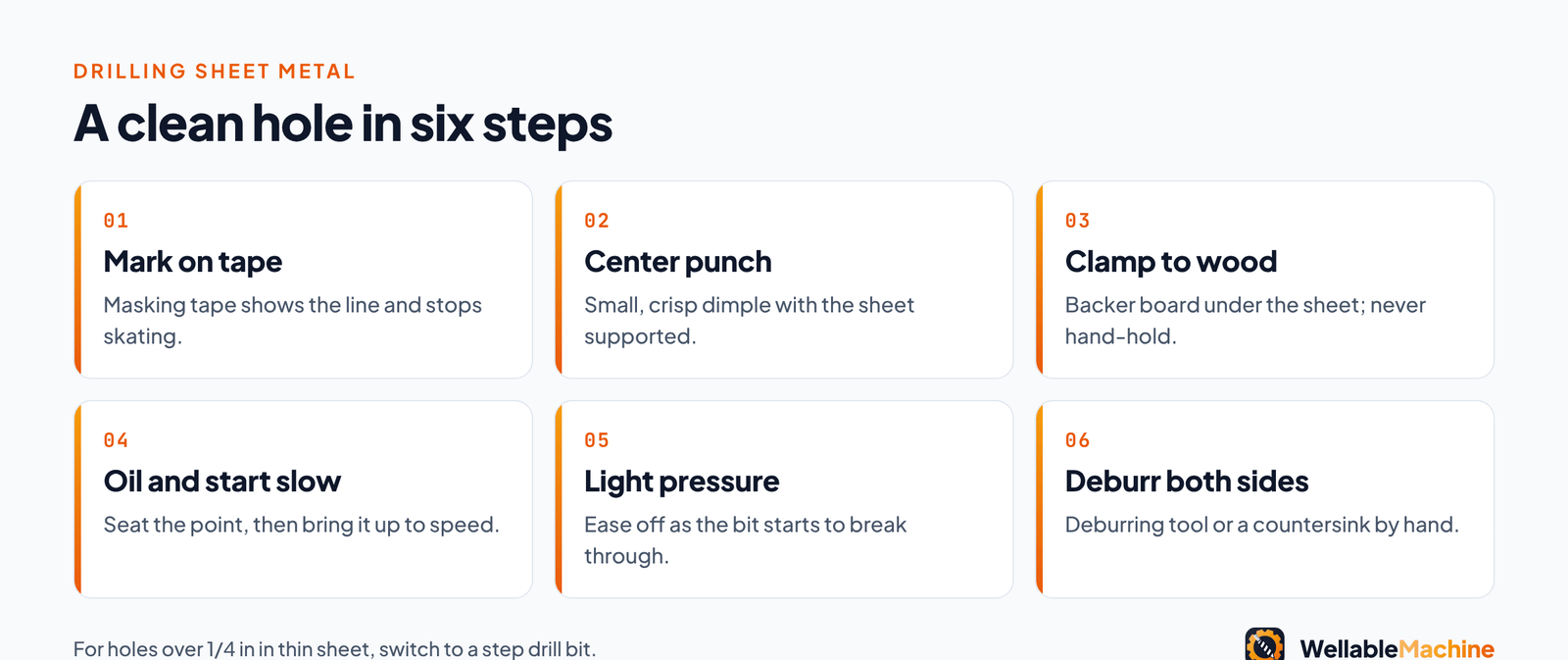
- Mark the hole. Put masking tape over the spot so the pencil line shows and the bit has some grip, then mark the center.
- Center punch. Make a small, crisp dimple. On thin sheet, use light blows with a backer underneath so the punch doesn’t dent the panel.
- Clamp the sheet to a backer board. The wood supports the metal under the bit, so the drill cuts instead of pushing the sheet down, and it stops the bit grabbing when it breaks through.
- Add a drop of oil on the punch mark for steel and stainless.
- Start slowly until the point is seated, then bring the drill up to speed.
- Use light, even pressure. You should see a steady curl or flakes of metal. Ease off as you feel the bit start to break through.
- Enlarge in steps for holes over 1/4 in in a twist drill, or switch to a step bit.
- Deburr both sides with a deburring tool or a countersink turned by hand. Burrs cut fingers and wires, and stop screws and rivets sitting flat.
Tips for Very Thin Sheet
- Sandwich it. Clamp the sheet between two pieces of plywood and drill through all three. The top board stops the bit grabbing and the bottom one supports the metal, giving perfectly round holes even in 26-gauge roofing.
- Use a brad-point or “sheet metal” bit in very thin aluminum and copper; its spurs cut a clean disc.
- Reduce the point angle effect by choosing a step bit. Each step is only a couple of millimeters tall, so it is always cutting with the full edge.
- Don’t push hard. Pressure dents thin sheet around the hole, which then looks like a crater.
- Use a drill stop or a short bit so the chuck can’t hit and dent the panel when the bit breaks through.
Holes Near Edges and Bends
Holes too close to an edge or a bend tear out or distort. A good rule is to keep the edge of a hole at least two times the sheet thickness from a free edge (and more in soft aluminum), and at least 2.5 times the thickness plus the bend radius from a bend. If a hole has to be closer, drill it before bending, and expect it to stretch slightly into an oval.
Drilling Different Sheet Metals
- Mild and galvanized steel: HSS bits, oil and moderate speed. Galvanized coating gives off zinc fumes only when heated strongly, so avoid burning the bit; normal drilling is fine with ventilation.
- Stainless steel: cobalt bits, slow speed, firm steady pressure and plenty of oil. Never let the bit rub without cutting.
- Aluminum: high speed, sharp bits with polished flutes, and a little lubricant so chips don’t weld to the bit. See how to drill aluminum.
- Copper and brass: sharp bits with a slightly blunted (dubbed) cutting edge stop the bit grabbing. Brass can be drilled dry.
- Painted or powder-coated panels: masking tape on both sides prevents chipping; step bits leave the neatest edge.
Common Problems and Fixes
| Problem | Cause | Fix |
|---|---|---|
| Bit skates off the mark | No punch mark, dull point | Center punch and use a split-point bit |
| Triangular or star-shaped hole | Twist drill too large for the sheet thickness | Use a step bit, or sandwich the sheet between boards |
| Bit grabs and spins the sheet | Sheet not clamped; breakthrough too fast | Clamp it, ease off at breakthrough, back with wood |
| Big burr on the exit side | Too much pressure, dull bit | Lighter feed, sharp bit, backer board, deburr |
| Bit stops cutting in stainless | Work hardening from rubbing | Slower speed, more pressure, fresh cobalt bit, oil |
| Dented panel around the hole | Too much force; no support | Support from behind and let the bit cut |
After Drilling: Fastening Into Sheet Metal
Most holes in sheet metal are for screws, bolts or rivets. For bolts, size the hole from the clearance hole size chart. If you want a flush screw head, use a countersink after drilling; our guide on how to countersink covers the angles. Seal outdoor holes with a dab of primer or sealant on the bare edge to stop rust, especially on galvanized roofing and car panels.
Frequently Asked Questions
6 quick answers from our editors
01What is the best drill bit for sheet metal?
A 135° split-point HSS or cobalt bit for small holes, and a step bit for anything over about 1/4 in.
02How do you drill sheet metal without a burr?
Use a sharp bit, light pressure, a wood backer, and deburr both sides. Step bits leave the smallest burr.
03What speed should I drill sheet metal at?
About 1,300 RPM for a 1/4 in bit in mild steel, slower in stainless and faster in aluminum.
04Why does my drill bit tear sheet metal?
The bit is too big for the sheet thickness, so the point breaks through before the edges cut. Use a step bit or sandwich the sheet.
05Do I need oil to drill sheet metal?
For steel and stainless, yes: it keeps the bit cool and sharp. Aluminum benefits from a light lubricant; brass can be drilled dry.
06Can I use a wood bit on sheet metal?
No. Wood bits dull at once on metal. Use HSS, cobalt or a step bit.
Bottom Line
Punch, clamp to a backer board, and drill with a sharp split-point bit at a moderate speed with light pressure and oil. Switch to a step bit for holes over 1/4 in, sandwich very thin sheet between boards, keep holes away from edges and bends, and always deburr. Those steps give round, clean holes in steel, aluminum and stainless every time.