How to Use a Step Drill Bit: Speeds, Tips and Mistakes

Quick answer: a step drill bit is a cone with stepped edges that drills clean, round holes in many sizes with one bit. To use it, clamp thin material, mark the target size on the bit, run the drill at low to medium speed (about 500–1,000 RPM in mild steel for the smaller steps) with a drop of cutting oil, and let the bit climb one step at a time until it reaches your size. Step bits work best in sheet metal, plastic and thin wood up to about the height of one step, typically 1/8 in.
Step bits (often called “unibits”) are an electrician’s and fabricator’s favorite because they make perfectly round holes in thin sheet without grabbing, and they deburr the edge as they go. They also make it easy to enlarge an existing hole to an exact size. This guide explains how they work, which sizes and coatings to buy, and the technique for clean, accurately sized holes.
Why Use a Step Bit?
- Round holes in thin sheet. A twist drill in thin sheet tends to grab and leave a triangular hole; a step bit doesn’t.
- Many sizes in one bit. A single bit can cover 1/8 to 1/2 in in 1/32 in steps.
- Self-starting. The small tip acts as its own pilot.
- Deburring. The next step up chamfers the edge of the hole you just made.
- Enlarging holes. Step up an existing hole to a larger exact size without wandering.
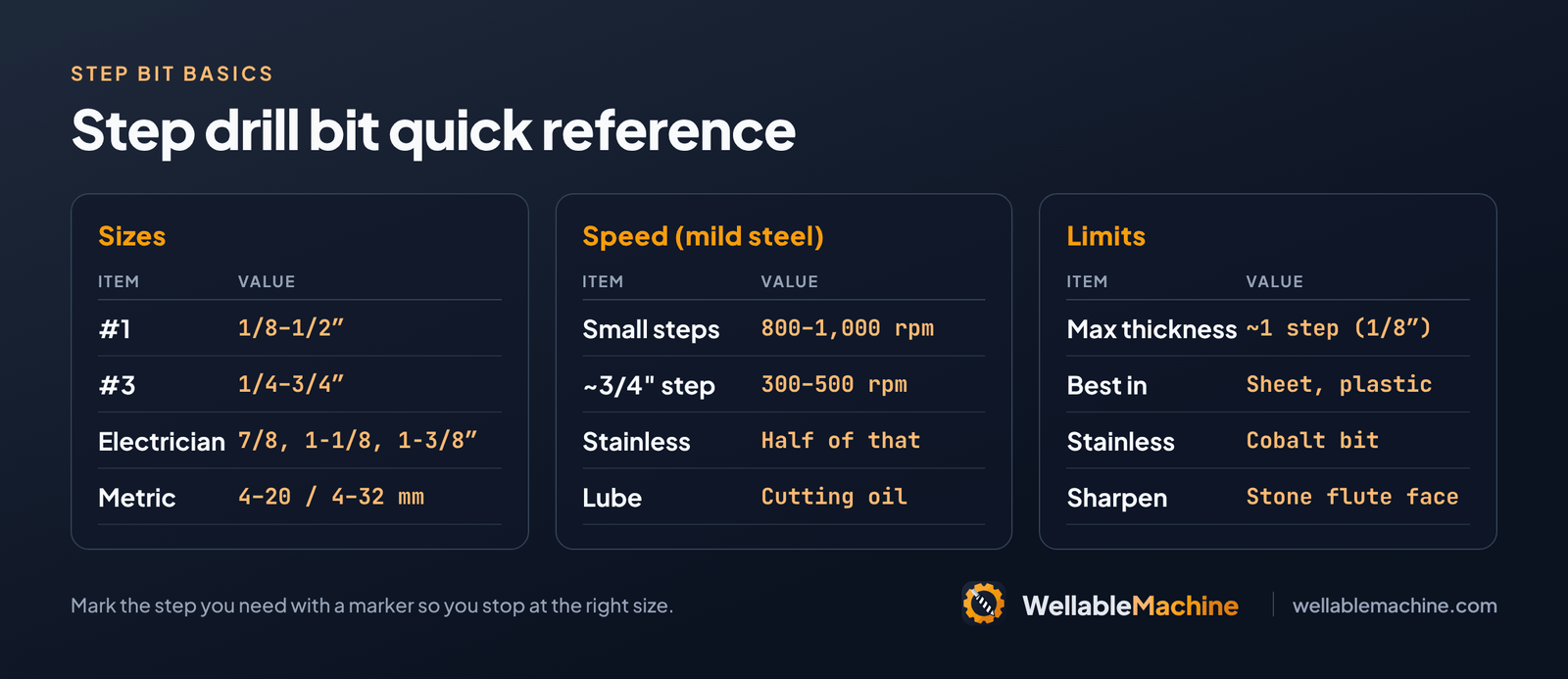
Common Step Bit Sizes
| Typical bit | Range | Steps | Good for |
|---|---|---|---|
| #1 | 1/8–1/2 in | 13 steps of 1/32 in | Small holes, screws, LEDs, switches |
| #2 | 3/16–7/8 in | Mixed, 1/16 in | General sheet metal, 1/2 in conduit knockouts |
| #3 | 1/4–3/4 in | 9 steps of 1/16 in | Bolts, cable glands |
| Electrician’s bit | 7/8, 1-1/8, 1-3/8 in, etc. | Conduit knockout sizes | Electrical boxes and panels |
| Metric | 4–20 mm, 4–32 mm | 1–2 mm | Metric fittings and glands |
For conduit, the standard knockout holes are about 7/8 in for 1/2 in conduit, 1-1/8 in for 3/4 in and 1-3/8 in for 1 in; electrician’s step bits are ground to these sizes.
How to Use a Step Drill Bit
- Mark and punch the center. The tip is small and starts easily, but a punch mark keeps it exactly on the spot.
- Clamp the work. Thin sheet can spin violently if the bit catches. Put scrap wood underneath.
- Mark your step. Put a dab of marker on the step you need so you can see when you reach it.
- Set the speed. Low to medium. In mild steel, about 800–1,000 RPM for the smallest steps and 300–500 RPM for steps around 3/4 in; slower in stainless. See our drill speed chart.
- Add cutting oil in steel and stainless; a little wax or WD-40 in aluminum.
- Drill steadily, keeping the bit square. Let each step cut through before moving on; you’ll feel the bit drop slightly as each step clears.
- Stop at your mark, then let the next step just kiss the edge to deburr it.

How Thick Can a Step Bit Drill?
Each step can only cut as deep as it is tall, typically about 1/8 in (3 mm); some heavy-duty bits have 1/4 in steps. In material thicker than one step, the hole will be tapered rather than straight. For thick plate, drill with a twist drill or annular cutter instead, and use the step bit only to chamfer or deburr.
Materials You Can Drill
| Material | Works? | Tip |
|---|---|---|
| Mild steel sheet | Yes | Cutting oil, moderate speed |
| Stainless sheet | Yes, with cobalt or TiAlN bits | Slow speed, firm feed, oil |
| Aluminum sheet | Yes, easily | Wax or WD-40 to stop chips sticking |
| Acrylic and polycarbonate | Yes | Slow, light pressure; reduces cracking |
| PVC boxes and plastic enclosures | Yes | Medium speed |
| Thin plywood and paneling | Yes | Back with scrap to avoid tear-out |
| Thick steel plate | No | Use twist drill or annular cutter |
Step Bit Coatings and Flutes
- HSS (uncoated or black oxide): fine for aluminum, plastic and occasional mild steel.
- Titanium nitride (gold): lasts longer in mild steel.
- Cobalt or TiAlN: the choice for stainless and frequent use. See cobalt vs titanium drill bits.
- Single straight flute: the classic design; easy to sharpen.
- Two flutes or spiral flute: faster cutting, smoother entry, better chip clearing.
Sharpening a Step Bit
When a step bit starts to squeal or needs much more pressure, sharpen it by stoning the flat face of the flute with a diamond file or a fine diamond hone, keeping the file flat against the face. Don’t grind the stepped edges themselves, or every size will change. A few strokes per flute is usually enough. For general sharpening technique, see how to sharpen drill bits.
Common Problems
| Problem | Cause | Fix |
|---|---|---|
| Hole tapered | Material thicker than one step | Use a twist drill for thick stock |
| Hole one size too big | Went past the mark | Mark the step; drill slowly near the end |
| Sheet spins | Not clamped | Clamp securely |
| Bit squeals, edges blue | Too fast or dull | Slow down, add oil, sharpen |
| Chipped acrylic | Too much pressure | Light feed and slow speed |
Enlarging an Existing Hole
One of the best uses for a step bit is opening up a hole that is too small, such as a mounting hole that doesn’t match a new part. Because the tip already sits in the old hole, the bit centers itself and the new hole stays concentric. Just drill until the step you need breaks through. This is much easier than using a big twist drill, which tends to grab and chatter when enlarging a hole in thin material.
Counting Steps and Hitting the Exact Size
Most step bits have the size of each step laser-etched on the side, but the markings are small and wear off. A few tricks help:
- Color the target step with a permanent marker. When the color disappears into the hole, stop.
- Count steps as you feel each one break through; there is a small drop in resistance.
- Check with calipers or the actual part before the final step, since it is easy to go one too far.
- Wrap tape just above the target step as a visual stop in poor light.
Step Bits vs Hole Saws and Punches
| Tool | Best for | Limits |
|---|---|---|
| Step bit | Holes up to about 1-3/8 in in thin sheet | Material thicker than one step |
| Hole saw | Larger holes, thicker material | Needs a pilot; rougher edge |
| Knockout punch | Perfect conduit holes in enclosures | Needs a pilot hole and specific punch sizes |
| Twist drill | Thick metal, small holes | Grabs and makes triangular holes in thin sheet |
Frequently Asked Questions
6 quick answers from our editors
01What is a step drill bit used for?
Drilling round holes of many sizes in thin sheet metal, plastic and thin wood, and enlarging or deburring holes.
02Can a step bit drill thick steel?
Not well. It only cuts straight through material up to about one step tall, usually 1/8 in.
03What speed should a step bit run?
Low to medium: about 500–1,000 RPM in mild steel for small steps, slower for large steps and stainless.
04Do step bits need a pilot hole?
No. The tip is self-starting, but a center punch mark helps accuracy.
05Can you use a step bit in wood?
Yes, in thin wood and paneling. Back it with scrap to prevent tear-out.
06What step bit for electrical boxes?
An electrician’s step bit with knockout sizes such as 7/8, 1-1/8 and 1-3/8 in.
Bottom Line
A step bit is the best tool for clean, round holes in thin sheet. Clamp the work, mark your step, run at a moderate speed with oil, and let it climb one step at a time. Keep it to material no thicker than one step, choose cobalt for stainless, and sharpen by stoning the flute face. For thick metal, go back to a twist drill.