Cobalt vs Titanium Drill Bits: Which Is Better for Metal?

Quick answer: cobalt drill bits are high-speed steel with 5–8% cobalt alloyed all the way through, so they stay hard when hot and are the right choice for stainless steel and other tough metals. Titanium drill bits are ordinary high-speed steel with a thin titanium-nitride coating, which cuts friction and makes them a good, cheaper choice for wood, plastic, aluminum and mild steel. Cobalt bits can be resharpened many times; titanium bits lose the coating at the tip the first time they are sharpened.
Walk down any tool aisle and you’ll see gold “titanium” sets next to bronze or gold “cobalt” sets at twice the price. The names make them sound like rival metals, but they are very different things: one is a coating, the other is an alloy. Understanding that difference tells you exactly when the extra cost of cobalt pays off and when titanium is all you need.
Cobalt vs Titanium at a Glance
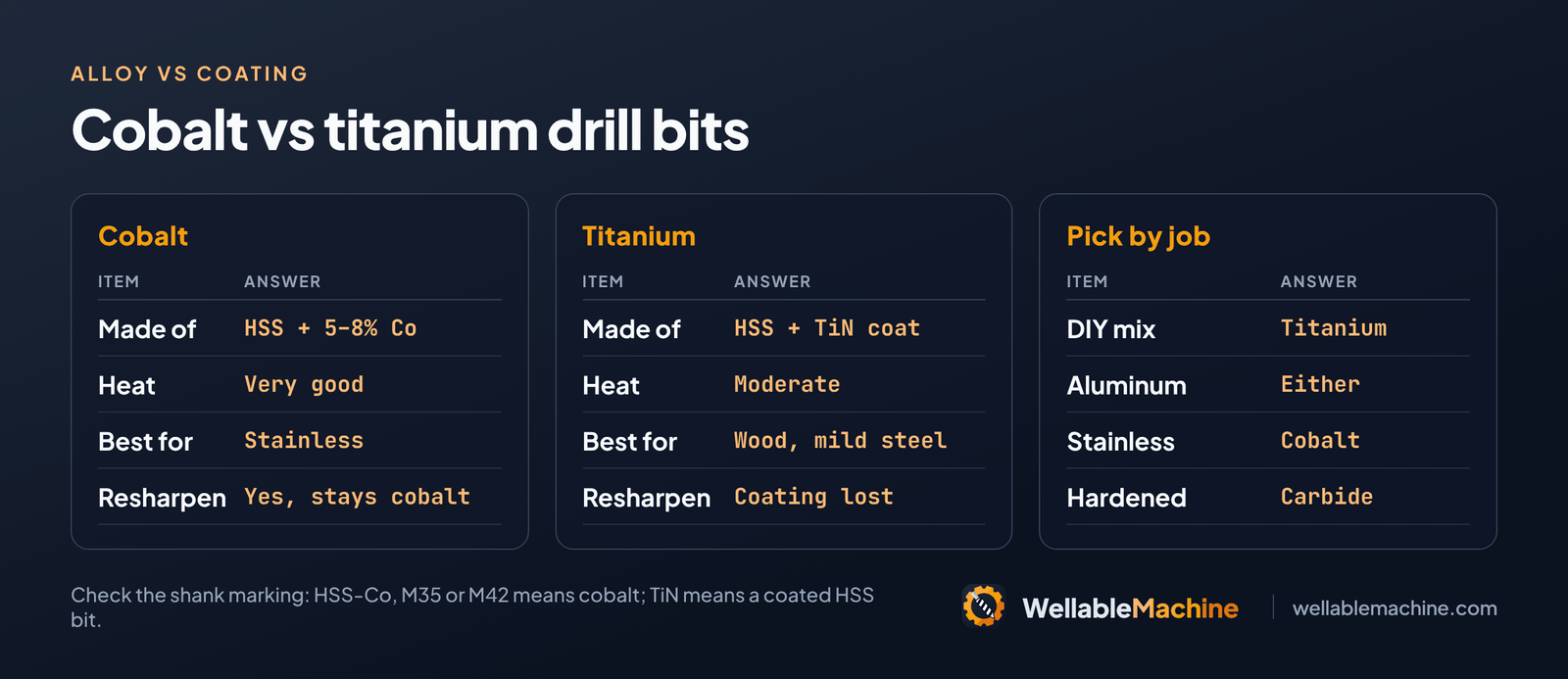
| Cobalt (M35 / M42) | Titanium-coated HSS | |
|---|---|---|
| What it is | HSS alloy with 5% (M35) or 8% (M42) cobalt, solid throughout | Standard HSS with a thin TiN, TiCN or TiAlN coating |
| Heat resistance | Very good; keeps its hardness when the edge gets hot | Moderate; the coating helps, the steel underneath is ordinary HSS |
| Best for | Stainless steel, cast iron, titanium, hard alloys | Wood, plastic, aluminum, mild steel, general DIY |
| Resharpening | Yes, and it stays a cobalt bit | Possible, but the coating is gone from the sharpened edge |
| Brittleness | Slightly more brittle; can snap if bent | Tougher; tolerates side load in a hand drill |
| Price | Higher, often about double | Lower |
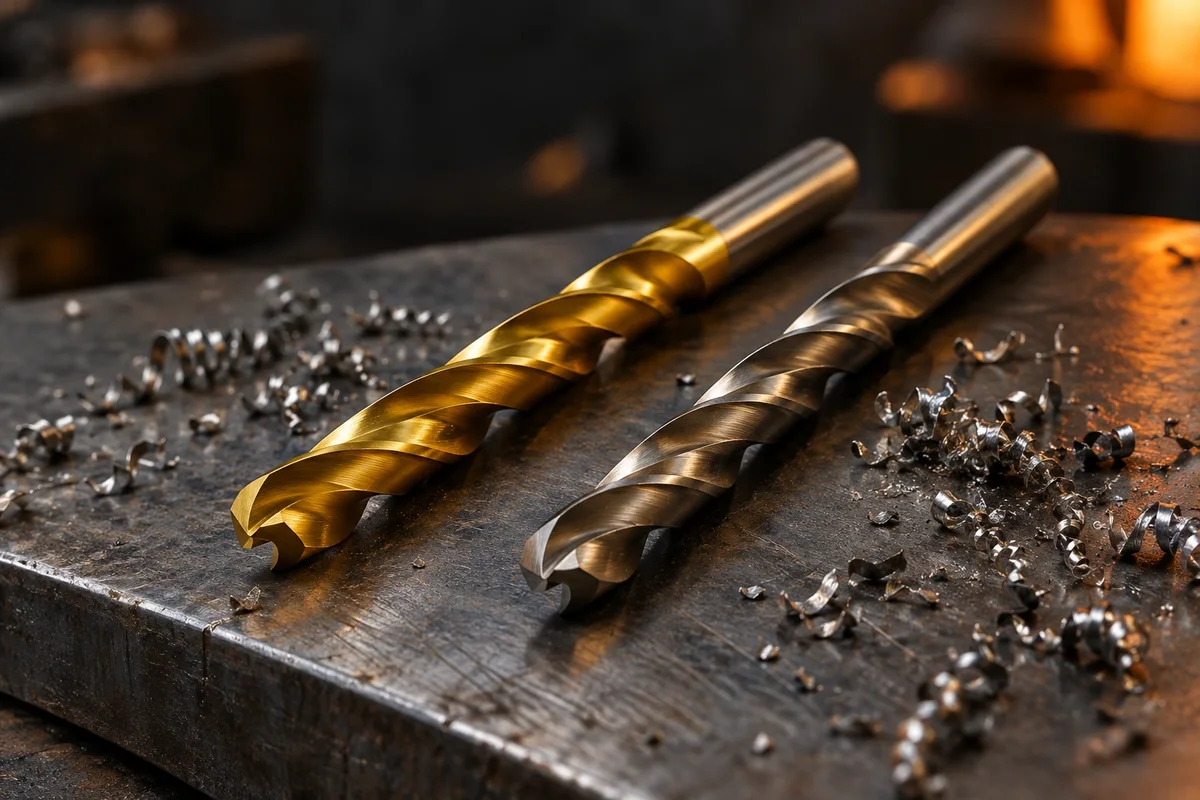
| Typical color | Dull bronze or straw; some are gold-coated too | Bright gold (TiN) or dark violet-gray (TiAlN) |
What Is a Cobalt Drill Bit?
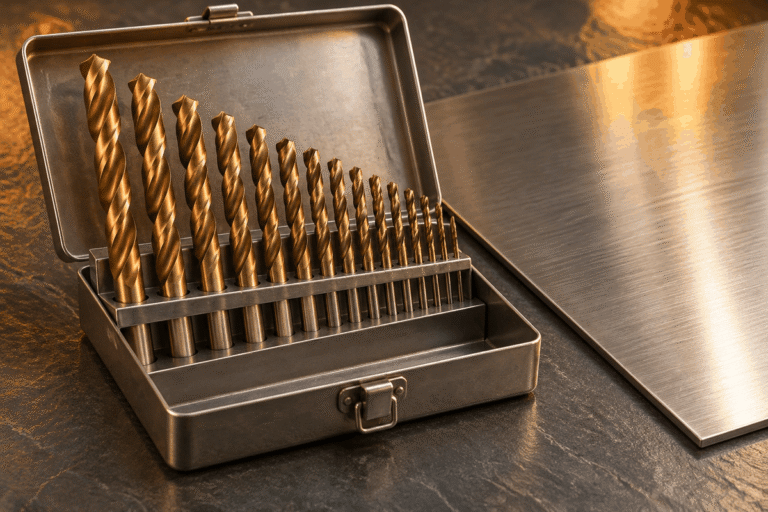
A cobalt bit is made from a high-speed steel grade that has cobalt added to the alloy. The two common grades are M35 (about 5% cobalt) and M42 (about 8% cobalt). Cobalt raises the steel’s “hot hardness,” meaning it keeps a hard cutting edge at temperatures that would soften ordinary HSS. That matters in stainless steel, which conducts heat poorly and concentrates it right at the cutting edge.
Because the cobalt is in the metal itself, there is no coating to wear through. You can grind the point again and again and it remains a cobalt bit. The trade-off is that the harder steel is slightly more brittle, so small cobalt bits snap more easily if the drill wobbles or the bit binds. The high-speed steel article covers the alloy grades in more detail.
What Is a Titanium Drill Bit?
A “titanium” bit is not made of titanium. It is a normal HSS bit with a very thin ceramic coating, usually titanium nitride (TiN), which gives the bright gold color. Better versions use titanium carbonitride (TiCN) or titanium aluminum nitride (TiAlN), which handle more heat. The coating is much harder than the steel and slippery, so it reduces friction, keeps chips from sticking and lets the bit run a little faster and last longer between sharpenings.
The weak point is that the coating is only a few thousandths of a millimeter thick. Once it wears off the corners of the cutting edge, or once you sharpen the bit, the edge is plain HSS again. In everyday DIY use that happens slowly and the bits still work well; in stainless steel, the coating doesn’t save a bit that is running too hot.
Which Should You Buy?
| Your work | Better choice | Why |
|---|---|---|
| General DIY: wood, plastic, drywall, occasional metal | Titanium-coated HSS | Cheaper, tougher in a hand drill, plenty of life |
| Aluminum and brass | Titanium or plain HSS | These metals cut easily; cobalt isn’t needed |
| Mild steel, lots of holes | Either; cobalt lasts longer | Titanium is fine; cobalt wins on life and resharpening |
| Stainless steel | Cobalt (M35 or M42) | Heat resistance is what stainless demands |
| Cast iron, tool steel, titanium alloys | Cobalt | Abrasive or tough materials wear coatings fast |
| Hardened steel above ~45 HRC | Neither: carbide | Both will dull almost immediately |
For a closer look at stainless, see our guides to the best drill bits for stainless steel and how to drill stainless steel. For hardened parts, read the best drill bits for hardened steel.
How to Tell Them Apart
- Read the shank. Real cobalt bits are marked “HSS-Co,” “M35,” “M42” or “Cobalt.” Titanium bits say “TiN,” “HSS-TiN” or “Titanium.”
- Don’t trust color alone. Many cobalt bits are a dull bronze, but some makers coat cobalt bits gold, and some cheap bits are tinted to look like cobalt.
- Check a sharpened bit. Grind a tiny spot: a coated bit shows gray steel under a gold skin; a cobalt bit looks the same all the way through.
- Price is a clue. A 29-piece “cobalt” set at the price of a basic HSS set is a warning sign.
What About Black Oxide and Carbide?
Black oxide bits are plain HSS with a dark surface treatment that resists rust and holds a little oil. They are the budget option for wood and mild steel. Carbide bits, solid or carbide-tipped, are much harder than either cobalt or titanium and cut hardened steel, but they are brittle and need a rigid drill press. Our guide to the types of drill bits shows where each fits.
Getting the Most From Either Type
- Run the right speed. Too fast burns the edge on any bit. Our drill speed chart lists RPM by size and metal.
- Use cutting oil in steel and keep steady pressure so the bit cuts rather than rubs.
- Use a pilot hole for bits over about 1/4 in.
- Keep cobalt bits for metal. Using them in masonry or dirty wood wastes their edge.
- Resharpen cobalt bits when they start to squeal or need more force; see how to sharpen drill bits.
Does the Point Angle Matter More Than the Material?
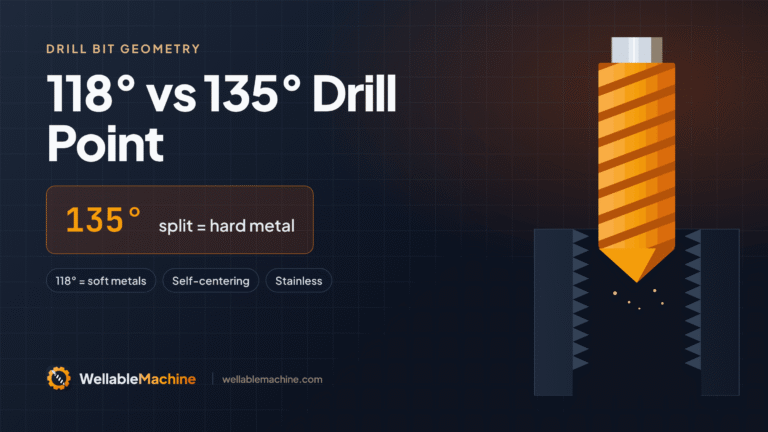
Often, yes. Many cheap titanium sets have a 118° standard point, while most cobalt bits have a 135° split point. The split point starts without a punch mark, walks less on curved or hard surfaces and needs less pushing force. That alone makes a big difference in steel. When comparing sets, check the point: a titanium bit with a 135° split point can outperform a cobalt bit with a poorly ground 118° point in mild steel. In stainless, though, you want both: cobalt and a 135° split point.
A Simple Buying Plan
- Everyday set: a 21- or 29-piece titanium-coated (or black oxide) HSS set with 135° split points for wood, plastic and light metal.
- Metal set: a cobalt M35 set, or just the sizes you use most (1/8, 3/16, 1/4, 5/16, 3/8 in and your tap drills), kept for metal only.
- Specialty bits as needed: carbide for hardened steel, brad point for fine woodwork and masonry bits for concrete.
This keeps your expensive cobalt bits sharp for the jobs that need them, while cheaper bits take the wear from everyday drilling.
How Long Do They Last?
Life depends far more on speed, feed and cooling than on the bit label. A titanium bit run at the right speed with oil will outlast a cobalt bit run too fast and dry. As a rough guide in mild steel, a quality cobalt bit drills many more holes between sharpenings than a coated HSS bit, and because it can be resharpened without losing its properties, its total life is much longer. In stainless, a coated HSS bit may last only a handful of holes, while cobalt can drill dozens if the speed is kept low and the feed steady.
Frequently Asked Questions
6 quick answers from our editors
01Are cobalt drill bits better than titanium?
For stainless and other tough metals, yes. For wood, plastic and general DIY, titanium-coated bits are just as good and cheaper.
02Are titanium drill bits made of titanium?
No. They are high-speed steel with a thin titanium-nitride coating.
03Can you sharpen titanium drill bits?
Yes, but sharpening removes the coating from the cutting edge, so the bit then performs like plain HSS.
04What is the difference between M35 and M42 cobalt?
M35 has about 5% cobalt and M42 about 8%. M42 holds its edge better in heat but is slightly more brittle and costs more.
05Can cobalt bits drill hardened steel?
Up to about 40–45 HRC with care. Harder steel needs carbide.
06Can I use cobalt bits in wood?
Yes, they work, but it is a waste of an expensive bit. Brad point or HSS bits give cleaner holes in wood.
Bottom Line
Titanium bits are coated HSS: affordable, tough and ideal for wood, plastic, aluminum and mild steel. Cobalt bits are an alloy all the way through: more expensive, slightly more brittle, but the right tool for stainless and tough metals, and they keep working after every resharpening. Buy a titanium set for general use and add a cobalt set, or just the sizes you need, when you start drilling stainless.