3/4-10 Tap Drill Size: 21/32 Drill Chart, Clearance & Anchor Rods
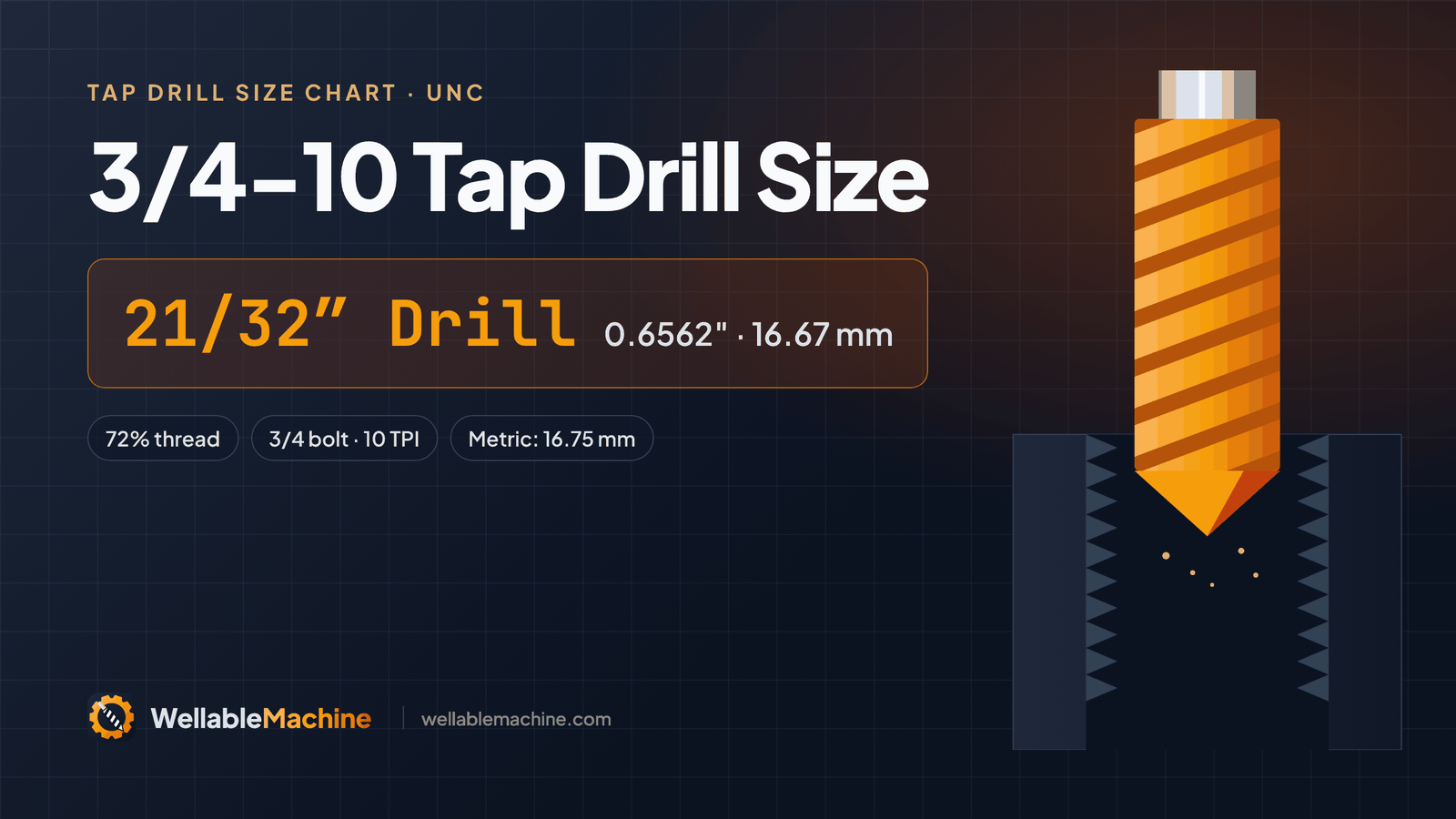
Quick answer: the standard tap drill for a 3/4-10 UNC thread is a 21/32 in drill (0.6562 in / 16.67 mm), which gives about a 72% thread. The closest metric drill is 16.75 mm. When hand tapping steel or stainless, a 43/64 in (0.6719 in) drill gives about 60% thread and cuts the effort a great deal.
3/4-10 is a heavy structural thread. You meet it on anchor rods, column base plates, large machinery and agricultural equipment, more often as threaded rod and nuts than as a tapped hole. This guide covers the tap drill, clearance and base-plate holes, how to cut 3/4-10 threads on rod, and what to expect when tapping a hole this big.
3/4-10 Thread Specifications at a Glance
“3/4-10” is a 3/4 in (0.750 in) diameter thread with 10 threads per inch, the coarse (UNC) pitch for this size in the Unified Thread Standard.
| Specification | Value |
|---|---|
| Thread series | UNC (Unified National Coarse) |
| Major diameter | 0.750 in (19.05 mm) |
| Threads per inch | 10 |
| Pitch | 0.100 in (2.540 mm) |
| Basic minor diameter | 0.6417 in (16.30 mm) |
| Standard tap drill | 21/32 = 0.6562 in (16.67 mm) |
| Easy-tapping drill | 43/64 = 0.6719 in (17.07 mm) |
| Close-fit clearance | 49/64 = 0.7656 in (19.45 mm) |
| Free-fit clearance | 25/32 = 0.7812 in (19.84 mm) |
3/4-10 Tap Drill Size Chart by Thread Percentage
Pick the drill by how much thread engagement you need. Around 75% is the shop standard for 3/4-10; going tighter mostly adds tapping torque and broken taps, while going looser makes hard metals much easier to thread. Each figure below comes from % thread = 76.98 × TPI × (major diameter − drill diameter).
| Drill | Inches | mm | Approx. thread | When to use it |
|---|---|---|---|---|
| 41/64 | 0.6406 | 16.27 | 84% | Very full thread; hard to tap |
| 16.25 mm | 0.6398 | 16.25 | 85% | Metric near 41/64 |
| 21/32 | 0.6562 | 16.67 | 72% | Standard choice for most materials |
| 16.75 mm | 0.6594 | 16.75 | 70% | Metric twin of 21/32 |
| 43/64 | 0.6719 | 17.07 | 60% | Steel and stainless by hand |
| 11/16 | 0.6875 | 17.46 | 48% | Too loose for structural use |
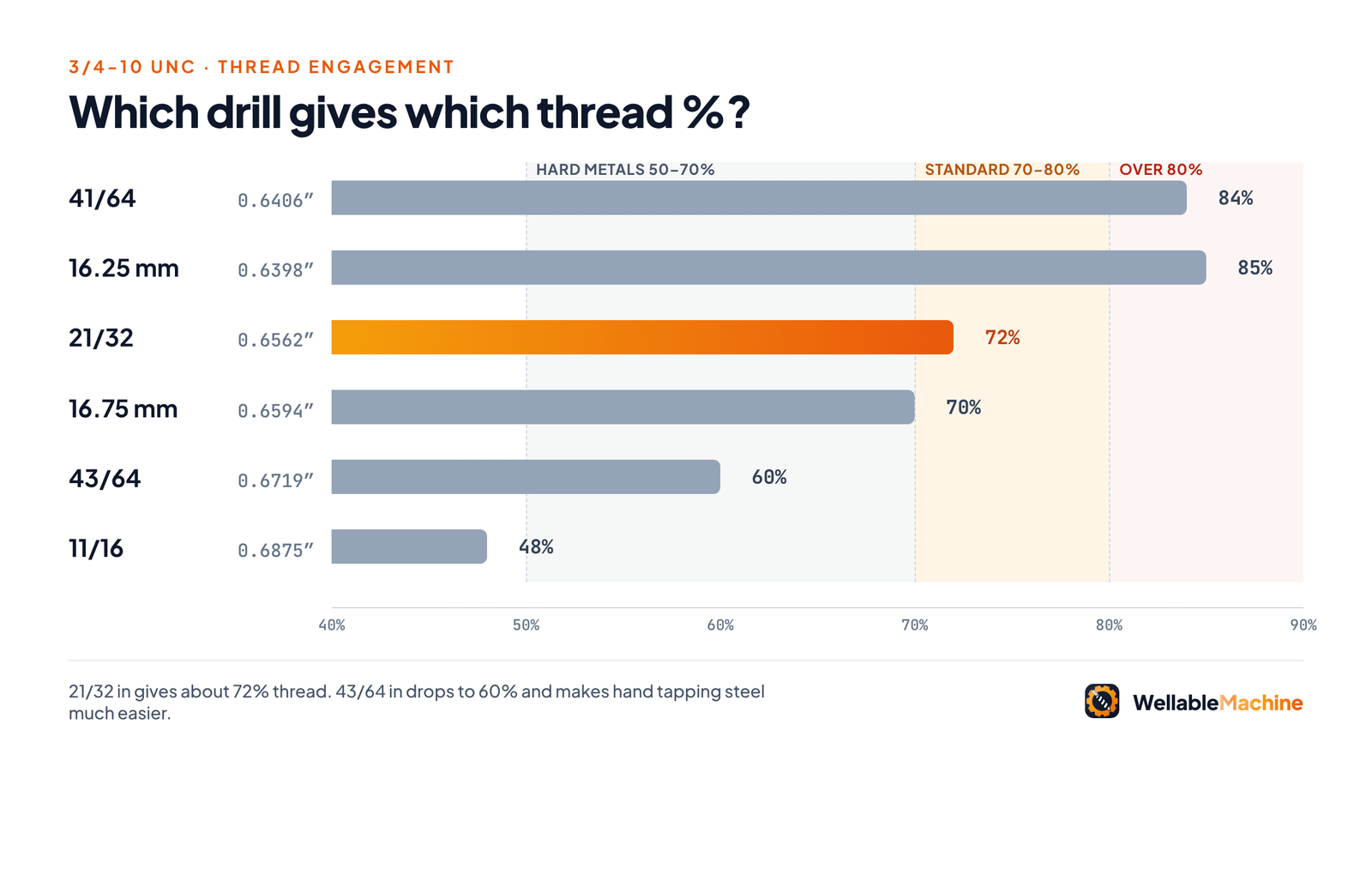
Which drill should you use? Use 21/32 in in cast iron, aluminum and brass, and for any joint that is tapped by machine. When tapping mild steel by hand, 43/64 in leaves a 60% thread that is still stronger than the bolt with 1-1/2 diameters of engagement. In stainless, 43/64 in is the practical choice. Avoid 11/16 in for anything that carries load.
Clearance Hole Sizes for a 3/4 in Bolt
Clearance holes are the same for 3/4-10 and 3/4-16 bolts. Steel connections often use standard 13/16 in holes; see our clearance hole size chart for other sizes.
| Fit | Drill | Inches | mm | Use it for |
|---|---|---|---|---|
| Close fit | 49/64 | 0.7656 | 19.45 | Machined parts |
| Free fit | 25/32 | 0.7812 | 19.84 | General assemblies |
| Standard structural | 13/16 | 0.8125 | 20.64 | Steel connections |
3/4-10 vs. 3/4-16 vs. M20
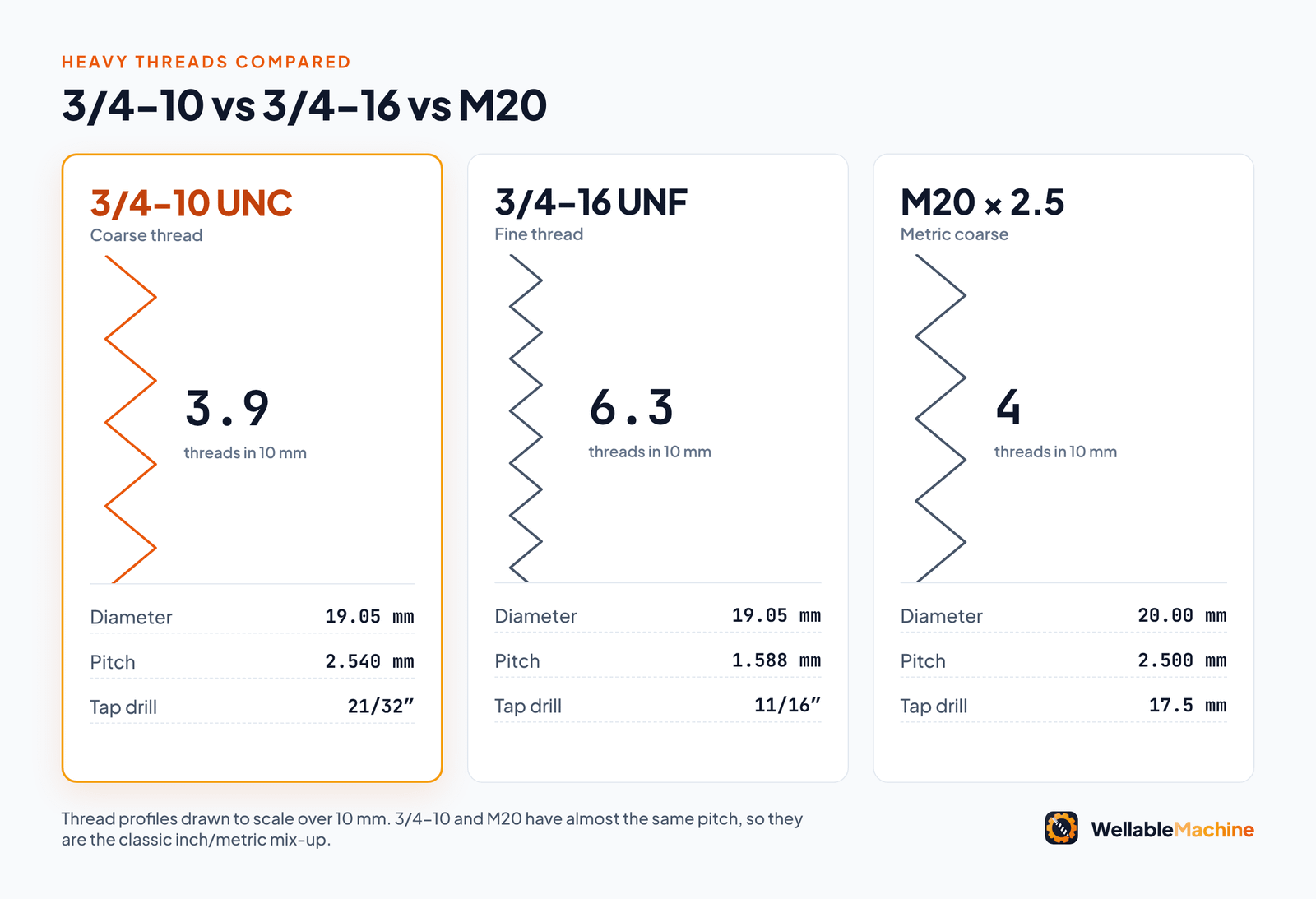
A 3/4-10 bolt will thread into an M20 hole and feel normal at first, because the pitches are within 0.04 mm. It is about 1 mm smaller in diameter, though, so the joint is weak.
| Thread | Diameter | Pitch | Tap drill | Typical use |
|---|---|---|---|---|
| 3/4-10 UNC | 19.05 mm | 2.54 mm (10 TPI) | 21/32 in | Anchor rods, structures |
| 3/4-16 UNF | 19.05 mm | 1.588 mm (16 TPI) | 11/16 in | Hitch balls, axles |
| M20 × 2.5 | 20.00 mm | 2.5 mm | 17.5 mm | Metric machinery |
For the metric bolt, see the M20 tap drill size guide.
Other 3/4-10 Hole Sizes You Might Need
- Forming (roll) tap: about 0.703 in (45/64 in). Check the tap maker’s chart.
- Heli-Coil / STI insert: a 25/32 in drill, then a 3/4-10 STI tap.
- Counterbore for a socket head cap screw: 1-1/4 in diameter, 3/4 in deep.
How to Drill and Tap a 3/4-10 Hole
- Mark and center punch the hole so the drill starts exactly where you want it.
- Drill with a 21/32 bit. In aluminum, run about 600 RPM; in mild steel, about 350 RPM; in stainless, slow down to about 150 RPM with steady pressure and cutting oil. Our guide on how to drill stainless steel explains why stainless needs low speed and constant feed.
- Add a light chamfer just wider than the thread diameter, so the screw starts easily and the top thread stays clean.
- Start the tap straight. Use a bar wrench at least 24 in long and start the tap with the drill press spindle (power off) as a guide. A 3/4 tap is heavy and tilts easily.
- Keep the chips short: every half turn, back off a little so the chip breaks. Re-oil after every few turns, and back the tap right out if it starts to feel gritty.
- For blind holes, drill at least 0.30 in (3 pitches) deeper than the full thread you need, and finish with a bottoming tap.

A 21/32 in hole in steel needs a rigid drill press and a slow speed; our drill speed chart gives about 450 RPM in mild steel for a bit this size.
Which 3/4-10 Tap Should You Use?
At 3/4 in, hand tapping is slow but taps rarely break. A taper tap to start and a plug tap to finish shares the work.
| Tap type | Best for | Notes |
|---|---|---|
| Taper tap | Starting threads by hand in hard material | Long chamfer; the easiest to start straight |
| Plug tap | Through-holes and most blind holes | The everyday hand tap |
| Bottoming tap | Full threads to the bottom of blind holes | Use only after a plug or taper tap |
| Spiral point (gun) tap | Through-holes, power tapping | Pushes chips ahead; strong core, fewer breaks |
| Spiral flute tap | Blind holes, power tapping | Lifts chips up and out of the hole |
| Forming (roll) tap | Aluminum, brass, mild steel | No chips; needs a larger 45/64 in hole |
Tapping 3/4-10 in Different Materials
Soft metals forgive mistakes; tough ones do not. Use this table to adjust your drill, fluid and approach for the material in front of you.
| Material | Recommended drill | Tapping fluid | Tips |
|---|---|---|---|
| Aluminum | 21/32 | Light oil or WD-40 | Light oil; long wrench |
| Mild steel | 21/32 | Sulfurized cutting oil | Reverse often to break the chip |
| Stainless (304/316) | 43/64 | Heavy tapping paste | Cobalt tap; tap in two passes |
| Brass | 21/32 | Dry or light oil | Cuts cleanly; tap can grab at the end |
| Cast iron machine bases | 21/32 | Dry or air blast | Blow out the powder often |
How Deep Should a 3/4-10 Thread Be?
A common rule is to engage at least one screw diameter in steel and more in softer metals. Past that, extra length adds work but very little holding power:
- Steel: 1 × diameter, 3/4 in.
- Cast iron: 1.5 × diameter, 1-1/8 in.
- Aluminum: 2 × diameter, 1-1/2 in, or a Heli-Coil.
Where Is 3/4-10 Used?
3/4-10 appears on anchor rods and column base plates, large machinery feet, farm implements, heavy trailer hitches and frames, bridge and timber construction hardware, and large clamps and fixtures.
3/4-10 Anchor Rods and Base Plates
In steel buildings and equipment foundations, 3/4 in anchor rods (3/4-10 threaded) are among the most common sizes. A few points that catch people out:
- Base plate holes are oversized on purpose. Anchor rods set in concrete are never perfectly placed, so steel design guides call for much larger holes in the base plate, typically about 1-5/16 in for a 3/4 in rod, with a thick plate washer on top. Follow the structural drawings.
- Drilling for post-installed anchors: a 3/4 in wedge anchor goes in a 3/4 in hole made with a carbide bit; epoxy anchors usually need a larger hole, often 7/8 in. See how to drill into concrete for technique.
- Nuts and washers: use heavy hex nuts and hardened washers where the drawings call for them, and match the grade of the rod.
Cutting 3/4-10 Threads on Rod
Making a custom anchor or stud from plain round bar is a common job. Start with rod at, or a few thousandths under, 0.750 in. Chamfer the end at 45°, clamp the rod upright, and use a 3/4-10 round die in a die stock with long handles. Expect to back off every half turn; a die this size removes a lot of metal. On a lathe, a die holder in the tailstock keeps the die square. Our guide on how to use a tap and die covers the basics.
3/4 in Bolt Grades, Heads and Wrench Sizes
At 3/4 in, the grade of the bolt matters as much as the thread. Grade 5 bolts have three radial lines on the head and grade 8 bolts have six; structural bolts are stamped with their ASTM grade, such as A325 or A490. A standard 3/4 in hex bolt head takes a 1-1/8 in wrench, while heavy hex structural nuts and bolts take 1-1/4 in. Tightening values depend on grade, lubrication and whether the joint is structural, so use the bolt maker’s chart or the project specification rather than a generic number. A 3/4 in drive torque wrench or an impact wrench with a torque stick makes consistent tightening practical at this size.
Common 3/4-10 Tapping Problems (and How to Fix Them)
- Tap too hard to turn: use 43/64 in and a longer wrench.
- Bolt loose in an imported part: the hole may be M20. Measure it.
- Die starts crooked on rod: chamfer the rod end and keep the stock level.
- Thread strips in aluminum: use longer engagement or an insert.
Frequently Asked Questions
7 quick answers from our editors
01What size drill bit for a 3/4-10 tap?
A 21/32 in drill (0.6562 in). It gives about a 72% thread.
02What metric drill for 3/4-10?
16.75 mm.
03Is 3/4-10 the same as M20?
No. The pitch is nearly the same, but M20 is about 1 mm larger in diameter.
04What clearance hole for a 3/4 in bolt?
49/64 in for a close fit, 25/32 in for a free fit, or 13/16 in for standard structural holes.
05What size wrench fits a 3/4 in bolt?
1-1/8 in for a standard hex head; 1-1/4 in for a heavy hex nut.
06Can I tap 3/4-10 with a hand wrench?
Yes, with a long bar wrench and a 43/64 in hole in steel, but it is hard work. A tapping machine is easier for several holes.
07What is the difference between 3/4-10 and 3/4-16?
3/4-10 is coarse (10 threads per inch); 3/4-16 is fine and needs an 11/16 in drill.
Bottom Line
For a 3/4-10 thread, drill 21/32 in or 16.75 mm, and use 43/64 in for easier hand tapping in steel. Use 25/32 in for clearance, follow the drawings for base-plate holes, and never mix 3/4-10 with M20. For every size, see our tap drill size chart.