7/8-9 Tap Drill Size: 49/64″ Drill, Clearance Holes & Tapping Tips

Quick answer: the standard tap drill for a 7/8-9 UNC thread is a 49/64 in drill (0.7656 in / 19.45 mm), which gives about a 76% thread. The nearest metric drill is 19.5 mm. For hand tapping thick steel or stainless, a 25/32 in drill (about 65%) cuts the torque a great deal.
7/8-9 is the coarse thread for a 7/8 in bolt, a size you find on heavy machinery, structural steel, anchor bolts and pipe flanges. At this size, drilling and tapping become serious jobs: the drill is over 3/4 in, the tap needs a long wrench, and the wrong hole size can make tapping almost impossible by hand. This guide covers the drill sizes, clearance holes, how to drill a hole this large, and how 7/8-9 compares with 7/8-14 and M22.
7/8-9 Thread Specifications at a Glance
“7/8-9” is a 7/8 in (0.875 in) diameter thread with 9 threads per inch, the coarse (UNC) pitch for this size in the Unified Thread Standard. The fine pitch is 7/8-14.
| Specification | Value |
|---|---|
| Thread series | UNC (Unified National Coarse) |
| Major diameter | 0.875 in (22.23 mm) |
| Threads per inch | 9 |
| Pitch | 0.1111 in (2.822 mm) |
| Basic minor diameter | 0.7307 in (18.56 mm) |
| Standard tap drill | 49/64 = 0.7656 in (19.45 mm) |
| Metric tap drill | 19.5 mm = 0.7677 in |
| Close-fit clearance | 57/64 = 0.8906 in (22.62 mm) |
| Free-fit clearance | 29/32 = 0.9062 in (23.02 mm) |
| Wrench size, hex bolt | 1-5/16 in |
7/8-9 Tap Drill Size Chart by Thread Percentage
Every drill in the table below leaves a different amount of metal for the tap to cut. Tests have shown that a 60% thread is only a few percent weaker than a 75% one, yet it takes far less effort to tap, so there is no prize for the tightest hole. Percentages are worked out with % thread = 76.98 × TPI × (major diameter − drill diameter).
| Drill | Inches | mm | Approx. thread | When to use it |
|---|---|---|---|---|
| 3/4 | 0.7500 | 19.05 | 87% | Too tight; very high torque |
| 19.25 mm | 0.7579 | 19.25 | 81% | Full thread in soft metals |
| 49/64 | 0.7656 | 19.45 | 76% | Standard chart size (76%) |
| 19.5 mm | 0.7677 | 19.50 | 74% | Metric equivalent of 49/64 |
| 25/32 | 0.7812 | 19.84 | 65% | Steel by hand, stainless |
| 20 mm | 0.7874 | 20.00 | 61% | Too loose for structural loads |

Which drill should you use? 49/64 in is the standard drill and gives a full 76% thread, which is right for cast iron, aluminum and machine tapping in steel. If you are tapping steel by hand, 25/32 in gives about 65% thread at much lower torque, and a 7/8 in bolt with a diameter or more of engagement will still break before the thread strips. 19.5 mm is the metric substitute for 49/64 in. Avoid 3/4 in: at 87% thread the tap is very likely to stall or break.
Clearance Hole Sizes for a 7/8 in Bolt
Clearance holes are the same for 7/8-9 and 7/8-14 bolts. For other sizes, see our clearance hole size chart.
| Fit | Drill | Inches | mm | Use it for |
|---|---|---|---|---|
| Close fit | 57/64 | 0.8906 | 22.62 | Machined parts |
| Free fit | 29/32 | 0.9062 | 23.02 | General assemblies |
| Standard structural | 15/16 | 0.9375 | 23.81 | Steel connections (1/16 in oversize) |
Drilling a 49/64 in Hole
A hole this size is beyond most cordless drills. A drill press or a magnetic drill is the right tool, and even then it pays to work up in steps:
- Pilot first: drill about 1/4 in, then 1/2 in, then the final 49/64 in. Each step only removes a little metal, so the big drill cuts cleanly and stays on center.
- Use a reduced-shank (Silver & Deming) bit if your chuck only takes 1/2 in. These have a full-size cutting end on a 1/2 in shank.
- Run slowly: about 300 RPM in mild steel and 150 RPM in stainless, with plenty of cutting oil.
- Clamp the work. A large drill that grabs can spin a part with enough force to injure you.
An annular cutter in a magnetic drill is faster still for holes in plate and beams.
Tapping 7/8-9 by Hand
A 7/8-9 tap removes a lot of metal per turn. Use a T-handle wrench at least 18 in long, or better, a tap held in the drill press spindle (power off) for the first few turns to keep it square. Turn a quarter to a half turn at a time, back off to break the chip, and keep the flutes full of sulfurized cutting oil. In steel thicker than about 1 in, many shops tap in two stages: a taper tap first, then a plug tap. If the tap jams, stop and back it out rather than forcing it; see how to remove a broken tap if the worst happens.
7/8-9 vs. 7/8-14 vs. M22
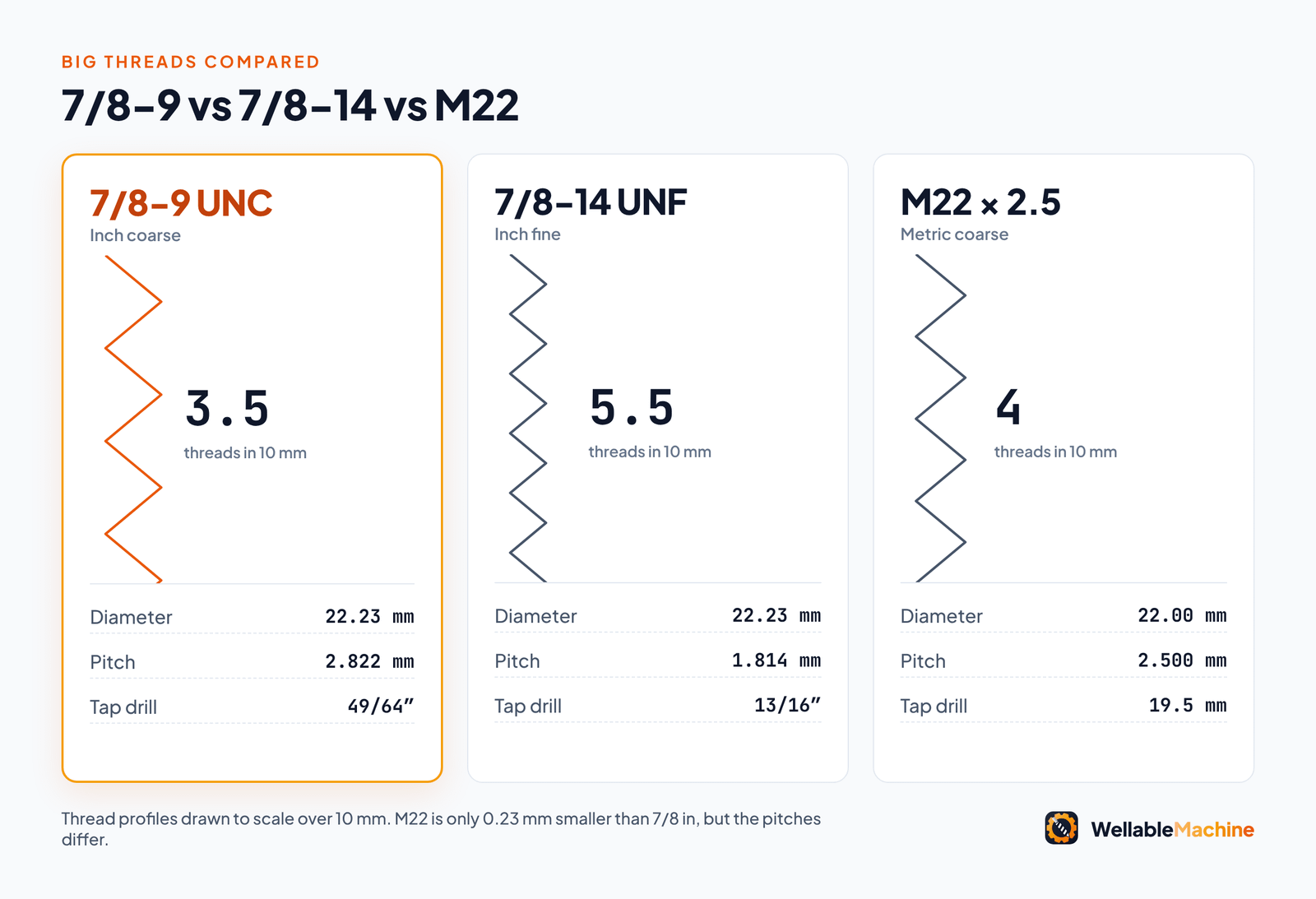
7/8-9 and 7/8-14 share a diameter. M22 × 2.5 is almost the same size and even uses the same 19.5 mm tap drill, which makes mix-ups easy on mixed-origin machinery.
| Thread | Diameter | Pitch | Tap drill | Typical use |
|---|---|---|---|---|
| 7/8-9 UNC | 0.875 in (22.23 mm) | 9 TPI (2.822 mm) | 49/64 in | Structural, machinery, flanges |
| 7/8-14 UNF | 0.875 in (22.23 mm) | 14 TPI (1.814 mm) | 13/16 in | Automotive, hydraulics |
| M22 × 2.5 | 22.00 mm | 2.5 mm | 19.5 mm | Metric machinery |
For metric, see the M22 tap drill size guide. The neighboring inch sizes are 3/4-10 and 1-8.
Other 7/8-9 Hole Sizes You Might Need
- Forming (roll) tap: not usually made in this size; use a cutting tap.
- Helicoil / STI insert: about a 29/32 in drill, then the 7/8-9 STI tap.
- Counterbore for a socket head cap screw: 1-3/8 in diameter, 7/8 in deep.
- Anchor bolt holes in concrete: follow the anchor maker; usually 1 in for a 7/8 in wedge anchor.
How to Drill and Tap a 7/8-9 Hole
- Mark and center punch the hole so the drill starts exactly where you want it.
- Drill with a 49/64 bit. In aluminum, run about 500 RPM; in mild steel, about 300 RPM; in stainless, slow down to about 150 RPM with steady pressure and cutting oil. Our guide on how to drill stainless steel explains why stainless needs low speed and constant feed.
- Break the sharp edge with a countersink. A small chamfer guides the tap in and keeps a raised burr from forming around the hole.
- Start the tap straight. Start the tap in the drill press or mill spindle with the power off, or use a large tap guide block.
- Work in short strokes. Turn forward until you feel resistance build, then reverse slightly to snap the chip. Keep the flutes wet with tapping fluid the whole time.
- For blind holes, drill at least 3/8 in (3–4 pitches) deeper than the full thread you need, and finish with a bottoming tap.
For RPM at this size, see our drill speed chart. To cut the matching thread on rod, see how to use a tap and die.
Which 7/8-9 Tap Should You Use?
Buy a taper and a plug tap together. A spiral-point tap is the best choice for power tapping through-holes.
| Tap type | Best for | Notes |
|---|---|---|
| Taper tap | Starting threads by hand in hard material | Long chamfer; the easiest to start straight |
| Plug tap | Through-holes and most blind holes | The everyday hand tap |
| Bottoming tap | Full threads to the bottom of blind holes | Use only after a plug or taper tap |
| Spiral point (gun) tap | Through-holes, power tapping | Pushes chips ahead; strong core, fewer breaks |
| Spiral flute tap | Blind holes, power tapping | Lifts chips up and out of the hole |
| Forming (roll) tap | Aluminum, brass, mild steel | No chips; needs a larger n/a hole |
Tapping 7/8-9 in Different Materials
The hole size rarely changes from one metal to another, but the fluid, tap and technique do. Here is a quick guide for 7/8-9 work.
| Material | Recommended drill | Tapping fluid | Tips |
|---|---|---|---|
| Aluminum | 49/64 | Light oil or WD-40 | 49/64 for a full thread |
| Mild steel | 49/64 | Sulfurized cutting oil | Reverse often to break the chip |
| Stainless (304/316) | 25/32 | Heavy tapping paste | Cobalt tap; 25/32 drill |
| Brass | 49/64 | Dry or light oil | Cuts cleanly; tap can grab at the end |
| Cast iron | 49/64 | Dry or kerosene | Easy to tap; clear powder often |
How Deep Should a 7/8-9 Thread Be?
How much thread you need depends on what the hole is made of. Softer materials need longer engagement so the internal thread doesn’t strip before the screw breaks:
- Steel: 1 × diameter, 7/8 in.
- Cast iron: 1.5 × diameter, about 1-5/16 in.
- Aluminum: 2 × diameter, 1-3/4 in.
Where Is 7/8-9 Used?
7/8-9 UNC is used on structural steel connections, anchor and foundation bolts, pipe flange bolting, heavy agricultural and construction machinery, crane and lifting equipment, and large machine bases.
Common 7/8-9 Tapping Problems (and How to Fix Them)
- Tap stalls halfway: the hole is too small or chips are packed. Back out, clear and re-oil, or open to 25/32 in.
- Thread starts crooked: start the tap in a spindle or guide.
- Metric bolt won’t fit: it may be M22 × 2.5.
- Drill wanders: drill a pilot and step up in sizes.
Frequently Asked Questions
6 quick answers from our editors
01What drill size for a 7/8-9 tap?
A 49/64 in drill (0.7656 in), about 76% thread. 19.5 mm is the metric equivalent.
02Is 7/8-9 coarse or fine?
Coarse (UNC). The fine thread is 7/8-14.
03What clearance hole for a 7/8 bolt?
29/32 in for a free fit, or 15/16 in for standard structural holes.
04What wrench fits a 7/8 bolt?
1-5/16 in for a standard hex head and 1-7/16 in for heavy hex.
05Can I use a 3/4 in drill for 7/8-9?
It gives about 87% thread and is very hard to tap. Use 49/64 in.
06Is 7/8-9 the same as M22?
No. The diameters are close but the pitch is different.
Bottom Line
For 7/8-9 UNC, drill 49/64 in (or 19.5 mm) for a standard thread, or 25/32 in for easier hand tapping in steel. Clearance is 29/32 in, or 15/16 in for structural work. Drill in steps, keep the tap square and use plenty of oil. For every size, see our tap drill size chart.