Drill Chuck Sizes: 3/8 vs 1/2 in and What They Mean
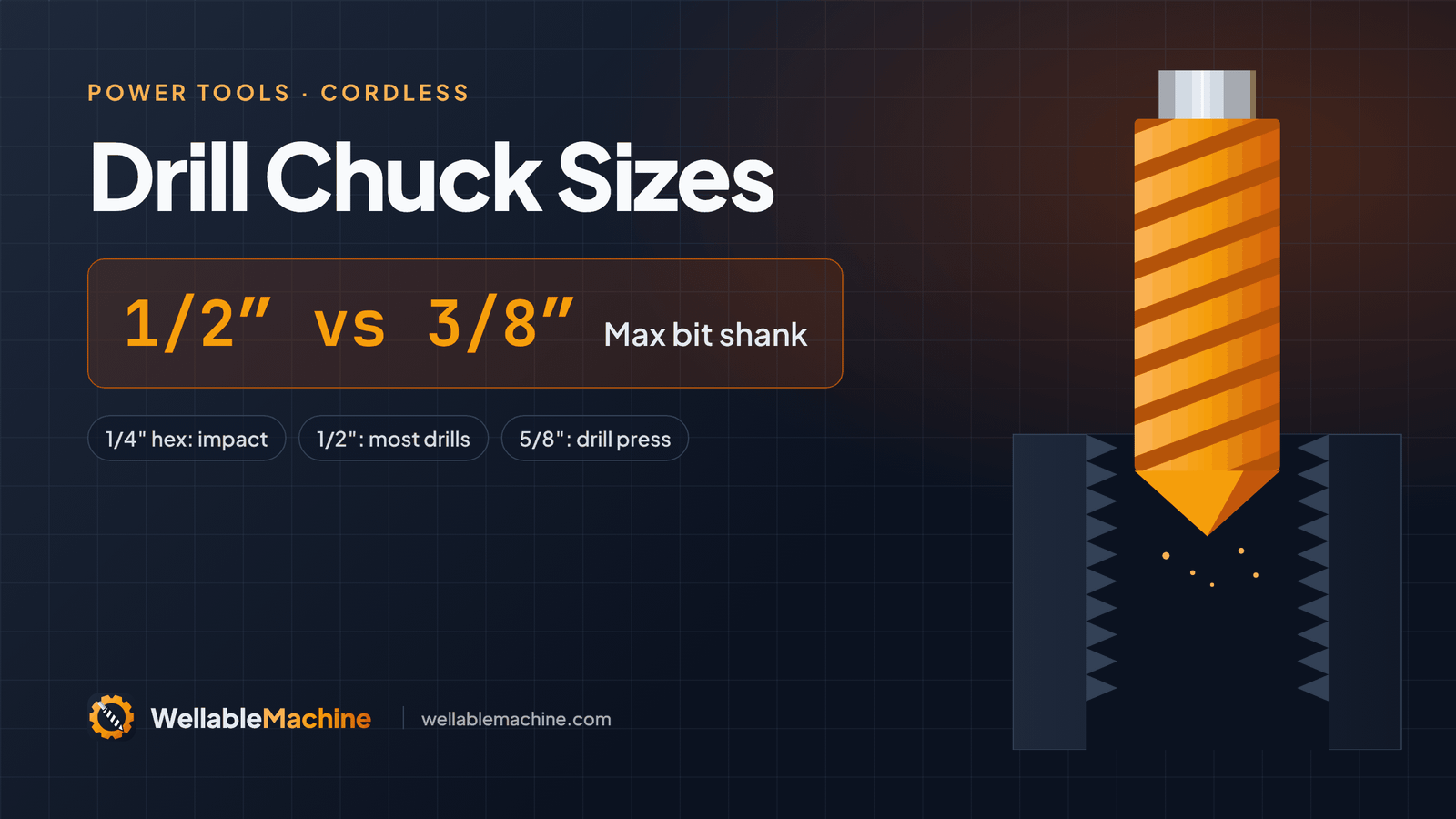
Quick answer: drill chuck size is the largest bit shank the chuck can hold. The common sizes are 3/8 in (light drills and older or compact tools), 1/2 in (most 18–20 V cordless drills, hammer drills and corded drills), and 5/8 in on many drill presses. Impact drivers don’t have a jaw chuck at all; they use a 1/4 in hex quick-release collet. A 1/2 in chuck can still hold small bits, usually down to about 1/16 in or 1/32 in.
The chuck is the part of a drill you use every time, yet most people never think about its size until a bit won’t fit. This guide explains what the sizes mean, how 3/8 in and 1/2 in chucks compare, how chucks are mounted, how to tell what you have, and what to do when a bit’s shank is too big.
Drill Chuck Sizes at a Glance
| Chuck | Max shank | Typical min. | Found on | Good for |
|---|---|---|---|---|
| 1/4 in hex collet | 1/4 in hex | – | Impact drivers, some compact drivers | Driving screws; hex-shank bits only |
| 1/4 in jaw chuck | 1/4 in | 1/32 in | Small rotary tools, some 4–8 V drivers | Small holes, light work |
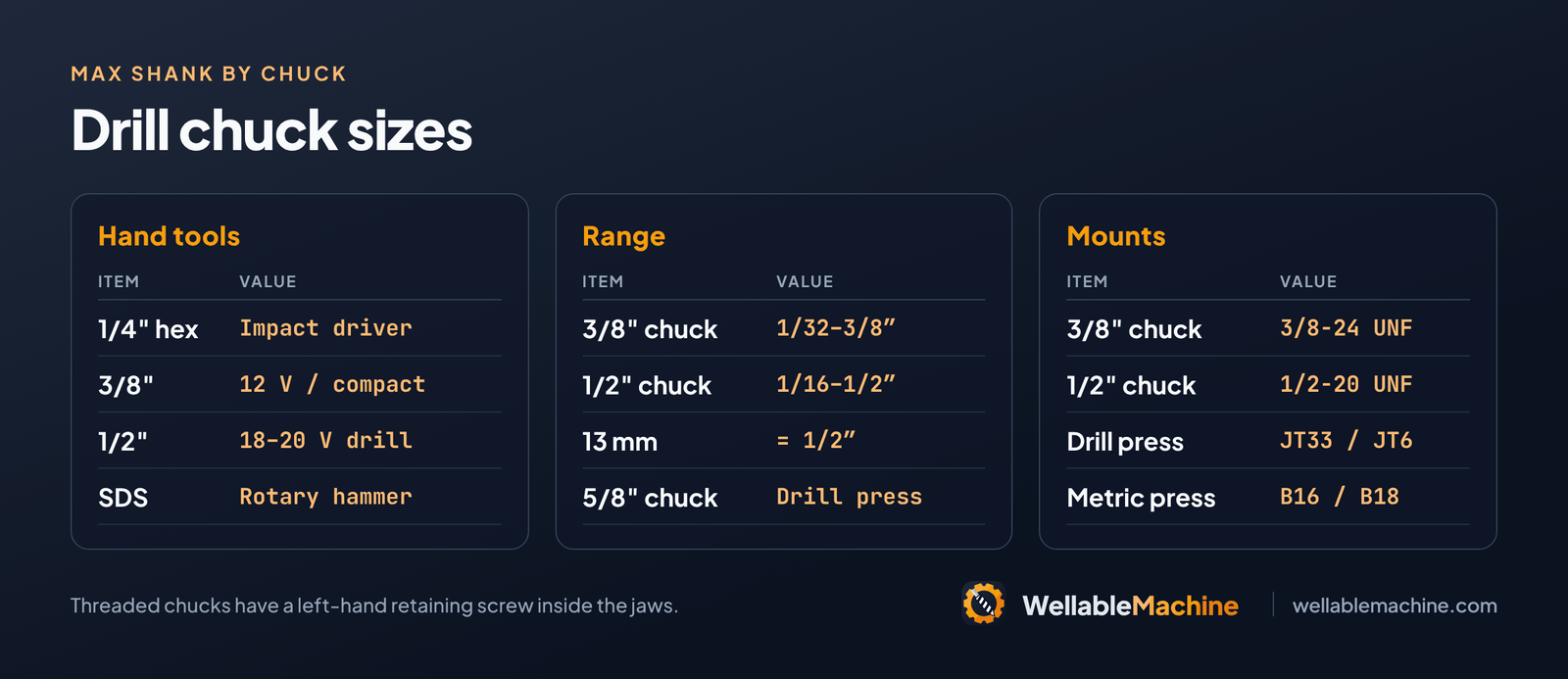
| 3/8 in jaw chuck | 3/8 in | 1/32–1/16 in | 12 V and compact drills, light corded drills | Holes up to about 3/8 in in steel, 1 in in wood |
| 1/2 in jaw chuck | 1/2 in | 1/16 in (some 1/32 in) | 18–20 V drills, hammer drills, corded drills | General work, large bits, hole saws, mixers |
| 5/8 in jaw chuck | 5/8 in | 1/16–1/8 in | Drill presses, heavy-duty drills | Large twist drills, Forstner bits |
| SDS-plus / SDS-max | 10 mm / 18 mm SDS | – | Rotary hammers | Concrete; slotted SDS bits only |
The size printed on a chuck (for example “1.5–13 mm” or “1/16–1/2 in”) tells you the range. The chuck jaws close evenly around round, hex or flatted shanks within that range.
3/8 in vs 1/2 in Chuck: Which Do You Need?
The difference is more than the largest bit. A 1/2 in chuck is usually fitted to a drill with more torque and a stronger gearbox, so it can turn large hole saws, spade bits and auger bits without stalling. A 3/8 in chuck is lighter and shorter, which helps when you work overhead or in tight cabinets.
- Choose 3/8 in if you mostly drive screws and drill holes under 3/8 in: furniture assembly, cabinet installs, picture hanging, electronics and light repairs.
- Choose 1/2 in if you drill large holes, use hole saws or step bits often, drill masonry with a hammer drill, or mix paint and mortar.
Most people end up with a compact 12 V drill with a 3/8 in chuck and an 18–20 V drill with a 1/2 in chuck, or a 1/2 in drill plus an impact driver. See impact driver vs drill and brushless vs brushed drills for help choosing the tool itself.
Keyless vs Keyed Chucks
- Keyless (single or double sleeve): tightened by hand. Fast bit changes; on cordless drills, a spindle lock lets you tighten with one hand. Ratcheting keyless chucks click as they lock and grip better.
- Keyed: tightened with a geared key in three holes. Grips harder, so bits are less likely to slip under heavy load. Common on drill presses, corded drills and older tools.
If round-shank bits slip in a keyless chuck, use bits with three flats on the shank, tighten the chuck hard with one last firm twist, or switch to a keyed chuck for heavy work.
Bits Bigger Than Your Chuck
Many large bits are made to fit smaller chucks:
- Reduced-shank (Silver & Deming) bits: twist drills from 9/16 in to 1 in or more with a 1/2 in shank. Run them slowly, preferably in a drill press.
- Hole saws and arbors: arbors have 3/8 in or 7/16 in hex shanks, so even a 3/8 in chuck can hold a 2 in saw, though a small drill may lack the torque. See the hole saw size chart.
- Spade, step and Forstner bits: usually have 1/4 in hex or 3/8 in shanks.
Never grind down the shank of a bit to make it fit; it weakens the bit and can make it run off-center. For the range of twist drill sizes, see fractional drill bit sizes.
How Chucks Are Mounted
When you replace a chuck, the mount matters as much as the size:
| Mount | Common on | Notes |
|---|---|---|
| 3/8-24 UNF thread | Most 3/8 in and many 1/2 in hand drills | Chuck screws on; often held by a left-hand screw inside |
| 1/2-20 UNF thread | Most 1/2 in hand drills | Same idea, larger thread |
| Jacobs taper (JT33, JT6, JT2) | Drill presses | Chuck is pressed onto a tapered arbor |
| B16 or B18 taper | Metric drill presses | European taper sizes |
| Morse taper arbor | Larger drill presses and lathes | Arbor fits the spindle; chuck fits the arbor |
Threaded chucks on hand drills usually have a retaining screw inside the jaws with a left-hand thread; remove it (turn clockwise) before unscrewing the chuck. Check the drill’s manual for the thread size before ordering a replacement.
Drill Press Chucks
Drill presses usually have a 1/2 in or 5/8 in keyed chuck on a taper. A good drill press chuck runs with very little wobble (runout), which is what makes accurate holes possible. If a drill press starts drilling oversize or the bit wobbles, clean the taper and the chuck jaws, or replace a worn chuck. More in how to use a drill press.

Caring for a Chuck
- Blow out dust after masonry work; grit in the jaws causes slipping and wear.
- Close the jaws fully now and then and open them to full size to spread grease.
- Don’t use pliers on a keyless chuck sleeve; it damages the plastic and overtightens the mechanism.
- Insert bits as deep as possible (but not on the flutes) so the jaws grip the full shank.
- Replace a chuck that wobbles or won’t hold bits; it is cheaper than the bits it ruins.
For the right bit for each job, see types of drill bits. For SDS chucks on rotary hammers, see SDS-plus vs SDS-max.
How to Tell What Chuck Size You Have
- Look at the chuck: most are stamped with the range, such as “1.5–13 mm”, “1/2 in” or “10 mm”.
- Check the manual or model number: the specifications list the chuck capacity.
- Measure: open the jaws fully and measure the gap with calipers, or test with a bit shank of known size.
- Look at the tool: compact and 12 V drills usually have 3/8 in (10 mm) chucks; full-size 18–20 V drills and hammer drills usually have 1/2 in (13 mm).
Replacing or Upgrading a Chuck
Chucks wear out: the jaws stop gripping, or the chuck wobbles. Replacements are inexpensive if you match the mount thread and capacity. Remove the retaining screw (left-hand thread, turned clockwise to loosen), clamp a large hex key in the jaws, and give the key a sharp tap counterclockwise to break the chuck loose. Thread on the new chuck by hand, tighten it with the same hex key trick, and refit the retaining screw. Some people upgrade an older drill from a keyed to a ratcheting keyless chuck, or the reverse for better grip. A drill with a 3/8 in spindle thread can’t take a 1/2 in chuck unless the chuck is made with that thread, and the drill may lack the torque anyway.
Frequently Asked Questions
7 quick answers from our editors
01What size is a standard drill chuck?
1/2 in on most 18–20 V cordless and corded drills; 3/8 in on compact and 12 V drills.
02Can a 1/2 in chuck hold small bits?
Yes. Most close down to about 1/16 in, and some to 1/32 in.
03Is a 1/2 in chuck better than 3/8 in?
For large holes and heavy work, yes. For light work, a 3/8 in drill is lighter and handier.
04What does 13 mm chuck mean?
The same as 1/2 in. Metric drills list 13 mm (about 0.51 in) as the maximum shank.
05Can I put a jaw chuck on an impact driver?
There are hex-shank chuck adapters, but impact drivers wobble with them and the impacts loosen the chuck. Use a drill for round-shank bits.
06How do I remove a drill chuck?
Open the jaws, remove the left-hand retaining screw inside, then unscrew the chuck counterclockwise, often with a hex key clamped in the jaws and a sharp tap.
07What thread is on a drill chuck?
Most 3/8 in chucks use 3/8-24 UNF and most 1/2 in chucks use 1/2-20 UNF. Drill presses usually use a Jacobs taper such as JT33.
Bottom Line
Chuck size is the largest shank it holds: 3/8 in for light, compact drills, 1/2 in for general and heavy work, 5/8 in on many drill presses and 1/4 in hex on impact drivers. Choose by the bits you use most, use reduced-shank bits for big holes, and keep the chuck clean so it grips.