7 mm Drill Bit in Inches: 0.2756″ and the Closest Sizes
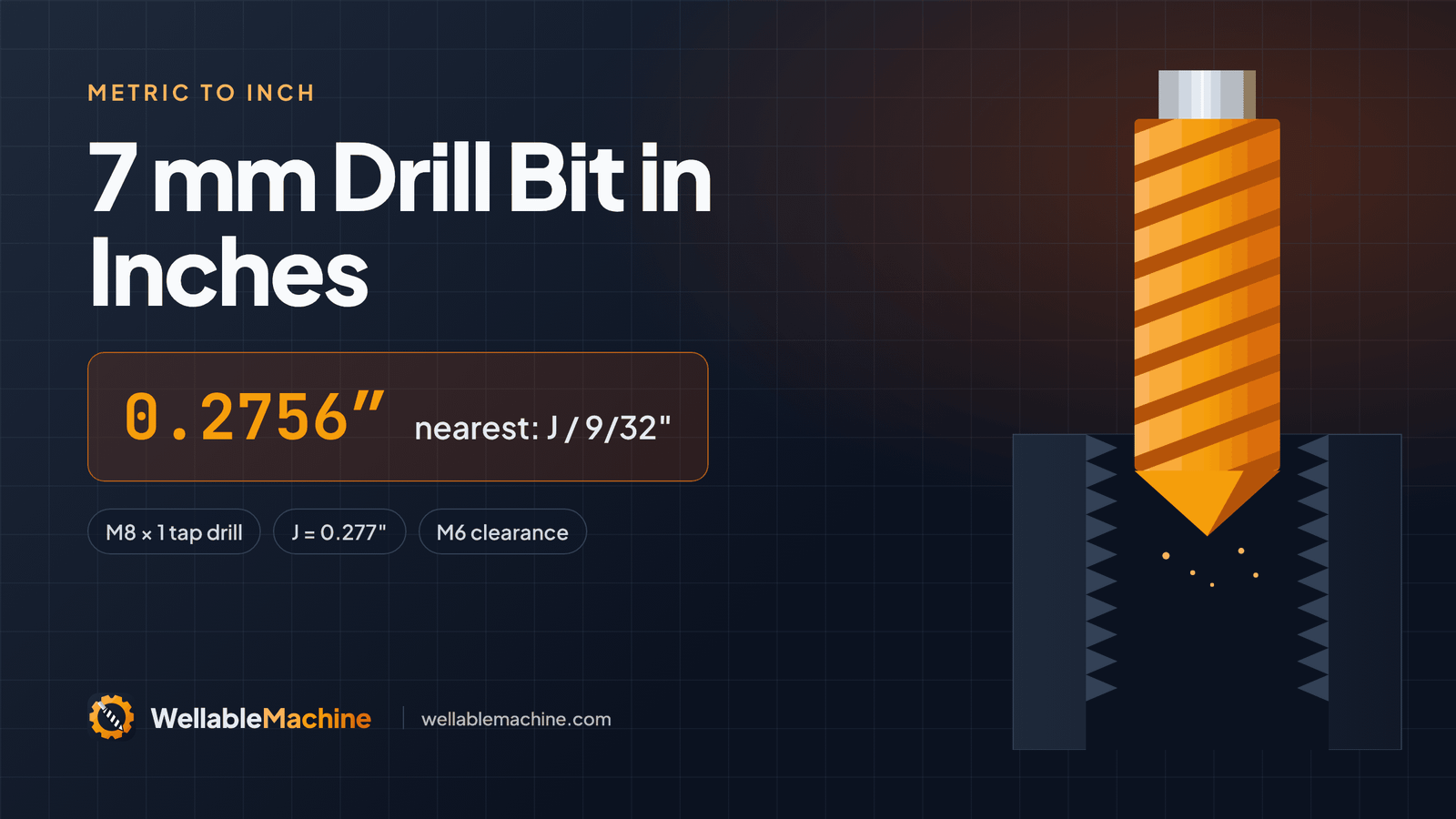
Quick answer: a 7 mm drill bit is 0.2756 in. There is no exact fractional equivalent. The closest fraction is 9/32 in (0.2813 in), which is 0.0057 in (0.14 mm) larger, and the closest American drill of any kind is the letter J (0.2770 in), just 0.0014 in larger. Going smaller, 17/64 in (0.2656 in) is 0.25 mm undersize.
Whether those small differences matter depends on what the hole is for. For a wall plug, a clearance hole or a hole in wood, 9/32 in is a perfectly good stand-in. For a tapped thread, a dowel pin or a bearing fit, you want the real 7 mm or a letter J. This guide covers the conversion, the nearby sizes, what 7 mm holes are used for, and when a substitute is fine.
7 mm in Inches at a Glance
| Measurement | Value |
|---|---|
| Decimal inches | 0.2756 in |
| Nearest fraction | 9/32 in (0.2813 in), +0.0057 in |
| Nearest 64th below | 17/64 in (0.2656 in), −0.0100 in |
| Nearest letter drill | J (0.2770 in), +0.0014 in |
| Main uses | M8 × 1 tap drill, M6 loose clearance, 7 mm wall plugs |
The conversion is simple: divide millimeters by 25.4. 7 ÷ 25.4 = 0.27559 in. To go the other way, multiply inches by 25.4. The drill bit sizes reference lists metric and inch series side by side. Our fractional drill bit sizes guide lists every fraction with its metric value.
Drill Sizes Near 7 mm
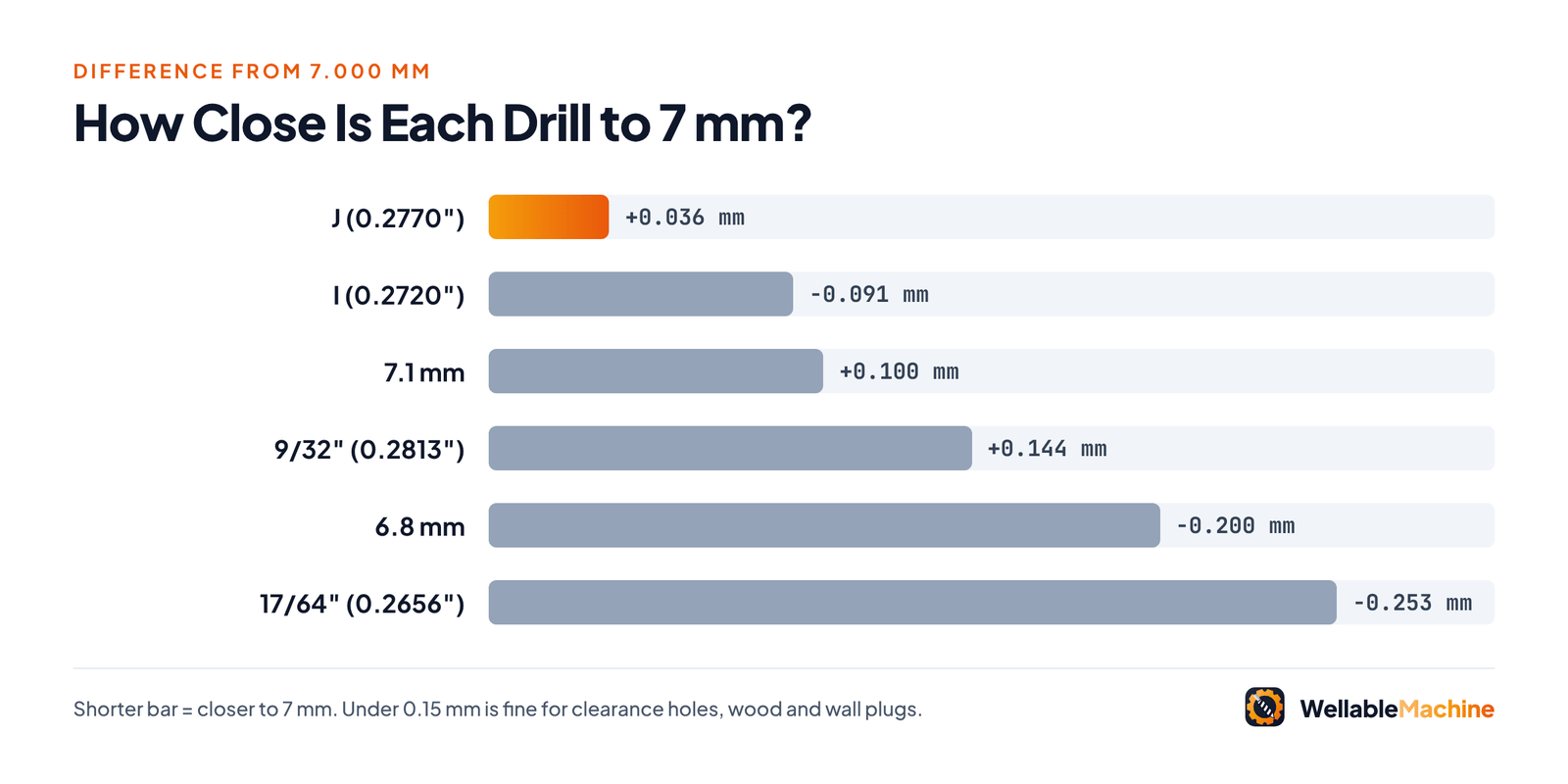
| Drill | Inches | mm | Difference from 7 mm |
|---|---|---|---|
| 17/64 in | 0.2656 | 6.747 | −0.253 mm |
| H | 0.2660 | 6.756 | −0.244 mm |
| 6.8 mm | 0.2677 | 6.800 | −0.200 mm |
| I | 0.2720 | 6.909 | −0.091 mm |
| 7 mm | 0.2756 | 7.000 | — |
| J | 0.2770 | 7.036 | +0.036 mm |
| 7.1 mm | 0.2795 | 7.100 | +0.100 mm |
| K | 0.2810 | 7.137 | +0.137 mm |
| 9/32 in | 0.2813 | 7.144 | +0.144 mm |
| L | 0.2900 | 7.366 | +0.366 mm |
| 7.5 mm | 0.2953 | 7.500 | +0.500 mm |

Letter drills fill the gaps between fractions above 1/4 in, just as number drills do below it. See our number and letter drill size chart for the full series.
What Is a 7 mm Drill Used For?
Tap drill for M8 × 1 fine thread
The tap drill for a metric thread is the diameter minus the pitch. For M8 × 1, that is 8 − 1 = 7 mm, giving about 77% thread. M8 × 1 is used on many automotive, motorcycle and bicycle parts, hydraulic fittings and machine adjusters. Our M8 × 1 tap drill size guide covers it in detail. Don’t confuse it with the common coarse M8 × 1.25, which needs a 6.8 mm drill; a 7 mm hole gives only about 62% thread on M8 × 1.25, which is weak in soft metals. See M8 tap drill size.
Loose clearance hole for M6 and 1/4 in bolts
ISO 273 lists three clearance holes for an M6 bolt: 6.4 mm (close), 6.6 mm (medium) and 7 mm (coarse). A 7 mm hole gives room to line up several bolts through two parts at once, or to allow for paint, plating and slightly out-of-position holes. The same hole works as a loose clearance for a 1/4 in (6.35 mm) bolt. For other bolt sizes, see our clearance hole size chart.
7 mm wall plugs and masonry anchors
In the UK and parts of Europe, brown wall plugs are made for 7 mm holes and take screws of about 4.5 to 5 mm (size 10 to 12). They are a common choice for heavier shelves, curtain poles and cabinets in brick and block. Drill these with a 7 mm masonry bit, not an HSS bit. Our wall anchor drill bit size chart covers plug colors and sizes.
Thread engagement for 5/16-24
A 7 mm drill gives about 68% thread on a 5/16-24 UNF tap. The standard drill is the letter I (about 75%), but 7 mm is a good choice in stainless steel or for deep holes, where a little less thread makes tapping much easier. See 5/16-24 tap drill size.
Woodworking and general holes
7 mm holes are used for some knock-down furniture fittings, threaded inserts in softwood, cable pass-throughs for thin cords and metric dowel work. For holes in wood, a 9/32 in brad point works the same.
Can You Use 9/32 in Instead of 7 mm?
| Use | 9/32 in OK? | Notes |
|---|---|---|
| Wall plug in masonry | Usually | Masonry holes come out slightly oversize anyway. In soft brick, use 7 mm or the plug may spin. |
| Clearance hole for M6 or 1/4 in | Yes | A loose fit either way. |
| Hole in wood or plastic | Yes | The 0.14 mm difference won’t show. |
| Tapping M8 × 1 | Not ideal | Drops thread to about 66%. Fine in steel for light loads; use 7 mm or J for best results. |
| Press fit for a 7 mm pin or bushing | No | Use a 6.9 mm drill and a 7 mm reamer. |
| Bearing or shaft fit | No | Bore or ream to size. |
The letter J (0.277 in) is a much closer substitute than 9/32 in, only 0.036 mm larger, and it is in any letter drill set. If you have one, it is the best inch-sized drill for tapping M8 × 1.
Can You Use 17/64 in Instead?
Only where the hole needs to be smaller, not equal. 17/64 in is a quarter of a millimeter undersize. That is a problem for a 7 mm wall plug (it may not go in, or it may split brick) and for clearance holes (bolts won’t pass). It is close to the 6.8 mm needed for M8 × 1.25, so a 17/64 in or letter H drill is a good inch substitute there.
Choosing a 7 mm Drill Bit
- HSS (DIN 338 jobber): the standard metal-drilling bit; fine for steel, aluminum, wood and plastic.
- Cobalt (HSS-Co): for stainless and hard steels. See HSS vs cobalt drill bits.
- Masonry (carbide tip): for brick, block and concrete with a hammer drill. SDS-plus 7 mm bits are common for rotary hammers.
- Brad point: for clean holes in wood.
- Tile and glass bits: for wall plugs in tiled walls. See how to drill through tile.
Most drills cut very slightly oversize, by 0.02 to 0.05 mm in steel and more if the bit isn’t sharp or the hole isn’t started cleanly. For a hole that must be exactly 7 mm, drill 6.8 or 6.9 mm and ream.
Drilling Speeds for a 7 mm Bit
| Material | Approx. starting speed |
|---|---|
| Aluminum, brass | About 1,400 RPM |
| Mild steel | About 850 RPM |
| Stainless steel | About 400 RPM |
| Wood | 1,500 to 3,000 RPM |
| Masonry (hammer mode) | Medium speed, let the hammer action work |
These are starting points for a drill press or a steady hand drill. Use cutting fluid in steel and stainless, and back off if the chips turn blue. The drill speed chart covers more sizes.
How to Drill an Accurate 7 mm Hole
A drill rarely cuts exactly its own size. In steel, a sharp 7 mm jobber drill typically cuts about 7.02 to 7.08 mm. A dull bit, a bit with uneven lips, or a hole started without a center punch can cut 0.1 mm or more oversize. For most uses that doesn’t matter, but for tapped holes and fits it does:
- Center punch or spot drill the location so the bit starts true.
- Use a pilot of about 3 mm in steel, so the 7 mm bit’s chisel edge doesn’t have to push into solid metal.
- Clamp the work and use a drill press if you can; it keeps the hole straight and round. See how to use a drill press.
- Use cutting fluid in steel and stainless to keep the cutting edges sharp.
- For a precise fit, drill 6.8 or 6.9 mm and finish with a 7 mm machine or hand reamer.
7 mm Compared With Other Common Metric Sizes
| Metric drill | Inches | Closest inch drill | Common use |
|---|---|---|---|
| 6 mm | 0.2362 | B (0.238) or 15/64 | 6 mm wall plugs and masonry anchors |
| 6.5 mm | 0.2559 | F (0.257) | Bolt clearance, 1/4 in pop rivets |
| 6.8 mm | 0.2677 | H (0.266) or 17/64 | M8 × 1.25 tap drill |
| 7 mm | 0.2756 | J (0.277) | M8 × 1 tap drill, M6 coarse clearance |
| 8 mm | 0.3150 | O (0.316) | 8 mm dowels, 5/16 in bolt clearance |
| 8.5 mm | 0.3346 | Q (0.332) or R (0.339) | M10 × 1.5 tap drill |
Is 7 mm in a Standard Drill Set?
Most metric HSS sets go from 1 to 10 mm or 1 to 13 mm in 0.5 mm steps, so a 7 mm bit is almost always included. Inch fractional sets don’t include it; the nearest bits are 17/64 in and 9/32 in. A full letter set (A to Z) gives you J. If you work across both systems, a 1 to 13 mm metric set is a useful companion to a fractional set, because many metric tap drills and clearance holes fall between the fractions.
Frequently Asked Questions
7 quick answers from our editors
01What is 7 mm in inches?
0.2756 in.
02What size drill bit is equal to 7 mm?
None exactly. The letter J (0.277 in) is closest; 9/32 in (0.281 in) is the closest fraction.
03Is 7 mm bigger than 1/4 inch?
Yes. 1/4 in is 6.35 mm, so 7 mm is 0.65 mm larger.
04Is 7 mm the same as 9/32?
Close but not the same. 9/32 in is 7.14 mm.
05What tap uses a 7 mm drill?
M8 × 1. It is also used for 5/16-24 in hard materials.
06What screw fits a 7 mm wall plug?
Usually a 4.5 to 5 mm (size 10 to 12) wood screw. Check the plug packaging.
07What size bolt fits a 7 mm hole?
An M6 or a 1/4 in bolt, with loose clearance.
Bottom Line
A 7 mm drill is 0.2756 in. The letter J is the closest inch-system drill, and 9/32 in is the closest fraction. Use either for clearance holes, wood and wall plugs, but use a true 7 mm or a J for tapping M8 × 1 and ream for precise fits. Don’t swap 7 mm for 6.8 mm when tapping coarse M8 × 1.25.