M3 Tap Drill Size: 2.5 mm Drill Chart for M3 x 0.5 Threads
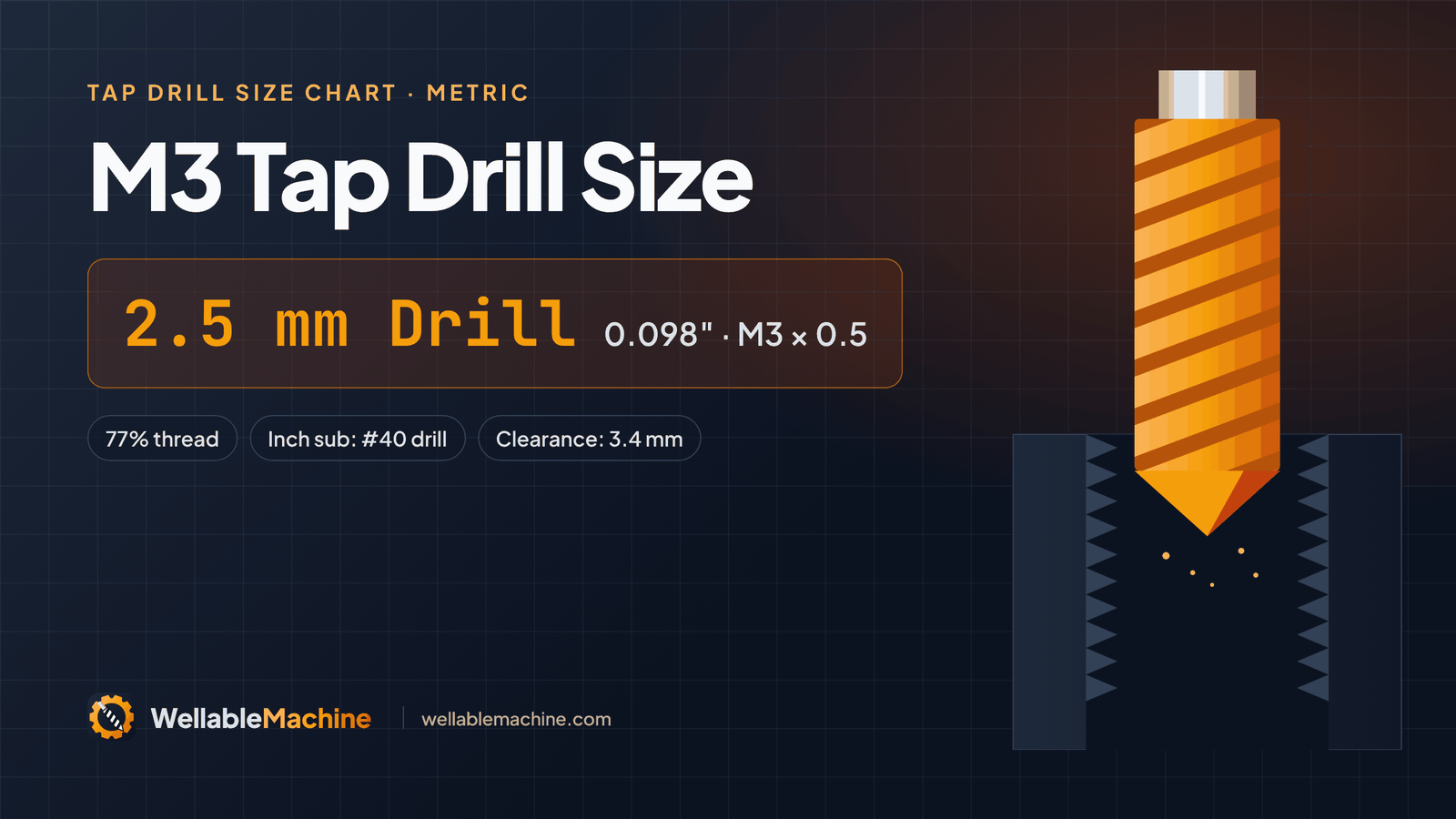
Quick answer: an M3 × 0.5 thread needs a 2.5 mm drill (0.098 in), which gives about a 77% thread. If you only have inch drills, a #40 (0.098 in) is practically identical. For stainless steel or deep blind holes, use 2.6 mm or a #38 so the small tap is less likely to snap.
M3 is the most common small screw in electronics, 3D printers, drones and RC models. At this size, a tap can break with almost no warning, so this guide focuses on the right drill, the right tools and the habits that keep small taps in one piece.
M3 Thread Specifications at a Glance
“M3” means an ISO metric thread with a 3 mm diameter and a 0.5 mm coarse pitch. See the ISO metric screw thread reference for all standard sizes.
| Specification | Value |
|---|---|
| Thread series | ISO metric coarse (M) |
| Major diameter | 3.00 mm (0.118 in) |
| Pitch | 0.5 mm (50.8 TPI) |
| Basic minor diameter (internal) | 2.459 mm |
| Tap drill, ~77% thread | 2.5 mm (0.098 in) |
| Inch substitute | #40 = 0.098 in (2.49 mm) |
| Fine pitch | M3 × 0.35, tap drill 2.65 mm |
| Clearance hole, normal fit | 3.4 mm |
| Hex key, socket head screw | 2.5 mm |
M3 Tap Drill Size Chart by Thread Percentage
Every drill in the table below leaves a different amount of metal for the tap to cut. Tests have shown that a 60% thread is only a few percent weaker than a 75% one, yet it takes far less effort to tap, so there is no prize for the tightest hole. Percentages are worked out with % thread = (D − drill) ÷ (1.299 × pitch) × 100.
| Drill | mm | Inches | Approx. thread | When to use it |
|---|---|---|---|---|
| 2.4 mm | 2.40 | 0.0945 | 92% | Far too tight; breaks taps |
| #41 | 2.44 | 0.0960 | 86% | Inch drill; too tight in metal |
| #40 | 2.49 | 0.0980 | 79% | Closest inch drill; soft metals |
| 2.5 mm | 2.50 | 0.0984 | 77% | Standard choice for most materials |
| #39 | 2.53 | 0.0995 | 73% | Inch option for steel |
| #38 | 2.58 | 0.1015 | 65% | Stainless and hard alloys |
| 2.6 mm | 2.60 | 0.1024 | 62% | Stainless, deep blind holes |
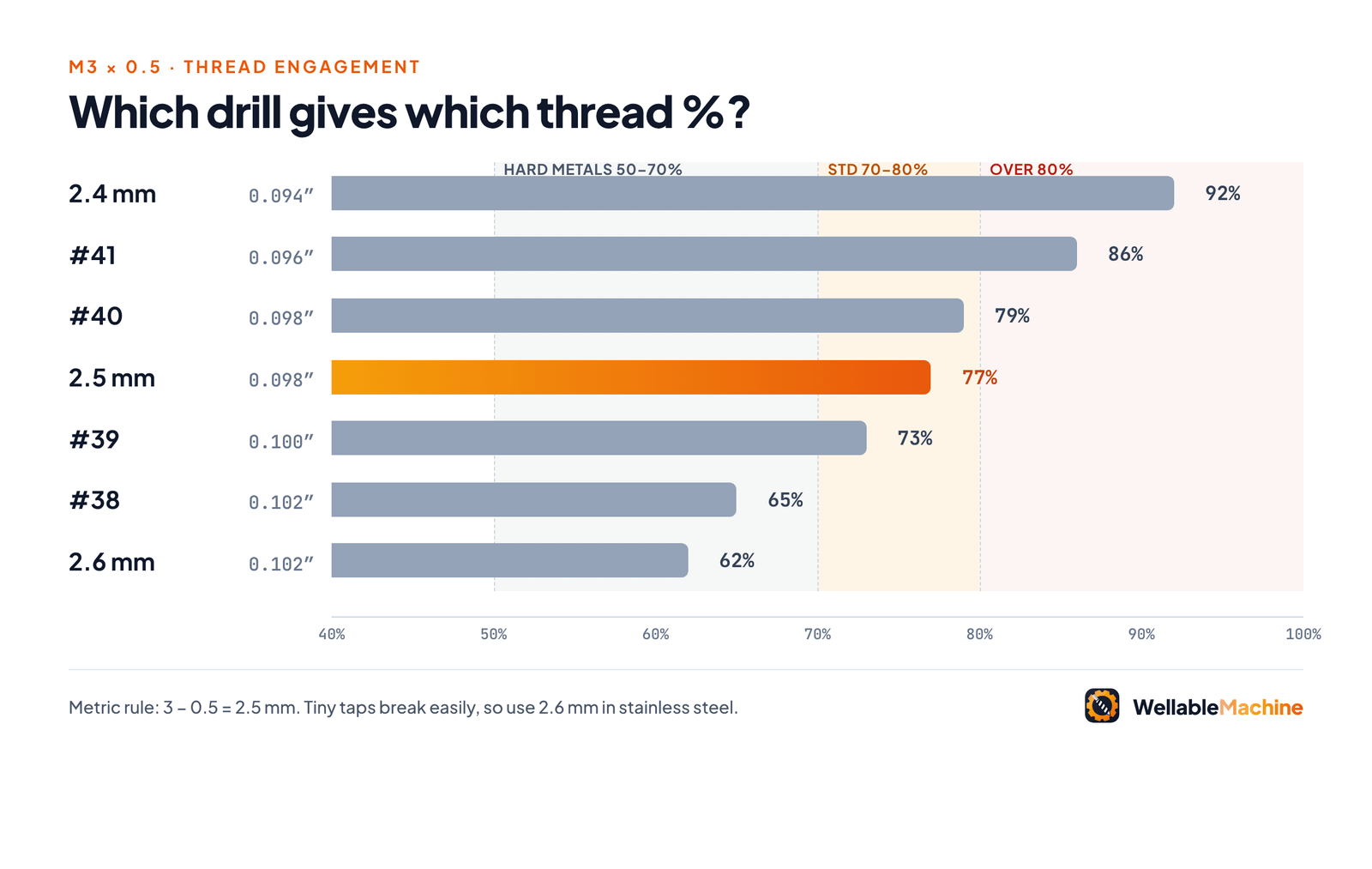
Which drill should you use? Use 2.5 mm for aluminum, brass, plastic and mild steel. In stainless steel, 2.6 mm gives about 62% thread, which is plenty for an M3 screw and dramatically reduces tap breakage. With inch drills, #40 matches 2.5 mm and #38 suits stainless.
Clearance Hole Sizes for an M3 Screw
For screws that pass through a part, ISO 273 gives these clearance holes:
| Fit | Drill | Inches | mm | Use it for |
|---|---|---|---|---|
| Close (fine) | 3.2 mm | 0.126 | 3.20 | Precise alignment |
| Normal (medium) | 3.4 mm | 0.134 | 3.40 | Most assemblies |
| Loose (coarse) | 3.6 mm | 0.142 | 3.60 | Panels, 3D-printed parts |
M3 vs. 4-40 vs. M2.5
M3 is often confused with the inch 4-40 and the smaller M2.5, especially on circuit boards and computer parts.
| Thread | Diameter | Pitch | Tap drill | Typical use |
|---|---|---|---|---|
| M3 × 0.5 | 3.00 mm | 0.5 mm | 2.5 mm | 3D printers, drones, PC parts, electronics |
| 4-40 UNC | 2.84 mm | 0.635 mm (40 TPI) | #43 (0.089 in) | US electronics, connectors |
| M2.5 × 0.45 | 2.50 mm | 0.45 mm | 2.05 mm | Raspberry Pi and small boards |
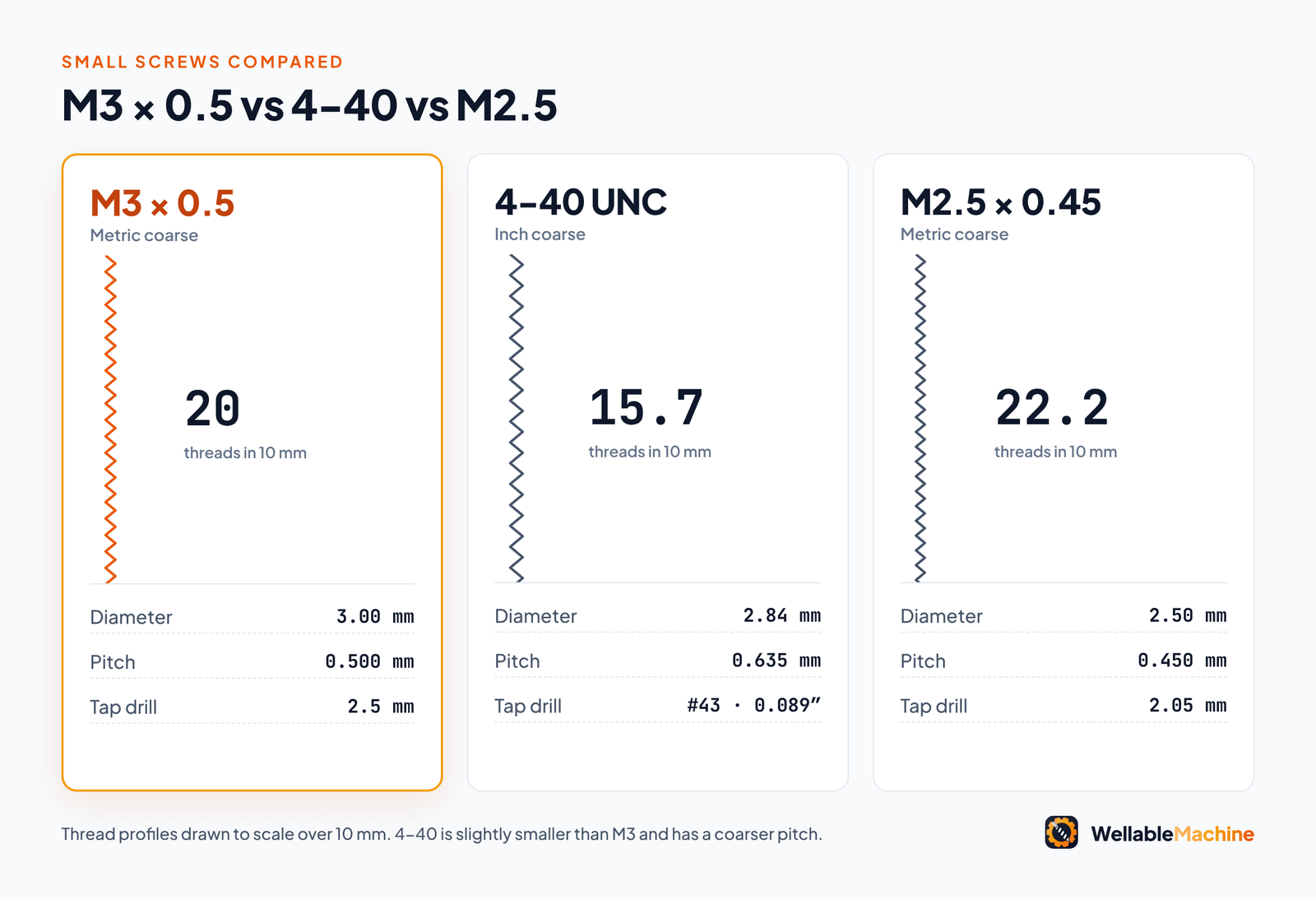
An M3 screw won’t go into a 4-40 hole, and a 4-40 screw is loose in M3. See the 4-40 tap drill size guide for the inch version.
Other M3 Hole Sizes You Might Need
- Forming (roll) tap: about 2.8 mm.
- Helicoil / wire thread insert: drill 3.2 mm and use the M3 STI tap.
- Heat-set insert for 3D prints: usually 4.0–4.2 mm; follow the insert maker’s spec.
- Counterbore for an M3 socket head cap screw: 6.5 mm diameter, 3.4 mm deep.
How to Drill and Tap a M3 Hole
- Mark and center punch the hole so the drill starts exactly where you want it. On a part this small, a spot drill or stub drill helps a lot.
- Drill with a 2.5 mm bit. In aluminum, run about 3,900 RPM; in mild steel, about 2,300 RPM; in stainless, slow down to about 1,200 RPM with steady pressure and cutting oil. Our guide on how to drill stainless steel explains why stainless needs low speed and constant feed.
- Break the sharp edge with a countersink. A small chamfer guides the tap in and keeps a raised burr from forming around the hole.
- Start the tap straight. Use a pin vise or a very small T-handle tap wrench and hold it with your fingertips. Any side load can snap an M3 tap.
- Work in short strokes. Turn forward until you feel resistance build, then reverse slightly to snap the chip. Keep the flutes wet with tapping fluid the whole time.
- For blind holes, drill at least 1.5 mm deeper than the full thread you need, and finish with a bottoming tap.

For slightly bigger metric screws, see the M4 tap drill size and M5 tap drill size. If a tap does break, read how to remove a broken tap.
Which M3 Tap Should You Use?
The best upgrade for M3 through-holes is a spiral point tap; in aluminum, a forming tap makes stronger threads and no chips at all.
| Tap type | Best for | Notes |
|---|---|---|
| Taper tap | Starting threads by hand in hard material | Long chamfer; the easiest to start straight |
| Plug tap | Through-holes and most blind holes | The everyday hand tap |
| Bottoming tap | Full threads to the bottom of blind holes | Use only after a plug or taper tap |
| Spiral point (gun) tap | Through-holes, power tapping | Pushes chips ahead; strong core, fewer breaks |
| Spiral flute tap | Blind holes, power tapping | Lifts chips up and out of the hole |
| Forming (roll) tap | Aluminum, brass, mild steel | No chips; needs a larger 2.8 mm hole |
Tapping M3 in Different Materials
The hole size rarely changes from one metal to another, but the fluid, tap and technique do. Here is a quick guide for M3 work.
| Material | Recommended drill | Tapping fluid | Tips |
|---|---|---|---|
| Aluminum | 2.5 mm | Light oil or WD-40 | Back out every half turn |
| Mild steel | 2.5 mm | Sulfurized cutting oil | Standard plug tap works well |
| Stainless (304/316) | 2.6 mm | Heavy tapping paste | Cobalt tap; extremely slow |
| Brass and bronze | 2.5 mm | Light oil or dry | Cuts cleanly; avoid high-rake taps |
| 3D-printed PLA/PETG | 2.5 mm | None | Heat-set inserts last far longer |
How Deep Should a M3 Thread Be?
How much thread you need depends on what the hole is made of. Softer materials need longer engagement so the internal thread doesn’t strip before the screw breaks:
- Steel: 1 × diameter = 3 mm.
- Aluminum and brass: 1.5–2 × diameter = 4.5–6 mm.
- Plastic: 2.5 × diameter or a heat-set insert.
Where Is M3 Used?
M3 screws hold together 3D printers (hotends, fans, extrusion brackets), drones and RC models, laptops and PC parts such as SSDs and M.2 standoffs, small electronics enclosures and camera accessories. It is probably the single most common screw in the maker world.
Common M3 Tapping Problems (and How to Fix Them)
- Tap snapped: use 2.6 mm in steel, a pin vise, and lots of fluid.
- Thread stripped in 3D-printed plastic: use a heat-set insert or a captive nut.
- Drill breaks: use a stub drill, high RPM and peck often.
- Screw won’t go in: it may be 4-40 or M2.5; check the pitch.
Frequently Asked Questions
5 quick answers from our editors
01What size drill bit for an M3 tap?
A 2.5 mm drill. It gives about a 77% thread.
02What inch drill is used for M3?
A #40 drill (0.098 in), or #38 for stainless.
03What size clearance hole for M3?
3.4 mm for a normal fit and 3.2 mm for a close fit.
04Is M3 the same as 4-40?
No. 4-40 is smaller (2.84 mm) with a coarser pitch.
05Can I tap M3 in 3D-printed plastic?
Yes, but heat-set brass inserts are far more durable for parts that get taken apart.
Bottom Line
For an M3 × 0.5 thread, drill a 2.5 mm hole (or a #40), go to 2.6 mm in stainless, and drill 3.4 mm for clearance. Small taps need a light touch, so use a pin vise and plenty of fluid. See our tap drill size chart for other sizes.