1/4-28 Tap Drill Size: #3 Drill Chart, Clearance & Metric

Quick answer: the standard tap drill for a 1/4-28 UNF thread is a #3 drill (0.213 in / 5.41 mm). It produces roughly an 80% thread, which suits aluminum, brass and mild steel. A 5.4 mm metric drill is effectively the same size. In steel or stainless, many machinists prefer a 7/32 in (0.2188 in) drill, which gives about 67% thread and is far easier to tap.
1/4-28 is the fine-thread version of the familiar 1/4-20. You will see it on aircraft and automotive parts, bicycle components, firearm accessories and anywhere a 1/4 in fastener has to resist vibration or work in thin material. This page covers the drill choices, clearance holes, how 1/4-28 compares with 1/4-20, and how to tap it cleanly.
1/4-28 Thread Specifications at a Glance
“1/4-28” is a 1/4 in (0.250 in) diameter thread with 28 threads per inch, the Unified Fine (UNF) pitch for this size in the Unified Thread Standard.
| Specification | Value |
|---|---|
| Thread series | UNF (Unified National Fine) |
| Major diameter | 0.250 in (6.35 mm) |
| Threads per inch | 28 |
| Pitch | 0.0357 in (0.907 mm) |
| Basic minor diameter | 0.2062 in (5.24 mm) |
| Standard tap drill | #3 = 0.213 in (5.41 mm) |
| Easy-tapping drill | 7/32 = 0.2188 in (5.56 mm) |
| Close-fit clearance | F = 0.257 in (6.53 mm) |
| Free-fit clearance | H = 0.266 in (6.76 mm) |
1/4-28 Tap Drill Size Chart by Thread Percentage
Thread percentage tells you how much of a full thread the tap actually cuts. A smaller hole gives a fuller thread but needs much more torque, and anything above about 75% adds almost no real strength. That’s why machinists use about 75% in soft metals and drop to 60–70% in hard ones. The values below use % thread = 76.98 × TPI × (major diameter − drill diameter).
| Drill | Inches | mm | Approx. thread | When to use it |
|---|---|---|---|---|
| #4 | 0.2090 | 5.31 | 88% | Too tight; hard to tap |
| 5.4 mm | 0.2126 | 5.40 | 81% | Metric twin of #3 |
| #3 | 0.2130 | 5.41 | 80% | Standard choice for most materials |
| 7/32 | 0.2188 | 5.56 | 67% | Fractional option; steel and stainless |
| 5.6 mm | 0.2205 | 5.60 | 64% | Metric option for stainless |
| #2 | 0.2210 | 5.61 | 63% | Stainless, hard alloys |
| #1 | 0.2280 | 5.79 | 47% | Very hard materials only |

Which drill should you use? Use a #3 or 5.4 mm drill in aluminum, brass and cast iron, where a fuller thread helps. In mild steel either #3 or 7/32 in works. In stainless, titanium or for deep blind holes, 7/32 in or a #2 drill cuts the torque sharply and still leaves a thread that is stronger than the bolt in most joints. Fine threads have shallow teeth, so a 65% fine thread carries more load than you might expect.
1/4-28 or 1/4-20: Which Should You Use?
A fine thread has more threads per inch, so it engages more turns in the same depth and has a slightly larger core. That gives three practical advantages: it resists loosening from vibration, it allows finer adjustment, and it holds better in thin walls. Coarse 1/4-20 is better in soft or brittle materials like aluminum castings, plastic and wood inserts, because its deeper teeth are less likely to strip, and it assembles faster. If a hole has very little depth, 1/4-28 gives you more threads to work with.
Clearance Hole Sizes for a 1/4 in Bolt
Clearance holes are the same for 1/4-28 and 1/4-20 because they depend only on the bolt diameter.
| Fit | Drill | Inches | mm | Use it for |
|---|---|---|---|---|
| Close fit | F | 0.2570 | 6.53 | Accurate location |
| Free fit | H | 0.2660 | 6.76 | General assemblies |
| Loose fit | 9/32 | 0.2812 | 7.14 | Hole patterns, frames |
1/4-28 vs. 1/4-20 vs. M6
All three are close in size, and a mixed parts bin is the usual reason a 1/4 in bolt cross-threads.
| Thread | Diameter | Pitch | Tap drill | Typical use |
|---|---|---|---|---|
| 1/4-28 UNF | 6.35 mm | 0.907 mm (28 TPI) | #3 (0.213 in) | Aircraft, automotive, bike parts |
| 1/4-20 UNC | 6.35 mm | 1.270 mm (20 TPI) | #7 (0.201 in) | General hardware, camera mounts |
| M6 × 1.0 | 6.00 mm | 1.0 mm | 5.0 mm | Metric machinery |

A 1/4-20 bolt will not start in a 1/4-28 hole at all, while an M6 bolt is undersize and will feel loose. See the 1/4-20 tap drill size and M6 tap drill size guides for those threads.
Other 1/4-28 Hole Sizes You Might Need
- Forming (roll) tap: about 0.234 in (15/64 in or an A drill). Confirm with the tap maker.
- Heli-Coil / STI insert: a 17/64 in drill, then a 1/4-28 STI tap.
- Counterbore for a socket head cap screw: 7/16 in diameter, 1/4 in deep.
How to Drill and Tap a 1/4-28 Hole
- Mark and center punch the hole so the drill starts exactly where you want it.
- Drill with a #3 bit. In aluminum, run about 1,800 RPM; in mild steel, about 1,100 RPM; in stainless, slow down to about 550 RPM with steady pressure and cutting oil. Our guide on how to drill stainless steel explains why stainless needs low speed and constant feed.
- Chamfer the top of the hole with a countersink so the tap starts square and the first thread doesn’t lift.
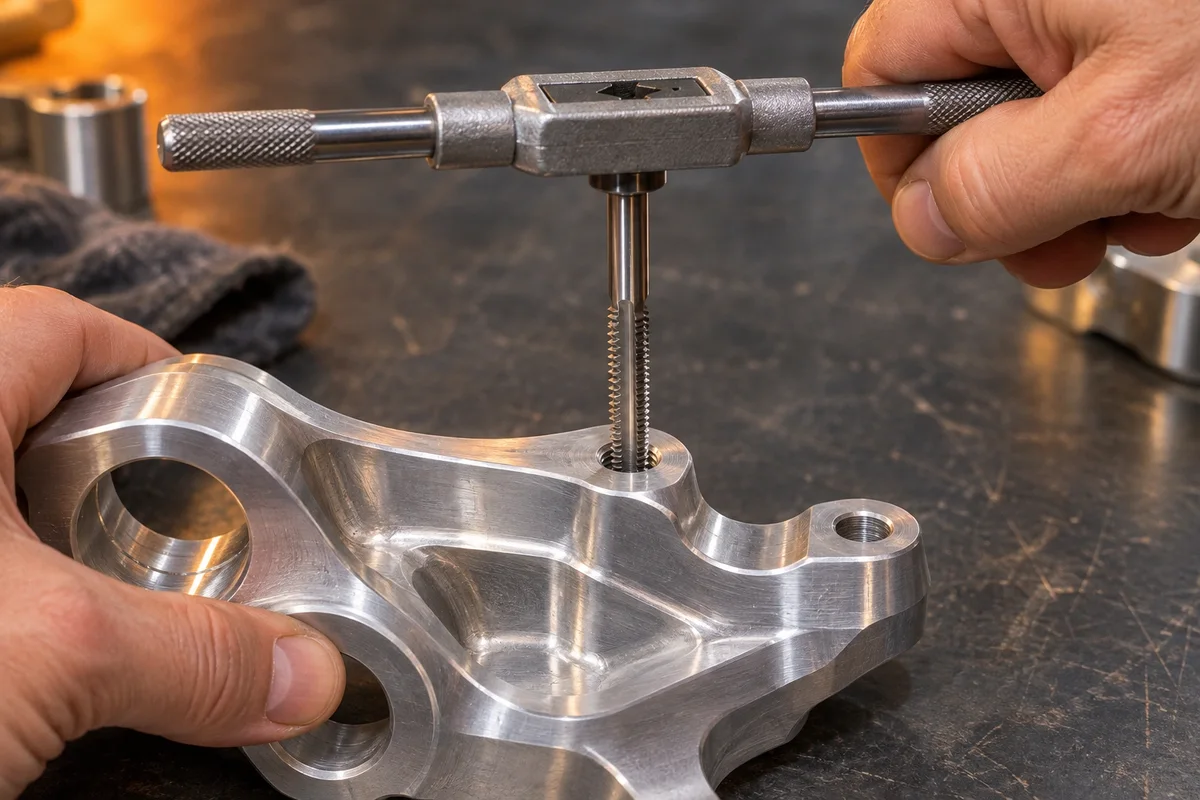
- Start the tap straight. A tap guide or the drill press spindle keeps it square. Fine taps have small teeth, so a crooked start shows up quickly as a wobbly bolt.
- Cut and break the chip: half a turn forward, a quarter turn back, with tapping fluid. Light oil suits aluminum; sulfurized cutting oil suits steel.
- For blind holes, drill at least 0.11 in (3 pitches) deeper than the full thread you need, and finish with a bottoming tap.
Cobalt drills hold their edge far better in steel; see our list of the best drill bits for stainless steel. If a tap does snap, our guide on how to remove a broken tap explains every option.
Which 1/4-28 Tap Should You Use?
Fine-thread taps have shallow teeth and short chips, so they cut smoothly but clog quickly in blind holes. Back out often and keep them well oiled.
| Tap type | Best for | Notes |
|---|---|---|
| Taper tap | Starting threads by hand in hard material | Long chamfer; the easiest to start straight |
| Plug tap | Through-holes and most blind holes | The everyday hand tap |
| Bottoming tap | Full threads to the bottom of blind holes | Use only after a plug or taper tap |
| Spiral point (gun) tap | Through-holes, power tapping | Pushes chips ahead; strong core, fewer breaks |
| Spiral flute tap | Blind holes, power tapping | Lifts chips up and out of the hole |
| Forming (roll) tap | Aluminum, brass, mild steel | No chips; needs a larger 15/64 in hole |
Tapping 1/4-28 in Different Materials
The #3 drill is right for most materials, but each metal behaves differently under the tap. This table sums up what works.
| Material | Recommended drill | Tapping fluid | Tips |
|---|---|---|---|
| Aluminum | #3 | Light oil or WD-40 | Use plenty of oil; fine threads clog fast |
| Mild steel | #3 | Sulfurized cutting oil | Standard plug tap works well |
| Stainless (304/316) | 7/32 or #2 | Heavy tapping paste | Cobalt tap; 7/32 drill |
| Brass and bronze | #3 | Light oil or dry | Cuts cleanly; avoid high-rake taps |
| Thin-wall tube | #3 | Light oil | Fine pitch gives more threads in thin walls |
How Deep Should a 1/4-28 Thread Be?
Thread engagement matters more than thread percentage. The first few threads carry most of the load, so going much deeper adds effort without adding strength. Use these lengths as a starting point:
- Steel: 1 × diameter, 1/4 in.
- Cast iron and brass: 1.5 × diameter, 3/8 in.
- Aluminum: 2 × diameter, 1/2 in, or a Heli-Coil.
Where Is 1/4-28 Used?
1/4-28 appears on aircraft hardware (AN bolts), car and motorcycle parts such as brackets and brake components, bicycle parts, firearm scope rings and accessories, pneumatic fittings and machine tool accessories. Wherever vibration or fine adjustment matters, engineers reach for the fine pitch.
Common 1/4-28 Tapping Problems (and How to Fix Them)
- Bolt won’t start: it’s probably 1/4-20. Check the pitch with a gauge.
- Tap tight in steel: switch from #3 to 7/32 in.
- Thread strips in aluminum: fine threads have shallow teeth; use longer engagement or a Heli-Coil.
- Tap snapped in a blind hole: chips packed. Back out completely every few turns.
Frequently Asked Questions
5 quick answers from our editors
01What size drill bit for a 1/4-28 tap?
A #3 drill (0.213 in). It gives about an 80% thread.
02Can I use 7/32 for 1/4-28?
Yes. 7/32 in gives about a 67% thread and is easier to tap, especially in steel.
03What metric drill for 1/4-28?
5.4 mm, the same size as a #3. Use 5.5–5.6 mm in stainless.
04What size clearance hole for a 1/4 in bolt?
F (0.257 in) for a close fit or H (0.266 in) for a free fit.
05Is 1/4-28 stronger than 1/4-20?
Slightly, because its core is larger, and it resists vibration better. 1/4-20 is better in soft materials.
Bottom Line
For a 1/4-28 thread, drill with a #3 bit (0.213 in) or 5.4 mm, and switch to 7/32 in for steel and stainless. Use F or H for clearance, and keep 1/4-28 and 1/4-20 bolts apart. For every size, see our tap drill size chart.