Sleeve Anchor Size Chart: Drill Bit, Bolt, Embedment and Torque
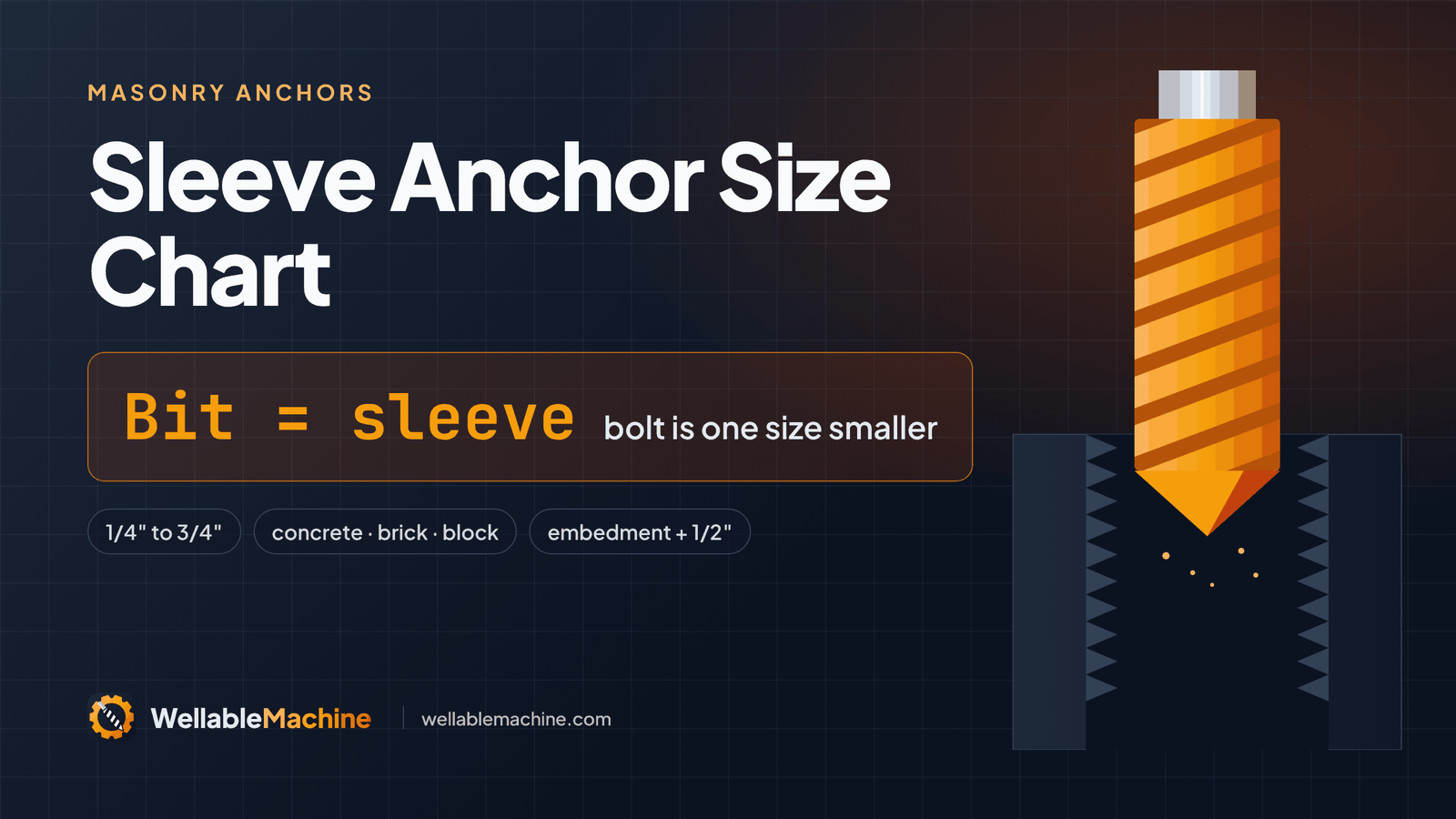
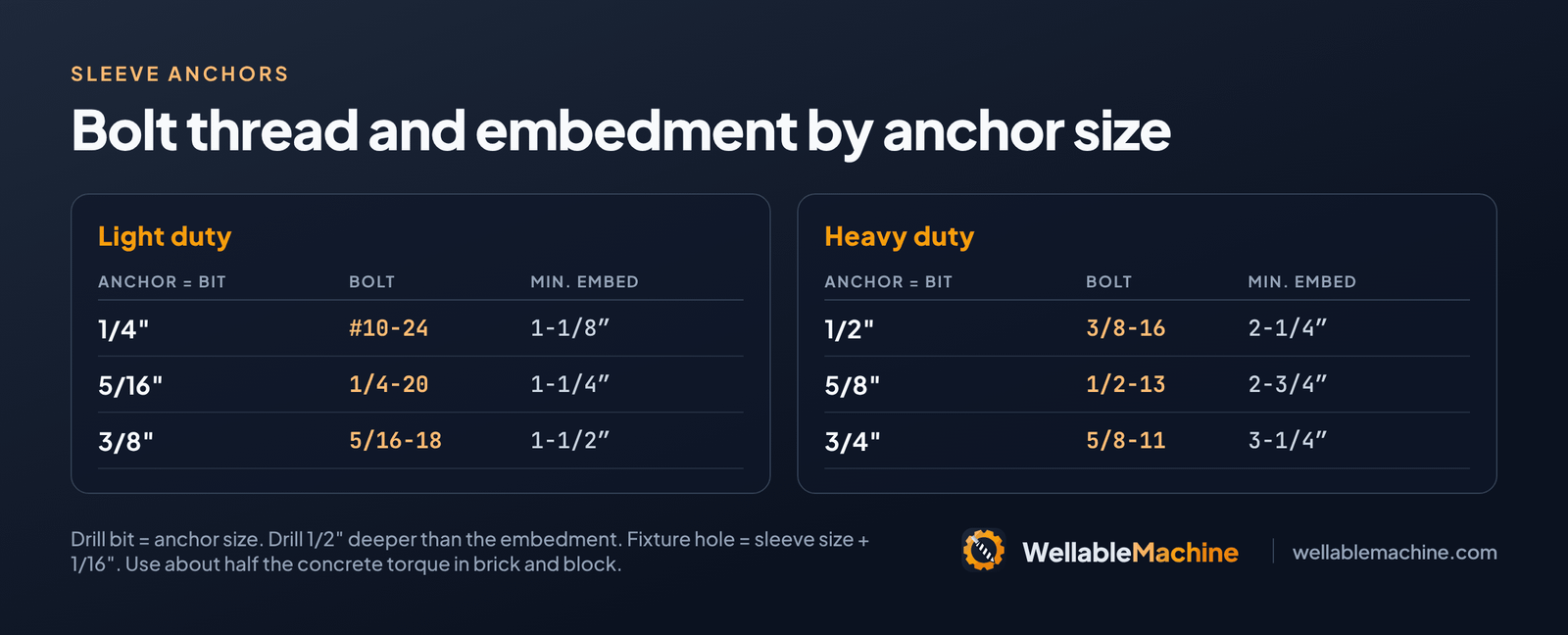
Quick answer: a sleeve anchor is sized by its outside sleeve diameter, and that is also the drill bit size: a 3/8 in sleeve anchor goes in a 3/8 in carbide masonry hole, a 1/2 in anchor in a 1/2 in hole. The bolt inside is one size smaller (a 3/8 in sleeve anchor has a 5/16 in thread). Drill about 1/2 in deeper than the embedment, and make the hole in the fixture 1/16 in larger than the sleeve. The chart below lists bit, thread, embedment, fixture hole and typical torque for every common size.
Sleeve anchors are the all-rounders of masonry fasteners. Unlike a wedge anchor, which only grips at its tip and needs solid concrete, a sleeve anchor expands along most of its length. That spreads the load and lets it hold in concrete, solid brick, grout-filled block and even, carefully, in hollow block. The catch is that the sizing confuses almost everyone the first time, because the number on the box describes the sleeve, not the bolt.
Sleeve Anchor Size Chart
| Anchor (sleeve) size | Drill bit | Bolt thread | Min. embedment | Fixture hole | Nut wrench | Typical torque (concrete) |
|---|---|---|---|---|---|---|
| 1/4 in | 1/4 in | #10-24 (3/16 in) | 1-1/8 in | 5/16 in | 3/8 in | 5 ft-lb |
| 5/16 in | 5/16 in | 1/4-20 | 1-1/4 in | 3/8 in | 7/16 in | 8–10 ft-lb |
| 3/8 in | 3/8 in | 5/16-18 | 1-1/2 in | 7/16 in | 1/2 in | 15–20 ft-lb |
| 1/2 in | 1/2 in | 3/8-16 | 2-1/4 in | 9/16 in | 9/16 in | 25–30 ft-lb |
| 5/8 in | 5/8 in | 1/2-13 | 2-3/4 in | 11/16 in | 3/4 in | 50 ft-lb |
| 3/4 in | 3/4 in | 5/8-11 | 3-1/4 in | 13/16 in | 15/16 in | 90–100 ft-lb |
Values are typical for carbon steel sleeve anchors in normal-weight concrete and vary from one maker to another. Torque in brick and block is usually half or less of the concrete figure. Always use the numbers printed on the box or in the manufacturer’s technical data, especially for railings, overhead work or anything that people lean on.
Why the Sleeve Size and the Bolt Size Differ
A sleeve anchor has three parts: a threaded bolt with a cone at the far end, a split steel sleeve around the bolt, and a nut and washer (or a fixed head). When you tighten the nut, the cone is pulled back into the sleeve, which splits and presses against the sides of the hole. The sleeve has to wrap around the bolt, so the bolt is always smaller than the sleeve, normally by one fractional size.
This trips people up in two ways. First, someone wants to hang a bracket with a 3/8 in hole and buys 3/8 in sleeve anchors, then finds the anchor won’t go through the bracket. They needed a 5/16 in sleeve anchor (5/16 in hole) or had to open the bracket to 7/16 in. Second, someone drills a 5/16 in hole because the bolt is 5/16 in, and the 3/8 in anchor won’t go in. Drill the size printed on the box, and that’s the sleeve size.
Head Styles and When to Use Each
| Head style | Looks like | Best for |
|---|---|---|
| Hex nut | Threaded stud with nut and washer | Brackets, angle iron, machinery, ledger strips; the most common type |
| Acorn nut | Domed cap nut | Exposed work where a neat finish matters, such as handrails |
| Flat (countersunk) Phillips | Flat head flush with the fixture | Door thresholds, door frames, anything that must sit flush |
| Round head | Domed slotted or Phillips head | Electrical boxes, signs, light fixtures |
| Tie-wire (eye) | Bent hook or eye | Hanging suspended ceilings and wire |
| Rod coupler | Female thread at the top | Threaded rod for overhead pipe and duct hangers |
Choosing the Right Length
Sleeve anchor length is measured from under the head (or under the nut and washer) to the tip. Work it out like this:
Anchor length = fixture thickness + minimum embedment, then round up to the next length on the shelf.
- Example 1: a 1/4 in thick steel bracket with 3/8 in anchors: 1/4 + 1-1/2 = 1-3/4 in, so a 3/8 × 1-7/8 in anchor works.
- Example 2: a 2× ledger (1-1/2 in) with 1/2 in anchors: 1-1/2 + 2-1/4 = 3-3/4 in, so use a 1/2 × 4 in anchor.
- Example 3: a 3/4 in wood threshold with 1/4 in flat head anchors: 3/4 + 1-1/8 = 1-7/8 in, so a 1/4 × 2-1/4 in anchor.
On a sleeve anchor, the sleeve must reach into the base material, not just the bolt. If the fixture is very thick, a long anchor with a short sleeve may expand inside the fixture instead of the wall. Check the sleeve length on the package for thick wood or stacked shims.
Which Base Materials Work?
| Base material | Sleeve anchor? | Notes |
|---|---|---|
| Poured concrete | Yes | Full rated load. Wedge anchors hold more in heavy work. |
| Solid brick | Yes | Drill into the brick, not the mortar, and use lower torque. |
| Grout-filled block | Yes | Good holding; drill into a filled cell. |
| Hollow concrete block | Light loads only | The sleeve can only grip the thin face shell; a toggle or adhesive anchor with a screen tube is better. |
| Natural stone | Often | Hard stone is fine; soft or layered stone may split. |
| Cored or old soft brick | Light loads only | Overtightening crushes the brick; see how to drill into brick. |
How to Install a Sleeve Anchor

- Mark the hole through the fixture if you can. This guarantees the holes line up.
- Drill with a carbide masonry bit the same size as the anchor. Use a hammer drill for concrete and dense brick; switch hammer off for soft brick and block. Bits should meet ANSI B212.15, the standard for carbide-tipped masonry bits, so the hole comes out the right size.
- Drill deep enough: embedment plus at least 1/2 in, so dust in the bottom doesn’t stop the anchor from going in fully.
- Clean the hole. Blow it out with a bulb or compressed air (wear eye protection) and brush it. Dust reduces holding power more than most people think.
- Insert through the fixture and tap it in with a hammer until the washer or head is snug against the fixture. Leave the nut on a couple of threads to protect the bolt end.
- Tighten to the maker’s torque, ideally with a torque wrench. Usually three to four turns past finger-tight sets the sleeve. Don’t use an impact driver at full power; it can spin the bolt or crack the base.
For general drilling technique in concrete, see how to drill into concrete, and our hammer drill vs drill guide explains which tool you need.
Edge Distance and Spacing
An anchor near an edge can blow out a chunk of concrete or brick when it’s tightened or loaded. As a starting point:
- Edge distance: at least 5 anchor diameters (about 2 in for a 3/8 in anchor). Some makers ask for 10 diameters for full load.
- Spacing between anchors: at least 10 anchor diameters (about 4 in for 3/8 in anchors).
- Brick: stay at least one inch from the end of a brick and away from the mortar joints.
- Base thickness: at least 1.5 times the embedment.
Sleeve Anchor vs Wedge Anchor vs Concrete Screw
| Feature | Sleeve anchor | Wedge anchor | Concrete screw |
|---|---|---|---|
| Base materials | Concrete, brick, block | Solid concrete only | Concrete, brick, block |
| Holding power | Medium | Highest | Light to medium |
| Bit size | Same as sleeve | Same as anchor | Smaller than screw (e.g. 3/16 in for 1/4 in) |
| Removable? | Bolt can be removed; sleeve stays | No, cut off flush | Yes |
| Head styles | Many | Stud and nut only | Hex or flat |
For heavier loads in solid concrete, see our wedge anchor size chart. For lighter work, Tapcon drill bit size covers concrete screws, and the wall anchor drill bit size chart includes plastic plugs and hollow-wall anchors.
Materials and Corrosion
- Zinc-plated carbon steel: dry indoor use only.
- Hot-dip galvanized or mechanically galvanized: outdoors, under covered porches and in damp basements.
- 304 stainless: outdoors, wet areas and contact with treated lumber.
- 316 stainless: near salt water, pools and de-icing salts.
Pressure-treated lumber is corrosive to plain zinc, so a ledger or sill plate on treated wood needs galvanized or stainless anchors. The anchor bolt article gives a wider view of mechanical and cast-in anchors.
Common Sleeve Anchor Problems
| Problem | Likely cause | Fix |
|---|---|---|
| Anchor spins and won’t tighten | Hole too big or soft base | Drill a new hole with a fresh bit; use an adhesive anchor in soft brick |
| Anchor won’t go in | Hole too small, too shallow or full of dust | Check bit size, drill deeper, clean the hole |
| Brick cracks while tightening | Too close to an edge or too much torque | Move away from edges; reduce torque |
| Fixture won’t fit over the anchor | Fixture hole sized for the bolt, not the sleeve | Open the fixture hole to sleeve size plus 1/16 in |
| Anchor pulls out under load | Embedment too shallow or wrong base material | Use a longer, larger anchor or switch anchor type |
Removing a Sleeve Anchor
Sleeve anchors aren’t really designed to come out, but you can often remove the bolt by unscrewing the nut, tapping the bolt in a little to free the cone, then unscrewing or pulling it. The sleeve usually stays in the hole. If you just want the surface flat, cut the anchor flush with an angle grinder or hacksaw, or drive it deeper with a punch if the hole is deep enough.
Frequently Asked Questions
7 quick answers from our editors
01What size drill bit for a 3/8 sleeve anchor?
A 3/8 in carbide masonry bit. The anchor size on the package is the sleeve size and the hole size. The bolt inside is 5/16 in.
02What size drill bit for a 1/4 sleeve anchor?
A 1/4 in masonry bit. The bolt is a #10-24 (about 3/16 in).
03What size bit for a 1/2 inch sleeve anchor?
A 1/2 in masonry bit, drilled at least 2-3/4 in deep for a 2-1/4 in embedment.
04How deep should I drill for a sleeve anchor?
At least 1/2 in deeper than the embedment, so the anchor has room for dust at the bottom.
05Can sleeve anchors be used in brick?
Yes, in solid brick. Drill into the brick rather than the mortar and tighten to a lower torque than for concrete.
06Are sleeve anchors stronger than wedge anchors?
No. In solid concrete, wedge anchors usually hold more. Sleeve anchors are more versatile because they work in brick and block too.
07Can I reuse a sleeve anchor?
Not reliably. Once the sleeve has expanded it won’t grip as well a second time. Use a new anchor in a new hole.
Bottom Line
Size a sleeve anchor by its sleeve: the drill bit matches the number on the box, the bolt inside is one size smaller, and the fixture hole is 1/16 in bigger than the sleeve. Drill 1/2 in deeper than the embedment, clean the hole, tap the anchor in and tighten to the maker’s torque, using less in brick and block. Choose a wedge anchor instead for heavy loads in solid concrete.