Hole Size for Wires Through Studs (NEC and IRC Rules)

Quick answer: for one to three standard NM (Romex) cables, drill a 3/4 in hole through the center of the stud; for three to four cables, a 7/8 in or 1 in hole. The edge of the hole must be at least 1-1/4 in from the face of the stud (NEC 300.4), or you must cover that spot with a 1/16 in steel nail plate. In a 2×4 that means a centered hole of 1 in or less needs no plates. Building codes also cap holes at 40% of the stud width in bearing walls (60% if the stud is doubled) and 60% in non-bearing walls.
Boring studs for cable looks simple, but two separate sets of rules apply: the electrical code protects the wire from drywall screws and nails, and the building code protects the strength of the wall. This guide puts both in one place, gives practical hole sizes for common cables and pipes, and shows how to drill neat, lined-up holes quickly in new framing and old walls.
Hole Size for Wires Through Studs: Chart
| What you are running | Typical hole size | Common bit |
|---|---|---|
| 1–2 NM cables (14/2, 12/2) | 5/8–3/4 in | 3/4 in spade or auger |
| 2–3 NM cables, or one 10/3 or 12/3 | 3/4–7/8 in | 7/8 in spade or auger |
| 3–4 NM cables | 1 in | 1 in spade or auger |
| Low-voltage bundle (Cat6, coax, speaker) | 3/4–1 in | Spade or auger, separate hole from power |
| 1/2 in EMT or ENT conduit | 7/8–1 in | 1 in auger or self-feed |
| 3/4 in EMT, 1/2 in PEX, 1/2 in copper | 1–1-1/8 in | 1-1/8 in self-feed or auger |
| 3/4 in PEX or copper | 1-1/4 in | 1-1/4 in self-feed (with nail plates in a 2×4) |
A 3/4 in hole is the everyday choice: it is easy to drill with one bit, leaves room to pull cable without snagging, and stays well inside the code limits in any 2×4. Check your own local code, which may add rules, and the cable or pipe maker’s instructions.
Rule 1: Keep Cables 1-1/4 in From the Face (NEC 300.4)
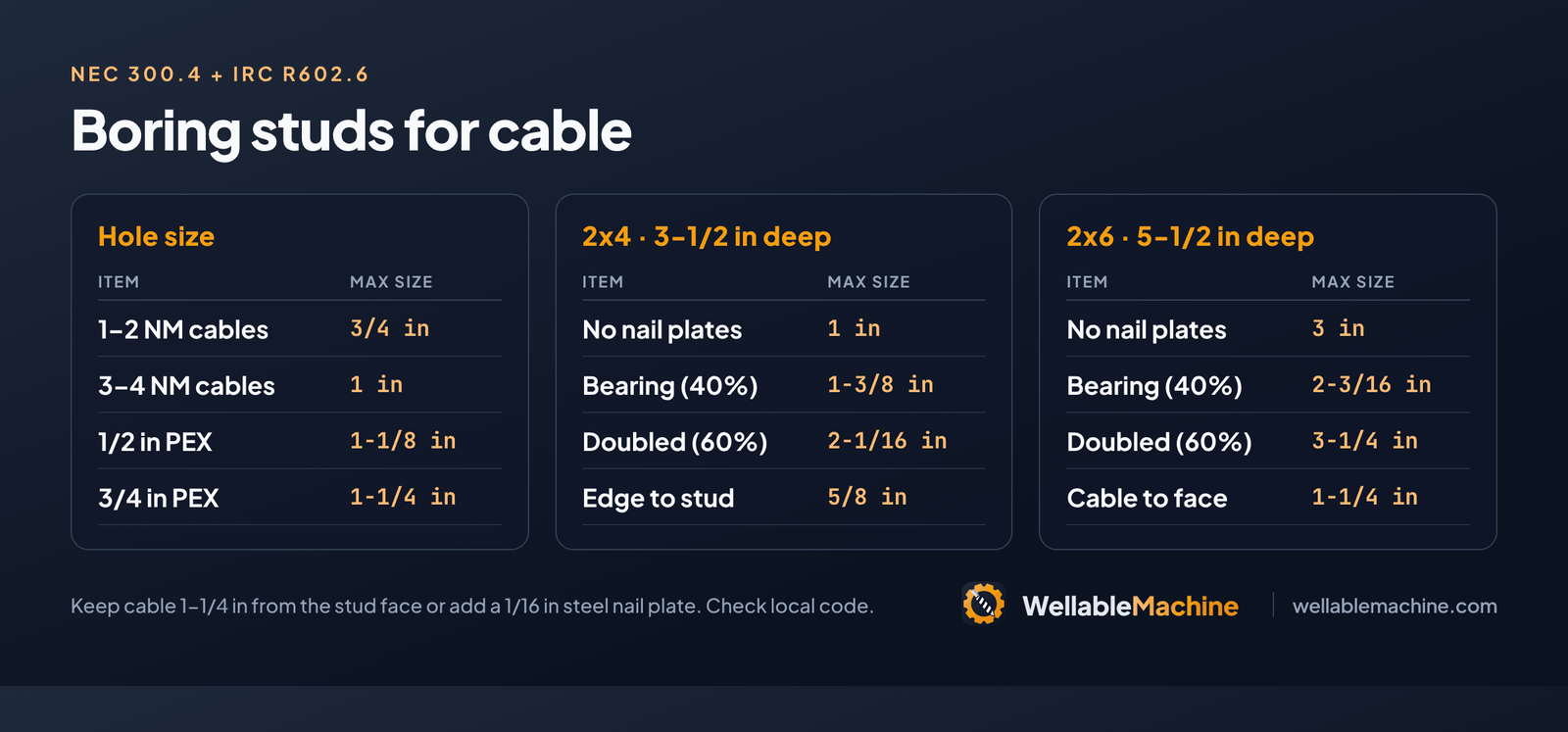
The U.S. National Electrical Code (NFPA 70) section 300.4(A)(1) says that where cable runs through bored holes in wood framing, the edge of the hole must be at least 1-1/4 in from the nearest edge of the stud. If it can’t be, a steel plate or sleeve at least 1/16 in thick must cover the stud face where the cable passes. The aim is simple: a 1-1/4 in drywall screw or a nail for a picture hook can’t reach the wire.
For a standard 2×4, which is actually 3-1/2 in deep, that leaves exactly 1 in in the middle (3-1/2 − 1-1/4 − 1-1/4). So a centered hole up to 1 in needs no nail plates. Bigger holes, or holes off center, need plates on one or both faces. In a 2×6 (5-1/2 in deep), the safe zone is 3 in wide, but the building code limits below apply first.
Rule 2: Don’t Weaken the Stud (IRC R602.6)
For houses in most of the U.S., the International Residential Code section R602.6 controls holes in studs:
- Bearing and exterior walls: a bored hole may be up to 40% of the stud width. Up to 60% is allowed if the stud is doubled, and no more than two doubled studs in a row are bored that large.
- Non-bearing partitions: holes may be up to 60% of the stud width.
- Edge distance: the edge of the hole must be at least 5/8 in from the edge of the stud.
- No notch and hole together: a hole may not be in the same section of stud as a cut or notch.
| Stud | Actual width | Max hole, bearing wall (40%) | Max hole, doubled or non-bearing (60%) | Max centered hole without nail plates (NEC) |
|---|---|---|---|---|
| 2×4 | 3-1/2 in | 1-3/8 in | 2-1/16 in | 1 in |
| 2×6 | 5-1/2 in | 2-3/16 in | 3-1/4 in | 3 in |
In practice the electrical rule is usually the tighter one in a 2×4, which is why most electricians stop at 3/4 to 1 in holes. Plumbers drilling 1-1/4 in or larger holes for drains need nail plates on both faces, and in bearing walls they should stay within the 40% limit unless the stud is doubled.
Top Plates, Joists and Engineered Lumber
- Top and bottom plates: drill through the center. If a hole or notch removes more than half the width of a top plate in a bearing wall, the IRC (R602.6.1) calls for a steel strap across the cut. Holes through top plates between floors or into the attic must be sealed with fire-rated caulk or foam as fireblocking.
- Solid joists and rafters (IRC R502.8): holes may be up to 1/3 of the joist depth, at least 2 in from the top and bottom edges and at least 2 in from other holes. Keep them away from the ends, where the joist carries most shear.
- I-joists, LVL and trusses: never drill flanges or truss chords. Use the knockouts or the maker’s hole chart for the web.
- Metal studs: run cable through the punched openings and fit plastic grommets or bushings to protect the cable from sharp edges.
How to Drill Holes Through Studs
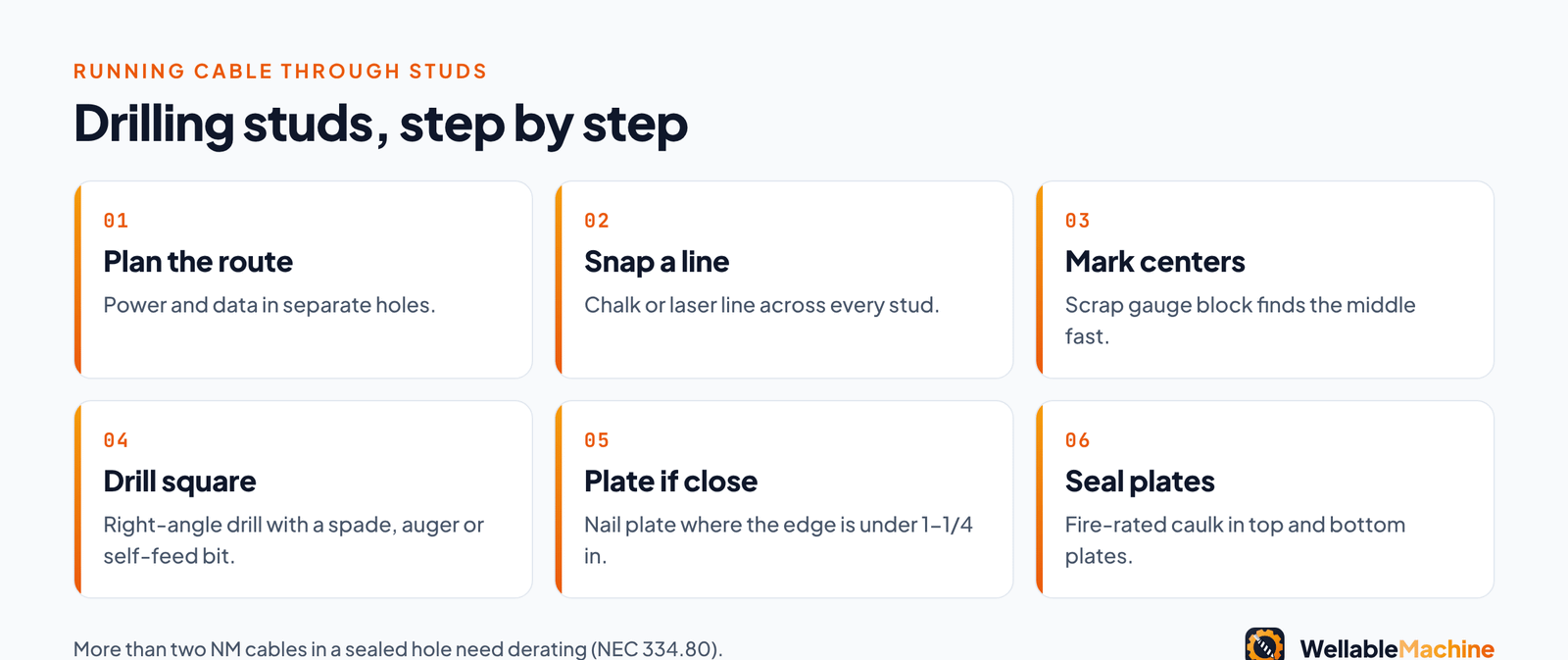
- Plan the route. Decide where each cable goes, and keep power and data in separate holes, or at least a few inches apart, to reduce interference.
- Snap a line. Mark a level line across all the studs with a chalk line or laser. Holes in line make pulling cable much easier.
- Mark the center of each stud on the line. A simple scrap block cut to the stud depth with a hole in the middle works as a quick gauge.
- Drill square and centered. Use a spade bit, auger bit or self-feed bit. Keep the drill level along the run. A right-angle drill or attachment is the best tool between studs on 16 in centers.
- Clean the holes of splinters so they don’t scrape the cable jacket.
- Fit nail plates wherever a hole edge is closer than 1-1/4 in to the face.
- Pull the cable without twisting or kinking it, and leave a little slack at each box.
- Seal holes through plates and fire-rated walls with fire-rated caulk or foam.
Which Bit Is Best?
| Bit | Pros | Cons |
|---|---|---|
| Spade bit | Cheap, fits any drill, fast in clean framing | Wanders, rough exit, ruined by nails |
| Ship auger / nail-eating auger | Self-feeds, clears chips, straight through several studs | Grabs hard; needs a strong drill and side handle |
| Self-feed bit | Very fast for 1 in and larger holes | Higher cost; needs a powerful low-speed drill |
| Hole saw | Clean holes in large sizes | Slow in thick framing; plug must be cleared |
| Flexible installer bit | Reaches through plates from an outlet hole in finished walls | Small holes only; slow |
For a closer look at spade bits and how to stop them splintering, see our spade bits guide. For larger plumbing holes, the hole saw size chart lists sizes for pipe. If your drill struggles with 1 in or larger bits, its chuck and gearing may be the limit; see drill chuck sizes and impact driver vs drill.
How Many Cables Fit in One Hole?
Physically, a 3/4 in hole will take three flat 14/2 or 12/2 NM cables, and a 1 in hole will take four or five. The limit is often heat, not space. NEC 334.80 says that when more than two NM cables pass through the same opening in wood framing and that opening is sealed with thermal insulation, caulk or foam, the conductors’ ampacity must be adjusted (derated). Unsealed holes in ordinary studs don’t trigger this, but holes through top plates that are fire-caulked do. The easy answer is to drill a second hole rather than packing one.
Running Wires in Finished Walls
In an existing house you can’t bore every stud from the side. Common methods are:
- Flexible drill bits (installer bits 36–72 in long) fed through an outlet or switch hole to drill up through the top plate or down through the bottom plate.
- Drilling through the baseboard line: remove the baseboard, cut a strip of drywall behind it, drill the studs, run the cable, and cover the slot with the baseboard. Add nail plates, because the baseboard nails go right there.
- Using the attic or basement to run cable along the joists, dropping into each stud bay through the plates.
Safety
- Turn off the circuit and check with a tester before drilling near existing wiring.
- Large bits can twist a drill hard if they catch on a knot or nail. Use the side handle and a low gear, and keep your body out of the swing path.
- Check for water, gas and drain lines before boring, especially near kitchens and bathrooms.
- Wear eye protection; drilling overhead through plates throws chips down.
Frequently Asked Questions
6 quick answers from our editors
01What size hole do I drill in a stud for Romex?
A 3/4 in hole for one to three cables, centered in the stud.
02How far from the edge of a stud must a wire be?
The edge of the hole must be at least 1-1/4 in from the face of the stud, or protected with a 1/16 in steel plate.
03What is the largest hole I can drill in a 2×4 stud?
1-3/8 in (40%) in a bearing wall, 2-1/16 in (60%) in a non-bearing wall or doubled stud. Holes over 1 in need nail plates for cable.
04Do I need nail plates for a 3/4 in hole in a 2×4?
Not if the hole is centered: its edges are 1-3/8 in from each face.
05Can power and data cables share a hole?
It is allowed in many cases, but separate holes a few inches apart reduce interference and make future changes easier.
06What is the best bit for drilling studs?
A spade bit for occasional jobs, and a nail-eating auger or self-feed bit with a right-angle drill for many holes.
Bottom Line
Drill a 3/4 in hole in the center of the stud for most cable runs, go to 7/8–1 in for more cables, and keep every hole edge 1-1/4 in from the face or add a steel nail plate. Stay within 40% of the stud width in bearing walls (60% if doubled), line the holes up with a chalk line, seal holes through plates, and drill a second hole instead of packing too many cables into one.