Toggle Bolt Hole Size Chart (Spring and Strap Toggles)
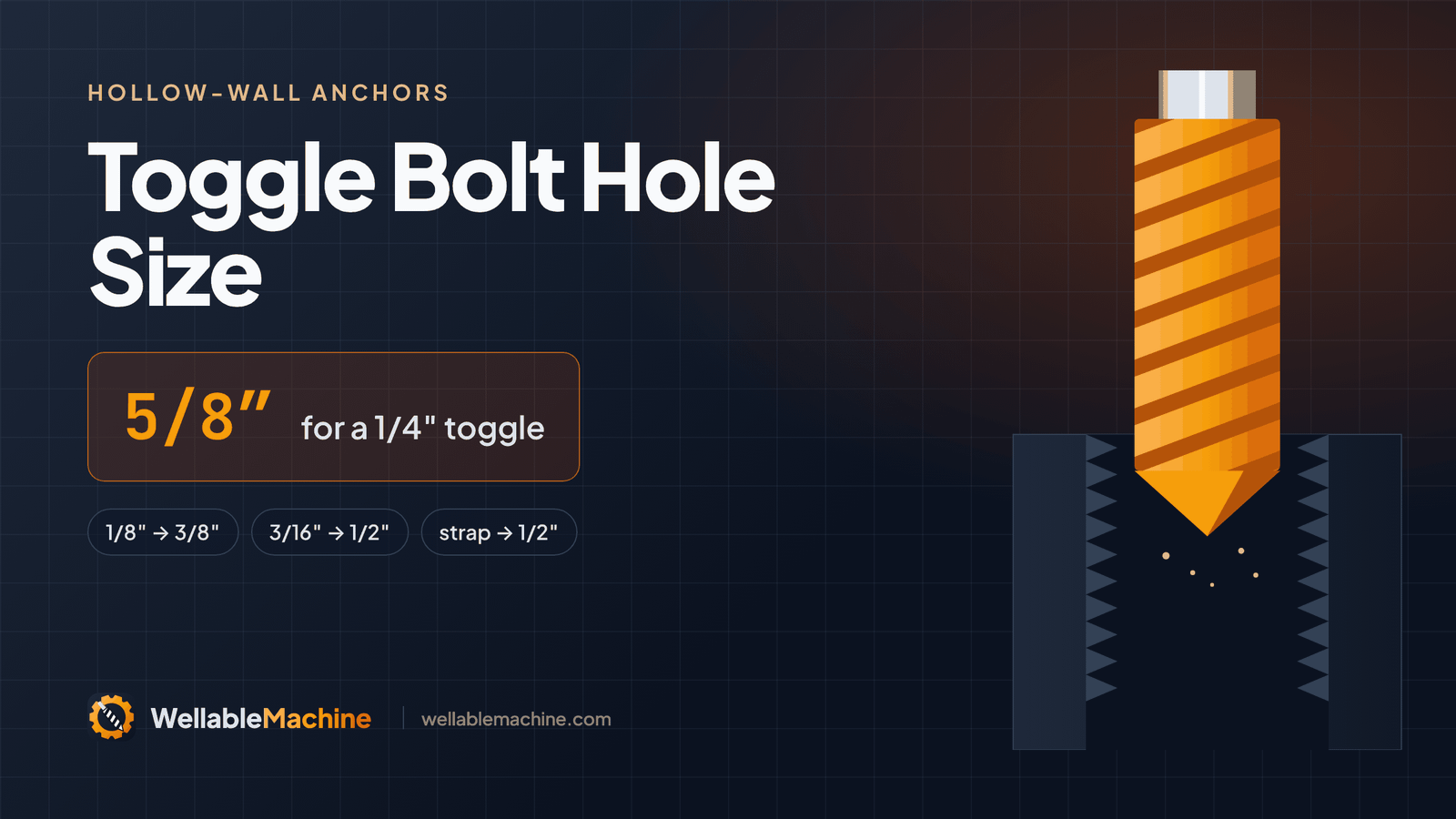
Quick answer: spring-wing toggle bolts need a hole much bigger than the bolt, because the folded wings have to pass through it. Typical sizes: 3/8 in hole for a 1/8 in toggle, 1/2 in for 3/16 in, 5/8 in for 1/4 in and 7/8 in for 5/16 in and 3/8 in. Strap (snap) toggles for 3/16 in and 1/4-20 bolts use a 1/2 in hole. Hole sizes vary a little between brands, so check the package before you drill.
Toggle bolts are one of the strongest ways to hang something on drywall, plaster or hollow block, because the load is spread across a wide wing or channel behind the wall rather than gripping the wallboard edge. But they are also the fastener most often installed in the wrong size hole. Too small and the wings won’t go through; too big and the toggle can pull back out, or the washer won’t cover the hole. Here is how to size, drill and install them correctly.
Toggle Bolt Hole Size Chart
| Toggle size | Bolt thread | Drill hole | Wing span (open) | Typical uses |
|---|---|---|---|---|
| 1/8 in | 6-32 | 3/8 in | about 1-3/8 in | Small shelves, mirrors, picture rails |
| 3/16 in | 10-24 | 1/2 in | about 1-7/8 in | Towel bars, curtain rods, coat hooks |
| 1/4 in | 1/4-20 | 5/8 in | about 2-1/16 in | Shelf standards, cabinets, grab-bar backing (with blocking) |
| 5/16 in | 5/16-18 | 7/8 in | about 2-3/4 in | Heavy brackets, hollow block |
| 3/8 in | 3/8-16 | 7/8 in | about 2-7/8 in | Heavy duty in block and ceilings |
| Strap toggle, 3/16 in or 1/4-20 | 10-24 / 1/4-20 | 1/2 in | Channel about 2-1/2 in | TVs (light mounts), shelves, cabinets |
| Plastic winged toggle | Screw #8–#10 | 5/16–3/8 in (check pack) | Varies | Light to medium loads in drywall |

A few makers specify 3/4 in for 1/4 in spring toggles and 1 in for the largest sizes. If the package and this chart disagree, follow the package. The wing span matters too: the wings need a clear space behind the wall at least as wide as the span, so check for pipes, studs and wiring before you drill.
Why Toggle Bolts Need Such a Big Hole
A spring toggle is a machine bolt with a pair of spring-loaded wings on a nut. To install it, you fold the wings flat against the bolt and push them through the wall. The hole has to clear the folded wings, not the bolt, which is why a 1/4 in bolt needs a 5/8 in hole. Once through, the spring opens the wings, and tightening the bolt pulls them against the back of the wall.
A strap toggle works differently. A flat metal channel on a plastic strap is fed through the hole sideways, pulled tight against the back of the wall, and then the bolt threads into the channel. Because the channel slides through edge-on, a 1/2 in hole is enough even for a 1/4-20 bolt, and the hole is completely covered by the bolt head and fixture.
How to Choose the Bolt Length
Bolt length = fixture thickness + wall thickness + room for the wings to open. For spring toggles, the wings need about 1 in of extra length beyond the back of the wall to swing open.
- Thin bracket on 1/2 in drywall: 1/8 + 1/2 + 1 in = at least 1-5/8 in, so a 2 in toggle.
- 3/4 in shelf cleat on 1/2 in drywall: 3/4 + 1/2 + 1 in = 2-1/4 in, so a 3 in toggle.
- Hollow block (1-1/4 in face shell): fixture + 1-1/4 + 1 in, so usually a 4 in toggle.
- Plaster and lath (about 7/8 in): add the full plaster thickness; a 3 in or 4 in toggle is typical.
Too long is better than too short. A long toggle simply sits deeper in the cavity, but a short one won’t let the wings open. Long bolts can be trimmed with a bolt cutter after installation if they’d hit something in the wall.
Choosing a Drill Bit for the Hole
| Wall material | Bit | Tips |
|---|---|---|
| Drywall | Twist drill or spade bit | Drill straight; drywall is easy to oversize by wobbling |
| Plaster and lath | Carbide masonry bit, then twist drill | No hammer mode; tape the surface to reduce cracking |
| Hollow concrete block | Carbide masonry bit | Hammer mode only until through the face shell |
| Hollow-core door | Brad point or twist drill | Use the smallest toggle that works; the skin is thin |
| Ceramic tile on drywall | Carbide spear or diamond bit | Slow speed, water cooling; see how to drill through tile |
For holes from 1/2 in up, a spade bit or step bit makes a cleaner hole in drywall than a large twist drill, which tends to grab and tear the paper face. Our guide on how to use a step drill bit shows the technique, and the screw size chart helps if you need to match a machine screw to a toggle you already have.
How to Install a Spring Toggle Bolt

- Check the wall. Use a stud finder and look for pipes and cables. If there’s a stud where you want to hang something, screw into the stud instead.
- Mark and drill the hole size for your toggle, straight and clean.
- Put the bolt through the fixture first. This is the step everyone forgets. Once the toggle is inside the wall, you can’t add the bracket without losing the wings.
- Thread the wings on a few turns, with the flat side of the wings facing the bolt head.
- Fold the wings and push them through the hole. You’ll hear or feel them spring open inside the wall.
- Pull back on the fixture so the wings bite against the back of the wall, and tighten the bolt with a screwdriver until snug. Don’t overtighten; the wings will crush into soft drywall.
How to Install a Strap Toggle
- Drill a 1/2 in hole (or the size on the package).
- Fold the metal channel flat against the straps and slide it through the hole.
- Pull the straps toward you so the channel sits flat against the back of the wall.
- Slide the plastic cap along the straps until it sits flush in the hole, then snap off the straps at the wall.
- Put your fixture over the hole and tighten the bolt into the channel.
Strap toggles have one big advantage: you can remove and reinstall the bolt without losing the anchor, which makes them easier for things that may come off the wall later.
How Much Weight Can a Toggle Bolt Hold?
Holding power depends on toggle size, wall material, wall thickness and whether the load pulls straight down (shear) or straight out (tension). As a general guide, toggles hold far more than plastic anchors in the same wall, and strap toggles usually hold more than spring toggles of the same size because the channel spreads the load further.
- Check the rated load on the package. Many manufacturers list ultimate loads; a common rule is to use no more than about one quarter of that figure.
- Drywall is the weak link. In 1/2 in drywall, the board itself often breaks before the toggle fails, so a bigger toggle doesn’t always mean more capacity.
- Use several toggles spaced apart for heavy items, and screw into studs wherever possible.
- Don’t use toggles for things that carry people, such as grab bars, unless the maker approves it for that use. Grab bars should go into blocking or studs.
The wall anchor drill bit size chart compares toggles with plastic plugs, self-drilling anchors and mollies. For masonry, see our sleeve anchor size chart.
Toggle Bolts in Ceilings
Toggles are one of the few anchors suitable for ceiling drywall, because the wings spread a hanging load across the board. Use them for light fixtures, plant hooks and curtain tracks. Don’t hang ceiling fans from toggle bolts; fans need a fan-rated electrical box fixed to the framing, as required by electrical codes.
Common Toggle Bolt Mistakes
| Mistake | What happens | Fix |
|---|---|---|
| Hole drilled to bolt size | Wings won’t go in | Drill to the toggle hole size on the package |
| Hole far too big | Toggle head or washer falls into the wall | Use a bigger toggle, a fender washer or patch and re-drill |
| Bracket not on the bolt first | Toggle is inside the wall without the fixture | Push the wings off into the wall and use a new toggle |
| Bolt too short | Wings can’t open | Use a longer bolt |
| Overtightened | Drywall crushes, toggle spins | Tighten only until snug; pull outward while tightening |
| Wings hit a stud or pipe | Toggle won’t open | Move over and patch the first hole |
Removing a Toggle Bolt
Unscrew the bolt completely. With a spring toggle, the wings drop into the wall cavity and stay there. With a strap toggle, you can leave the channel in the wall and reuse it, or push it through. Patch the hole with spackle for small holes or a self-adhesive mesh patch for 5/8 in and larger, then sand and paint.
Frequently Asked Questions
7 quick answers from our editors
01What size hole for a 1/4 toggle bolt?
Usually 5/8 in for a spring-wing toggle; some brands specify 3/4 in. A 1/4-20 strap toggle needs only a 1/2 in hole.
02What size hole for a 3/16 toggle bolt?
1/2 in for a spring toggle.
03What size hole for a 1/8 toggle bolt?
3/8 in.
04Why is the toggle hole so much bigger than the bolt?
The folded wings have to pass through the hole, and they are much wider than the bolt.
05Can I reuse a toggle bolt?
The bolt, yes. The spring wings fall inside the wall when you remove it, so you’ll need new wings. Strap toggles can be reused in the same hole.
06Are toggle bolts stronger than plastic anchors?
Yes, much stronger in drywall and plaster, because they spread the load behind the wall.
07Can I use toggle bolts in concrete block?
Yes. In hollow block, drill through the face shell into the cavity and use a long enough toggle. Sleeve anchors are better in solid or grout-filled block.
Bottom Line
Size the hole for the folded wings, not the bolt: 3/8 in for 1/8 in toggles, 1/2 in for 3/16 in, 5/8 in for 1/4 in and 7/8 in for 5/16 and 3/8 in, or 1/2 in for most strap toggles. Put the bolt through the fixture before the wings, choose a bolt long enough for the wings to open, and tighten only until snug. For the heaviest loads, screw into studs or use several toggles.