Self-Tapping Screw Drill Size: Pilot Hole Chart for Metal and Plastic
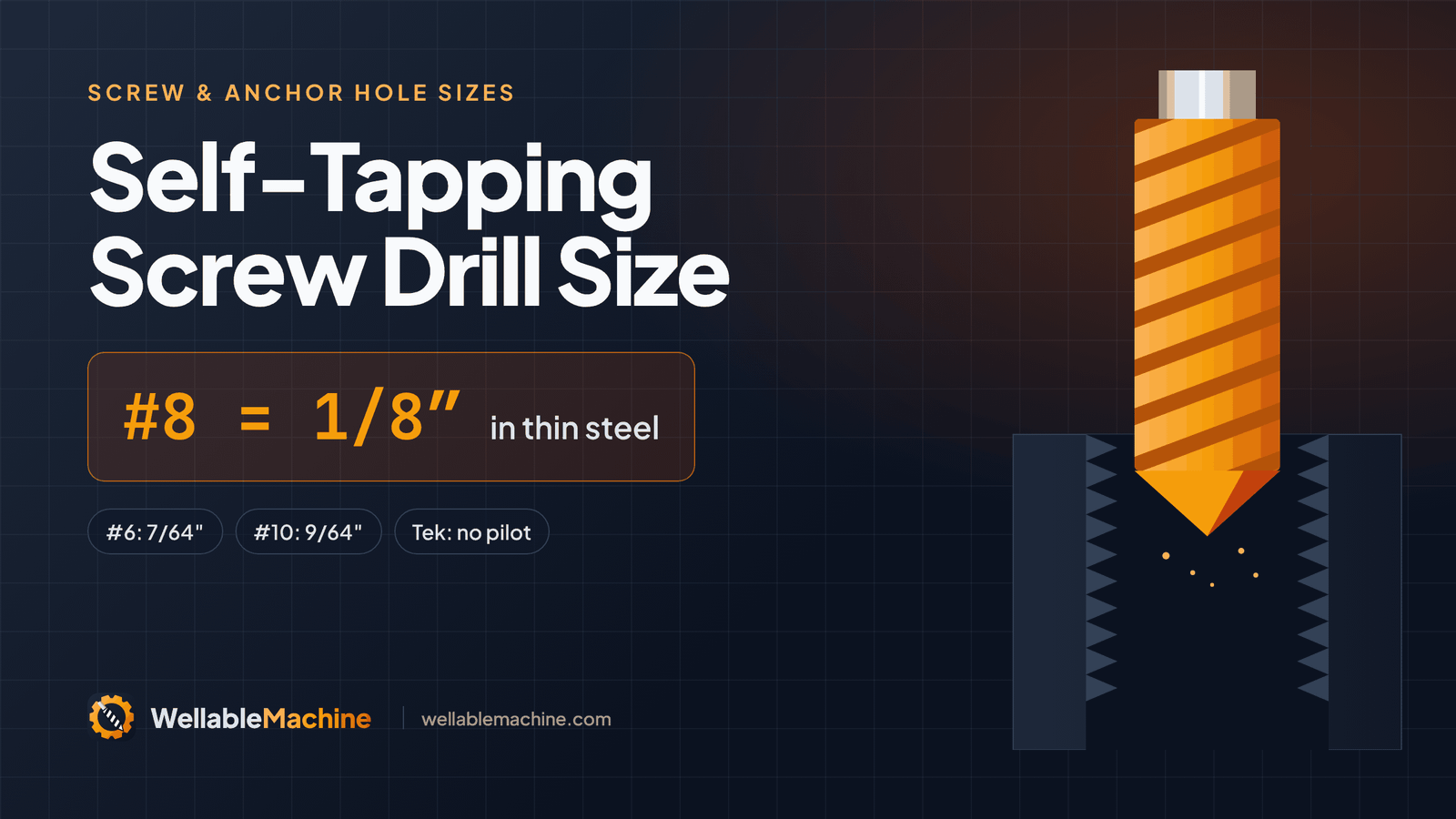
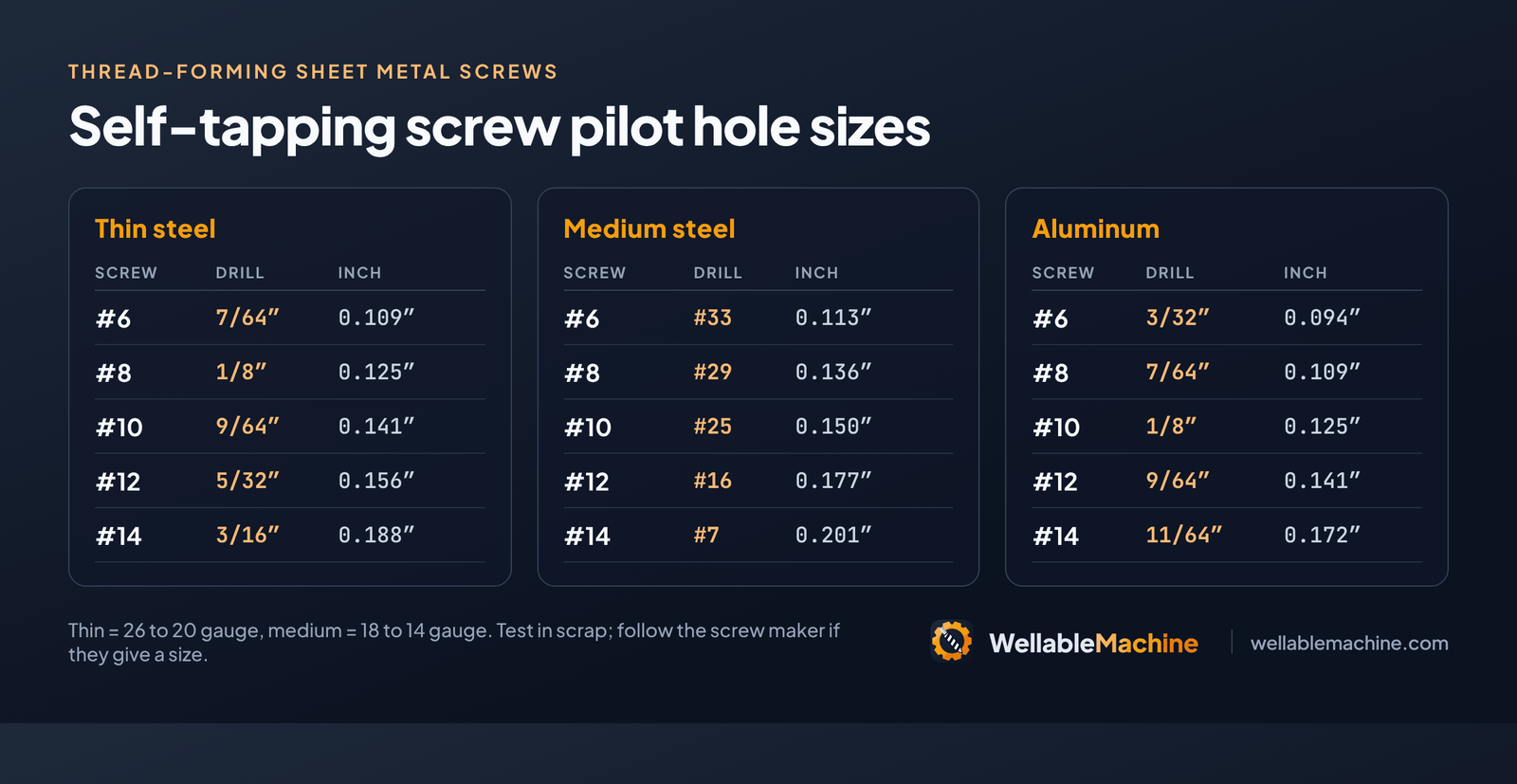
Quick answer: for a self-tapping (thread-forming) sheet metal screw, drill a pilot hole about the size of the screw’s minor diameter, slightly smaller in thin or soft metal. Typical sizes in mild steel sheet: #6 screw: 7/64 in, #8: 1/8 in, #10: 9/64 in, #12: 5/32 in and #14 (1/4 in): 3/16 in. Go one drill size larger in thick or hard metal, and one size smaller in aluminum or very thin sheet. Self-drilling screws (Tek screws) don’t need a pilot hole at all.
“Self-tapping” is used for several different screws, and each wants a different hole. Pick the wrong size and the screw either strips out, snaps, or never bites. This guide explains the types, gives you pilot hole charts for steel, aluminum and plastic, shows how to choose a self-drilling screw by metal thickness, and covers the mistakes that cause stripped holes.
Self-Tapping vs Self-Drilling Screws
- Self-tapping (thread-forming) screws make their own thread, but they need a pilot hole. Common types are sheet metal screws (Type A and AB, with a sharp point) and blunt-point Type B screws for thicker metal. They push metal aside rather than cutting it, so there are no chips.
- Thread-cutting screws (Type 23, Type 25, Type F) have a cutting slot at the tip, like a tap. They’re used in harder or brittle materials such as cast metal and some plastics, where forming would crack the part. They also need a pilot hole.
- Self-drilling screws (Tek screws) have a drill point that makes the hole and then taps it in one pass. They need no pilot, but the drill point must match the metal thickness.
Thread-forming screws hold best because the displaced metal work-hardens around the thread. You can see more on the families in this overview of self-tapping screws.
Self-Tapping Screw Pilot Hole Chart (Inch Sizes)
| Screw | Major dia. | Thin steel (26–20 ga) | Medium steel (18–14 ga) | Aluminum |
|---|---|---|---|---|
| #4 | 0.112 in | 3/32 in (0.094) | #40 (0.098) | #44 (0.086) |
| #6 | 0.138 in | 7/64 in (0.109) | #33 (0.113) | 3/32 in (0.094) |
| #8 | 0.164 in | 1/8 in (0.125) | #29 (0.136) | 7/64 in (0.109) |
| #10 | 0.190 in | 9/64 in (0.141) | #25 (0.150) | 1/8 in (0.125) |
| #12 | 0.216 in | 5/32 in (0.156) | #16 (0.177) | 9/64 in (0.141) |
| #14 / 1/4 in | 0.242–0.250 in | 3/16 in (0.188) | #7 (0.201) | 11/64 in (0.172) |
These are starting points that work for most Type A and AB sheet metal screws. Thread form and point style vary by maker, so if the box or the maker’s catalog gives a hole size, use that. A quick test hole in scrap of the same thickness is the best check of all.
Metric Self-Tapping Screws (ST Sizes)
Metric self-tapping screws are sold by ST size under ISO 1478. They’re close to the inch numbers, but not identical:
| Metric size | Nearest inch size | Pilot in steel sheet | Pilot in aluminum |
|---|---|---|---|
| ST2.9 | #4 | 2.2–2.4 mm | 2.1 mm |
| ST3.5 | #6 | 2.7–2.9 mm | 2.5 mm |
| ST4.2 | #8 | 3.2–3.5 mm | 3.0 mm |
| ST4.8 | #10 | 3.7–4.0 mm | 3.5 mm |
| ST5.5 | #12 | 4.3–4.6 mm | 4.0 mm |
| ST6.3 | #14 | 4.9–5.2 mm | 4.6 mm |
Use the lower figure for thin sheet and the higher one as the metal gets thicker or harder.
How Metal Thickness Changes the Hole
A thread-forming screw has to push metal out of the way. In thin sheet, there’s very little metal to grip, so a tighter hole gives the screw more to bite into. In thick sheet, the screw meets far more resistance, and a tight hole can make it bind, overheat or snap before it’s fully driven. The rule of thumb:
- Under about 0.036 in (20 gauge): use the smallest size in the chart, or even pierce the hole with a punch, which leaves a small collar that gives extra thread.
- 0.036–0.075 in (20 to 14 gauge): use the medium-steel column.
- Over about 0.075 in: switch to a Type B (blunt) or thread-cutting screw, and use a hole close to the screw’s minor diameter. Over about 3/16 in, a machine screw in a tapped hole is usually better.
| Sheet gauge | Steel thickness | Typical use |
|---|---|---|
| 26 ga | 0.018 in (0.45 mm) | Ductwork, flashing |
| 22 ga | 0.030 in (0.76 mm) | HVAC, appliance panels |
| 20 ga | 0.036 in (0.91 mm) | Light studs, enclosures |
| 18 ga | 0.048 in (1.2 mm) | Electrical boxes, brackets |
| 16 ga | 0.060 in (1.5 mm) | Structural studs, trailers |
| 14 ga | 0.075 in (1.9 mm) | Heavy brackets, frames |
Self-Drilling (Tek) Screws: Choosing the Drill Point
A self-drilling screw doesn’t need a pilot, but its drill point has a limit. The flute must be long enough to clear the full thickness of the metal before the threads engage; otherwise the threads start pulling while the point is still cutting, and the screw snaps or strips. Points are numbered #1 to #5:
| Drill point | Approx. total steel thickness | Typical job |
|---|---|---|
| #2 | up to about 0.100 in (2.5 mm) | Light sheet, metal studs |
| #3 | about 0.036–0.175 in (1–4.4 mm) | General sheet metal, roofing |
| #4 | about 0.175–0.250 in (4.4–6.3 mm) | Light structural steel |
| #5 | about 0.250–0.500 in (6.3–12.7 mm) | Purlins, heavy steel |
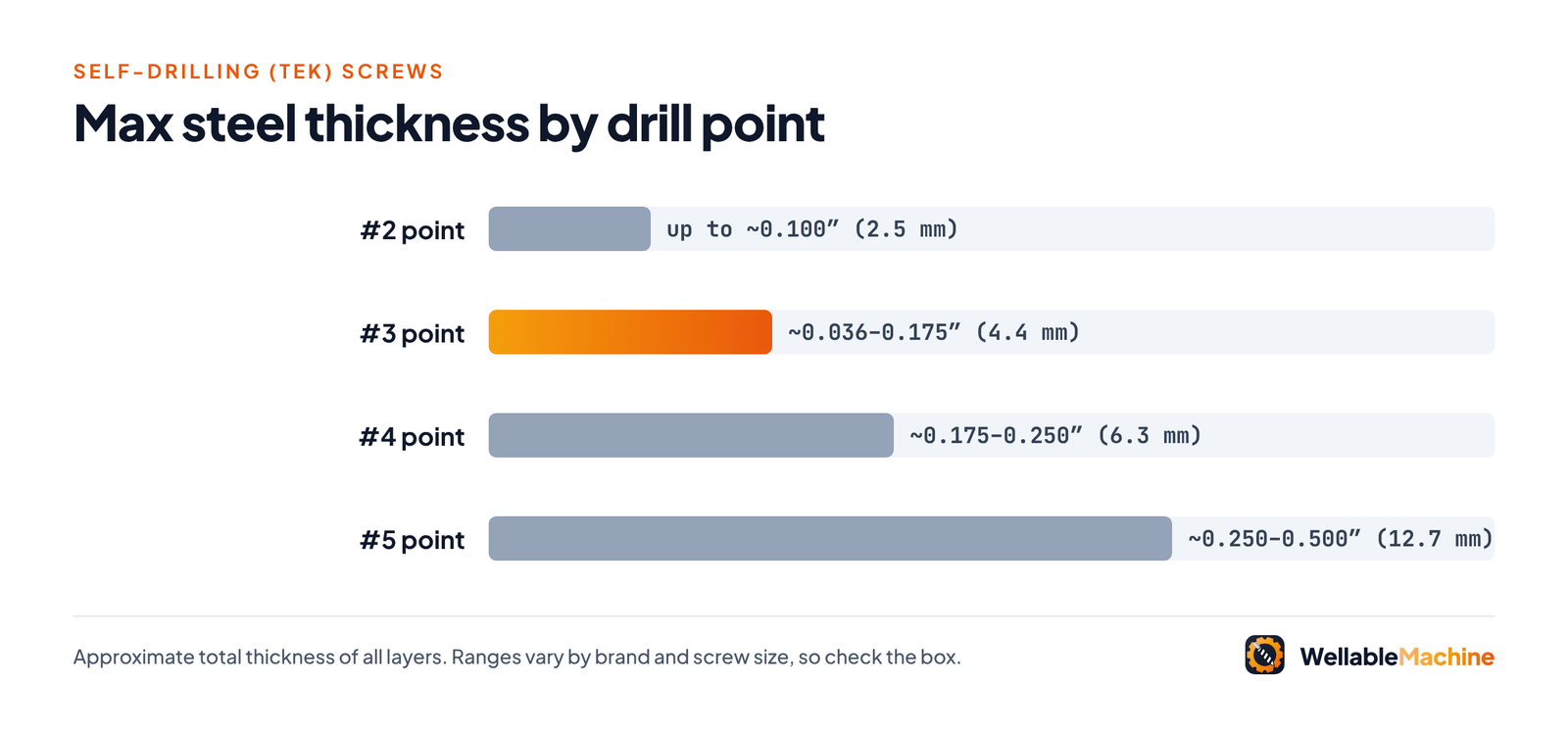
Ranges vary by brand and screw diameter, so check the box. Count the total thickness of all the layers being joined. When fastening wood to steel, use a winged Tek screw: the wings ream a clearance hole in the wood and then snap off when they reach the steel.
Self-Tapping Screws in Plastic
Plastic needs screws made for it (often called PT, Plastite or Type B screws for plastic) and a hole about 80–85% of the screw’s major diameter. Soft plastics like polyethylene and polypropylene can go tighter; brittle ones like acrylic and polystyrene need a larger hole or a thread-cutting screw, or they will crack. For acrylic, see how to drill acrylic.
- #6 in ABS: about 7/64 in (2.8 mm)
- #8 in ABS: about 1/8–9/64 in (3.2–3.5 mm)
- #10 in ABS: about 5/32 in (4.0 mm)
In molded bosses, the boss outer diameter should be about 2 to 2.5 times the screw diameter, and the hole should be deeper than the screw so the tip doesn’t bottom.
How to Drill and Drive a Self-Tapping Screw
- Mark and center punch the spot so the bit doesn’t skate across bare sheet.
- Clamp thin sheet to a backing board. Thin metal grabs a bit on breakthrough and spins.
- Drill at moderate speed: about 1,500–2,500 RPM for 1/8 in in mild steel. A sharp HSS jobber bit is fine; use cobalt in stainless. Our drill speed chart lists other sizes.
- Clamp the parts together before driving. If the sheets separate, the screw threads lift the top sheet and it never pulls tight.
- Drive with the clutch set low and raise it until the head seats. Over-driving strips thin sheet in an instant, so test on a scrap piece first.
- Stop when the head is snug. If you feel the screw suddenly spin free, it has stripped; move up a screw size or use a rivet nut.
Common Mistakes
- Hole too big: the screw spins without biting. Move to the next screw size, or the next smaller drill in a fresh spot.
- Hole too small in thick metal: the screw heats up, binds and snaps. Drill one size larger or switch to a thread-cutting screw.
- Wrong drill point: a #3 Tek in 1/4 in steel will burn its point out before it gets through. Use a #4 or #5.
- Running a Tek screw too fast: most self-drilling screws prefer about 1,800–2,500 RPM with steady pressure. An impact driver can overheat the point in thick steel.
- Stainless screw in steel: a stainless self-drilling screw often has a softer point; use bi-metal screws with a hardened carbon steel point when drilling steel.
If a screw head rounds out or strips, read how to remove a stripped screw. For wood screws and lag screws, use our pilot hole size chart instead; the rules for wood are different.
Frequently Asked Questions
6 quick answers from our editors
01Do self-tapping screws need a pilot hole?
Yes. Thread-forming and thread-cutting self-tapping screws need a pilot. Only self-drilling (Tek) screws make their own hole.
02What size pilot hole for a #8 self-tapping screw?
About 1/8 in in thin steel sheet, a #29 drill in thicker steel, and 7/64 in in aluminum.
03What size pilot hole for a #10 self-tapping screw?
About 9/64 in in thin steel, a #25 drill in thicker steel, and 1/8 in in aluminum.
04How do I know the minor diameter of my screw?
Measure across the root of the thread with calipers, or hold drill bits behind the screw: the right bit hides the shank but leaves the threads showing.
05Can I use a self-tapping screw in wood?
Sheet metal screws work in wood and plywood, using a wood pilot hole. For wood to steel, use winged self-drilling screws.
06Why does my self-tapping screw keep stripping?
Usually the hole is too large, the sheet is too thin for the screw, or the driver is set too high. Try a tighter hole and a lower clutch setting.
Bottom Line
Drill a pilot about the size of the screw’s minor diameter: 7/64 in for #6, 1/8 in for #8, 9/64 in for #10, 5/32 in for #12 and 3/16 in for #14 in thin steel. Go a size bigger in thicker or harder metal, a size smaller in aluminum, and around 80–85% of the major diameter in plastic. For self-drilling screws, skip the pilot and match the drill point (#2 to #5) to the total metal thickness. Clamp the parts, set the clutch low and stop as soon as the head is snug.