17/64 Drill Bit: 0.2656″ (6.747 mm), Equivalents and Uses
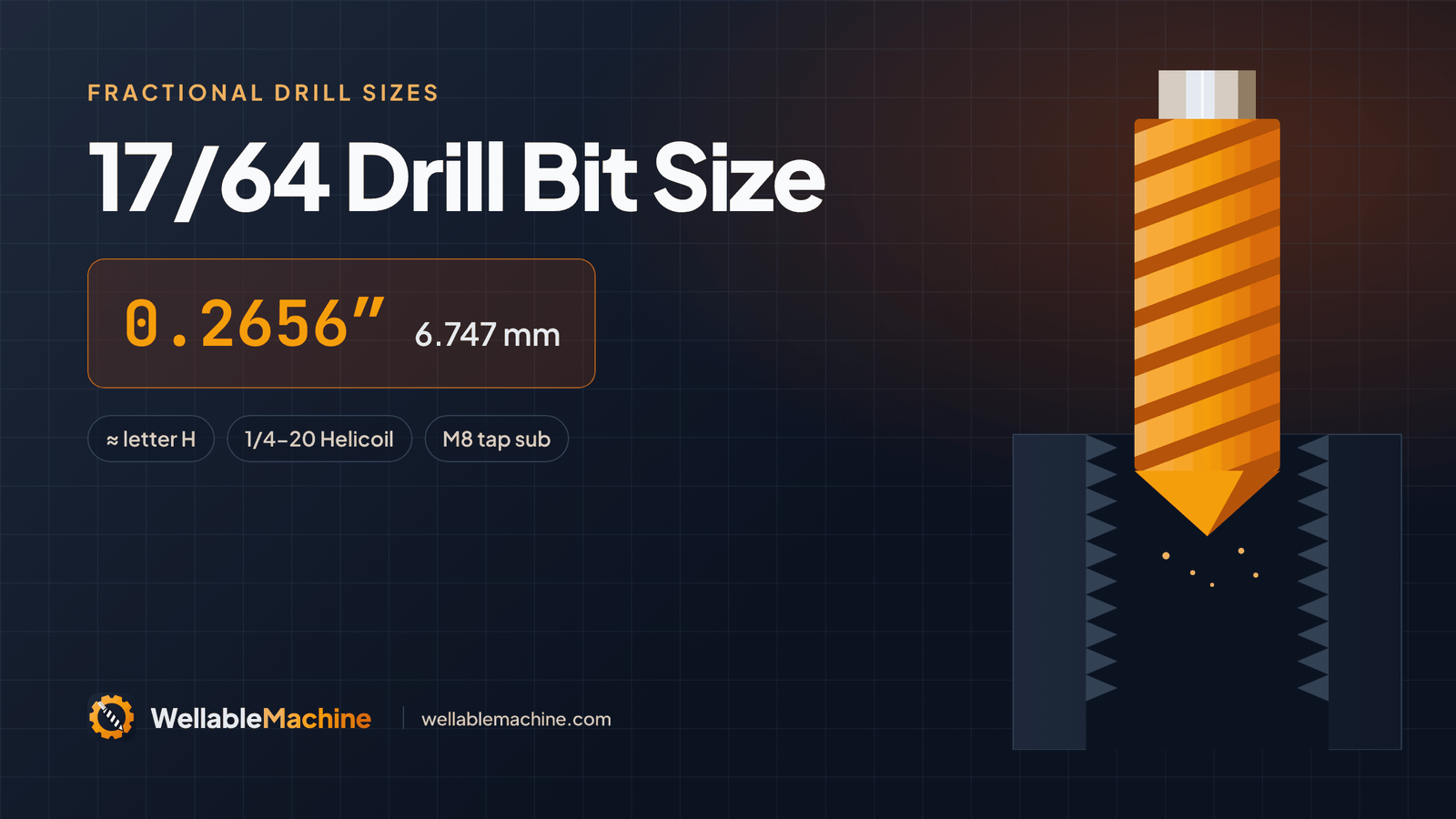
Quick answer: a 17/64 in drill bit is 0.2656 in, or 6.747 mm. That’s just over 1/4 in (by 1/64 in) and almost the same as the letter H drill (0.266 in) and a 6.75 mm metric bit. Its most common jobs are the tap drill for a 1/4-20 Helicoil (STI) insert, a free-fit clearance hole for 1/4 in bolts, and an inch substitute for the 6.8 mm drill used to tap M8 × 1.25.
17/64 in is in every standard 29-piece fractional drill set, but it’s one of the sizes people use least, until they need it. Then it turns out to be a surprisingly useful bit. This guide covers its exact size, nearby drills, what it’s good for, what to use instead, and how to drill with it.
17/64 Drill Bit at a Glance
| Measurement | Value |
|---|---|
| Fraction | 17/64 in |
| Decimal inches | 0.2656 in |
| Millimeters | 6.747 mm |
| Nearest letter drill | H (0.2660 in), +0.0004 in |
| Nearest metric drill | 6.75 mm (0.2657 in); 6.7 mm and 6.8 mm are common |
| Next fraction down / up | 1/4 in (0.250 in) / 9/32 in (0.2813 in) |
| Main uses | 1/4-20 STI tap drill, 1/4 in bolt clearance, M8 × 1.25 tap drill substitute |
To convert, multiply the fraction by 25.4: 17 ÷ 64 × 25.4 = 6.747 mm. Our fractional drill bit sizes chart lists every 64th in decimal and metric, and the drill bit sizes reference covers all the drill series side by side.
Drills Near 17/64
| Drill | Inches | mm | vs 17/64 |
|---|---|---|---|
| 1/4 in | 0.2500 | 6.350 | −0.0156 in |
| E | 0.2500 | 6.350 | −0.0156 in |
| F | 0.2570 | 6.528 | −0.0086 in |
| 6.6 mm | 0.2598 | 6.600 | −0.0058 in |
| G | 0.2610 | 6.629 | −0.0046 in |
| 6.7 mm | 0.2638 | 6.700 | −0.0018 in |
| 17/64 in | 0.2656 | 6.747 | — |
| H | 0.2660 | 6.756 | +0.0004 in |
| 6.8 mm | 0.2677 | 6.800 | +0.0021 in |
| I | 0.2720 | 6.909 | +0.0064 in |
| 9/32 in | 0.2813 | 7.144 | +0.0157 in |
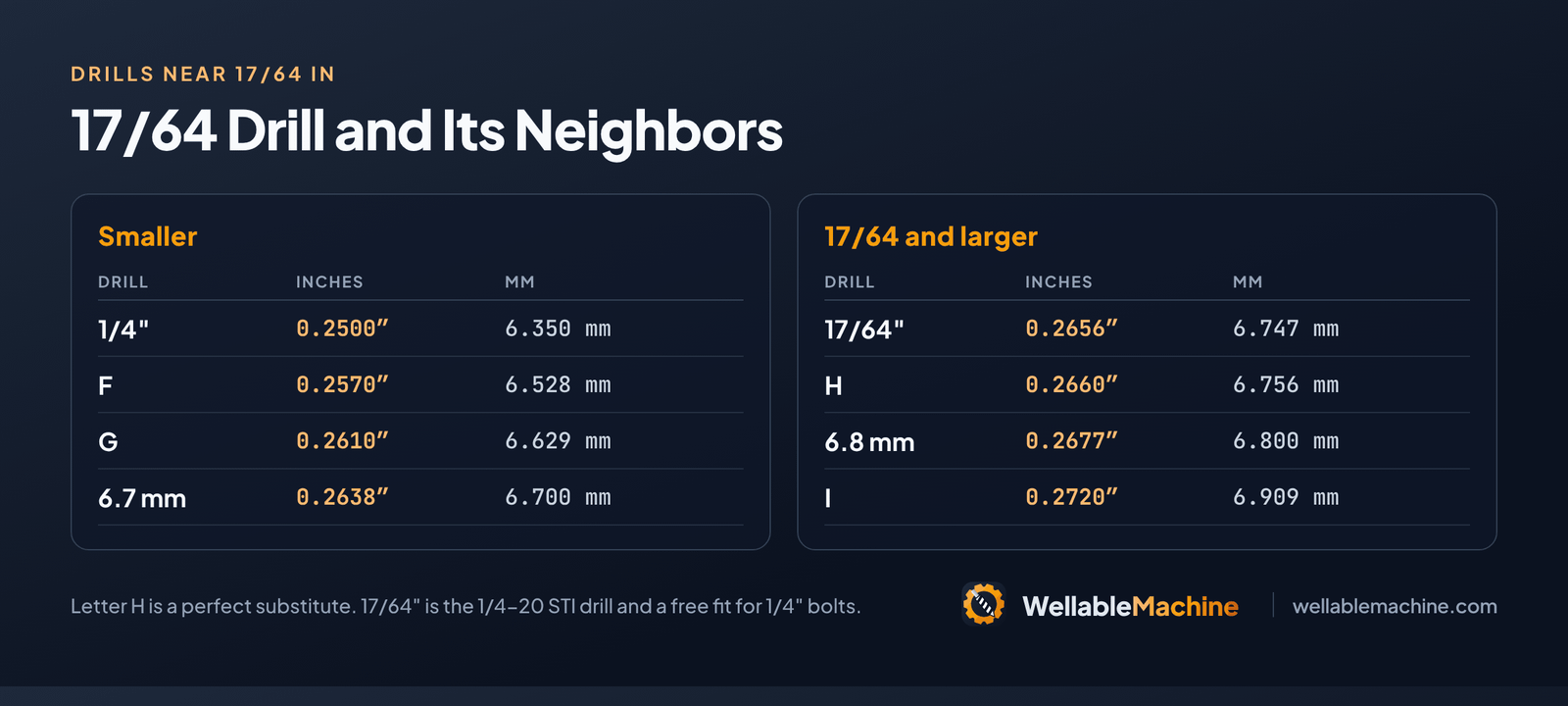
Letter drills fill the gaps between fractions above 1/4 in. The letter H is so close to 17/64 in that you can treat them as the same bit. See our number and letter drill size chart for the full list.
What Is a 17/64 Drill Bit Used For?
1. Tap drill for a 1/4-20 Helicoil (STI)
To repair a stripped 1/4-20 thread with a coil insert, you drill out the old thread with a 17/64 in bit, tap with a 1/4-20 STI tap, then install the insert. This is probably the most common reason anyone buys a single 17/64 in bit. The full chart of STI sizes is in our Helicoil tap drill size chart, and the repair itself is in how to install a Helicoil.
2. Clearance hole for 1/4 in bolts and screws
A 1/4 in bolt needs a hole slightly larger than itself to pass through. The standard close fit is a letter F (0.257 in), and the free fit is a letter H (0.266 in), which is the same as 17/64 in. A free fit lets you line up several bolts through two parts, allows for paint and plating, and makes assembly easy. See our clearance hole size chart for other sizes.
3. Substitute for the 6.8 mm M8 tap drill
Coarse M8 × 1.25 threads are normally tapped from a 6.8 mm hole. If you only have inch drills, 17/64 in is 0.05 mm smaller and gives about 77% thread instead of 74%, which is fine for steel and aluminum. Details are in our M8 tap drill size guide.
4. Looser tap drill for 5/16-18 in hard materials
The standard drill for 5/16-18 UNC is a letter F, giving about 75% thread. A 17/64 in drill gives about 65%, which makes tapping much easier in stainless steel and tough alloys while keeping most of the strength. See 5/16-18 tap drill size.
5. Lag screw pilot in medium-density wood
For a 3/8 in lag screw, the pilot is 1/4 in in softwood and 9/32 in in hardwood. 17/64 in sits between them and suits woods like Douglas fir and southern yellow pine. See lag screw pilot hole size.
6. Clearance for M6 screws
M6 needs a 6.4 mm close-fit or 6.6 mm medium-fit hole. A 17/64 in (6.75 mm) hole is between the medium and coarse (7 mm) fits, which is fine for general assembly.
Thread Percentage With a 17/64 Drill
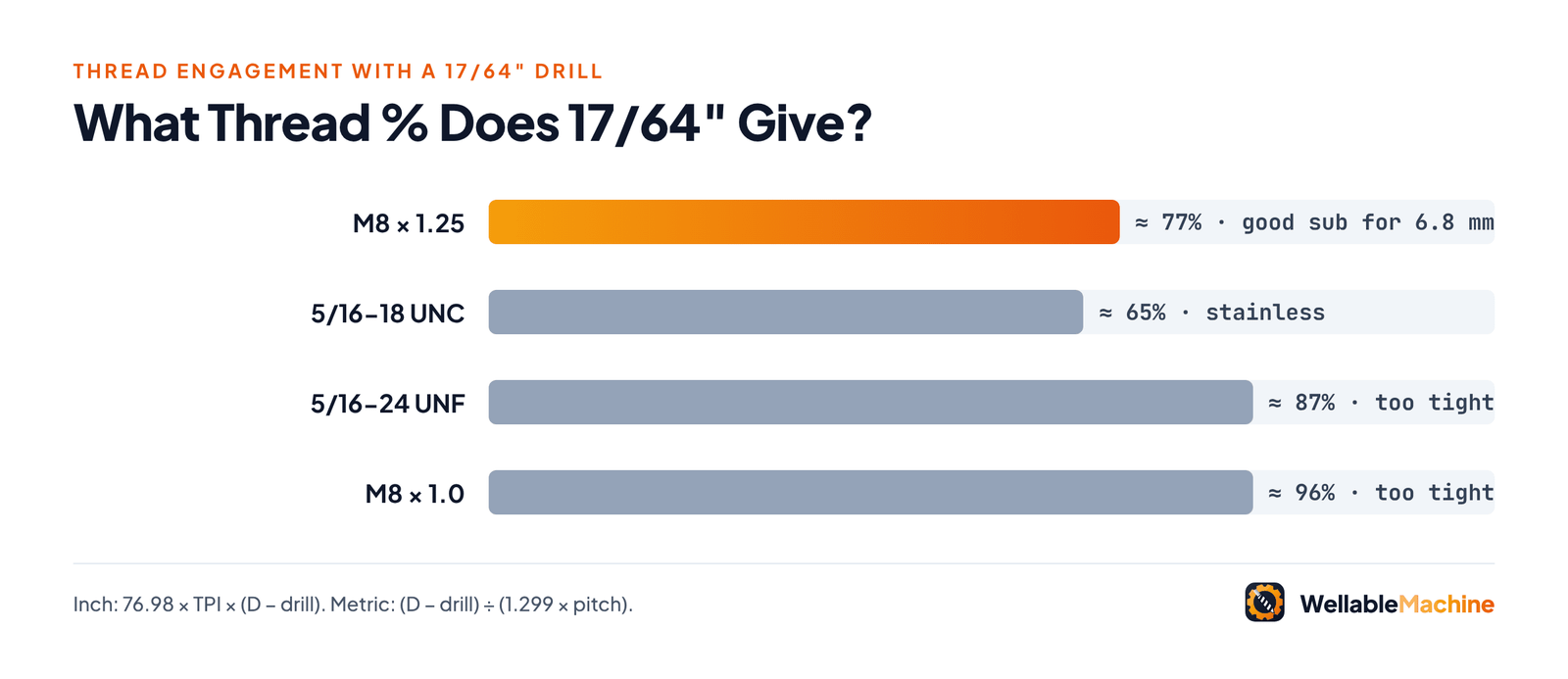
| Tap | Standard drill | Thread with 17/64 | Verdict |
|---|---|---|---|
| M8 × 1.25 | 6.8 mm (74%) | About 77% | Good substitute |
| 5/16-18 UNC | F (75%) | About 65% | Good for stainless and hand tapping |
| 5/16-24 UNF | I (75%) | About 87% | Too tight; use I |
| M8 × 1.0 | 7.0 mm (77%) | About 96% | Too tight; use 7 mm or J |
| 1/4-20 STI | 17/64 (standard) | Correct STI size | Use it |
Thread percentages use 76.98 × TPI × (major diameter − drill) for inch threads, and (D − drill) ÷ (1.299 × pitch) for metric. Our tap drill size chart lists the standard drill for every common thread.
Can You Use a Different Bit?
- Letter H: a perfect substitute, 0.0004 in larger.
- 6.75 mm or 6.8 mm: both work for clearance and M8 tapping. Use 6.75 mm for STI to stay close to spec.
- 1/4 in: too small for a 1/4 in bolt to pass through freely, and the wrong size for an STI tap.
- 9/32 in: too large for an STI hole (the insert would be loose), but fine as a loose bolt clearance.
How to Drill a Clean 17/64 Hole
- Center punch the location, or use a split-point bit.
- Pilot in steel: drill about 1/8 in first so the 17/64 in bit’s chisel edge doesn’t have to plough through solid metal.
- Use the right speed: roughly 1,400 RPM in aluminum, 850 RPM in mild steel and 430 RPM in stainless steel, with cutting oil in steel. See our drill speed chart.
- Keep it square, especially for STI holes, where an angled hole means an angled bolt.
- Chamfer the edge if you’ll tap the hole.
In wood, a 17/64 in brad point bit gives a clean hole for 1/4 in bolts, furniture connectors and dowel-like pins.
Buying a 17/64 Drill Bit
- Included in sets: every 29-piece (1/16 to 1/2 in by 64ths) set has one.
- Helicoil kits: a 1/4-20 kit usually includes a 17/64 in drill.
- Cobalt for steel repairs: STI repairs in steel parts, such as exhaust studs and brackets, go better with a cobalt bit. See HSS vs cobalt.
- Stub length for accuracy in hand drilling and for tight spaces such as engine bays.
17/64 in Wood, Plastic and Sheet Metal
In wood, 17/64 in is a useful size for 1/4 in carriage bolts and hanger bolts that need to slide through a part, for 1/4 in steel shelf pins that should drop in easily, and for T-nut shanks on some knock-down furniture. A brad point bit gives a clean entry; back the exit with scrap to stop tear-out. In plastics such as HDPE, acrylic and polycarbonate, a 17/64 in hole is a common clearance for 1/4 in hardware; slow the drill down and use a bit with a modified point for acrylic so it doesn’t crack. In thin sheet metal, twist drills this size tend to tear a triangular hole, so clamp the sheet to scrap wood, or use a step drill and stop at the nearest step.
Measuring and Identifying a 17/64 Bit
Fractional bits are marked on the shank, but the stamp wears off. Measure across the smooth shank with calipers: a 17/64 in bit reads 0.265 to 0.266 in (6.74 to 6.75 mm). A letter H bit reads 0.266 in, practically the same. A 1/4 in bit reads 0.250 in and a 9/32 in bit 0.281 in, so they’re easy to tell apart. A drill gauge, the steel plate with labelled holes, makes sorting a mixed box of loose bits much quicker. If you work with STI repairs often, mark the 17/64 in bit’s shank with a dab of paint so it never goes back in the wrong slot.
Why 17/64 Is the 1/4-20 STI Size
The coil of a Helicoil insert sits in a thread larger than the bolt it holds. For 1/4-20, that thread has a pitch of 0.050 in, and the STI tap’s minor diameter works out just above 0.265 in. A 17/64 in hole (0.2656 in) gives the STI tap the right amount of material to form a full-depth thread for the coil. A smaller 1/4 in hole would overload the tap, while a 9/32 in hole would leave shallow threads and a loose, weak insert. That is why nearly every 1/4-20 repair kit includes this exact bit, and why it’s worth replacing it with a cobalt version if you repair threads in steel often.
Drilling 17/64 Holes in Engine and Automotive Repairs
Many stripped 1/4-20 threads are in aluminum parts on cars, motorcycles and small engines: valve covers, intake parts, brackets and housings. When drilling out the old thread for an STI repair, use a drill guide or the old hole to keep the bit square, stuff rags or tape around the area to catch chips, and use a little grease on the bit flutes so chips stick to it instead of falling into the engine.
Frequently Asked Questions
7 quick answers from our editors
01What is 17/64 in decimal?
0.2656 in.
02What is 17/64 in mm?
6.747 mm.
03What is a 17/64 drill bit used for?
Mainly 1/4-20 Helicoil (STI) holes, free-fit clearance holes for 1/4 in bolts, and as a substitute for the 6.8 mm M8 tap drill.
04Is 17/64 the same as letter H?
Almost. H is 0.266 in, only 0.0004 in larger.
05Is 17/64 bigger than 1/4?
Yes, by 1/64 in (0.0156 in).
06What drill for 1/4-20 Helicoil?
17/64 in.
07Can I use 17/64 for M8?
Yes, for M8 × 1.25 it gives about 77% thread. Don’t use it for fine M8 × 1.0.
Bottom Line
A 17/64 in drill is 0.2656 in (6.747 mm), essentially the same as a letter H. Use it for 1/4-20 Helicoil holes, free-fit 1/4 in bolt clearance and as an inch substitute for the 6.8 mm M8 tap drill. Keep a cobalt one handy if you repair threads in steel.