13/64 Drill Bit: Size in mm and Decimal, Uses and Equivalents
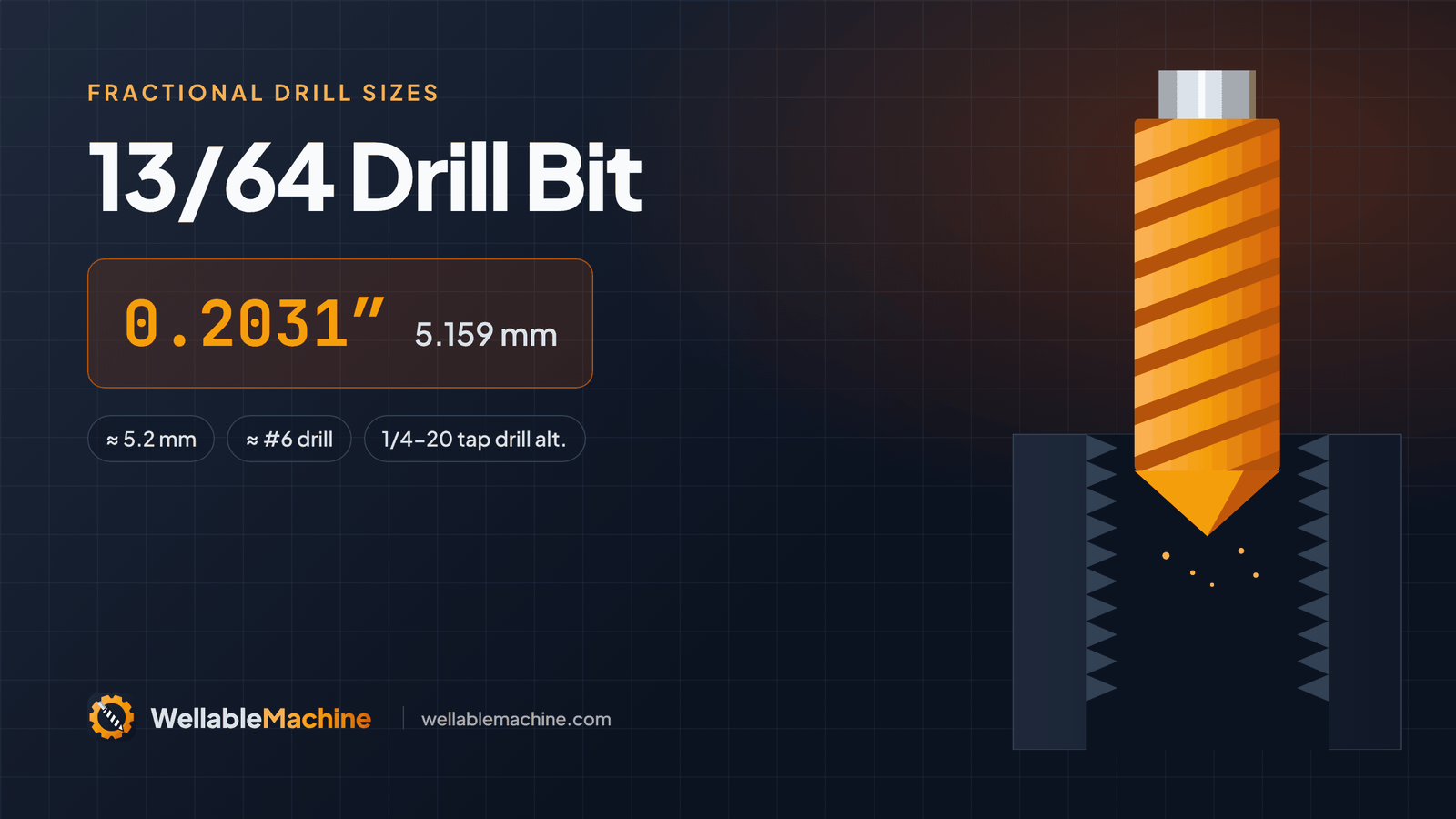
Quick answer: a 13/64 drill bit is 0.2031 in (5.159 mm). The closest metric bit is 5.2 mm (0.04 mm larger), and the closest number drill is #6 (0.2040 in). Its best-known job is as a fractional substitute for the #7 tap drill on 1/4-20, where it gives about a 72% thread. It’s also the drill for 10-24 and 10-32 thread inserts and a normal clearance hole for #10 screws.
13/64 in is one of those sizes that sits in every 29-piece drill set but rarely gets used on purpose, because most charts list a number or letter drill instead. Once you know what it’s good for, it becomes one of the handiest bits in the case. This guide covers the conversion, nearby sizes, the jobs it does well, and how to drill a clean hole with it.
13/64 Drill Bit Conversion
| Measurement | Value |
|---|---|
| Fraction | 13/64 in |
| Decimal | 0.2031 in (0.203125 exactly) |
| Millimeters | 5.159 mm |
| Nearest metric | 5.2 mm (0.2047 in); 5.1 mm (0.2008 in) is the next size down |
| Nearest number drill | #6 (0.2040 in) |
| Fraction below | 3/16 in (0.1875 in) |
| Fraction above | 7/32 in (0.2188 in) |
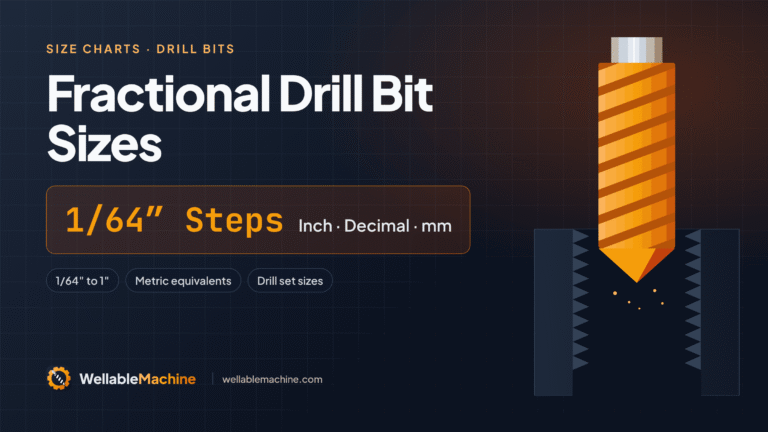
The conversion is simple: 13 ÷ 64 = 0.203125 in, and 0.203125 × 25.4 = 5.159 mm. Our fractional drill bit sizes chart lists every 1/64 step from 1/64 to 1 in.
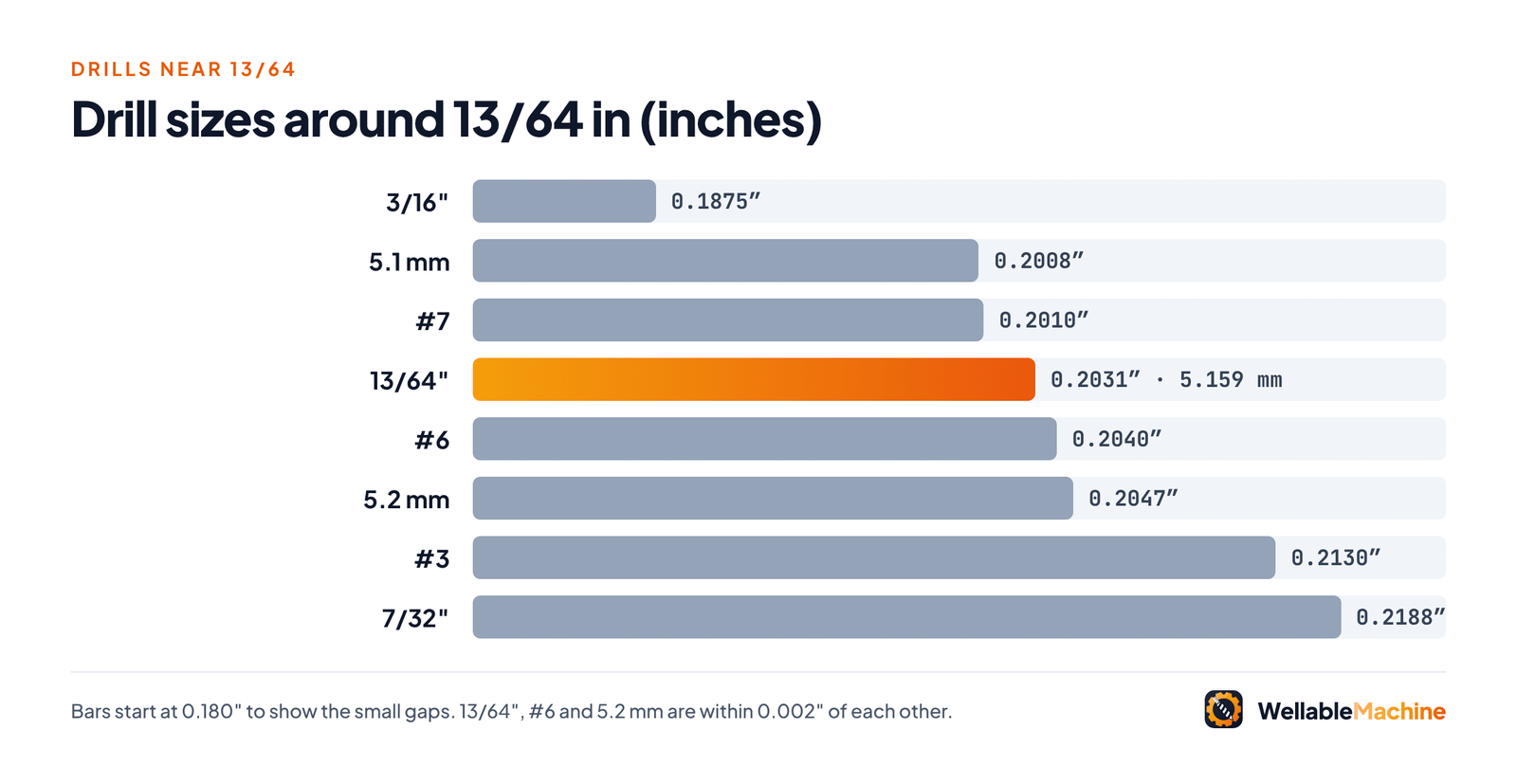
Drills Around 13/64
| Drill | Inches | mm | Typical job |
|---|---|---|---|
| 3/16 in | 0.1875 | 4.76 | Pilot for 1/4 in lags in hardwood; concrete screw holes |
| #10 | 0.1935 | 4.91 | Close clearance for #10 screws |
| 5 mm | 0.1969 | 5.00 | M6 × 1 tap drill; 5 mm shelf pins |
| #7 | 0.2010 | 5.11 | Standard 1/4-20 tap drill |
| 13/64 in | 0.2031 | 5.16 | 1/4-20 substitute; #10 thread inserts; #10 clearance |
| #6 | 0.2040 | 5.18 | Near twin of 13/64 |
| 5.2 mm | 0.2047 | 5.20 | Metric substitute; 1/4-20 in stainless |
| #3 | 0.2130 | 5.41 | 1/4-28 tap drill; free clearance for #10 |
| 7/32 in | 0.2188 | 5.56 | Pilot for 5/16 in lags in hardwood |
What a 13/64 Drill Bit Is Used For
1. Tap drill for 1/4-20 (instead of #7)
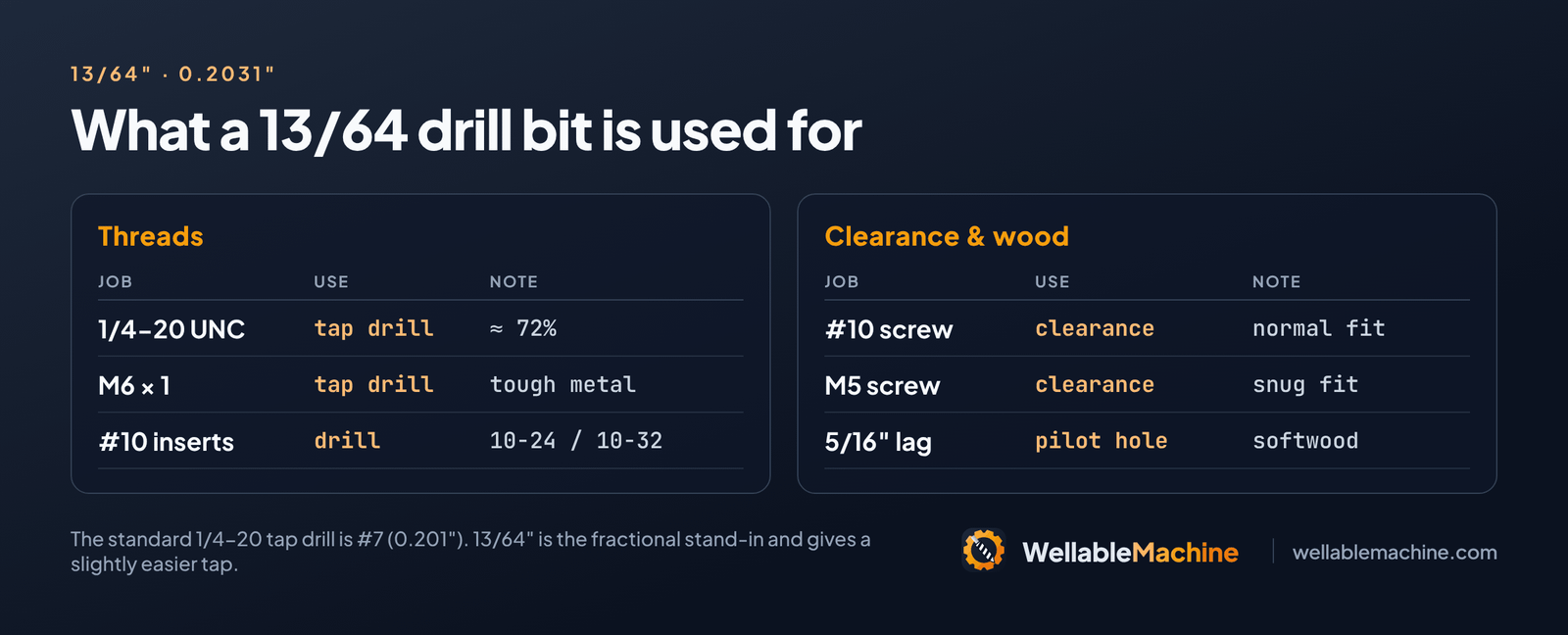
The standard tap drill for 1/4-20 UNC is a #7 (0.201 in), which gives about a 75% thread. Most people don’t own number drills, and 13/64 in is only 0.002 in larger. Using 76.98 × TPI × (major diameter − drill), a 13/64 gives about a 72% thread, which is plenty for steel, aluminum and brass and slightly easier to tap. Our 1/4-20 tap drill size guide has the full comparison.
2. Drill for #10 thread inserts
Helical coil thread repair kits for 10-24 and 10-32 use a 13/64 in drill before the STI tap. If you are repairing a stripped #10 thread, this is often the drill in the kit. See how to install a Helicoil for the full process.
3. Clearance hole for #10 screws
A #10 screw is 0.190 in across. A 13/64 hole leaves about 0.013 in of clearance, a normal fit for brackets, enclosures and panels. For a looser fit use #3 or 7/32 in; for a tighter fit use a #10 drill. The clearance hole size chart covers every screw size.
4. M6 tap drill in tough metals
M6 × 1 normally uses a 5 mm drill (about 77% thread). A 13/64 in bit gives about 65%, which makes hand tapping stainless or titanium far less likely to break the tap. See M6 tap drill size.
5. Pilot holes for 5/16 in lag screws
For 5/16 in lag screws, pilot holes run from 3/16 in in softwood to 7/32 in in dense hardwood. A 13/64 in bit sits in the middle and suits medium-density woods such as Douglas fir and southern yellow pine. Our lag screw pilot hole size guide has a full chart.
6. Clearance for M5 screws
M5 screws are 5 mm across. 13/64 (5.16 mm) is a tight fit, a little smaller than the 5.3 mm close-fit clearance, so it suits accurately drilled parts or a light push fit in plastic.
13/64 vs 5.2 mm vs #6
All three are within 0.0016 in of each other, so for almost every job they’re interchangeable. The table shows what that tiny difference does to a 1/4-20 thread:
| Drill | Inches | 1/4-20 thread | Best for |
|---|---|---|---|
| #7 | 0.2010 | 75% | Standard, any common metal |
| 13/64 in | 0.2031 | 72% | General use, slightly easier tapping |
| #6 | 0.2040 | 71% | Same as 13/64 |
| 5.2 mm | 0.2047 | 70% | Steel and stainless |
| #5 | 0.2055 | 68% | Stainless, hand tapping |
How to Drill a Clean 13/64 Hole
- Mark and center punch metal; in wood, use an awl.
- Pilot in steel over about 3/16 in thick with a 1/8 in bit.
- Use the right speed. Starting points for an HSS bit: about 1,800–1,900 RPM in mild steel, 4,000+ in aluminum, 550–750 in stainless with cutting oil, and 2,000–3,000 in wood. See the drill speed chart.
- Peck deep holes to clear chips.
- Deburr before tapping or fitting screws.
For tap holes, use a drill press to keep the hole square; how to use a drill press explains the setup. In thin sheet metal, a 13/64 twist drill can leave a triangular hole, so clamp the sheet to scrap wood or use a step bit.
Choosing a 13/64 Bit
- Black oxide or bright HSS: fine for wood, plastic, aluminum and occasional steel.
- Titanium-coated HSS: stays sharp longer in mild steel. Our black oxide vs titanium drill bits comparison explains the difference.
- Cobalt: for stainless and tap holes in tough alloys.
- Brad point: for clean holes in wood and plywood.
- Stub (screw-machine) length: for accurate tap holes.
Because 13/64 is part of every standard fractional set, it wears out early in sets used for general work. Buying a few loose replacements is cheaper than a new set.
How to Identify a 13/64 Bit
The size is usually stamped on the shank, but small bits wear smooth. Measure across the margins near the tip: 0.203 in or 5.16 mm. Don’t confuse it with 3/16 in (0.1875 in), which looks very similar, or with 7/32 in (0.219 in). A drill gauge with fractional holes settles it quickly.
Tapping 1/4-20 After a 13/64 Drill
- Drill square, ideally in a drill press, and deburr the top edge with a countersink.
- Pick the tap: a plug tap for most holes, a spiral point tap for through holes, a bottoming tap to finish blind holes.
- Lubricate: light oil in aluminum, sulfurized tapping fluid in steel, a heavy tapping paste in stainless.
- Start straight and check with a square after the first two turns.
- Turn half a turn forward, a quarter back to break the chip, and back the tap out fully every few turns in deep holes.
- Allow for the tap chamfer in blind holes: drill about 3/16 in deeper than the full thread you need.
Because 13/64 leaves slightly more room than a #7, the tap turns a little more easily, which is a real advantage when hand tapping steel. If a tap does snap, how to remove a broken tap covers the options.
13/64 in Wood: Pilot Holes for Screws
In woodworking, a 13/64 in bit is larger than most screw pilot holes, but it has a few uses:
- Shank (clearance) hole for #10 wood screws in the top board, so the screw pulls the two boards tight together.
- Pilot for 5/16 in lag screws in medium-density softwoods.
- Through holes for 3/16 in bolts and threaded rod with a little play.
- Holes for 5 mm hardware in furniture repairs, where a 5 mm bit isn’t at hand.
For the full list of screw pilot sizes, see the pilot hole size chart.
Common Mistakes With a 13/64 Bit
- Mixing it up with 3/16 in. The two look almost identical; a 3/16 in hole is too small for a 1/4-20 tap and will break it.
- Using it for 1/4-28. That fine thread needs a #3 (0.213 in); 13/64 would leave almost a 100% thread.
- Using it as a 1/4 in bolt clearance. A 1/4 in bolt won’t pass through; use 17/64 in or 9/32 in.
- Running it too fast in stainless. Keep it near 600 RPM with steady pressure.
13/64 in Plastic and Acrylic
A 13/64 hole is a common size for mounting acrylic and polycarbonate panels with #10 screws, because it leaves a little room for the plastic to expand and contract. Standard twist bits tend to grab acrylic as they break through and can crack the sheet, so a few changes help:
- Dull the cutting edge slightly. Stone a tiny flat on each lip so the bit scrapes instead of biting. Bits ground for plastic (about 0° rake) do the same job.
- Clamp the sheet to scrap wood and drill through into the wood, so the exit edge is supported.
- Use moderate speed (around 1,000–1,500 RPM) and back out often so chips don’t melt and weld to the bit.
- Leave the protective film on to keep the surface from scratching.
Countersinking a 13/64 Hole
When a 13/64 hole is a clearance hole for a #10 flat-head screw, the head needs a countersink so it sits flush. Imperial flat-head screws use an 82° countersink, while metric screws such as M5 use 90°, so use the matching tool. Cut until the countersink diameter is just under the head diameter (about 0.38 in for a #10 head), test with the screw, and stop once the head sits level with the surface. A countersink that is too deep lets the head sink below the surface and weakens thin material.
Frequently Asked Questions
6 quick answers from our editors
01What is 13/64 in mm?
5.159 mm. The nearest metric drill is 5.2 mm.
02What is 13/64 as a decimal?
0.203125 in, usually written 0.2031 in.
03Can I use 13/64 for a 1/4-20 tap?
Yes. It gives about a 72% thread, which is strong and a little easier to tap than the standard #7.
04What number drill is closest to 13/64?
#6 (0.204 in). #7 (0.201 in) is just below it.
05What size screw fits a 13/64 hole?
A #10 or M5 screw passes through with a little clearance.
06Is 13/64 bigger than 3/16?
Yes. 3/16 in is 12/64 in, so 13/64 in is 1/64 in (about 0.016 in) bigger.
Bottom Line
A 13/64 drill bit is 0.2031 in or 5.16 mm, practically the same as a 5.2 mm or #6 drill. Use it as an easy 1/4-20 tap drill (about 72% thread), the drill for #10 thread inserts, a normal clearance hole for #10 screws and an M6 tap drill in tough metals. Keep a couple of spares, because it’s one of the hardest-working bits in a fractional set.