Black Oxide vs Titanium Drill Bits: Which Should You Buy?
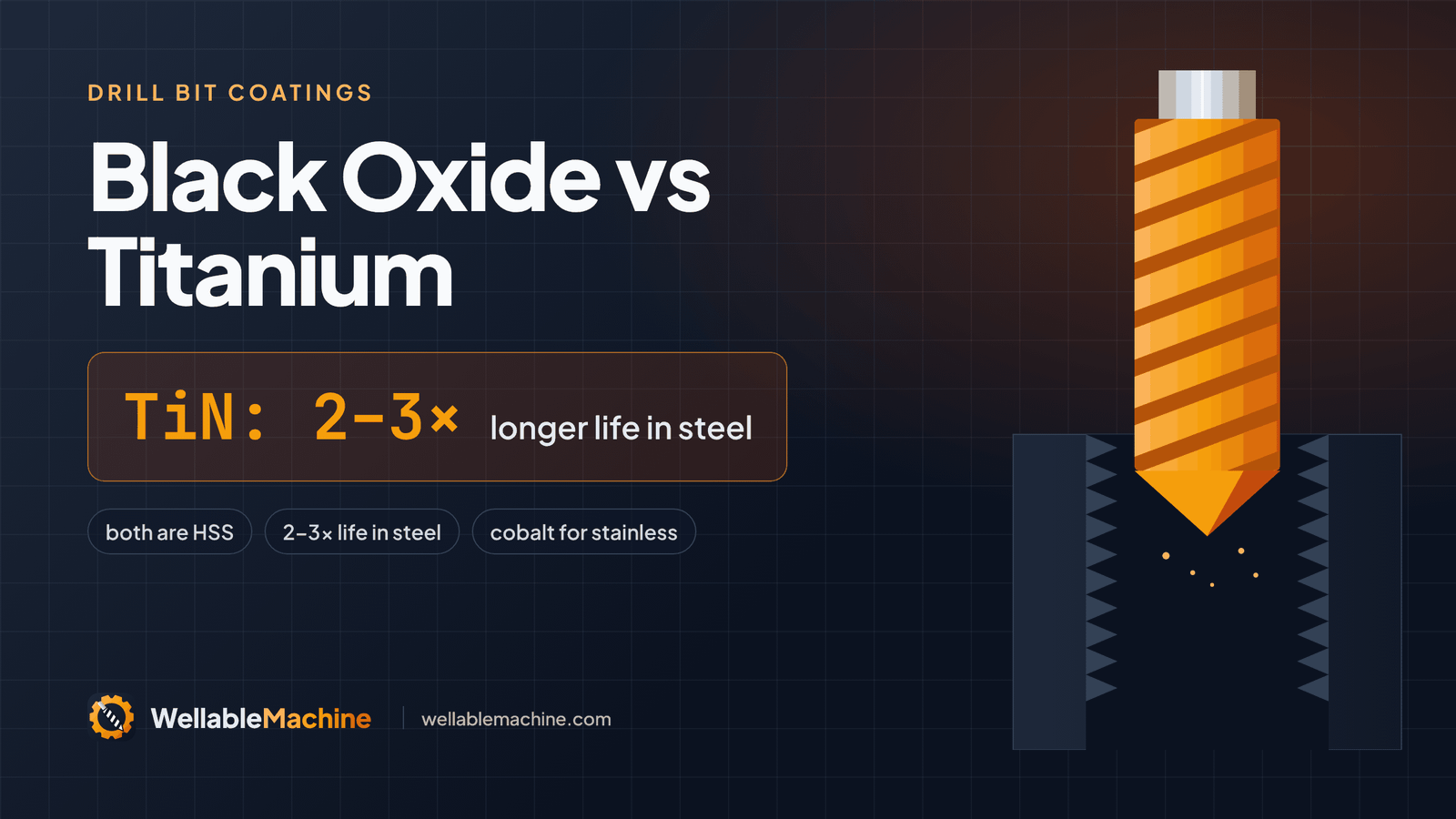
Quick answer: both are usually ordinary high-speed steel (HSS) bits with a surface treatment. Black oxide is a thin conversion layer that resists rust and holds oil; it’s cheap and fine for wood, plastic, aluminum and occasional mild steel. Titanium (TiN) is a hard gold-colored ceramic coating that reduces friction and wear, so the bit stays sharp longer in steel and runs at higher speeds. Titanium bits last noticeably longer in metal, but neither is the right choice for stainless or hardened steel; that’s a job for cobalt.
Walk into any hardware store and you’ll see two big piles of drill bits: black ones and gold ones. The gold ones cost more, and the packaging promises they last several times longer. That’s sometimes true and sometimes not, depending on what you drill and how you drill it. This guide explains what each finish actually is, where each one wins, and when to skip both.
Black Oxide vs Titanium at a Glance
| Feature | Black oxide | Titanium nitride (TiN) |
|---|---|---|
| What it is | Chemical conversion of the steel surface into black iron oxide | Thin ceramic coating applied by vapor deposition |
| Color | Black or blue-black | Gold |
| Thickness | Under 1 micron | About 2–4 microns |
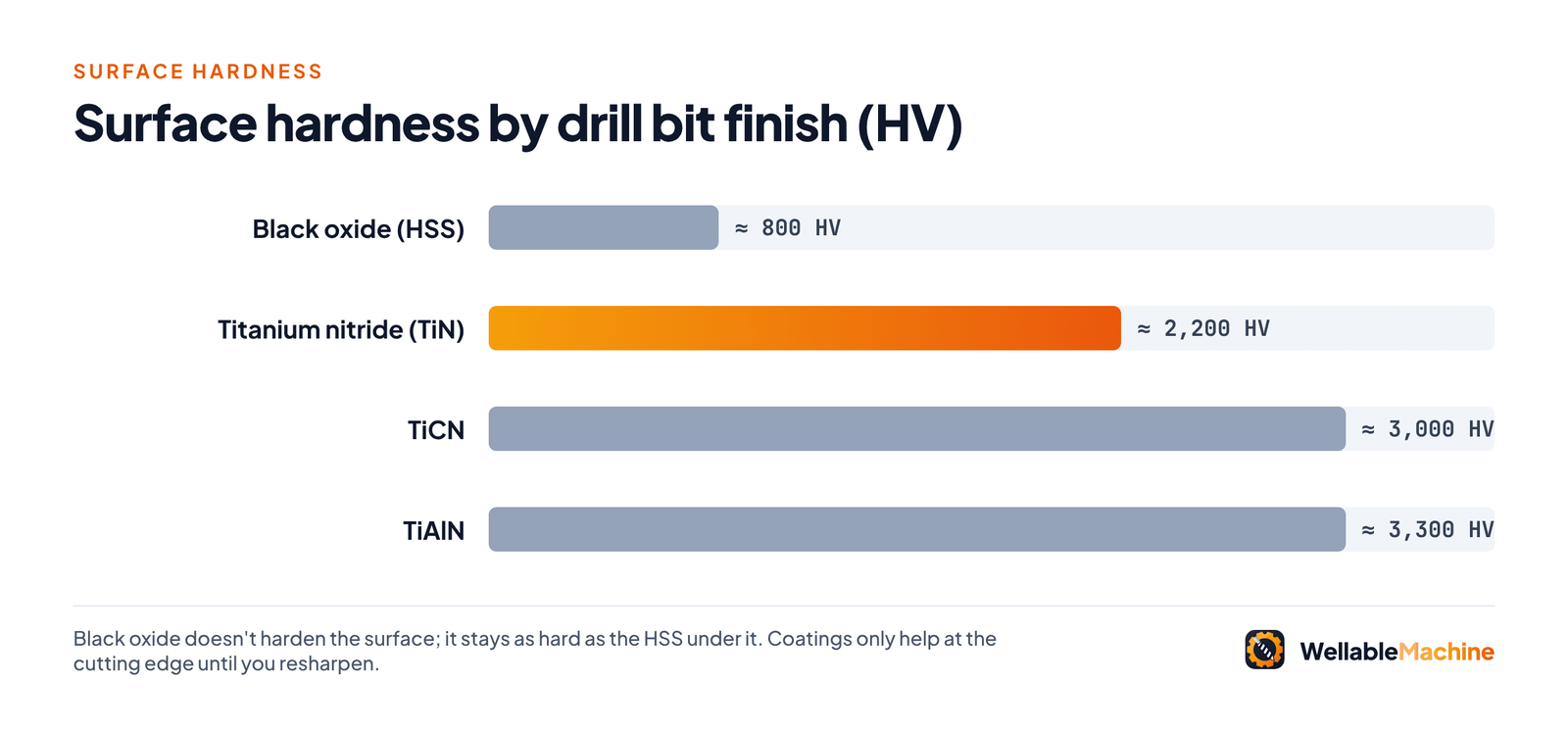
| Surface hardness | Same as the HSS underneath (about 62–65 HRC) | About 2,000–2,400 HV, roughly 2.5× HSS |
| Main benefit | Rust resistance, holds cutting oil, less chip welding | Wear resistance, lower friction, higher heat tolerance at the surface |
| Best for | Wood, plastic, aluminum, light steel work | Mild steel, cast iron, frequent metal drilling |
| Relative tool life in steel | 1× (baseline) | Often 2–3× with correct speed and coolant |
| After resharpening | Works the same | Coating is gone from the cutting edge |
| Price | Lowest | Moderately higher |
What Black Oxide Actually Does
Black oxide is made by dipping the finished bit in a hot alkaline salt bath that turns the outer surface into magnetite, a black form of iron oxide. It adds almost no thickness and doesn’t make the steel harder. What it does:
- Resists corrosion, especially with a light oil film, so bits stored in a damp garage stay usable.
- Holds lubricant in its slightly porous surface, which helps in the first holes.
- Reduces chip welding in aluminum and other gummy metals, because the oxide doesn’t bond to chips as easily as bare steel.
- Some bits are steam tempered instead of salt blackened. Both look similar and do much the same job.
The treatment wears off the cutting edges quickly, but because it never made the edge harder, that doesn’t matter much. A black oxide bit stays a black oxide bit after sharpening.
What Titanium Coating Actually Does
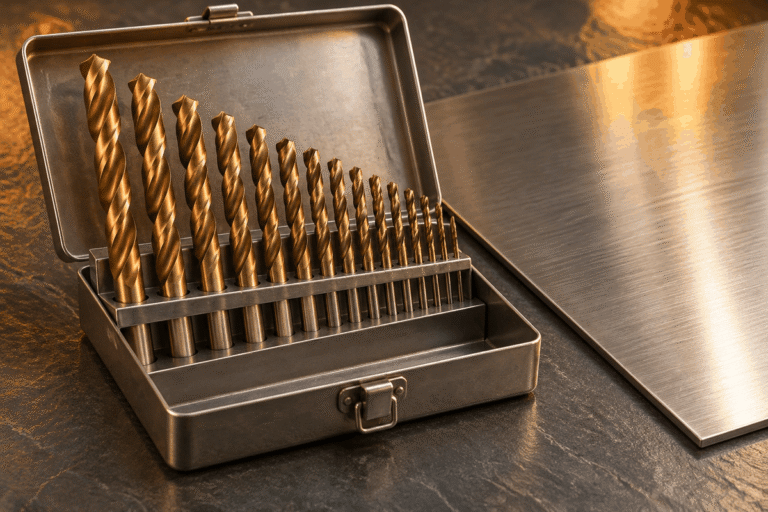
“Titanium” bits are HSS bits coated with titanium nitride (TiN), a ceramic deposited in a vacuum chamber. The titanium nitride layer is far harder than the steel underneath and has a low friction coefficient.
- Harder surface means the cutting edges and margins wear more slowly, especially in abrasive cast iron and steel.
- Less friction means less heat and smoother chip flow in the flutes.
- Better heat tolerance at the surface allows somewhat higher speeds in metal.
- The core is still HSS. If the bit overheats enough to soften the steel underneath, the coating can’t save it.
Other coatings sold under the “titanium” banner include TiCN (titanium carbonitride, blue-grey, harder and slicker) and TiAlN/AlTiN (purple-black, made for high heat, mostly on cobalt and carbide bits). Cheap “titanium” sets sometimes have a very thin, decorative coating that wears off in a few holes, so brand and quality matter more here than with black oxide.
Head-to-Head by Material
| Material | Black oxide | Titanium (TiN) | Better choice |
|---|---|---|---|
| Softwood, hardwood, plywood | Excellent | Excellent | Either; black oxide is cheaper. Brad point is better still. |
| Plastics and acrylic | Good | Good | Either, at low speed |
| Aluminum | Good; resists chip welding | Good, but aluminum can stick to TiN | Black oxide or bright HSS with lubricant |
| Mild steel | OK for occasional holes | Better; stays sharp longer | Titanium |
| Cast iron | Wears quickly | Better wear resistance | Titanium |
| Stainless steel | Poor | Poor to fair | Neither: use cobalt |
| Hardened steel | Fails | Fails | Neither: use carbide |
| Masonry and tile | No | No | Carbide-tipped masonry or diamond bits |
For stainless and tough alloys, see HSS vs cobalt drill bits and cobalt vs titanium drill bits. For hardened steel, our carbide drill bits guide explains the options.
The Resharpening Question
This is where the comparison changes. When you sharpen a TiN bit, you grind the coating off the cutting lips, which is where it did most of its work. The bit still has coating on the margins and flutes, which helps a little, but its edge is now plain HSS, the same as a black oxide bit.
- If you sharpen your own bits, buy black oxide (or bright HSS) and spend the savings on a good sharpening setup. See how to sharpen drill bits.
- If you throw bits away when dull, titanium gives you more holes per bit in metal.
- For small sizes (under about 1/8 in), most people don’t sharpen at all, so titanium’s longer life is worth having in metal.
Speeds for Each Type
| Material | Black oxide (SFM) | TiN (SFM) | RPM for 1/4 in, TiN |
|---|---|---|---|
| Aluminum | 200–300 | 250–350 | 3,800–5,300 |
| Mild steel | 70–100 | 90–130 | 1,400–2,000 |
| Cast iron | 60–80 | 80–110 | 1,200–1,700 |
| Stainless (if you must) | 30–40 | 35–50 | 530–760 |
These are starting points; reduce speed if the chips turn blue or the bit squeals. RPM = SFM × 3.82 ÷ diameter. The drill speed chart has more sizes. A coated bit run too fast will still burn; the coating just raises the limit a little.
How to Make Either Type Last Longer
- Center punch metal so the bit doesn’t skate and chip a corner.
- Pilot large holes in steel with a 1/8 in bit.
- Use cutting oil in steel; a few drops make a big difference to both types.
- Feed steadily. A bit that rubs without cutting dulls in seconds and work-hardens stainless.
- Clear chips in deep holes by pecking.
- Store bits in an index so the edges don’t knock against each other.
Which Should You Buy?
- Mostly wood, plastic and occasional aluminum: black oxide. Cheap, rust resistant and easy to sharpen.
- A general set for a homeowner who drills some steel: a good-quality titanium set.
- Regular metalwork in steel: titanium for mild steel, plus cobalt for stainless and tough jobs.
- You sharpen your own bits: black oxide or bright HSS.
- Stainless, Grade 8 bolts, hardened parts: neither; cobalt or carbide.
For a wider view of bit materials and shapes, see types of drill bits.
Common Myths
- “Titanium bits are made of titanium.” No. They’re steel bits with a titanium nitride coating.
- “Black oxide makes bits harder.” No. It improves rust resistance and lubricity, not hardness.
- “Gold bits drill stainless.” Only slowly and briefly. Stainless needs cobalt, low speed and constant feed.
- “Coated bits don’t need cutting oil.” They still last far longer with it in steel.
Other Drill Bit Finishes You’ll See
Black and gold aren’t the only colors on the rack, and the color tells you a lot about what you’re buying:
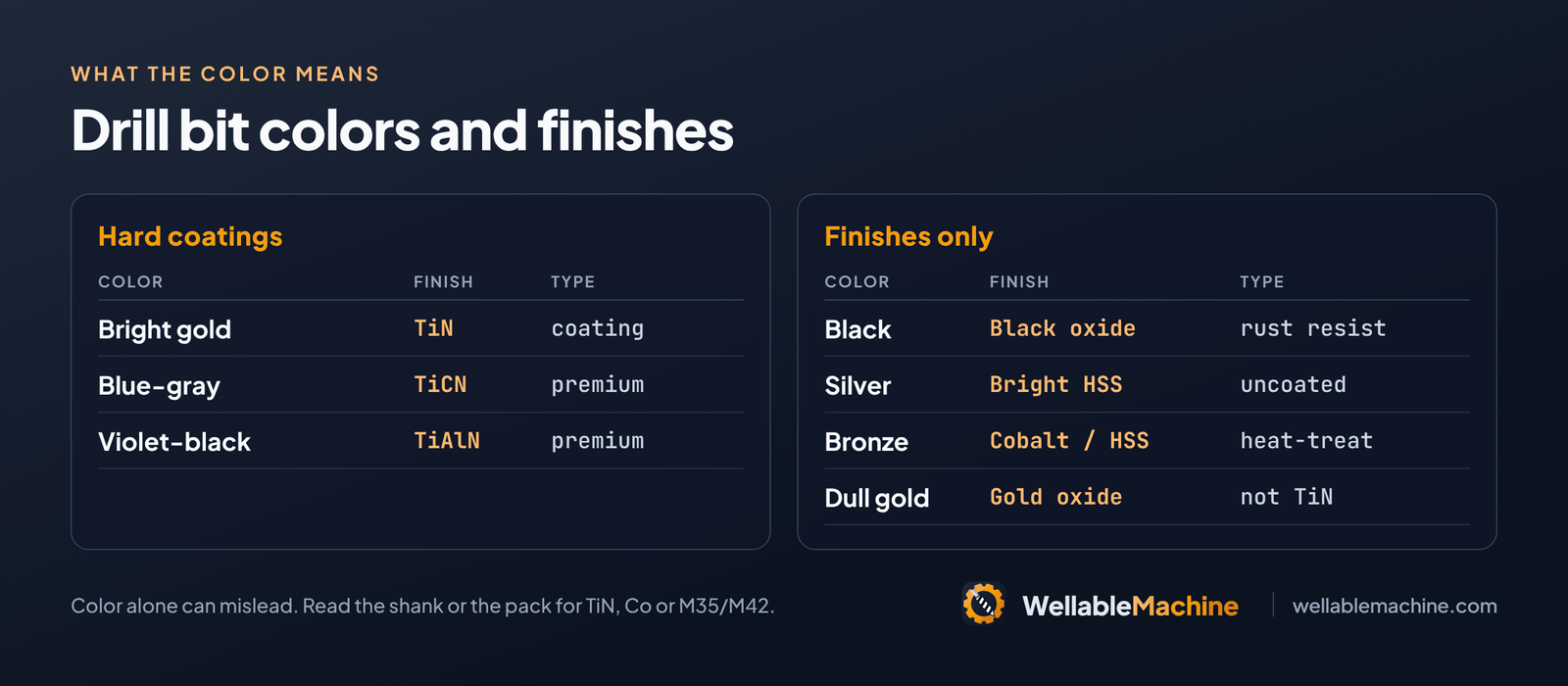
- Bright (uncoated) HSS: silver, polished flutes. Chips flow easily, which makes them popular for aluminum and plastics. No corrosion protection, so keep them oiled.
- Bronze or amber: usually a light oxide on cobalt bits, left by heat treatment. The color doesn’t add hardness; the cobalt in the steel does.
- Gold oxide: a steam-tempered finish on HSS that looks gold but is not titanium nitride. It behaves like black oxide.
- Blue-grey TiCN and purple-black TiAlN: premium coatings, mostly on cobalt and carbide bits for production metalwork.
- Black and gold together: some bits are black oxide on the body with a gold tip. Treat these as black oxide with slight extra wear resistance at the point.
If the packaging doesn’t say “titanium nitride” or “TiN” clearly, a gold color may just be an oxide finish. Read the material line, not the color.
What Tool Life to Expect
Manufacturers often claim that titanium bits last “up to 6 times longer.” That figure comes from controlled tests in steel at the right speed with coolant. In real hand-drill use, a fair expectation is roughly two to three times the life of a comparable black oxide bit in mild steel, and about the same life in wood. The gap shrinks if you run the bit too fast or without oil, because heat damages the steel under the coating either way. Bit quality matters more than finish: a good black oxide bit from a reputable maker often outlasts a cheap gold one.
Which Bit for Common Jobs
| Job | Better pick | Why |
|---|---|---|
| Pilot holes in wood and drywall | Black oxide | Wood barely wears either finish, so pay less |
| Steel brackets and angle iron | Titanium | Lower friction keeps the edge sharp longer in steel |
| Aluminum and plastic | Black oxide or bright HSS | Chips flow easily; the coating adds little |
| Car body panels and sheet metal | Titanium | Many small holes in thin steel at higher speed |
| Stainless steel | Neither (cobalt) | Stainless work-hardens and dulls both quickly |
| Bits you resharpen often | Black oxide | Sharpening removes the TiN at the point anyway |
Frequently Asked Questions
6 quick answers from our editors
01Which is better, black oxide or titanium drill bits?
Titanium is better for drilling steel and cast iron because the hard coating lasts longer. Black oxide is just as good for wood and plastic, and cheaper.
02Are titanium drill bits worth it?
Yes, if you drill metal regularly and replace bits rather than sharpen them. For woodworking only, they offer little advantage.
03Can black oxide bits drill metal?
Yes. They drill aluminum, brass and mild steel well enough for occasional use, especially with cutting oil.
04Do titanium bits work on stainless steel?
Not well. Use cobalt bits at low speed with steady pressure and cutting oil.
05Can you sharpen titanium-coated drill bits?
Yes, but sharpening removes the coating from the cutting edge, so afterwards the edge performs like plain HSS.
06What is the gold coating on drill bits?
Usually titanium nitride (TiN), a hard ceramic coating a few microns thick.
Bottom Line
Black oxide is the low-cost, rust-resistant choice for wood, plastic, aluminum and occasional mild steel, and it’s the better buy if you sharpen your own bits. Titanium (TiN) costs more but stays sharp noticeably longer in mild steel and cast iron. For stainless steel use cobalt, and for hardened steel use carbide; no surface coating turns an HSS bit into either.