NPT Tap Drill Chart: Drill Sizes for 1/16 to 2 in Pipe Threads
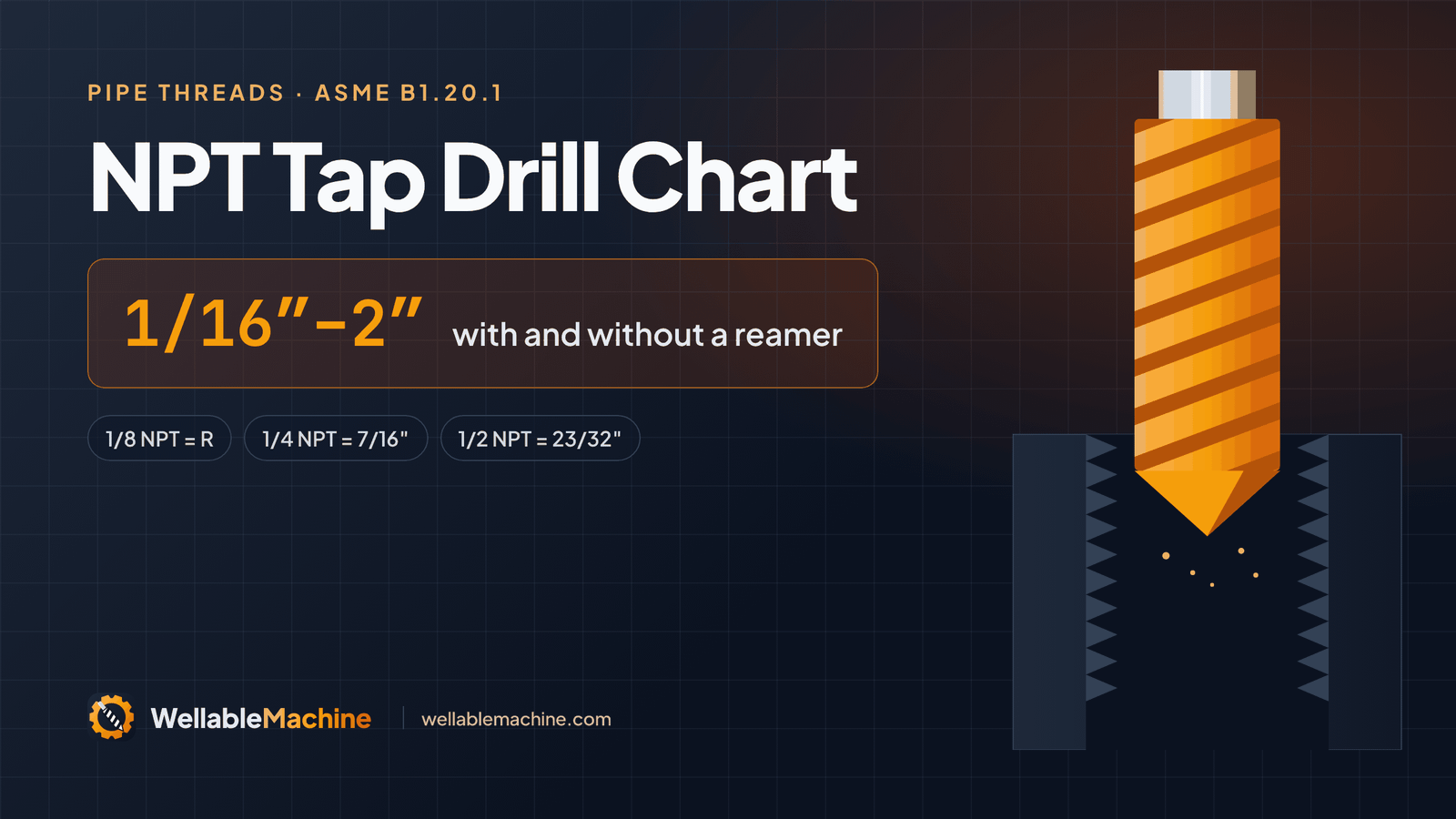
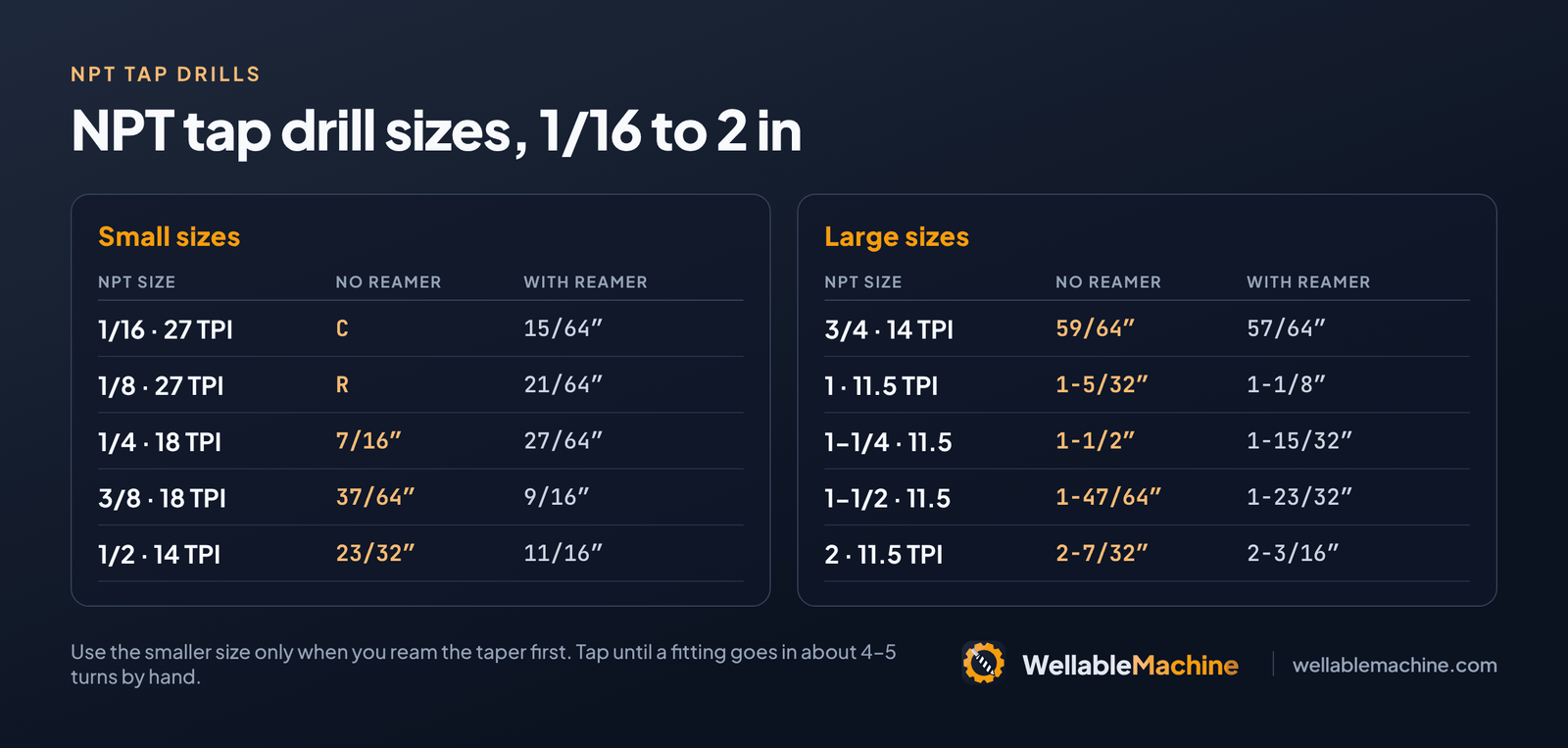
Quick answer: the common NPT tap drills (no reamer) are C for 1/16 NPT, R for 1/8, 7/16 in for 1/4, 37/64 in for 3/8, 23/32 in for 1/2, 59/64 in for 3/4, 1-5/32 in for 1 in, 1-1/2 in for 1-1/4, 1-47/64 in for 1-1/2 and 2-7/32 in for 2 in pipe. If you ream the hole with a taper pipe reamer first, drill one step smaller. The full chart below adds metric equivalents, reamed sizes, threads per inch and hand-tight engagement.
National Pipe Taper (NPT) threads are tapered 1 in 16 on diameter and seal by wedging, so their tap drills follow different rules from straight machine-screw threads. This chart pulls every common size into one place. Each size also has its own detailed guide, linked in the table, if you need tapping tips, depth checks and troubleshooting for that size.
NPT Tap Drill Chart (1/16 to 2 in)
| NPT size | TPI | Pipe OD | Drill, no reamer | Decimal / mm | Drill, with reamer |
|---|---|---|---|---|---|
| 1/16 NPT | 27 | 0.3125 in | C | 0.242 in / 6.15 mm | 15/64 in |
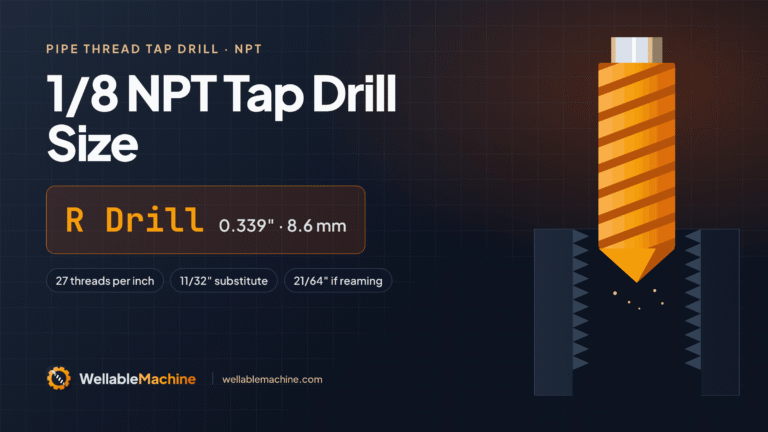
| 1/8 NPT | 27 | 0.405 in | R | 0.339 in / 8.6 mm | 21/64 in |
| 1/4 NPT | 18 | 0.540 in | 7/16 in | 0.4375 in / 11.1 mm | 27/64 in |
| 3/8 NPT | 18 | 0.675 in | 37/64 in | 0.5781 in / 14.7 mm | 9/16 in |
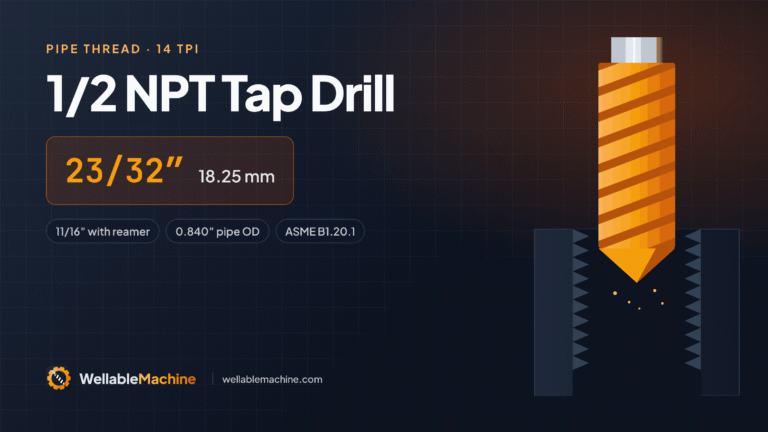
| 1/2 NPT | 14 | 0.840 in | 23/32 in | 0.7188 in / 18.25 mm | 11/16 in |
| 3/4 NPT | 14 | 1.050 in | 59/64 in | 0.9219 in / 23.4 mm | 57/64 in |
| 1 NPT | 11.5 | 1.315 in | 1-5/32 in | 1.1563 in / 29.4 mm | 1-1/8 in |
| 1-1/4 NPT | 11.5 | 1.660 in | 1-1/2 in | 1.500 in / 38.1 mm | 1-15/32 in |
| 1-1/2 NPT | 11.5 | 1.900 in | 1-47/64 in | 1.7344 in / 44.0 mm | 1-23/32 in |
| 2 NPT | 11.5 | 2.375 in | 2-7/32 in | 2.2188 in / 56.4 mm | 2-3/16 in |
Reamed sizes vary a little between published charts (for example 45/64 in instead of 11/16 in for 1/2 NPT). Any of them work, because the reamer cuts the taper either way. The no-reamer sizes are far more standard.
Why NPT Tap Drills Work Differently
On a straight thread such as 1/4-20, the tap drill sets the minor diameter for the whole length of the hole. On a tapered pipe thread, the tap grows wider along its length. You drill to suit the small end of the thread, then the tap cuts progressively deeper as it advances, leaving a cone-shaped thread that matches the taper of the fitting.
- Without a reamer, the tap has to cut the taper and the thread at once. That takes a lot of torque, so the standard drills are a little larger to make it manageable.
- With a taper pipe reamer, the reamer cuts the cone first and the tap only forms the thread. You can start from a smaller hole and get a smoother, more accurate port.
- The port depth decides whether it seals, not the drill alone. Tap too deep and the fitting never wedges. Tap too shallow and it won’t go in far enough.
The full thread dimensions are defined in ASME B1.20.1. A summary of the system is in the National pipe thread article.
Hand-Tight Engagement: How Deep to Tap
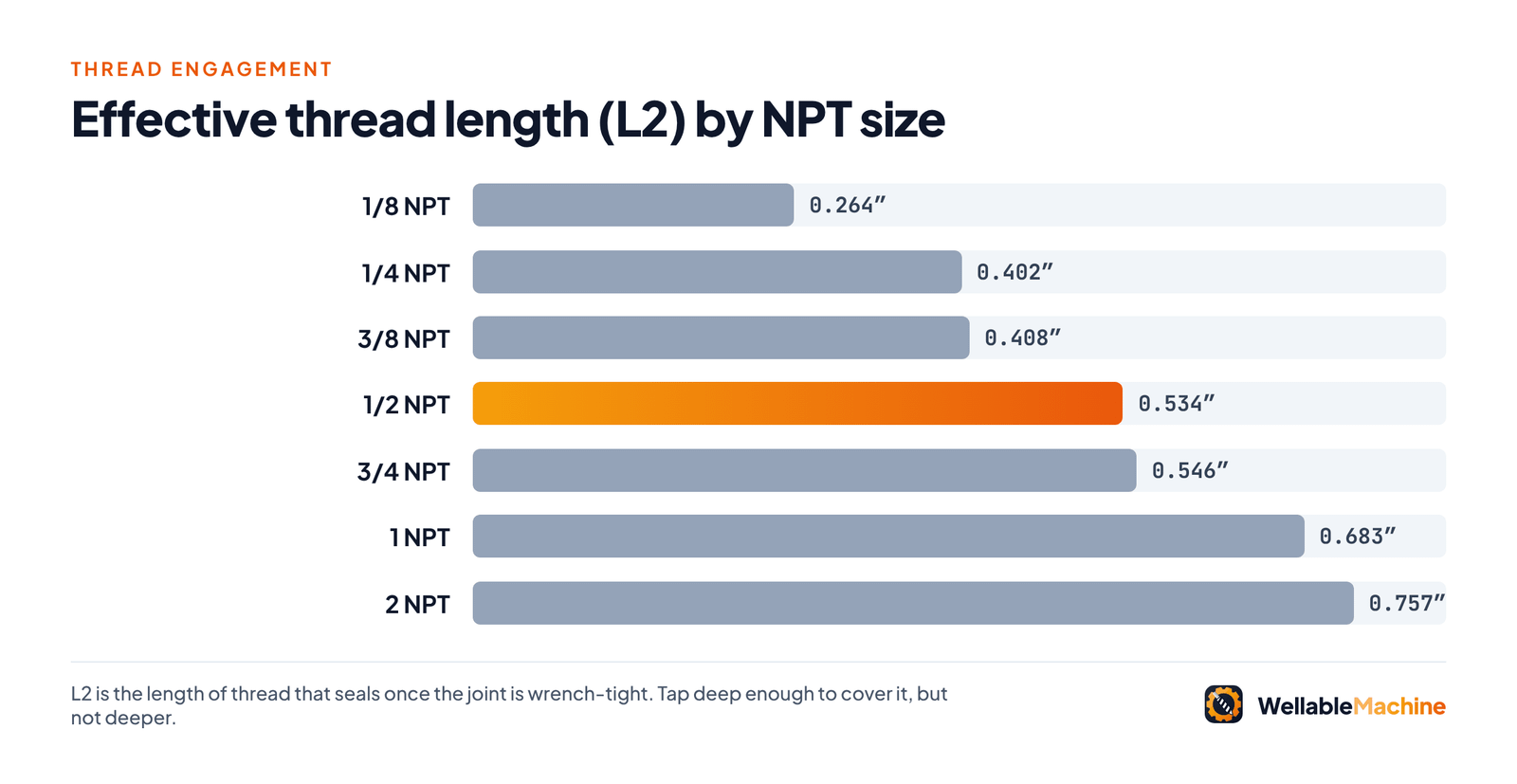
The easiest way to judge depth is to screw in a clean fitting by hand. It should go in about the number of turns below, then take another 2 to 3 turns with a wrench. These come from the standard L1 (hand-tight) length multiplied by the threads per inch.
| NPT size | L1 length | Hand-tight turns | Effective thread (L2) | Wrench turns after hand tight |
|---|---|---|---|---|
| 1/16 | 0.160 in | about 4.3 | 0.261 in | 2–3 |
| 1/8 | 0.162 in | about 4.4 | 0.264 in | 2–3 |
| 1/4 | 0.228 in | about 4.1 | 0.402 in | 2–3 |
| 3/8 | 0.240 in | about 4.3 | 0.408 in | 2–3 |
| 1/2 | 0.320 in | about 4.5 | 0.534 in | about 3 |
| 3/4 | 0.339 in | about 4.7 | 0.546 in | about 3 |
| 1 | 0.400 in | about 4.6 | 0.683 in | about 3 |
| 1-1/4 | 0.420 in | about 4.8 | 0.707 in | about 3 |
| 1-1/2 | 0.420 in | about 4.8 | 0.724 in | about 3 |
| 2 | 0.436 in | about 5.0 | 0.757 in | about 3 |
An NPT L1 plug gauge gives a more reliable check: screwed in by hand, its notch should sit flush with the face of the part, give or take one turn.
Threads per Inch Groups
NPT sizes share pitches in groups, which is useful when you are identifying an unknown fitting with a thread gauge:
- 27 TPI: 1/16 and 1/8 NPT
- 18 TPI: 1/4 and 3/8 NPT
- 14 TPI: 1/2 and 3/4 NPT
- 11.5 TPI: 1 in through 2 in NPT
- 8 TPI: 2-1/2 in and larger
Once you know the pitch, measure the outside diameter of the male thread to pick the size within the group. Our guide on how to measure thread pitch explains the method.
NPT vs BSP Tap Drills
British Standard Pipe threads use a 55° angle instead of 60°, and several sizes have different pitches. They need their own drills, and the parallel (G) and tapered (Rc) versions differ again:
| Size | NPT drill | BSPT (Rc) drill | BSPP (G) drill | Pitch NPT / BSP |
|---|---|---|---|---|
| 1/8 | R (8.6 mm) | 8.4 mm | 8.8 mm | 27 / 28 TPI |
| 1/4 | 7/16 in (11.1 mm) | about 11.2 mm | 11.8 mm | 18 / 19 TPI |
| 3/8 | 37/64 in (14.7 mm) | about 14.5–14.75 mm | 15.25 mm | 18 / 19 TPI |
| 1/2 | 23/32 in (18.25 mm) | about 18.25 mm | 19 mm | 14 / 14 TPI |
See our 1/8 BSP, 1/4 BSP, 3/8 BSP and 1/2 BSP guides for details, including how to tell the two systems apart.
NPTF, NPS and Other Related Threads
- NPTF (Dryseal): same taper and pitch as NPT, but the crests and roots are controlled so the threads seal metal-to-metal without tape. It uses the same tap drills; the tap itself is an NPTF tap.
- NPSM (straight mechanical): a parallel pipe thread used with a gasket or swivel nut, as on hose fittings and some valves. It needs a slightly larger drill than NPT of the same size.
- NPSF and NPSC: straight internal threads designed to accept a tapered male. Check the tap maker’s chart for their drill sizes.
- Garden hose (GHT) and fire hose (NH): straight threads that only look like pipe threads. They are not NPT.
Getting the Big Drills
Above 1/2 in, standard drill sets run out. Practical options:
- Reduced-shank bits (Silver & Deming) up to about 1-1/4 in, with a 1/2 in shank that fits a normal chuck. See drill chuck sizes.
- Taper-shank drills in a drill press or lathe with a Morse taper spindle.
- Step bits in sheet metal and thin tube.
- Annular cutters or hole saws for 1-1/4 in and up in plate, then a boring bar if you need accuracy.
- Weld-on bungs and half couplings when the wall is too thin to hold a full pipe thread anyway.
For holes this large, speed has to come down a lot. As a starting point in mild steel, about 350–450 RPM for 3/4 in and 250–300 RPM for 1-1/4 in with an HSS drill. The drill speed chart gives the formula.
Minimum Wall Thickness
A port needs enough material to hold the full effective thread (L2), plus a little. As a rough guide: about 0.30 in for 1/8 NPT, 0.45 in for 1/4 and 3/8 NPT, 0.60 in for 1/2 and 3/4 NPT and 0.75 in for 1 in. Thinner parts will still take a fitting, but with fewer full threads, so they rely more on sealant and are easier to crack by overtightening.
Tips for Tapping Any NPT Port
- Clamp the part and pilot drill before the full-size hole.
- Keep the tap square with a drill press spindle or guide; pipe taps are long and crooked ports leak.
- Use plenty of cutting oil and back off often to break chips.
- Check depth with a fitting once you’re close. Go deeper a quarter turn at a time.
- Seal properly: tape (2–4 wraps depending on size) or paste on the male thread only, then tighten once without backing off.
If a pipe tap breaks off in the hole, see how to remove a broken tap.
Common NPT Tapping Mistakes
- Using a straight-thread chart. Machine-screw tap drill charts don’t apply to pipe threads.
- Tapping until the tap stops. A pipe tap will keep going and ruin the seal; stop at the hand-tight depth.
- Drilling the reamed size without a reamer. The tap becomes extremely hard to turn and may break.
- Mixing NPT and BSP parts. 1/2 and 3/4 in share 14 TPI across both systems, so check the thread angle.
- Too much tape. Excess PTFE can stop a fitting from seating or crack a cast part; use 2–4 wraps.
Frequently Asked Questions
7 quick answers from our editors
01What drill size for a 1/4 NPT tap?
7/16 in (0.4375 in) without a reamer, or 27/64 in if you ream first.
02What drill size for a 1/8 NPT tap?
An R drill (0.339 in, about 8.6 mm). Use 21/64 in if you ream first.
03What drill size for a 1/2 NPT tap?
23/32 in (0.719 in, 18.25 mm) without a reamer, or 11/16 in with a reamer.
04Do I need a reamer for NPT threads?
No. Drilling to the no-reamer size and tapping directly works for most jobs. Reaming makes tapping easier and the port smoother, especially in stainless steel and in larger sizes.
05How deep do you tap an NPT thread?
Until a fitting screws in by hand about 4 to 5 turns, then 2 to 3 more turns with a wrench.
06Are NPT and NPTF tap drills the same?
Yes. They share the same taper and pitch, so the drill sizes are the same.
07Can I use an NPT chart for BSP threads?
No. BSP threads have a different angle and, in several sizes, a different pitch. Use BSP drill sizes.
Bottom Line
For NPT ports, drill C, R, 7/16, 37/64, 23/32, 59/64 and 1-5/32 in for 1/16 through 1 in pipe, and 1-1/2, 1-47/64 and 2-7/32 in for 1-1/4 through 2 in, or one step smaller if you ream first. Tap until a fitting goes in about 4 to 5 turns by hand, seal the male thread, and tighten 2 to 3 turns more. For straight machine threads, use our tap drill size chart instead.