Split Point Drill Bits: What They Are and When to Use Them
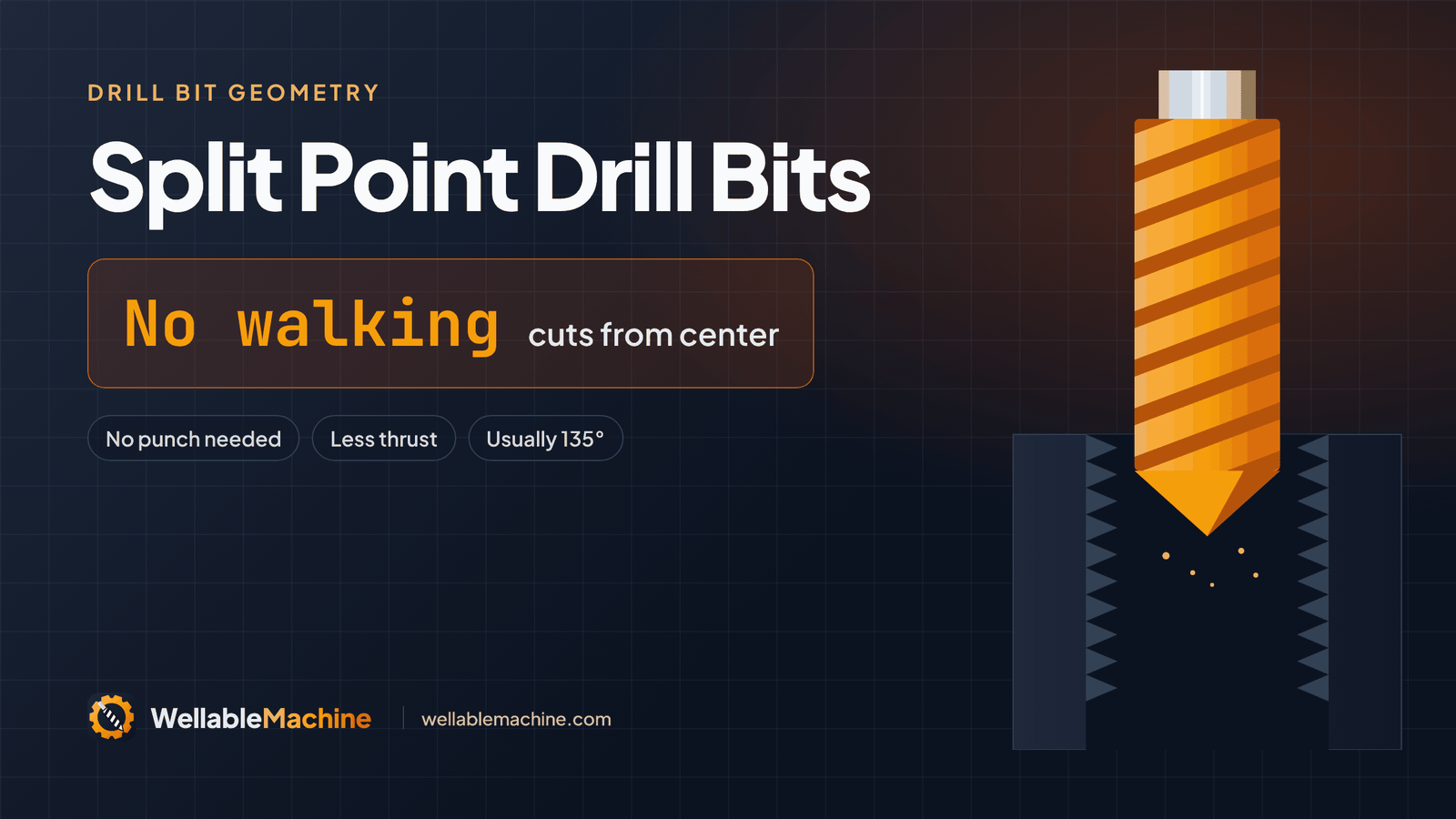
Quick answer: a split point drill bit has extra small grinds at its tip that split the dead center of the drill into two little cutting edges. Because the very center cuts instead of scraping, a split point bit starts exactly where you put it without a center punch, needs much less pushing force and drills a rounder hole. Split points are usually ground at 135° and are the best choice for drilling metal with a handheld drill, especially steel, stainless and curved surfaces. They’re less important in a drill press or in wood.
You’ll see “split point” printed on most good metal-drilling bits, and some brands use their own names for similar tips. This guide explains what the split does, how it differs from other point styles, when it’s worth paying for, how to tell whether a bit has one, and how to keep it sharp.
What Is a Split Point?
Every twist drill has two main cutting lips that meet near the center. Where they meet, there’s a short straight edge called the chisel edge, formed by the web, which is the solid core of metal that holds the two flutes together. The chisel edge doesn’t cut. It has a strongly negative rake, so it pushes and smears the metal outward, rather like a blunt wedge. On a standard bit, that chisel edge is why:
- the bit skates (walks) across the surface before it bites;
- you have to push hard, especially in steel;
- the hole often starts slightly off position or oval.
A split point removes most of the chisel edge with two small secondary grinds, one behind each lip. These create two short extra cutting edges right at the center, each with positive rake. The drill bit article shows the parts of a twist drill in more detail. The result is a drill that cuts from the center outward as soon as it touches the work.
Split Point vs Other Drill Point Styles
| Point style | What’s done at the center | Self-centering? | Typical use |
|---|---|---|---|
| Conventional (plain) point | Nothing; full chisel edge | No | Cheap general bits, drill press work with a punch mark |
| Web-thinned point | Web ground thinner, chisel edge shortened | Partly | Larger drills, heavy-web bits |
| Split point (4-facet) | Chisel edge split into two cutting edges | Yes | Most quality HSS and cobalt metal bits |
| Crankshaft or “notched” split | Deep notch splits for very thick webs | Yes | Heavy-duty bits for hard alloys and deep holes |
| Helical (S-point) | Curved, continuous center | Yes | Precision and CNC drilling |
| Brad point | Center spur and outer spurs | Yes (wood) | Wood only |
| Pilot point / bullet point | Small pilot cone or split-like tip | Yes | Branded general-purpose bits |
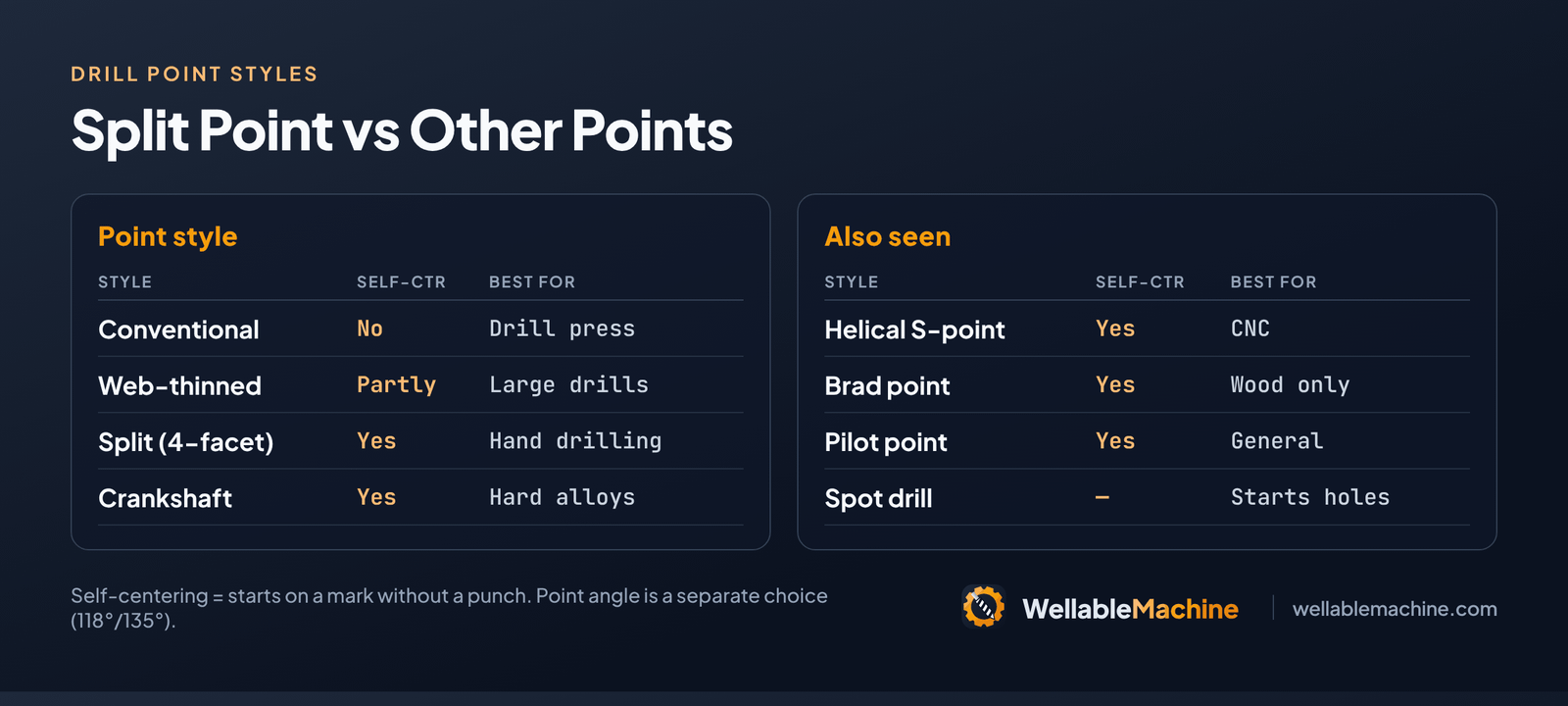
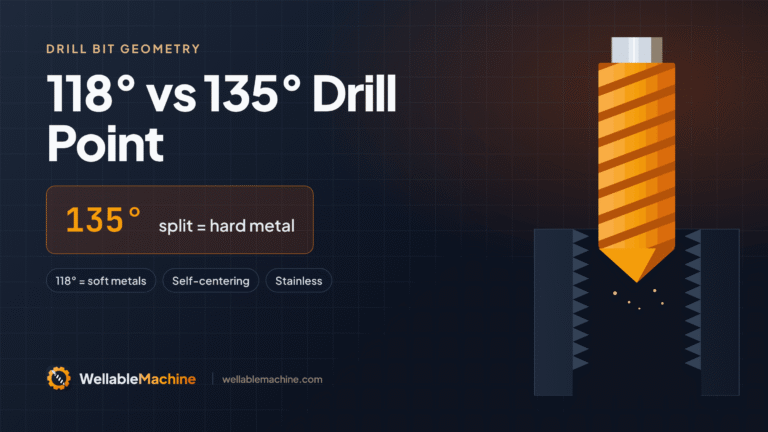
Point angle and split point are separate features. A split can be ground on a 118° drill. But split points are most often paired with a flatter 135° angle, because a flat point with a chisel edge is especially bad at starting. For more on angles, see our guide on 118 vs 135 degree drill points.
What a Split Point Does for You
- No walking: you can drill accurately on a pencil mark, on round tube, angle iron or a smooth painted surface without a punch.
- Less feed force: cutting from the center typically cuts the thrust needed by a third to a half, depending on drill size. With a cordless drill, that means faster holes and less fatigue.
- Less work hardening: in stainless steel, a rubbing chisel edge hardens the surface before the lips can cut. A split point bites immediately, which is a big part of why it works so well in stainless. See how to drill stainless steel.
- Rounder, more accurate holes: the drill doesn’t wobble around at the start, so holes are closer to size and position.
- Often no pilot needed: on bits up to about 3/8 in or 1/2 in in mild steel, a split point usually doesn’t need a pilot hole. On larger drills the web is thick, and a pilot still helps.
- Cleaner breakthrough in sheet metal: paired with a 135° point, a split helps the bit cut through thin sheet without grabbing or leaving a triangle-shaped hole. See how to drill a hole in sheet metal.
When You Don’t Need a Split Point
- Wood: use brad point or spade bits instead. A split point metal bit works in wood but leaves rougher entry holes.
- Drill press with a spot drill: the machine holds the bit rigidly, and a spot drill sets the start, so a plain point works fine and is easier to sharpen.
- Soft plastics and acrylic: a sharp split point can grab and chip. Bits with modified, zero-rake points work better. See how to drill acrylic.
- Brass and bronze: these grab on breakthrough. A plain point with a dubbed lip is better.
How to Tell If a Bit Has a Split Point
Look straight down at the tip in good light, or use a magnifier. A plain point shows a single straight line across the center (the chisel edge) between the two lips. A split point shows that line broken up: you’ll see four facets instead of two, with a small S or Z shape at the center where the secondary grinds meet. The package often says “split point” or “135° split point.” Some bits only have a split on larger sizes, because small diameters have a thin enough web not to need one.
How to Drill With a Split Point Bit
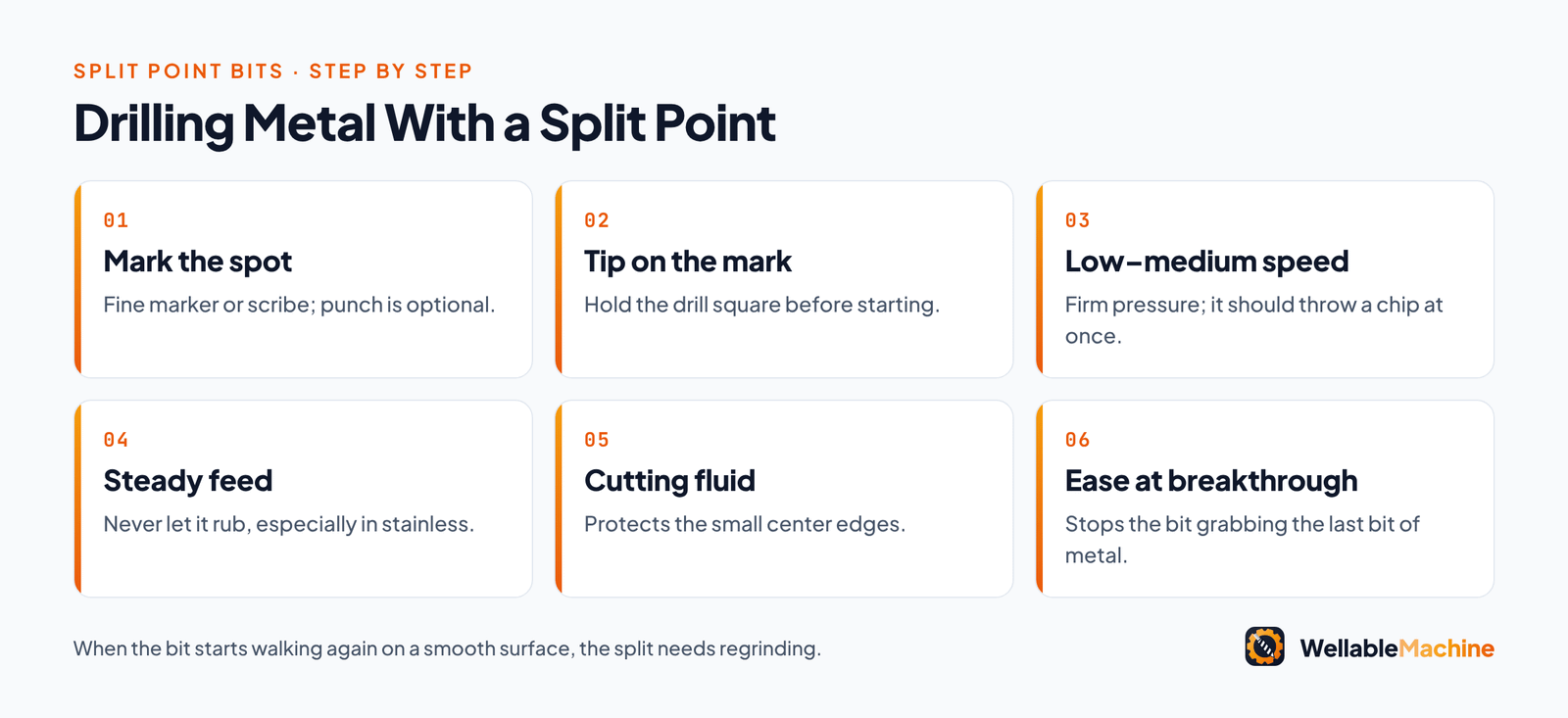
- Mark the spot with a fine marker or scribe. A punch is optional.
- Place the tip exactly on the mark and hold the drill square before you start.
- Start at low to medium speed with firm, steady pressure. The bit should start cutting at once and throw a chip.
- Feed steadily. Keep a continuous chip coming. Dwelling without cutting dulls the point fast, especially in stainless.
- Use cutting fluid in steel and stainless to protect the small center edges, which are the first to wear.
- Ease off at breakthrough so the bit doesn’t grab the last bit of metal.
Speed matters as much as point style. A split point running too fast in steel still burns out. Use our drill speed chart for starting speeds by size.
Sharpening Split Point Bits
The secondary grinds are small and precise, so they’re the part most people find hard to resharpen by hand. Your options:
- Drill sharpener: many bench drill sharpeners can grind a 118° or 135° point and add a split as a separate step. This is the easiest way to restore a split.
- Freehand on a bench grinder: sharpen the main lips first, then use the corner of a dressed wheel to grind a small notch behind each lip. It takes practice. See how to sharpen drill bits.
- Without the split: if you just sharpen the main lips, the bit still cuts well but will need a center punch to start. That’s fine for drill press work.
Split Point Bits by Material
| Bit material | Split point common? | Best for |
|---|---|---|
| Basic HSS | On better brands | Mild steel, aluminum, general use |
| Black oxide HSS | Often | General metal drilling, less rust |
| Titanium-coated HSS | Usually | Steel and general use; see cobalt vs titanium |
| Cobalt (M35, M42) | Almost always | Stainless, hard steel, cast iron |
| Solid carbide | Yes, often a special 140° geometry | Hardened steel in rigid machines; see carbide drill bits |
Split Point Bits on Curved and Angled Surfaces
Round tube, pipe and angle iron are where a split point really shows its value. A plain bit placed on the curve of a tube slides off the high point every time unless you file a flat or punch deeply. A split point bites at the very center as soon as it touches, so it stays on the crown of the tube. For best results, still clamp the tube in a V-block, keep the drill exactly vertical, and start with light pressure until the full point is engaged. On an angled face, start with the drill square to the surface, then tilt to the final angle once the point has made a small seat.
Do Split Points Wear Out Faster?
The small extra edges at the center are thin, so they can chip if the bit is dropped, used in hammer mode, or forced into hard material at high speed. In normal use, the outer corners of the lips still wear first, as on any drill. Use the right speed and cutting fluid, and store bits in an index so the tips don’t knock together. When the center starts to walk again on a smooth surface, it’s a sign the split has dulled and needs regrinding.
Frequently Asked Questions
6 quick answers from our editors
01What is a split point drill bit used for?
Drilling metal accurately without a center punch, with less pressure. It’s especially useful for steel, stainless and handheld drilling.
02Is a split point better than a regular point?
For metal with a hand drill, yes. In a drill press with a spot drill, or in wood, the difference is small.
03Do split point bits need a pilot hole?
Usually not for bits up to about 3/8 in. Larger bits still benefit from a pilot.
04Are all 135 degree bits split point?
Most are, but not all. Check the tip for four facets or look for “split point” on the package.
05Can I use split point bits in wood?
Yes, but brad point bits leave cleaner holes in wood.
06Can I sharpen a split point bit?
Yes. A drill sharpener that grinds splits is easiest; freehand takes practice.
Bottom Line
A split point turns the non-cutting chisel edge at the center of a drill into two small cutting edges, so the bit starts on the mark, needs less force and drills rounder holes. Choose split point bits, usually 135° cobalt or HSS, for handheld metal drilling, stainless and curved surfaces. Use brad points for wood. Keep the center sharp, because that’s where a split point earns its keep.