Cabinet Handle Hole Size: Drill Size, Pull Spacing and Screws

Quick answer: most cabinet handles, pulls and knobs sold in North America mount with 8-32 machine screws, which need a 3/16 in (0.1875 in) hole through the door or drawer front. European and metric hardware usually uses M4 screws, which need a 5 mm hole (4.5 mm for a snug fit). Pulls have two holes spaced at a standard center-to-center distance, most often 3 in, 3-3/4 in (96 mm), 5-1/16 in (128 mm) or 6-5/16 in (160 mm). Measure the spacing on your new hardware before you drill.
Installing cabinet hardware looks easy, and it is, as long as the holes are the right size, perfectly spaced and lined up from door to door. A hole that’s off by 1/16 in shows, and a bit that splinters the face of a painted door can ruin it. This guide covers hole sizes, standard spacings, screw lengths, placement and a clean drilling method that works on painted, veneered and solid wood doors.
Cabinet Hardware Hole Sizes
| Hardware | Screw | Hole size | Notes |
|---|---|---|---|
| Knob (US) | 8-32 | 3/16 in | One hole; the most common size |
| Pull or handle (US) | 8-32 | 3/16 in | Two holes at the pull’s center-to-center spacing |
| Heavy or large pulls (US) | 10-24 | 7/32 in | Appliance pulls, some bar pulls |
| Knob or pull (metric) | M4 | 5 mm (or 4.5 mm) | Most European and Asian hardware |
| Large metric pulls | M5 | 6 mm | Long bar pulls, appliance handles |
| Wood-screw knobs | #6 or #8 wood screw | Pilot only (1/16–3/32 in) | Older and rustic hardware |
A 3/16 in hole gives an 8-32 screw (0.164 in across) a bit of clearance, enough to let a pull settle into place even if the two holes are a hair off. If you’re not sure which screw your hardware uses, look at the package or test the screw with a nut or a screw size chart. For other through-holes, see our clearance hole size chart.
Standard Pull Spacing (Center to Center)
Pulls are measured from the center of one screw hole to the center of the other, not by their overall length. Metric sizes follow multiples of 32 mm, the European cabinet-making system.
| Inch spacing | Metric spacing | Typical use |
|---|---|---|
| 3 in | 76 mm | Traditional US pulls, older kitchens |
| 3-1/2 in | 89 mm | Some traditional pulls |
| 3-3/4 in | 96 mm | The most common modern size; small drawers and doors |
| 4 in | 102 mm | Some US pulls |
| 5-1/16 in | 128 mm | Very popular for doors and medium drawers |
| 6-5/16 in | 160 mm | Wide drawers, taller doors |
| 7-9/16 in | 192 mm | Large drawers, pantry doors |
| 8-13/16 in | 224 mm | Wide drawers |
| 10-1/16 in | 256 mm | Bar pulls on wide drawers |
| 12-5/8 in | 320 mm | Long bar pulls, tall pantry doors |
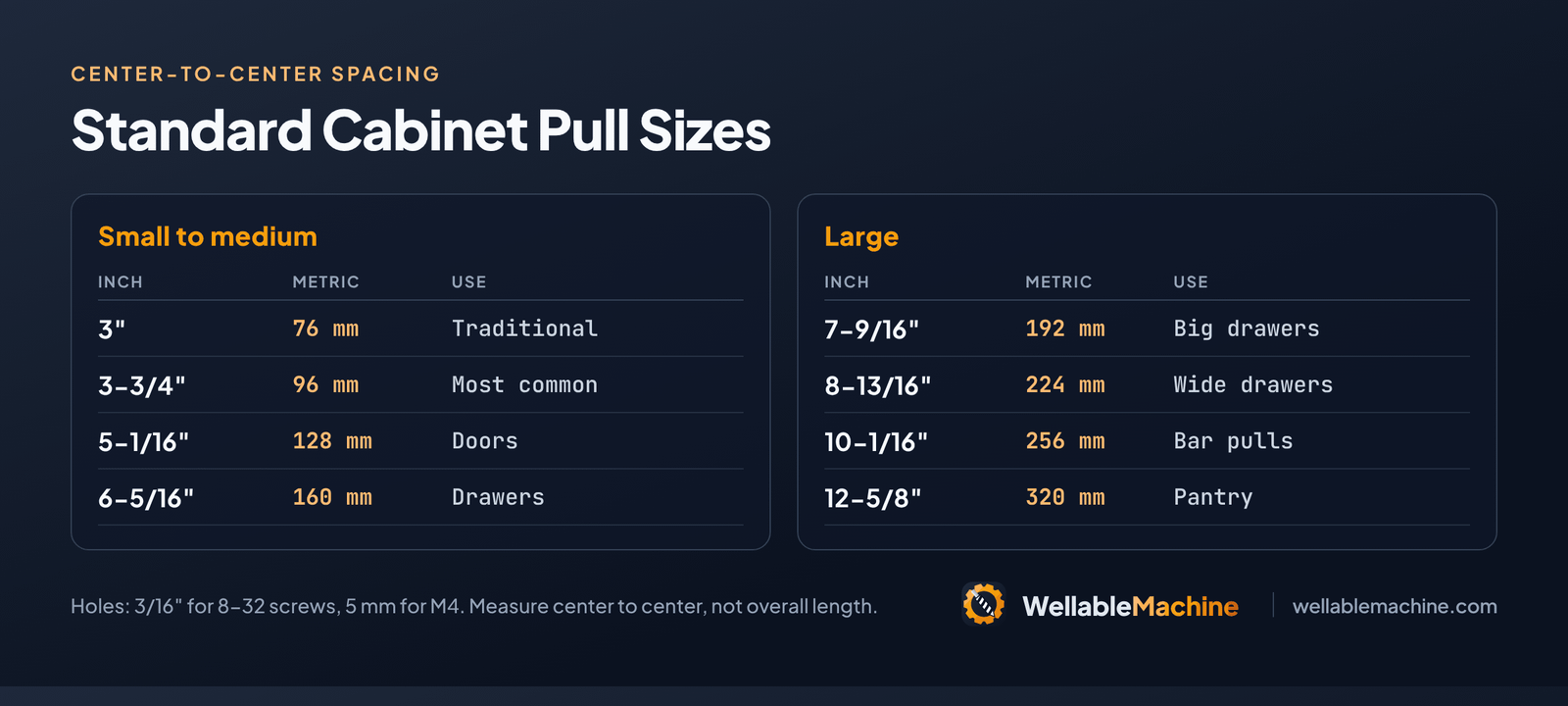
When replacing hardware, buy pulls with the same spacing as the old holes. If you want a different size, the old holes will show, so plan to use a backplate or fill and refinish the holes.
Screw Length
The screw must pass through the door and reach into the pull’s threaded post by at least about 1/4 in, without bottoming out:
- 3/4 in doors and drawer fronts: 1 in screws are standard and come with most hardware.
- Drawer fronts on a separate box: the screw goes through both the front and the box front, often 1-1/4 to 1-1/2 in total. Measure the stack.
- Thin doors (5/8 in) or glass-front frames: 7/8 in or shorter.
- Breakaway screws: scored 8-32 screws you snap to length with pliers. They’re handy when the hardware screws are the wrong length.
Measure door thickness with a ruler, add the thread depth of the pull (usually 1/4 to 3/8 in), and choose the closest screw that doesn’t exceed it.
Where to Put Cabinet Handles
- Upper cabinet doors: near the bottom corner on the opening side, typically 2 to 3 in up from the bottom edge and centered on the stile.
- Lower cabinet doors: near the top corner on the opening side, 2 to 3 in down from the top edge.
- Drawers: centered left to right. On shallow drawers, center top to bottom. On deep drawers, center on the top rail or a third of the way down, so the pull is easy to reach.
- Pull size: a common guide is a pull about a third of the drawer width. Use two pulls on drawers over about 30 in wide.
- Consistency: use the same measurements on every door and drawer of the same size. That matters more than the exact numbers.
How to Drill Holes for Cabinet Handles
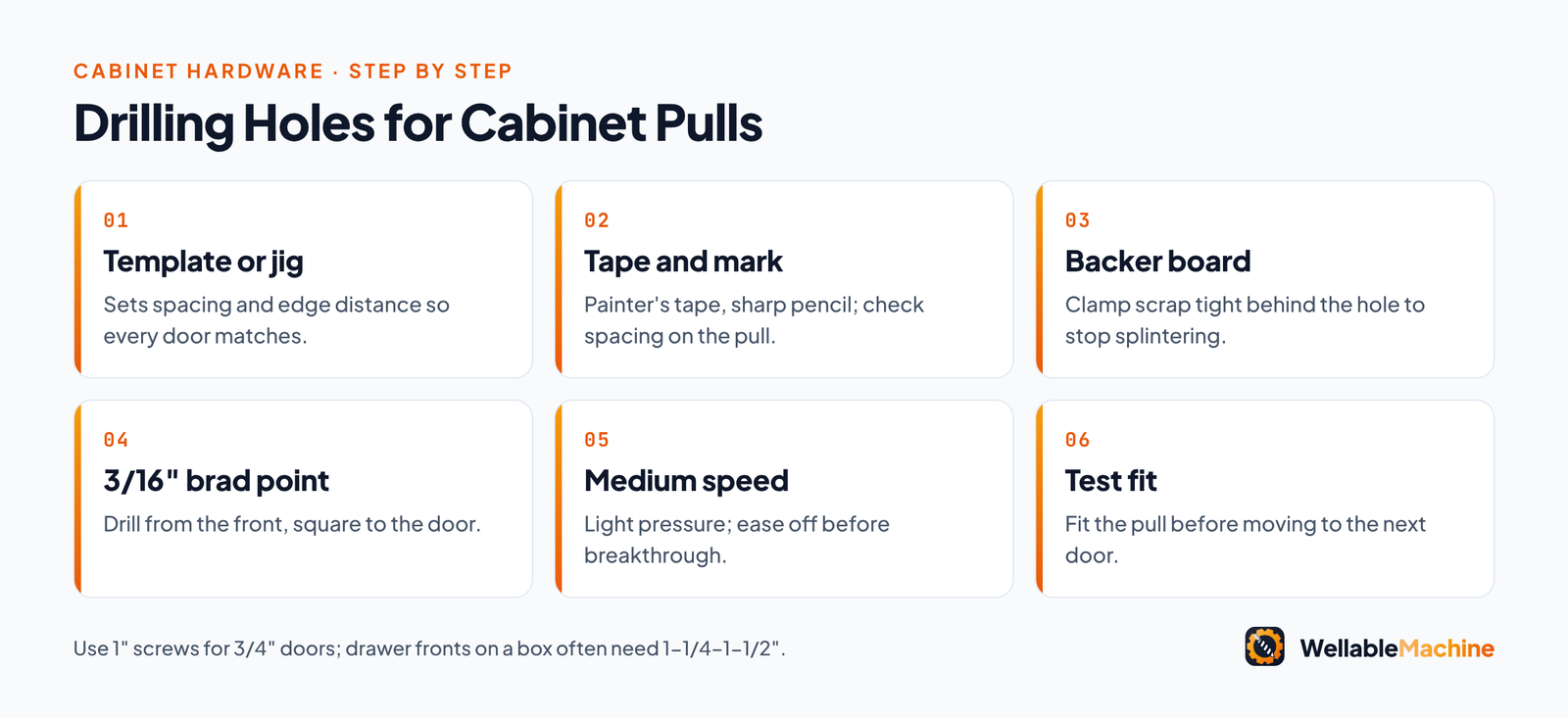
- Make or buy a template. A cabinet hardware jig sets the spacing and the distance from the edges, so every hole matches. A scrap of plywood with two holes at the right spacing and a fence glued on works too.
- Mark with tape. Put painter’s tape over the area. Mark the hole centers on the tape with a sharp pencil, and check the spacing against the actual pull.
- Clamp a backer board behind the door, tight against the inside face. This is the best way to stop splintering when the bit breaks through.
- Drill from the front with a sharp 3/16 in brad point bit, held square to the door. A brad point cuts a clean edge and won’t skate on paint. See our brad point drill bits guide.
- Drill steady and not too fast. Medium speed, light pressure, and ease off as the bit nears the back.
- Test fit the pull before drilling the next door, then repeat with the same template.
Without a backer board, drill a small 1/16 in pilot all the way through, then drill the 3/16 in hole halfway from each side. It’s slower but avoids chip-out on both faces. Our guide on drilling a straight hole has tips for keeping the drill square.
Drilling Different Door Materials
| Material | Tips |
|---|---|
| Painted MDF and wood | Tape plus a brad point bit stops the paint from chipping. Drill slowly at the start. |
| Thermofoil or vinyl wrap | Use a sharp bit and a backer; peel-up is common on dull bits. |
| Veneered plywood | Tape both sides and use a backer to protect the thin face veneer. |
| Solid hardwood | Easy to drill cleanly; a brad point gives the best entry. |
| Laminate (high-pressure) | Use a sharp HSS or carbide bit, and drill from the laminate face into a backer. |
| Aluminum-frame glass doors | Drill the frame with an HSS bit; never drill the glass panel. |
Fixing Mistakes
- Hole in the wrong place: glue in a 3/16 in hardwood dowel or a toothpick bundle, trim it flush, fill and touch up paint. A pull with a backplate can also cover it.
- Holes slightly off spacing: enlarge one hole to 7/32 in or 1/4 in on the back side only. The screw can then angle slightly into the pull, and the front still looks clean.
- Splintered back face: it’s usually hidden by the screw head and washer. Sand the edges smooth.
- Screw too long: use a shorter screw or a breakaway screw. Don’t overtighten into a bottomed-out post, or the pull can crack.
- Pull wobbles: add a small washer under the screw head, or use a thread locker on the screw.
Upgrading From Knobs to Pulls
When you switch from knobs to pulls, you can often use the existing knob hole as one end of the pull, then drill the second hole at the pull’s spacing. This only works if the pull ends up where you want it. Otherwise, choose a pull centered on the old hole, or fill the old hole and start over. A pull with a decorative backplate hides old holes neatly, and many come in standard spacings for this purpose.
For larger holes for hinges, see our 35 mm hinge cup hole guide, and for shelf supports, our dowel hole size guide. Kitchen designers often refer to the National Kitchen & Bath Association (NKBA) guidelines for cabinet layout.
Choosing Pulls That Fit Existing Holes
Before buying replacement hardware for an existing kitchen, measure the old holes precisely. Measure from the center of one hole to the center of the other, or from the left edge of one hole to the left edge of the other, which gives the same number. A measurement of 3-3/4 in means you need 96 mm pulls; 5 in or 5-1/16 in means 128 mm. Don’t round to the nearest inch: a 3-1/2 in pull won’t fit 3-3/4 in holes. If your measurement doesn’t match any standard size, it may be an older or custom spacing, and a backplate pull is the easiest fix.
Frequently Asked Questions
6 quick answers from our editors
01What size drill bit for cabinet handles?
3/16 in for the standard 8-32 screws, or 5 mm for M4 metric screws.
02What size hole for a cabinet knob?
A single 3/16 in hole for most knobs.
03What is the most common cabinet pull size?
3-3/4 in (96 mm) center to center, followed by 5-1/16 in (128 mm) and 3 in.
04How long should cabinet handle screws be?
1 in for 3/4 in doors. Drawer fronts on a separate box often need 1-1/4 to 1-1/2 in.
05Do I need a jig to install cabinet pulls?
Not strictly, but a jig or simple template makes every hole match and is much faster for a whole kitchen.
06How do I stop the door from splintering?
Use a sharp brad point bit, tape the area, and clamp a scrap board tightly behind the hole.
Bottom Line
Drill a 3/16 in hole for 8-32 screws or a 5 mm hole for M4. Match the pull’s center-to-center spacing exactly (3-3/4 in / 96 mm is the most common), and use 1 in screws for 3/4 in doors. Use a template for consistency, tape the face, and clamp a backer board behind the door for clean, chip-free holes.