How to Drill a Large Hole in Metal (6 Methods Compared)

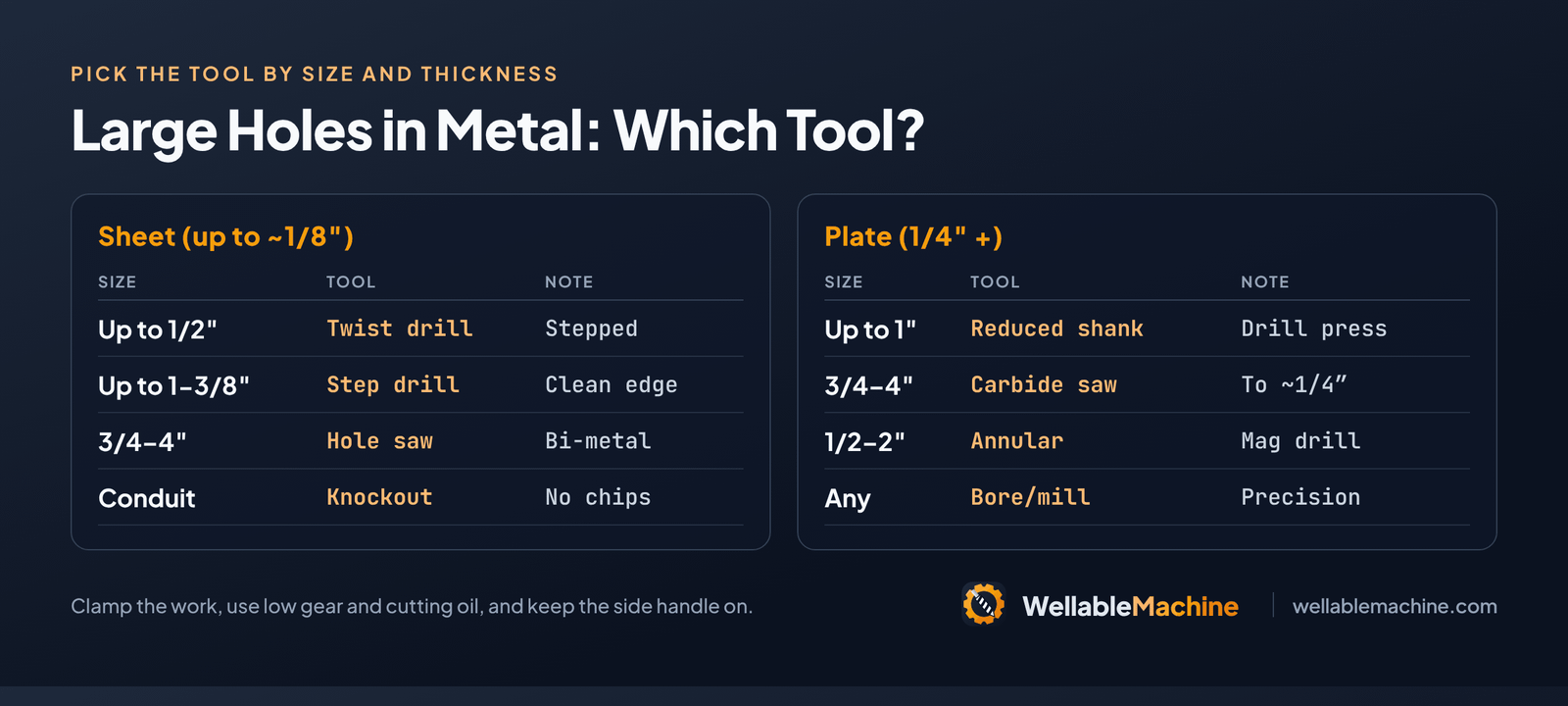
Quick answer: to drill a large hole in metal, pick the method by hole size and thickness. Up to about 1/2 in, use twist drills, stepping up from a pilot hole. For holes up to about 1-3/8 in in sheet up to about 1/8 in thick, use a step drill. From 3/4 in to 4 in or more in sheet and plate up to about 1/4 in, use a bi-metal hole saw. In thick plate, use an annular cutter in a magnetic drill. In every case, run the tool slowly, clamp the work, and use cutting fluid.
Large holes in metal are where most people burn up bits, stall drills or get hurt when the tool grabs. The problem isn’t the drill’s power; it’s using the wrong cutter, running it too fast and not holding the work. This guide compares every practical method, gives speeds and limits, and walks through the technique that works with a hand drill or a drill press.
Choose the Method by Hole Size and Thickness
| Method | Hole sizes | Metal thickness | Tools | Hole quality |
|---|---|---|---|---|
| Twist drill, stepped up | Up to 1/2 in (more in a drill press) | Any | Hand drill or drill press | Good |
| Reduced-shank twist drill | 1/2 to 1 in | Any | 1/2 in chuck, drill press best | Good |
| Step drill | 1/8 to about 1-3/8 in | Up to about 1/8 in (some to 1/4 in) | Hand drill | Very good, clean edge |
| Bi-metal hole saw | 3/4 to 6 in | Up to about 1/4 in | Hand drill or drill press | Fair; edge needs deburring |
| Carbide-tipped hole saw | 3/4 to 4 in | Up to about 1/4 in, including stainless | Drill with steady feed | Good |
| Annular cutter | 7/16 to 2-3/8 in (larger available) | Up to 2 in or more | Magnetic drill or drill press | Excellent, burr-free |
| Knockout punch | 1/2 to 4 in conduit sizes | Sheet up to about 10 gauge | Hand or hydraulic punch | Excellent, no chips |
| Boring or milling | Any | Any | Lathe or mill | Precision |
| Plasma or oxy-fuel | Large | Thick plate | Cutting torch | Rough; needs cleanup |
Method 1: Stepping Up With Twist Drills
For holes up to about 1/2 in, start with a small pilot and step up. Don’t jump from a tiny pilot straight to the final size, though. The jump should be about the width of the large bit’s chisel edge, not much more, so the big bit cuts with its lips instead of being dragged into the hole.
- Center punch the mark, or use a split-point bit. See how to use a center punch.
- Drill a pilot about the width of the final drill’s web: 1/8 in for a 3/8 in hole, 3/16 in for a 1/2 in hole.
- Go up in one or two steps, for example 1/8, 5/16, 1/2 in. Too many tiny steps make bits chatter and leave a triangular hole.
- Slow down as the bit gets bigger. A 1/2 in bit in mild steel runs at only about 450 to 500 RPM.
For holes up to 1 in, reduced-shank (silver and Deming) bits have a 1/2 in shank that fits a normal chuck. They need a drill press or a powerful low-speed drill with a side handle, plus a pilot hole.
Method 2: Step Drill for Sheet Metal
A step drill (unibit) cuts a series of sizes, each a short step, so one bit makes many holes in sheet metal, electrical boxes, panels and enclosures. It self-starts, makes round holes in thin sheet that twist drills tend to tear, and deburrs as it goes. The limit is thickness: each step is only about 1/8 in tall, so on thicker metal you only get a short cylindrical section before the next step. Our guide on how to use a step drill bit covers technique, and how to drill a hole in sheet metal covers thin material in detail.
Method 3: Bi-Metal Hole Saw
Hole saws are the usual tool for 1 in to 4 in holes in steel sheet, tube, enclosures and thin plate. A bi-metal saw has HSS teeth welded to a spring-steel body and cuts mild steel, aluminum and thin stainless.
- Choose the right teeth: 10 to 14 TPI or a variable pitch like 10/14 for sheet metal, 4/6 for thicker or general use.
- Clamp the work firmly. A hole saw that grabs can spin a part or wrench your wrist.
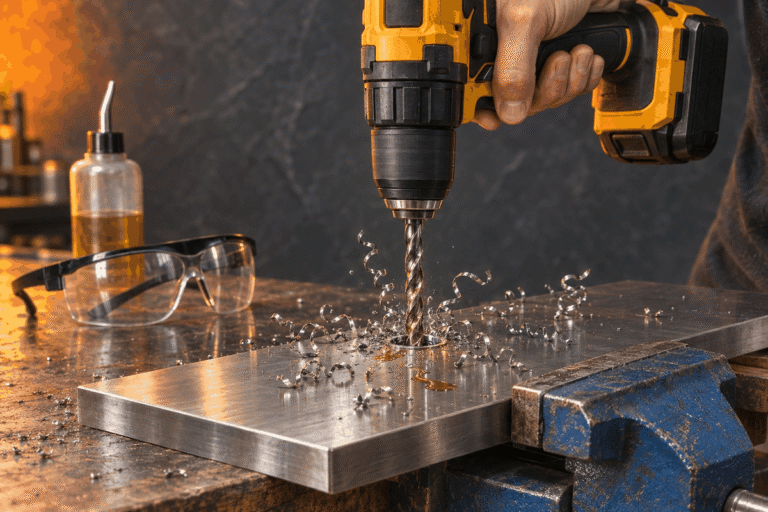
- Use the side handle and the drill’s low gear.
- Start at low speed. The pilot bit locates the hole; slow down as the teeth contact.
- Keep the saw square and feed lightly. Let the teeth cut; heavy pressure strips them.
- Use cutting oil and back out every 15 to 20 seconds to clear chips and cool the teeth.
- Remove the slug through the slots with a screwdriver.
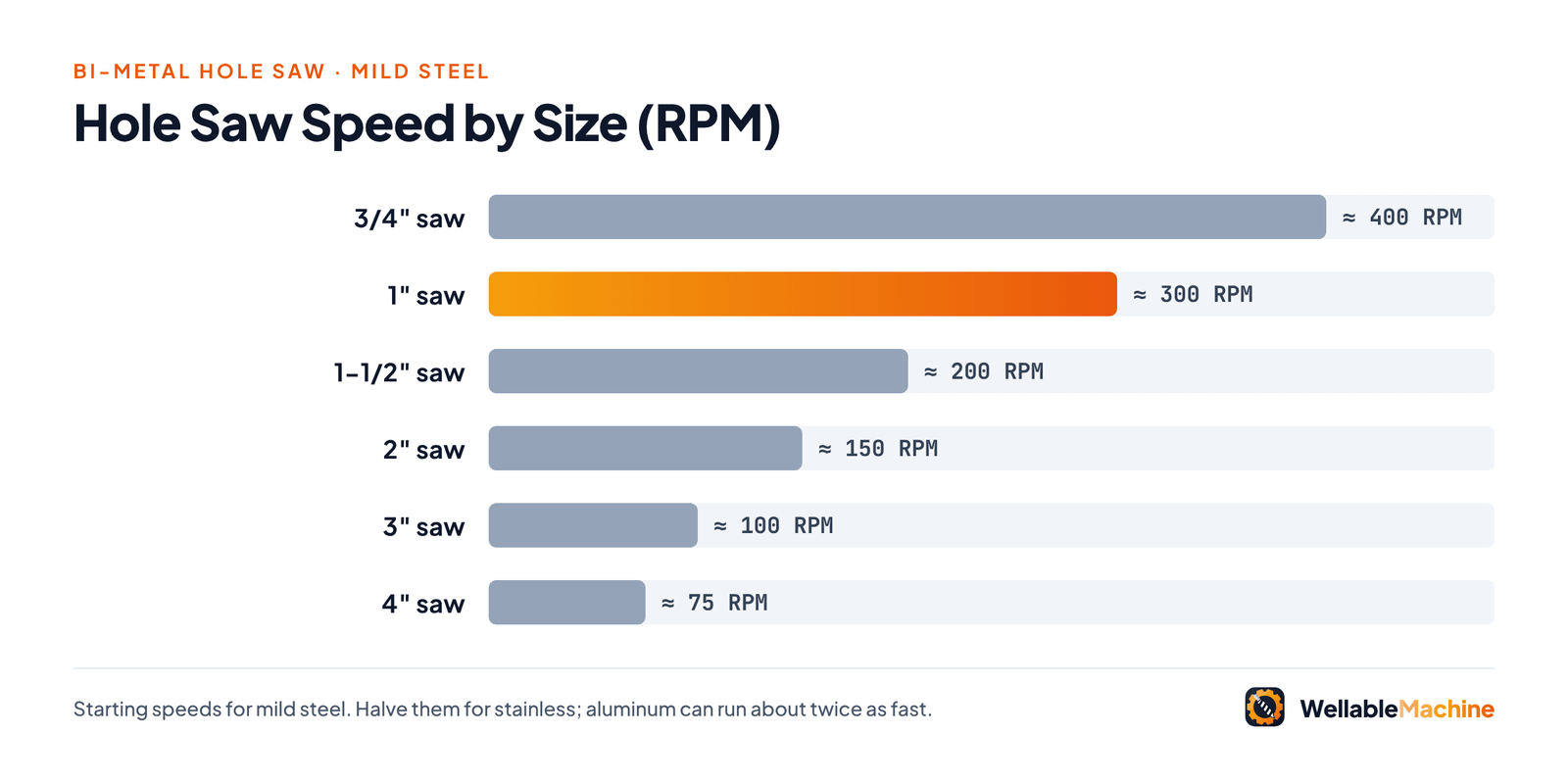
Hole saw speeds are much lower than most people expect, because the teeth are moving fast at the rim. In mild steel, a 1 in saw runs at about 300 RPM, and a 3 in saw at about 100 RPM. Halve these for stainless steel. For sizes and arbors, see our hole saw size chart.
Method 4: Carbide-Tipped Hole Saw
Carbide-tipped saws stay sharp in stainless steel, hard steel and abrasive materials far longer than bi-metal ones. They’re more expensive and less forgiving of wobble and impact, so use a steady drill with the side handle, a firm feed and no hammer mode. They’re worth it for repeated holes in stainless panels, food-service equipment and heavy-gauge steel.
Method 5: Annular Cutter With a Magnetic Drill
An annular cutter is like a short, rigid, multi-tooth hole saw. It cuts only a ring of metal, so it needs far less power than a twist drill of the same size, and it makes a clean, burr-free hole with a solid slug. Used in a magnetic drill (mag drill), it’s the professional way to make 1/2 to 2 in holes in structural steel, beams, plate and heavy brackets. A 13/16 in hole for a 3/4 in bolt in 1/2 in plate takes seconds. The cutter has a pilot pin that centers it and pushes out the slug, plus internal coolant feed. Annular cutters also work in a rigid drill press. See the annular cutter article for background.
Method 6: Knockout Punch
For round holes for conduit and connectors in electrical boxes and panels, a knockout punch is the cleanest and quietest option. You drill a small pilot hole, run the draw bolt through it, and tighten the bolt so the punch shears a clean hole against the die. It doesn’t leave chips inside the enclosure, which matters with electrical equipment. It’s limited to sheet metal.
Safety With Large Cutters
- Clamp everything. Never hold small parts by hand under a hole saw or large drill.
- Use the side handle and brace for torque. Large cutters can catch suddenly at breakthrough.
- Keep the drill in low gear and set the clutch if it has one. Many drills have electronic kickback control; use it if available.
- Wear eye protection and gloves only when handling sharp edges and slugs, never while the tool is running near your hand.
- Watch for hot chips and slugs. They can be hot enough to burn.
Drilling Different Metals
| Metal | Tips for large holes |
|---|---|
| Mild steel | Any method; cutting oil and low speed. |
| Stainless steel | Cobalt bits, carbide-tipped saws, or annular cutters. Very low speed, constant feed, plenty of oil. See how to drill stainless steel. |
| Aluminum | Higher speeds are fine; use wax or kerosene to stop chips sticking. See how to drill aluminum. |
| Cast iron | Dry or with air; brittle chips. Support the exit side to prevent breakout. See how to drill cast iron. |
| Hardened steel | Carbide tools only, or anneal the part first. See how to drill hardened steel. |
Common Problems
- Bit squeals and doesn’t cut: too fast, not enough pressure, or dull. Slow down, push harder, add oil.
- Triangular or oversized hole: too big a jump from the pilot, or thin sheet. Use a step drill or hole saw, or clamp the sheet to scrap.
- Hole saw teeth stripped: too fast, too much pressure, or hard metal. Use a carbide saw or annular cutter.
- Hole saw walks: the pilot bit is dull or missing. Replace the pilot and start square.
- Drill stalls: not enough torque in high gear. Use low gear or a bigger drill.
For speeds at every size, see our drill speed chart.
Frequently Asked Questions
6 quick answers from our editors
01What is the best way to drill a large hole in metal?
A step drill for sheet, a bi-metal hole saw for 1 to 4 in holes in sheet and thin plate, and an annular cutter in a magnetic drill for thick plate.
02How do I drill a 1 inch hole in steel?
Use a 1 in bi-metal hole saw at about 300 RPM with oil, or a 1 in reduced-shank drill in a drill press after a pilot. In thick plate, use an annular cutter.
03Can a regular drill make large holes in metal?
Yes, with a hole saw or step drill, in low gear with the side handle. For thick plate, a magnetic drill or drill press is much better.
04What speed should I drill large holes in steel?
Slow. About 450 to 500 RPM for a 1/2 in twist drill and about 100 RPM for a 3 in hole saw in mild steel.
05Do I need cutting oil?
For steel and stainless, yes. It cools the cutter and keeps it sharp much longer.
06How do I keep a hole saw from wandering?
Use a sharp pilot bit, start slowly and keep the saw square.
Bottom Line
Match the tool to the job: stepped twist drills up to 1/2 in, step drills for sheet, bi-metal or carbide hole saws for 1 to 4 in holes, and annular cutters for thick plate. Clamp the work, run slow with cutting oil, use the side handle, and let the cutter do the work.