#25 Drill Bit Size: 0.1495″ (3.797 mm) and the 10-24 Tap
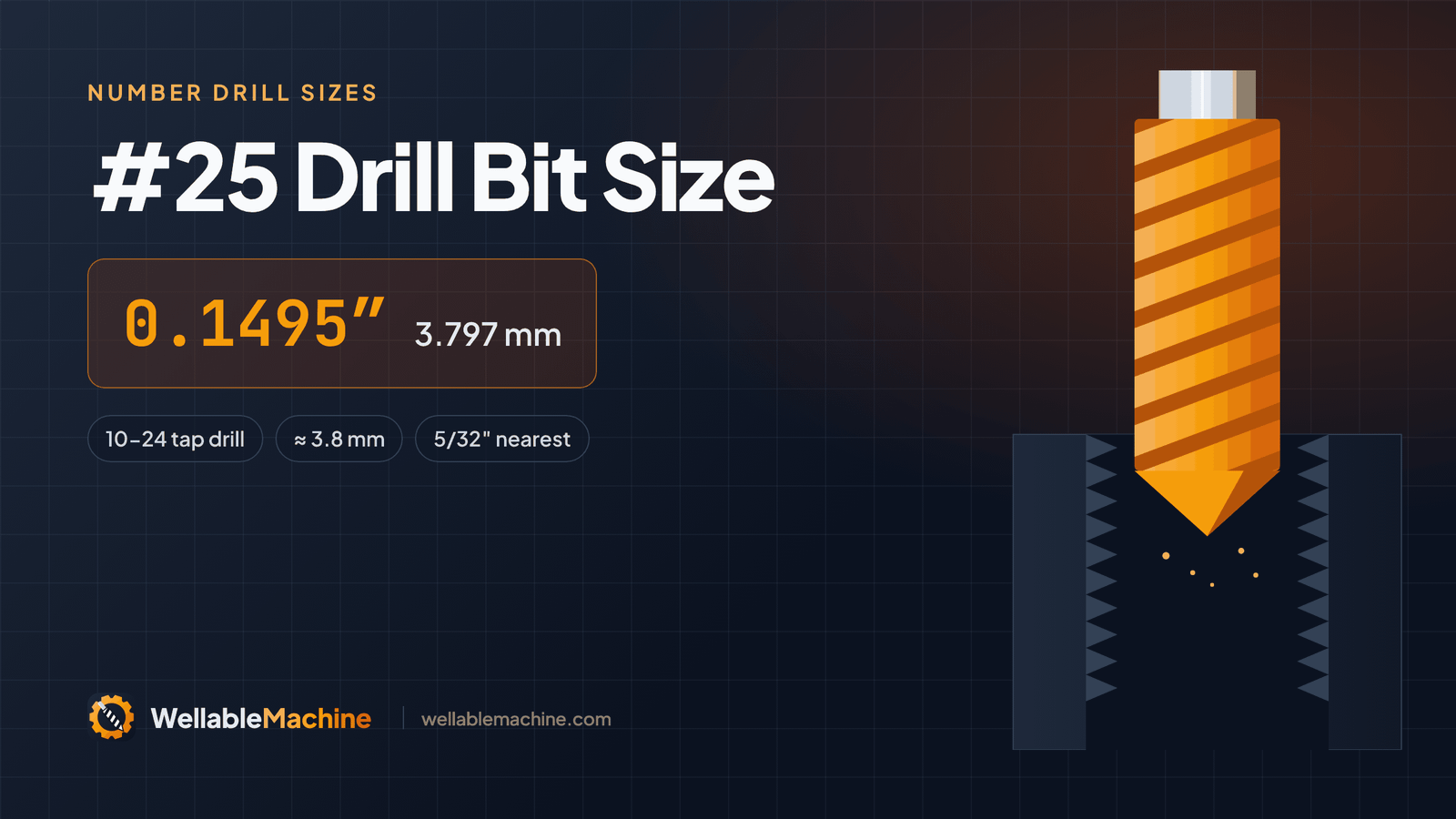
Quick answer: a #25 drill bit measures 0.1495 in, or 3.797 mm. Its main job is drilling the hole for a 10-24 UNC tap, where it leaves almost exactly a 75% thread. The closest metric size is 3.8 mm (0.1496 in), which is effectively the same bit. The nearest fraction, 5/32 in (0.1563 in), is noticeably larger, so it gives a much shallower 10-24 thread.
A 10-24 screw is everywhere: electrical boxes, rack-mounted equipment, door hardware, hinges, machinery guards and countless shop fixtures. That’s why a #25 is one of the drills most often lost, broken and replaced from a number drill index. This guide covers the exact size, what’s either side of it, what the #25 does besides tapping, and how to drill and tap a clean 10-24 hole.
#25 Drill at a Glance
| Measurement | Value |
|---|---|
| Decimal inches | 0.1495 in |
| Millimeters | 3.797 mm |
| Metric equivalent | 3.8 mm (0.1496 in) |
| Nearest fraction above | 5/32 in (0.1563 in), +0.0068 in |
| Nearest fraction below | 9/64 in (0.1406 in), −0.0089 in |
| Main use | 10-24 UNC tap drill (about 75% thread) |
| Second use | Free-fit clearance hole for #6 screws |
Number drills run from #80, the smallest, to #1, the largest, and the sizes came from an old wire gauge rather than a neat series. Our number and letter drill size chart lists all of them, and the drill bit sizes reference explains where the series came from.
Drill Sizes Close to #25
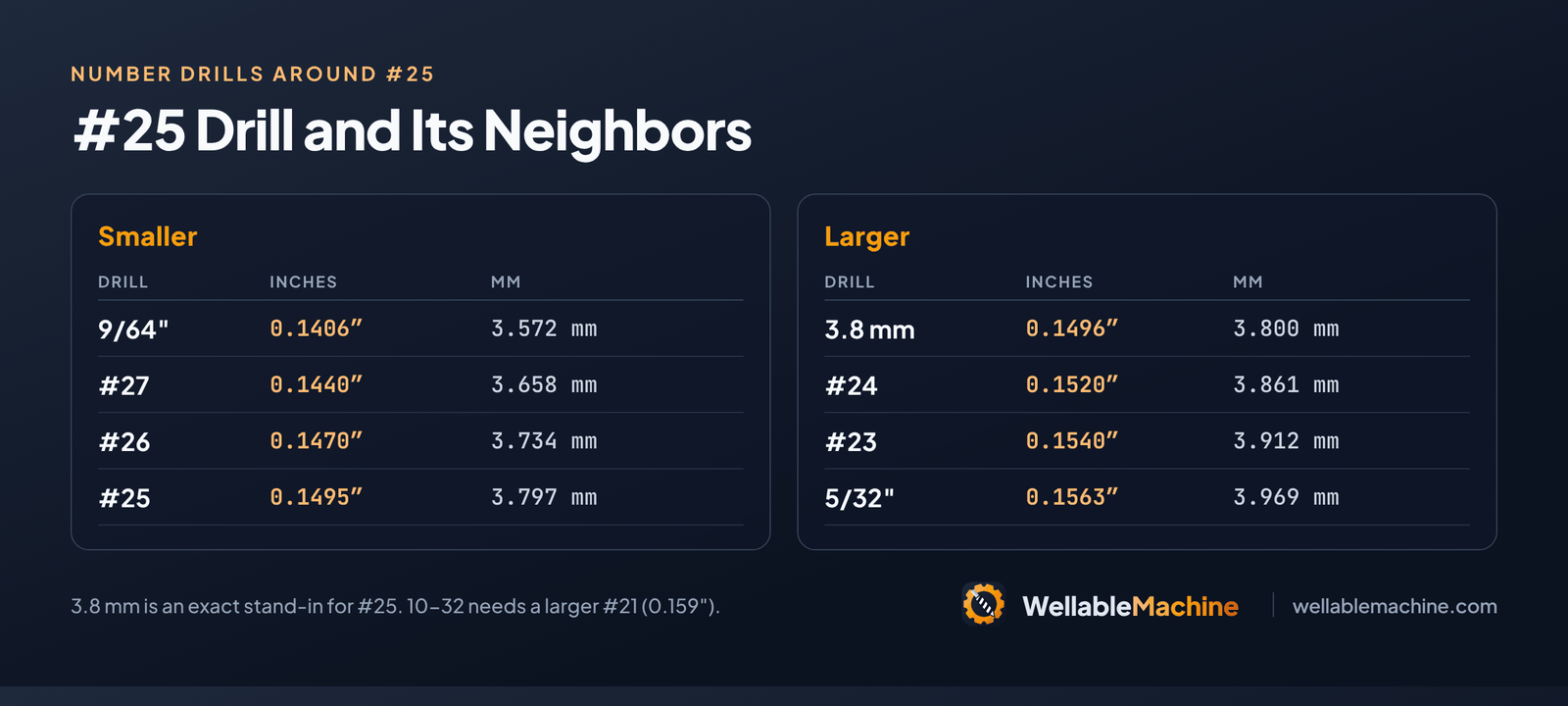
| Drill | Inches | mm | vs #25 |
|---|---|---|---|
| #28 | 0.1405 | 3.569 | −0.0090 in |
| 9/64 in | 0.1406 | 3.572 | −0.0089 in |
| #27 | 0.1440 | 3.658 | −0.0055 in |
| #26 | 0.1470 | 3.734 | −0.0025 in |
| #25 | 0.1495 | 3.797 | — |
| 3.8 mm | 0.1496 | 3.800 | +0.0001 in |
| #24 | 0.1520 | 3.861 | +0.0025 in |
| #23 | 0.1540 | 3.912 | +0.0045 in |
| 5/32 in | 0.1563 | 3.969 | +0.0068 in |
| #22 | 0.1570 | 3.988 | +0.0075 in |
| 4.0 mm | 0.1575 | 4.000 | +0.0080 in |
Why #25 Is the 10-24 Tap Drill
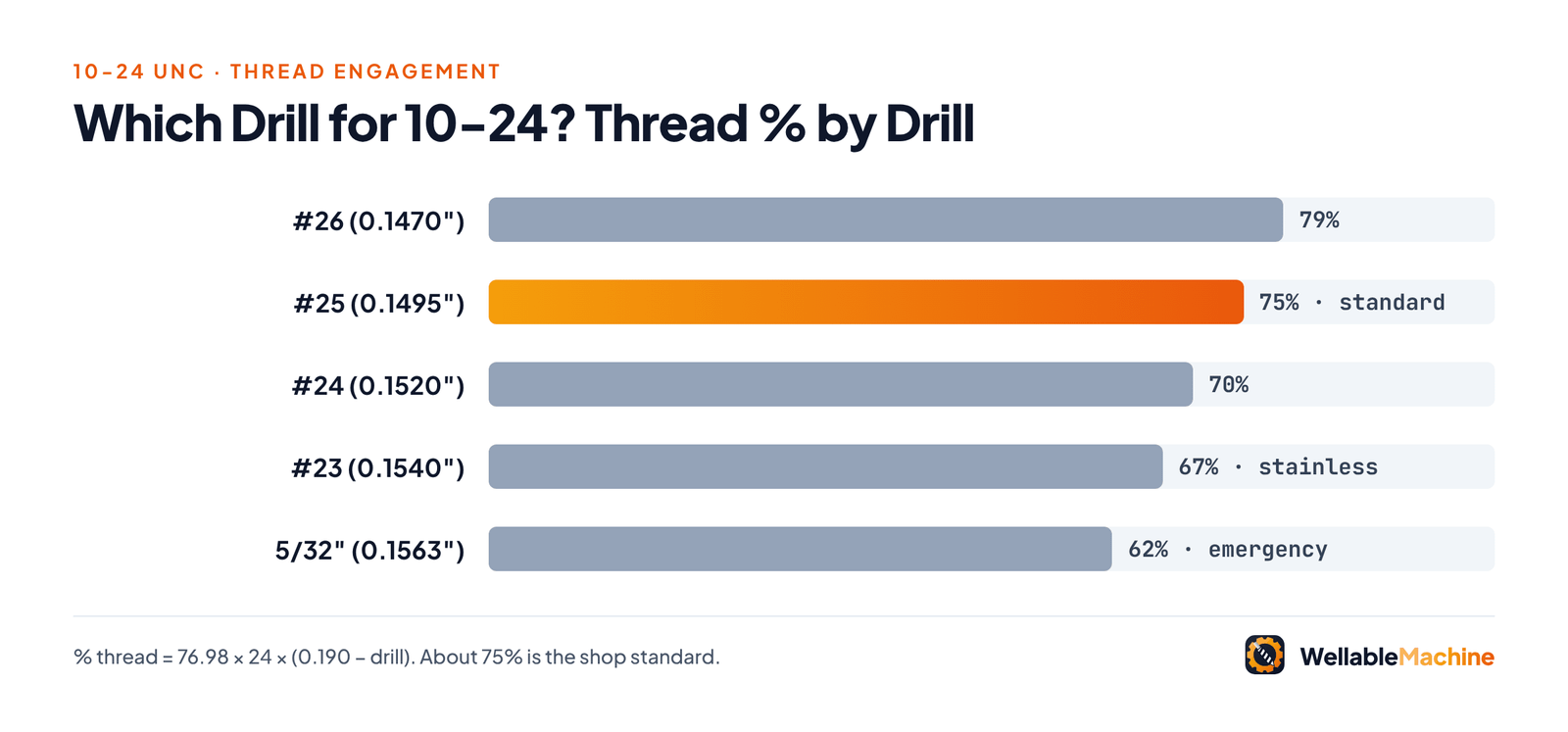
A #10 screw has a major diameter of 0.190 in. The 10-24 version has 24 threads per inch. Thread depth for a given drill can be estimated with % thread = 76.98 × TPI × (major diameter − drill diameter). For a #25, that’s 76.98 × 24 × (0.190 − 0.1495) = 74.8%. That lands right on the 75% that machinists use as the standard for most metals.
| Drill for 10-24 | Inches | Approx. thread | When to choose it |
|---|---|---|---|
| #26 | 0.1470 | 79% | Thin aluminum or plastic, where every bit of thread counts |
| #25 | 0.1495 | 75% | The default for steel, aluminum and brass |
| 3.8 mm | 0.1496 | 75% | Same as #25 if you have a metric set |
| #24 | 0.1520 | 70% | Tough steel, deep holes, hand tapping |
| #23 | 0.1540 | 67% | Stainless steel |
| 5/32 in | 0.1563 | 62% | Emergency only; light loads in steel |
The full 10-24 picture, including forming taps and clearance holes, is in our 10-24 tap drill size guide. Don’t mix it up with 10-32, the fine thread on the same diameter, which needs a bigger #21 drill.
Can You Use 5/32 in Instead of a #25?
You can, but think about it first. 5/32 in is 0.0068 in larger than a #25, which drops a 10-24 thread from 75% to about 62%. In steel, a 62% thread is still close to the strength of the screw for light jobs such as covers, brackets and guards, because the screw usually fails before a full-length thread strips. In aluminum, plastic or thin sheet, it’s a real loss, and screws can pull out. A better plan is a 3.8 mm bit, which matches a #25 to a ten-thousandth of an inch and is in most metric sets.
Going smaller, 9/64 in (0.1406 in) is far too tight for 10-24. It would try to cut a thread deeper than the tap’s own profile, and a 10-24 tap will snap long before it cuts that.
Other Uses for a #25 Drill
- Clearance hole for #6 screws. A #6 screw is 0.138 in. A #25 gives a free fit with about 0.0115 in of room, so several screws line up easily through two parts. For a closer fit, use a #28. See our clearance hole size chart for other sizes.
- Metric 3.8 mm holes. Wherever a drawing calls for 3.8 mm, a #25 is a direct substitute.
- Pilot for a 5/32 in or 3/16 in hole. Drilling a smaller pilot first gives a rounder, better-placed hole in steel.
- Pins and dowels. A #25 is a clearance fit for 0.145 in (about 3.7 mm) pins and wire.
Where You’ll Tap 10-24 With a #25
The 10-24 thread is the go-to small thread for electrical and equipment work in North America. Typical jobs where you’ll drill #25 holes:
- Equipment racks: the classic 19 in rack uses 10-32 rails, but many shelves, panels and older cabinets use 10-24.
- Electrical work: ground screws in metal boxes are 10-32, but many brackets, strut fittings and enclosure parts use 10-24.
- Door and cabinet hardware: some hinges, closers and stops.
- Shop jigs and machine guards: 10-24 is a good size for light clamps, fences and covers on aluminum plate.
- Automotive and trailer parts: trim, light brackets and small panels.
How to Drill and Tap a 10-24 Hole
- Center punch the location. A #25 is stiff enough to start on a good punch mark, but a spot drill helps on a drill press.
- Drill at the right speed. Rough starting speeds for a #25: 2,500 RPM in aluminum, 1,500 RPM in mild steel, and 750 RPM in stainless steel. Use cutting oil in steel. See our drill speed chart.
- Peck to clear chips every two or three bit diameters of depth.
- Chamfer the edge with a countersink, slightly wider than 0.190 in.
- Tap with a 10-24 plug tap, turning half a turn forward and a quarter turn back. Use a spiral point tap for through-holes when power tapping.
- Blind holes: drill at least 0.15 in deeper than the thread depth you need, and finish with a bottoming tap.
For thread-tapping basics, see how to use a tap and die. If a tap breaks, how to remove a broken tap explains what to do next.
Buying a #25 Drill Bit
- Jobber-length HSS is fine for most materials and the cheapest choice. Buy a few at a time.
- Screw-machine (stub) length is shorter and stiffer. It’s ideal for hand drilling and for keeping holes straight before tapping.
- Cobalt is worth it for stainless and hard alloys. See HSS vs cobalt drill bits.
- Tap-and-drill kits pair a 10-24 tap with a #25 drill, which saves hunting for the right bit.
- Check the marking. #24, #25 and #26 look identical. Measure with calipers across the shank: you should read 0.149 to 0.150 in.
Common Mistakes
- Using a #25 for 10-32. It’s far too small for the fine thread and will break the tap. 10-32 needs a #21.
- Grabbing a #26 or #24 by mistake. Keep the index organized, or mark the #25 shank with a dab of paint.
- Drilling with a dull bit. A dull bit drills a rough, oversized or tapered hole, which leads to weak threads.
- Tapping dry in steel. Even a small tap needs oil, or it tears the thread and seizes.
- Tapping an angled hole. The tap follows the hole and may snap when it hits the wall.
Tapping 10-24 in Different Materials
| Material | Drill | Tapping fluid | Tips |
|---|---|---|---|
| Aluminum | #25 or #26 | Light oil, kerosene or wax | Clear chips often; aluminum packs into tap flutes |
| Mild steel | #25 | Sulfurized cutting oil | The standard case; break chips every half turn |
| Stainless steel | #24 or #23 | Heavy cutting oil or paste | Use a sharp, new tap; don’t stop and restart mid-cut |
| Brass | #25 | Dry or light oil | Cuts cleanly; taps can grab on the way out |
| Cast iron | #25 | Dry or air blast | Powdery chips; clear them with air |
| Plastics | #26 or #25 | None or water | Use a sharp tap; don’t overtighten screws |
How Deep Should a 10-24 Thread Be?
The first few threads carry most of the load, so engagement length matters more than thread percentage. Common starting points for a 10-24 screw: about 0.19 in (1× diameter) in steel, 0.29 in (1.5×) in cast iron and brass, and 0.38 in (2×) in aluminum. In thin sheet, consider a rivet nut, a weld nut or a clinch nut instead of tapping, because a 10-24 thread needs at least about three full threads (0.125 in) to hold a meaningful load.
#25 vs 3.8 mm vs 5/32: Which to Keep in Your Kit?
If you tap 10-24 regularly, keep a dedicated #25 (or a few) in a tap-and-drill pouch with the tap. If your sets are metric, a 3.8 mm bit does the same job. A 5/32 in bit from a fractional set is the fallback when nothing else is on hand, as long as the joint is lightly loaded.
Frequently Asked Questions
7 quick answers from our editors
01What size is a #25 drill bit?
0.1495 in, or 3.797 mm.
02What tap uses a #25 drill?
The 10-24 UNC tap. A #25 gives about 75% thread.
03What is a #25 drill in mm?
3.797 mm. Use a 3.8 mm drill as a direct substitute.
04What fraction is close to a #25 drill?
5/32 in is the nearest common fraction above it, but it’s 0.0068 in larger, so it gives a shallower 10-24 thread.
05Is a #25 bigger than a #26?
Yes. Lower numbers are larger. A #26 is 0.147 in.
06What drill size for 10-32?
A #21 (0.159 in). Don’t use a #25 for 10-32.
07What size hole for a #6 screw to pass through?
A #28 for a close fit, or a #25 for a free fit.
Bottom Line
A #25 drill is 0.1495 in (3.797 mm) and the standard 10-24 tap drill, at about 75% thread. A 3.8 mm bit is an exact stand-in. 5/32 in works in a pinch, but it gives a shallower thread. Go up to a #24 or #23 for tough steel and stainless, and never use a #25 for 10-32.